🟪24ラ英113- Did you always know you would grow up to be a famous writer? - 説明ルール「結果のto」

#English_Grammar #ラ英2024 #ラジオ英会話 #24ラ英113 #Explanation_Rule
Slides
TOC
Section	Subtitle	Topic Sentence	Pedagogical Remark
Slide 1	The Cognitive Trajectory of Resultatives	Deciphering 'to' through the lens of chronological flow.	Focuses on the movement of thought rather than static rules.
Slide 2	The Functional Shift	The preposition/particle 'to' essentially denotes Directionality leading to a Destination.	Explains the shift from Purpose to Result as a "chronological arrival."
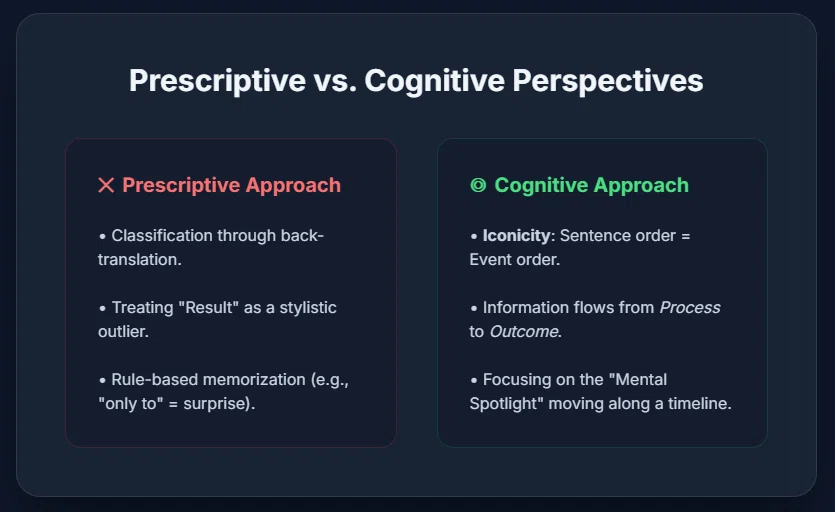
Slide 3	Prescriptive vs. Cognitive Perspectives	Iconicity: Sentence order = Event order.	Contrast between post-hoc translation and real-time mental processing.
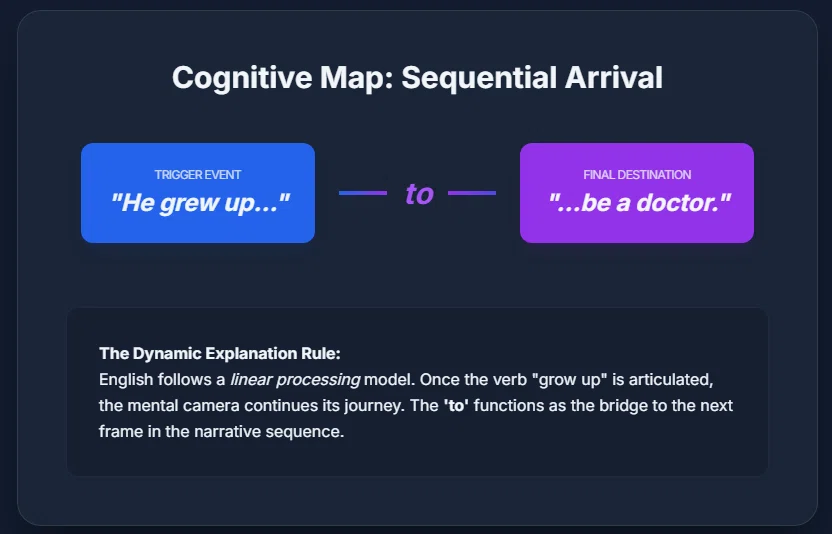
Slide 4	Cognitive Map: Sequential Arrival	English follows a linear processing model where 'to' acts as a bridge to the next frame.	Uses the "Mental Camera" metaphor to explain chronological sequencing.
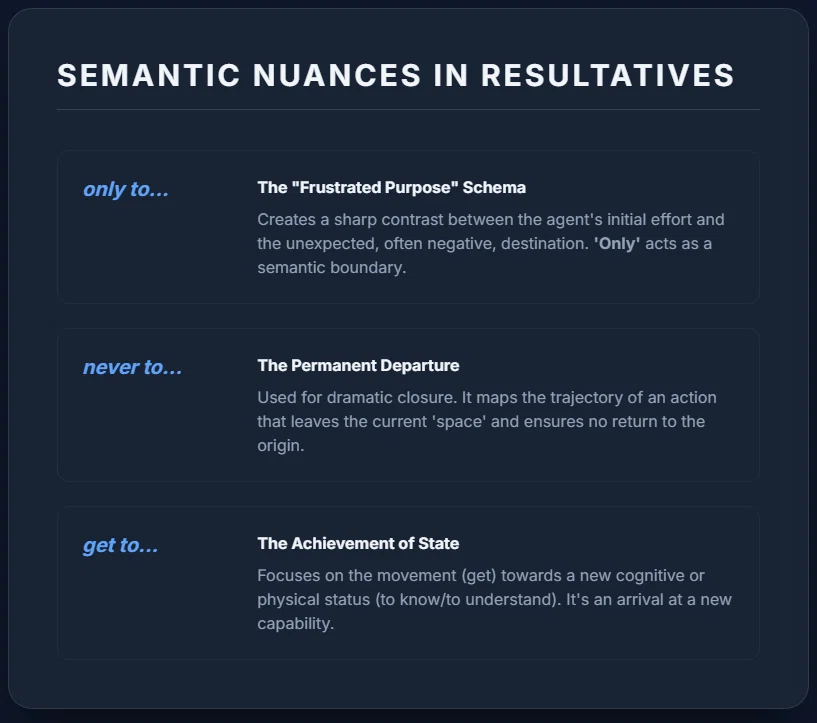
Slide 5	Semantic Nuances in Resultatives	'Only to' creates a sharp contrast between effort and unexpected destination.	Explains specific idioms (only to, never to, get to) as cognitive schemas.
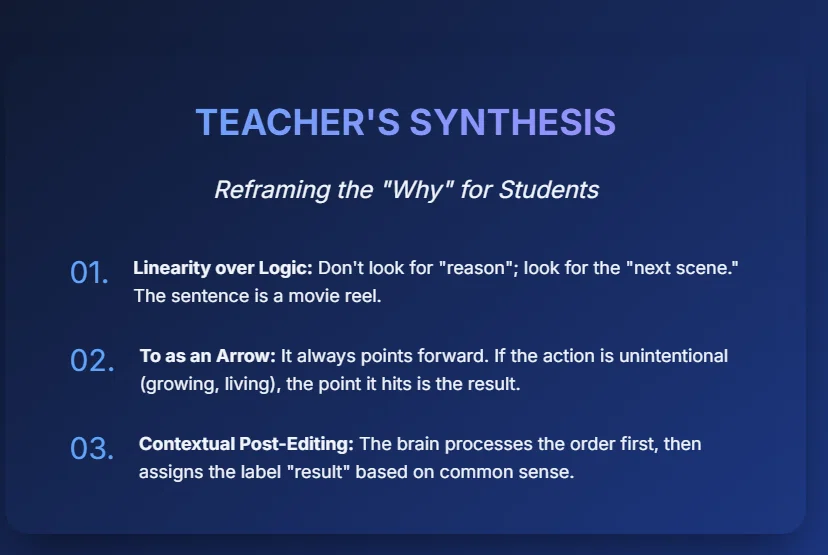
Slide 6	Teacher's Synthesis	Don't look for "reason"; look for the "next scene."	Reframes grammar as a "movie reel" of sequential snapshots.
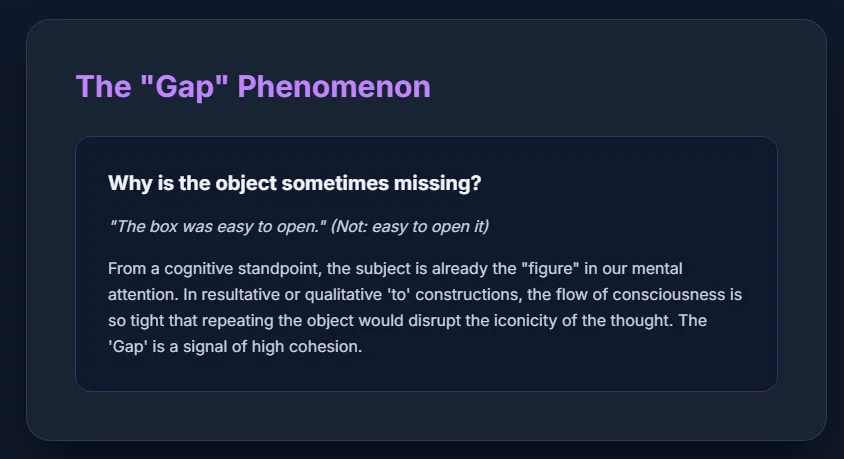
Slide 7	The "Gap" Phenomenon	The 'Gap' is a signal of high cohesion where the subject is the focal figure.	Connects syntactic absence to cognitive focus and "iconicity of thought."
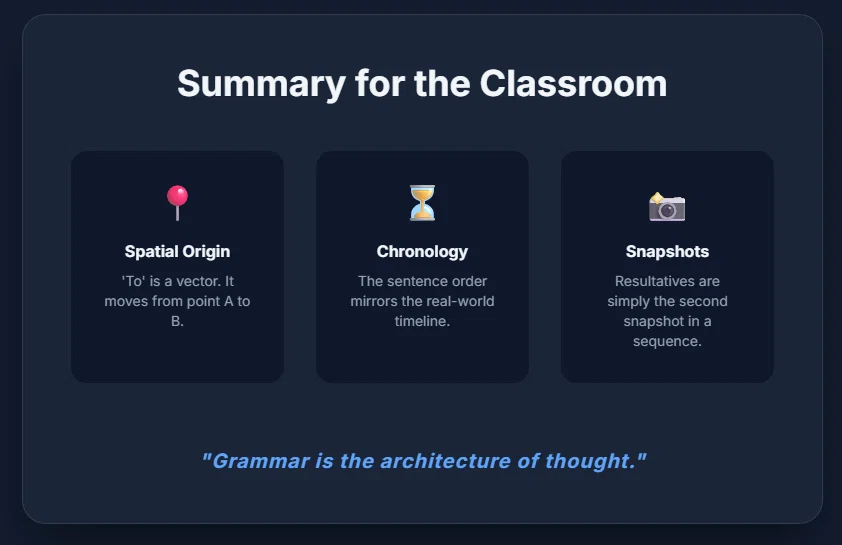
Slide 8	Summary for the Classroom	Grammar is the architecture of thought.	Summarizes 'to' as a spatial vector and a chronological marker.
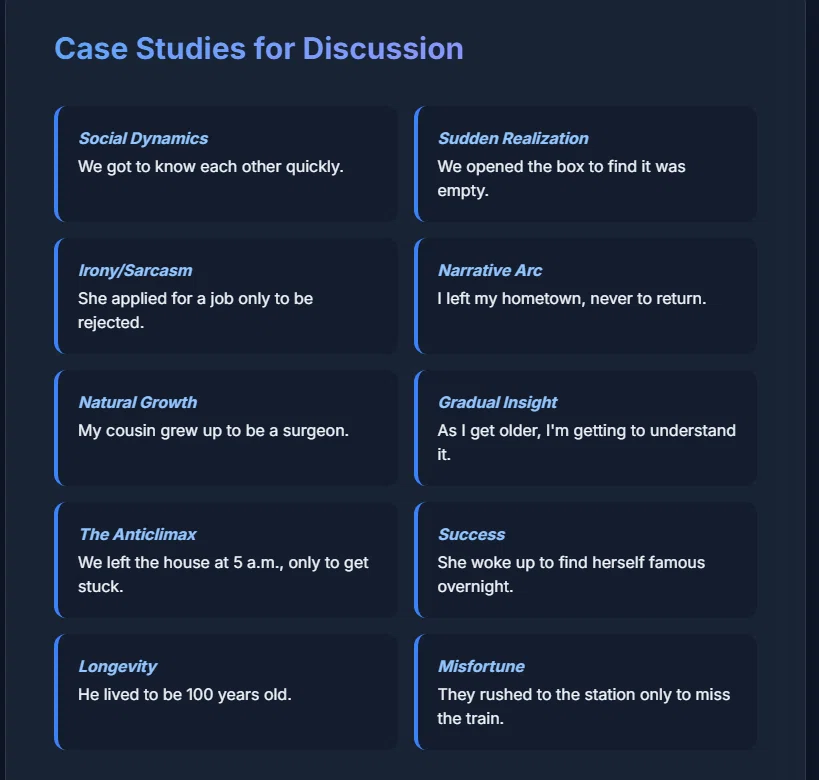
Slide 9	Case Studies for Discussion	Ten practical examples ranging from social dynamics to narrative arcs.	Provides diverse contexts to test the "linear processing" theory.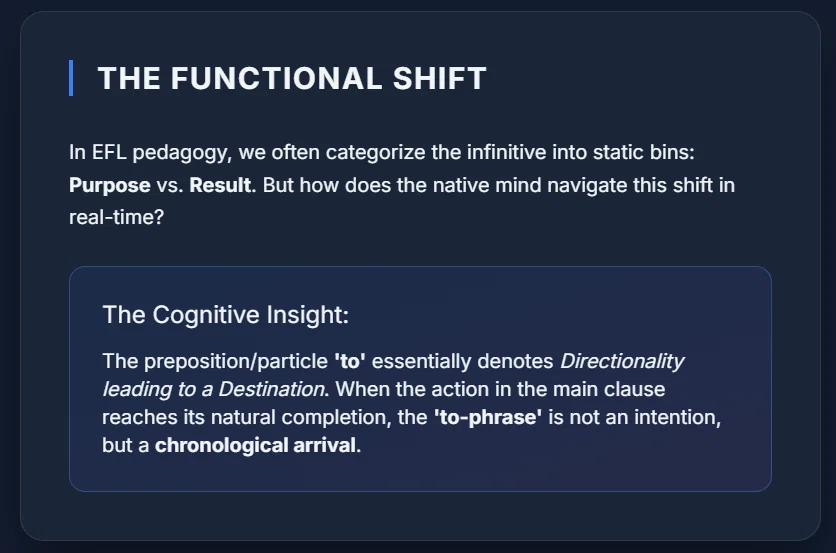
Contents
Speaker's Notes: The Cognitive Trajectory of Resultatives
Target Audience: EFL Professionals (British context, experience with Japanese learners)
Chapter 1: The Functional Shift & Cognitive Vectors
As an educator who has navigated the Japanese EFL system for six years, you’ve likely encountered the "Infinitive Bottleneck." Students are often taught to categorize the infinitive into silos: noun, adjective, or adverb. Within the adverbial silo, they further bifurcate it into "Purpose" or "Result." This creates a heavy cognitive load for learners.
In this slide, we introduce the concept of the "Arrow of Time." Instead of asking "Is this a reason or a result?", we encourage students to see the particle 'to' as a directional vector. In Cognitive Linguistics, 'to' is a movement from a Source to a Goal. In a purpose-clause (e.g., "I went to the store to buy milk"), the 'to' represents an intended goal. In a result-clause (e.g., "He grew up to be a writer"), the 'to' represents an attained goal. The shift is not in the grammar, but in the Agent's Volition. Since "growing up" is involuntary, the arrival at "being a writer" is perceived as a chronological outcome.
Key Terms: Chapter 1
Cognitive Vector: Viewing 'to' as a literal movement through space-time towards a landmark.
Volitional Trigger: The factor that determines if 'to' is interpreted as "in order to" or "with the result of."
Source-Path-Goal Schema: The underlying mental framework for all 'to' constructions.
Chapter 2: Iconicity and the Mental Camera
The magic happens when we discuss Iconicity. This is the principle that the structure of language mirrors the structure of the world. For a native speaker, the sentence "He opened the box to find it empty" follows the actual physical timeline.
Imagine a Mental Camera.
Frame 1: The action of opening.
Frame 2: The bridge ('to').
Frame 3: The discovery.
Japanese learners often struggle here because they are trained in "Trans-lation," which forces them to look at the end of the sentence first to determine the function. We need to teach them Sequential Scanning. If they process the sentence left-to-right, the "Result" interpretation is the only logical path because the find-action happens after the opening-action.
ASCII Diagram: The Sequential Scanning Model
[ MAIN CLAUSE ] -------- ( to ) --------> [ RESULTING STATE ]
      |                     |                      |
   "Process"            "Transition"           "Terminal Point"
      |                     |                      |
(Action Started)   (Gaze moves forward)   (New Fact Discovered)
Key Terms: Chapter 2
Iconicity: The mapping between the sequence of words and the sequence of events.
Sequential Scanning: The act of processing information as it arrives, without backward jumping.
Mental Spotlight: The focus of attention moving along the timeline of the sentence.
Chapter 3: Semantic Nuances & The "Gap" Phenomenon
This is where we get into the "nitty-gritty" of stylistic choices like "only to" and "never to." These aren't just idioms; they are Constraint Markers.
Only to: This acts as a semantic barrier. It signals that the "Path" was blocked by an ironic or unfortunate "Goal."
Never to: This creates a definitive narrative exit, mapping a trajectory that never curves back to the origin.
Furthermore, we address the "Gap" Phenomenon. In sentences like "The water was good to drink," why don't we say "drink it"? This is because the subject "Water" is already the Focal Figure. In resultative or qualitative 'to' constructions, the connection is so tight that the brain treats the subject and the infinitive as a single, cohesive unit. This high degree of Cohesion is a hallmark of native-level fluency.
Key Terms: Chapter 3
Semantic Boundary: Using words like 'only' to limit the possible outcomes of a 'to' vector.
Focal Figure: The entity currently occupying the center of the speaker's attention.
Syntactic Gap: The deliberate omission of an object when it is cognitively redundant.
Key Takeaways
Trajectory over Translation: Move students away from translating "to" and towards visualizing a path.
Iconic Mapping: Emphasize that the order of words in English is the order of reality.
Volition as a Compass: Use the involuntary nature of verbs (grow up, live, wake up) to predict a resultative interpretation.
Narrative Cohesion: Teach "only to" and "never to" as tools for storytelling and emotional emphasis.
Blog Tags
#CognitiveLinguistics #ELT #EnglishGrammar #TeachingInJapan #LinguisticsForTeachers #ResultativeInfinitive #EnglishLogic #TeacherTraining
Examples
Terms
Key Term	Simple Remark for Learners
Cognitive Vector	Think of the word "to" as an arrow or a physical movement toward a goal.
Volitional Trigger	If the action is something you can't control (like growing up), "to" usually shows the result.
Source-Path-Goal Schema	The mental map of starting at point A, moving along a path, and reaching point B.
Iconicity	The idea that the order of words in a sentence follows the order of time in real life.
Sequential Scanning	Reading or listening from left to right, processing each event as it happens.
Mental Spotlight	Where your attention is focused as the sentence moves forward in time.
Semantic Boundary	Using words like "only" to show that the path was blocked by a surprise or a problem.
Focal Figure	The main person or thing you are already talking about and focusing on.
Syntactic Gap Leaving out a word (like "it") because everyone already knows what you are talking about.いいなと思ったら応援しよう!
 Generative AIを使って何ができるかを実践しています。応援ありがとうございます。