
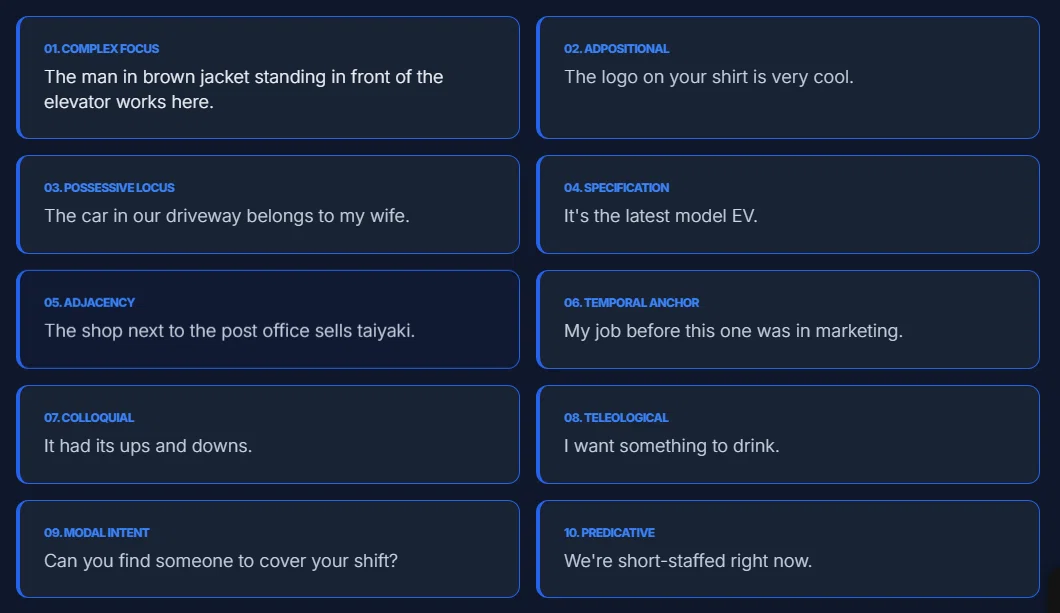
🟪24ラ英101- The man in the brown jacket standing in front of the elevator works here.- 説明ルール

#English_Grammar #ラ英2024 #ラジオ英会話 #24ラ英101 #Explanation_Rule
Slides

TOC
Slide Number	Subtitle	Topic Sentence	Pedagogical Remark
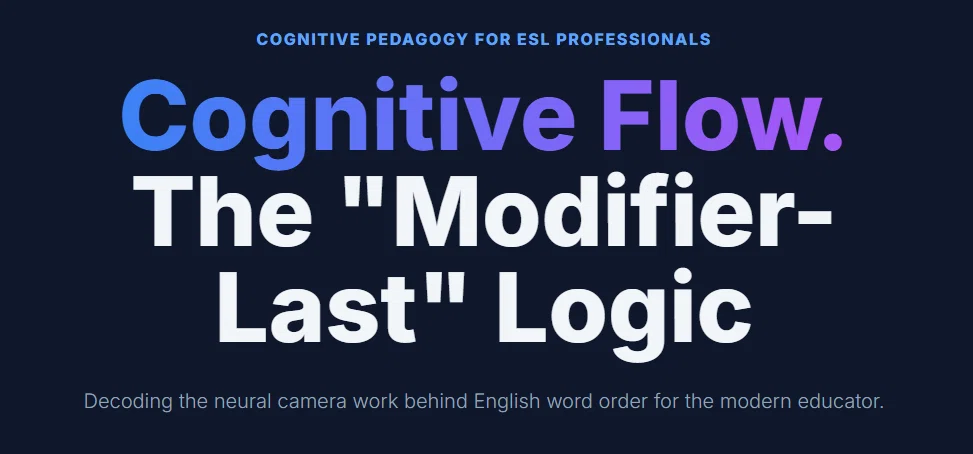
1	Cognitive Flow: The "Modifier-Last" Logic	Decoding the neural camera work behind English word order for the modern educator.	Title slide establishing the focus on Cognitive Pedagogy.
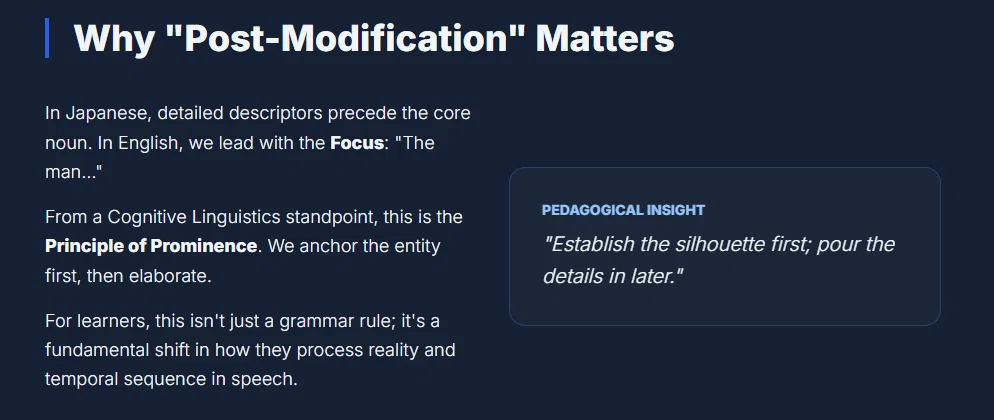
2	Why "Post-Modification" Matters	We anchor the entity first, then elaborate; this is the Principle of Prominence.	Establish the silhouette first; pour the details in later.
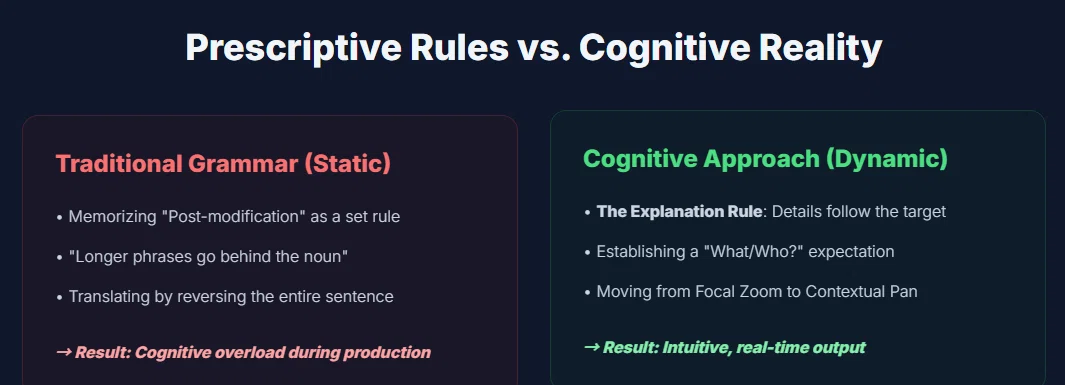
3	Prescriptive Rules vs. Cognitive Reality	The Explanation Rule: Details follow the target to move from Focal Zoom to Contextual Pan.	Contrast between static prescriptive rules and dynamic cognitive processes.
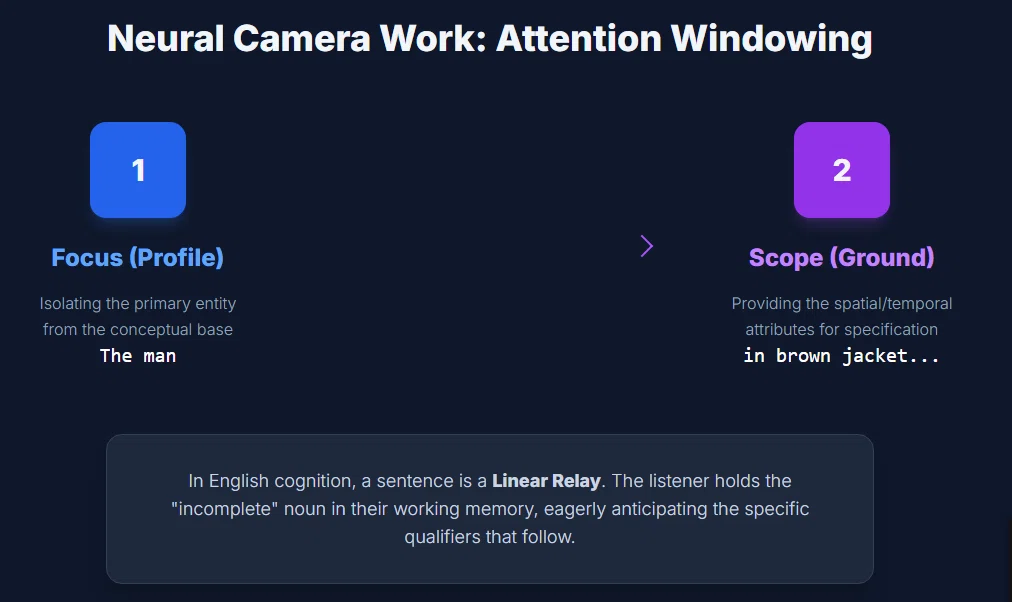
4	Neural Camera Work: Attention Windowing	In English cognition, a sentence is a Linear Relay.	Explains the movement from Focus (Profile) to Scope (Ground).
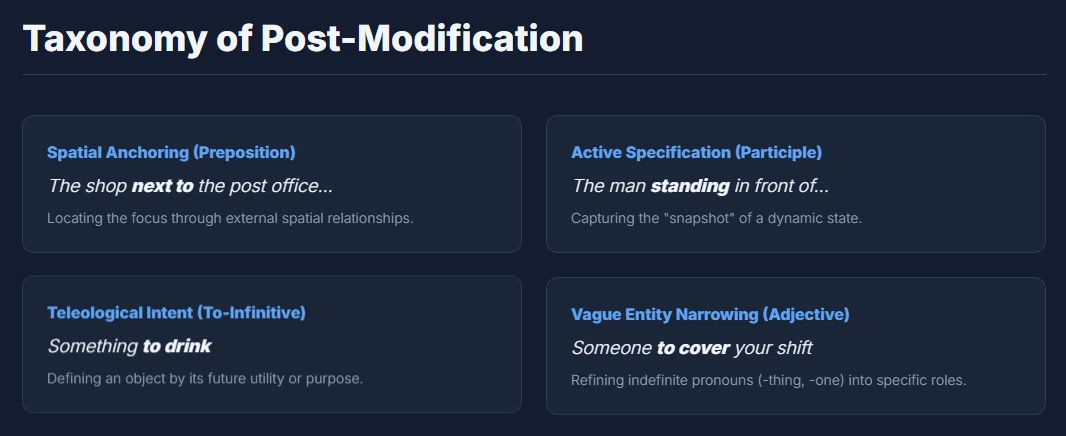
5	Taxonomy of Post-Modification	Taxonomy of spatial, active, teleological, and narrowing modification forms.	Categorizes different structural types of post-modification.
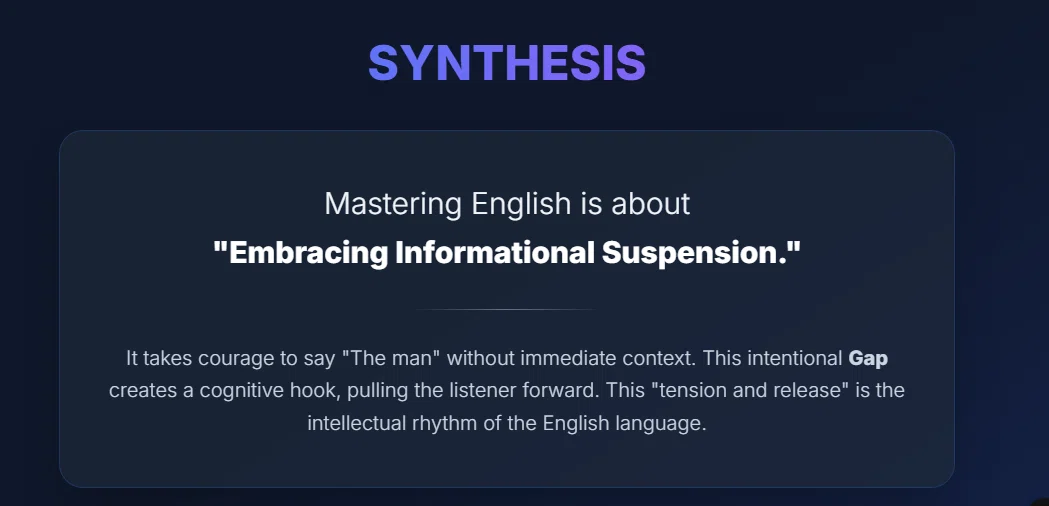
6	Synthesis	Mastering English is about "Embracing Informational Suspension."	The "tension and release" created by the informational Gap is the intellectual rhythm of English.
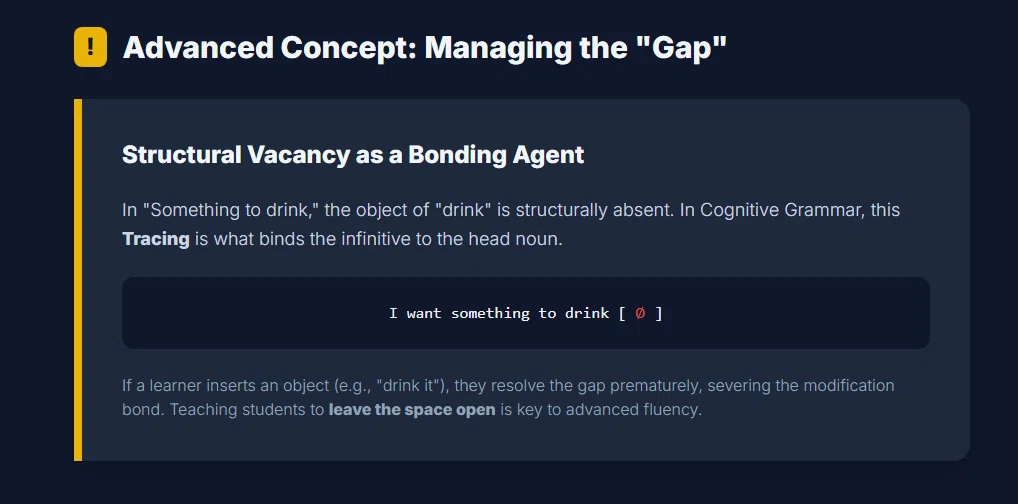
7	Advanced Concept: Managing the "Gap"	In Cognitive Grammar, structural vacancy (the Gap) is the bonding agent for modification.	Instruction on avoiding premature gap resolution (e.g., adding unnecessary objects).
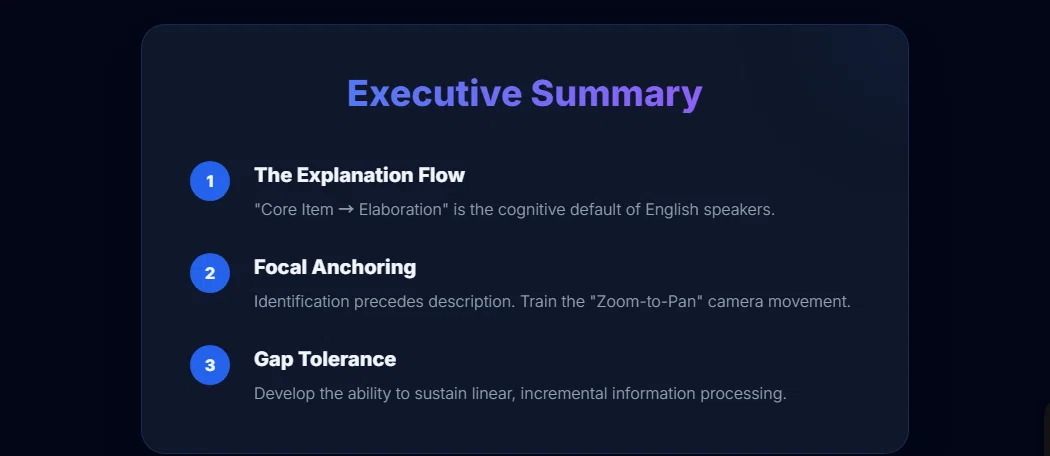
8	Executive Summary	"Core Item → Elaboration" is the cognitive default of English speakers.	Summarizes the key takeaways for teacher professional development.
9	Illustrative Corpus	Corpus of 10 sentences ranging from complex focus to situational predicatives.	Provides practical examples for classroom or personal study.
Contents
Speaker's notes
Speaker’s Notes: The Cognitive Architecture of Post-Modification
Target Audience: Advanced Learners / Fellow Educators Tone: Intellectual, Analytical, yet Pedagogically Actionable
Slide 1: Introduction – The Modifier-Last Logic
Speaker Script & Context: "Hello everyone. As an educator living in Japan for six years, I’ve often been struck by the sheer 'mental torque' my students experience when trying to flip their internal word-order switch. We often tell students that 'English grammar is different,' but we rarely explain why it feels so counter-intuitive. Today, I want to move away from prescriptive 'rules' and look at the Cognitive Flow. We aren't just teaching a sequence of words; we are teaching a Neural Camera Work. In the British school of linguistics, we focus heavily on functionalism—how language serves a purpose. Here, the purpose is the immediate establishment of the Focus before any descriptive baggage slows down the delivery of the core message."
Key Terms & Remarks:
Cognitive Flow: The mental path an interlocutor takes during real-time processing.
Neural Camera Work: A metaphor for how the brain 'zooms' in on subjects.
Modifier-Last: The structural tendency to place elaborative units after the head noun.
Slide 2: Why Post-Modification Matters
Speaker Script & Context: "The heart of the issue is what cognitive linguists call the Principle of Prominence. In Japanese, the language is 'Head-Final'—you build a beautiful, detailed frame before showing the painting. In English, we throw the painting at you first. Think of it as Conceptual Anchoring. When I say 'The man...', I have anchored a specific entity in your mental space. Everything that follows—'in the brown jacket,' 'standing by the lift'—is simply refining that anchor. For a Japanese learner, this feels 'exposed' or 'naked' because they are used to the safety of descriptors first. We need to teach them that in English, the Silhouette is the priority."
ASCII Diagram: Cognitive Anchoring
JAPANESE (Head-Final)             ENGLISH (Head-Initial)
[Detail A] + [Detail B] -> HEAD   HEAD -> [Detail A] + [Detail B]
(Frame)       (Frame)     (Picture) (Picture)  (Color)      (Shadow)
      BUILD-UP PROCESS                  ANCHOR-AND-REFINE
Key Terms & Remarks:
Principle of Prominence: The most important information (the noun) gets first billing.
Conceptual Anchoring: Fixing a subject in the listener's mind immediately.
Head-Initial: Languages that place the primary word before its modifiers.
Slide 3: Prescriptive Rules vs. Cognitive Reality
Speaker Script & Context: "In our staff rooms, we see textbooks that say: 'If the modifier is two or more words, put it behind.' That is a Static Rule. It’s boring and hard to remember mid-conversation. Instead, let's look at Attention Windowing. The English brain has a 'window' of attention that opens the moment a noun is uttered. The following modifiers are not 'rules'—they are responses to the listener's unspoken question: 'Which one?' or 'What kind?'. Moving from Focal Zoom (the noun) to Contextual Pan (the surroundings) is a cinematic experience. If we teach students to treat grammar as a camera lens, the 'rule' disappears and becomes a natural instinct."
Key Terms & Remarks:
Attention Windowing: The period during which a listener is primed for specific information.
Focal Zoom: Starting with a narrow, sharp focus on the primary subject.
Contextual Pan: Expanding the view to include location, action, or state.
Slide 4: Neural Camera Work & Linear Relay
Speaker Script & Context: "Think of a sentence as a Linear Relay. One word passes the baton to the next. In the example 'The man in the brown jacket...', 'The man' is the baton. But it’s an incomplete baton—it’s 'heavy' with potential. The prepositional phrase 'in the brown jacket' catches that weight and resolves it. We must emphasize to our students that English is Incremental. You don't need to see the end of the sentence to start the beginning. This is the biggest hurdle in Japan, where the verb at the end of the sentence dictates the entire structure. We are teaching them to live in the Linear Moment."
ASCII Diagram: The Relay Flow
[ THE MAN ] ----(expectation)----> [ IN BROWN JACKET ]
    |                                     |
  FOCUS                               ELABORATION
 (Baton)                               (Reception)
Key Terms & Remarks:
Linear Relay: The word-by-word progression of meaning.
Incremental Processing: Interpreting language as it arrives, not as a finished block.
Linear Moment: The state of processing the current word without looking back.
Slide 5: Taxonomy & Conceptual Grounding
Speaker Script & Context: "Now, let's categorize these 'Batons.' Whether it’s a Spatial Anchor ('next to the shop') or a Teleological Intent ('something to drink'), the cognitive function remains identical. We are Grounding the noun. When we use a 'to-infinitive' post-modally, we are projecting the noun into a future utility. 'Someone to cover your shift' isn't just a person; it's a person defined by a future necessity. This kind of Conceptual Grounding allows the speaker to be incredibly precise without complex subordinate clauses. It’s elegant, efficient, and very 'British' in its directness."
Key Terms & Remarks:
Conceptual Grounding: Connecting a noun to its environment or purpose to make it 'real.'
Teleological Intent: Defining something by the end-goal or function it serves.
Spatial Anchor: Using physical location to specify an entity.
Slide 6: Synthesis & Informational Suspension
Speaker Script & Context: "The final 'Aha!' moment for a student is Informational Suspension. This is the 'Tension and Release' of English. By saying 'The man...', you create a 'tension'—a vacuum of information. The post-modifier is the 'release.' Japanese learners hate the tension; they feel they are making a mistake if they haven't clarified everything first. We need to encourage them to embrace the Cognitive Hook. If they can learn to enjoy the moment where the listener is 'hooked' and waiting for the description, they have moved beyond translation and into true English fluency."
Key Terms & Remarks:
Informational Suspension: The state of holding an incomplete idea in mind.
Cognitive Hook: The psychological pull created by an underspecified subject.
Tension and Release: The rhythmic build and resolution of information density.
Slide 7: The Gap – Structural Vacancy
Speaker Script & Context: "Here is the advanced bit: The Gap. In 'Something to drink,' the verb 'drink' is missing its object. Why? Because the object is the 'Something' that came before it! This Structural Vacancy acts like a chemical bond—it’s the 'glue' that holds the modifier to the noun. Students often try to fill the gap ('Something to drink it'), which actually breaks the bond. We must teach them that in English, Silence is a Connector. The 'empty space' after the verb is exactly what points the listener back to the head noun. It’s a beautiful, invisible architecture."
Key Terms & Remarks:
Structural Vacancy: An intentional 'hole' in a phrase that links back to a previous word.
Bonding Agent: The linguistic mechanism that holds modifiers in place.
Tracing: The mental process of linking a gap back to its antecedent.
Key Takeaways for the Educator
Shift from Rules to Flow
Stop teaching 'backwards modification' and start teaching 'forward explanation.'
Embrace the Anchor
Train students to 'lock in' the noun before they even know how they will describe it.
The Power of the Gap
Use the 'missing object' in to-infinitives as a visual proof of connection.
Cinema over Grammar
Use 'Zoom' and 'Pan' as mental cues to help students visualize their speech path.
Blog Tags
#EnglishEducation #CognitiveLinguistics #TeachingInJapan #TESOL #GrammarArchitecture #LanguageProcessing #ELT #LinguisticFlow
Examples
Terms
Key Term	Simplified Remark (for Learners)
Cognitive Flow	The natural path your brain follows when you speak or listen to English.
Neural Camera Work	Thinking of English like a camera lens that first zooms in on an object and then pans out to show the background.
Modifier-Last	The English habit of saying the main "thing" first and adding the details afterward.
Principle of Prominence	Putting the most important information at the beginning so the listener knows what you are talking about right away.
Conceptual Anchoring	Naming a person or object immediately to "drop an anchor" in the listener's mind.
Head-Initial	A language style where the main word comes first, followed by its description.
Attention Windowing	The short time after you say a noun when the listener is waiting and ready for more details.
Focal Zoom	Focusing sharply on the main subject before describing anything else.
Contextual Pan	Moving your attention from the main subject to the surrounding details (like location or action).
Linear Relay	Passing information forward like a relay race, where each word leads naturally to the next.
Incremental Processing	Understanding a sentence piece-by-piece as it is spoken, rather than waiting for the end.
Linear Moment	Focusing only on the word you are saying right now, without worrying about the words that come later.
Conceptual Grounding	Giving a noun a "real-world" feel by connecting it to a place or a specific purpose.
Teleological Intent	Describing an object by explaining what it is used for (its future goal).
Spatial Anchor	Using words like "next to" or "in" to help the listener "see" where an object is located.
Informational Suspension	The feeling of "waiting" for more information after the main noun is spoken.
Cognitive Hook	Using the main noun to "hook" the listener's interest so they want to hear the description.
Tension and Release	Building a little mystery with a noun (tension) and then solving it with a description (release).
Structural Vacancy (The Gap)	A "hidden space" in a sentence that connects a description back to the main noun.
Bonding Agent	The invisible "glue" that keeps a description attached to the correct noun.
Tracing The mental act of "following the line" from a description back to the noun it belongs to.いいなと思ったら応援しよう!
 Generative AIを使って何ができるかを実践しています。応援ありがとうございます。