🟪24ラ英111- He went to England to learn English and other things. - 説明ルール to不定詞

#English_Grammar #ラ英2024 #ラジオ英会話 #24ラ英111 #Explanation_Rule
Slides
TOC
Slide No	Subtitle	Topic Sentence	Pedagogical Remarks
1	Vectors of Meaning	A Cognitive Exploration of the to-Infinitive for Educators	Focus on the shift from grammar rules to spatial intuition.
2	Beyond Simple Translation	In EFL/ESL classrooms, we often teach the to-infinitive as a marker of purpose.	Emphasize the "Image Schema" of "to" as a spatial movement.
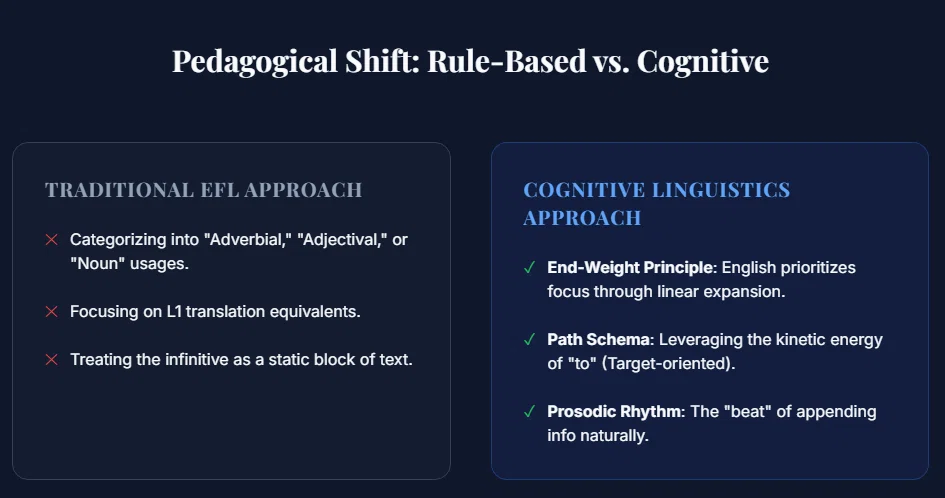
3	Pedagogical Shift	Rule-Based vs. Cognitive	Contrasts traditional categorization with the "End-Weight Principle."
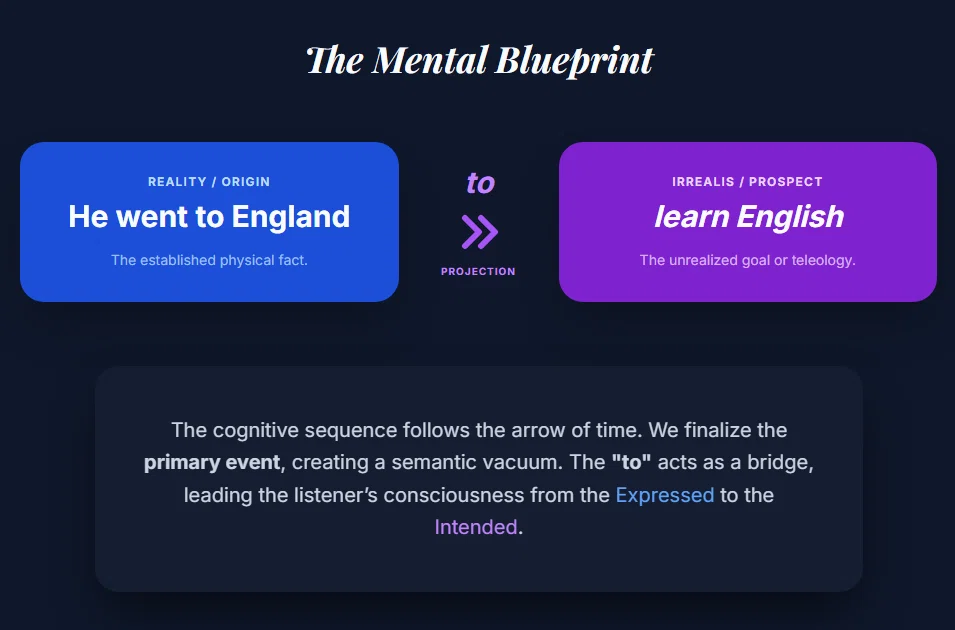
4	The Mental Blueprint	The cognitive sequence follows the arrow of time.	Visualizes the transition from "Reality" to "Irrealis" (prospective goals).
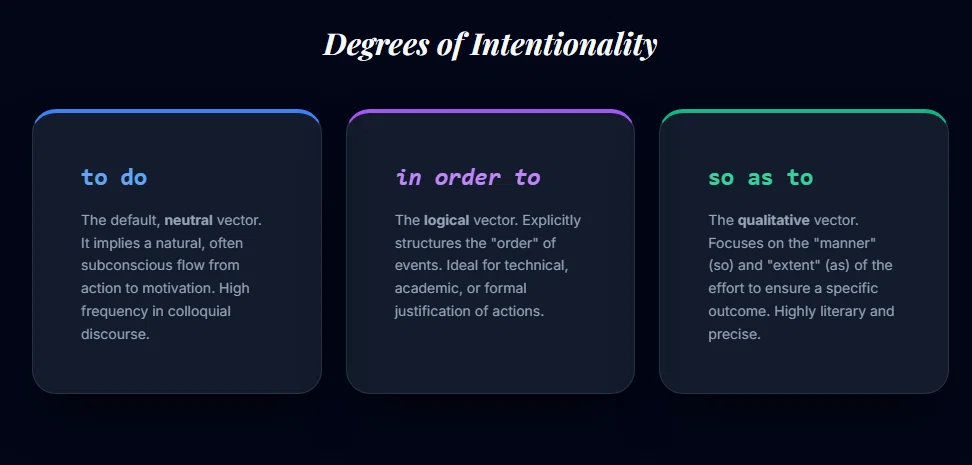
5	Degrees of Intentionality	Differences between to do, in order to, and so as to.	Categorizes vectors as Neutral, Logical, or Qualitative.
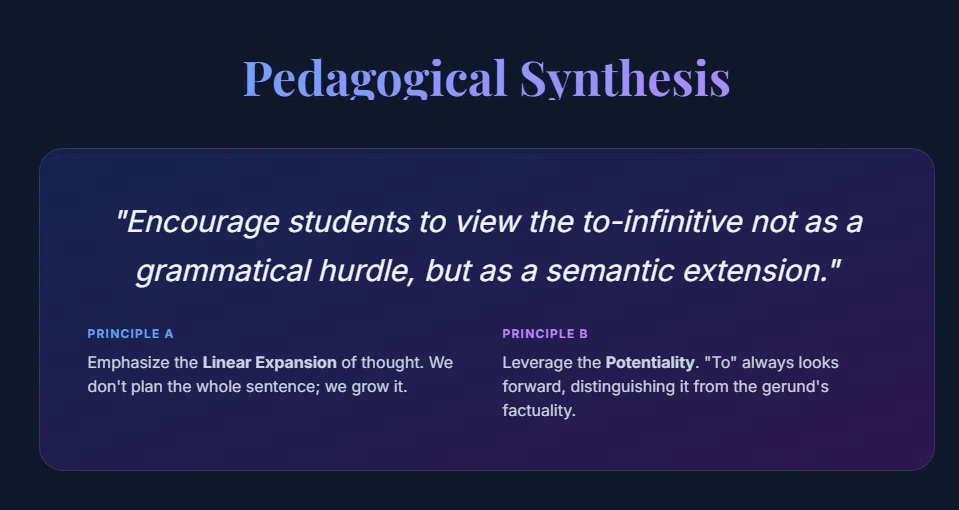
6	Pedagogical Synthesis	Encourage students to view the to-infinitive as a semantic extension.	Highlights "Linear Expansion" and "Potentiality" as core principles.
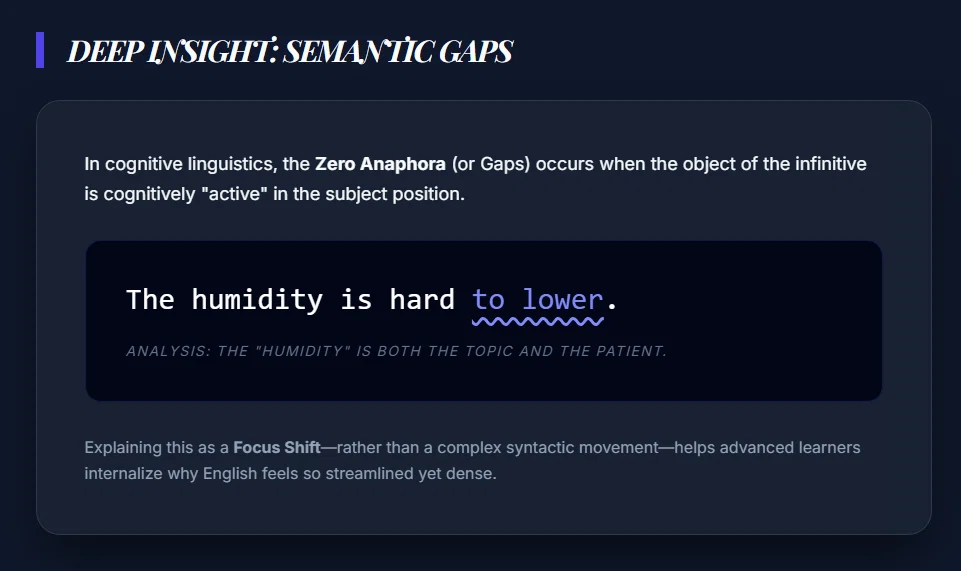
7	Deep Insight: Semantic Gaps	Zero Anaphora occurs when the object is cognitively active in subject position.	Explains complex syntactic movements as a simple "Focus Shift."
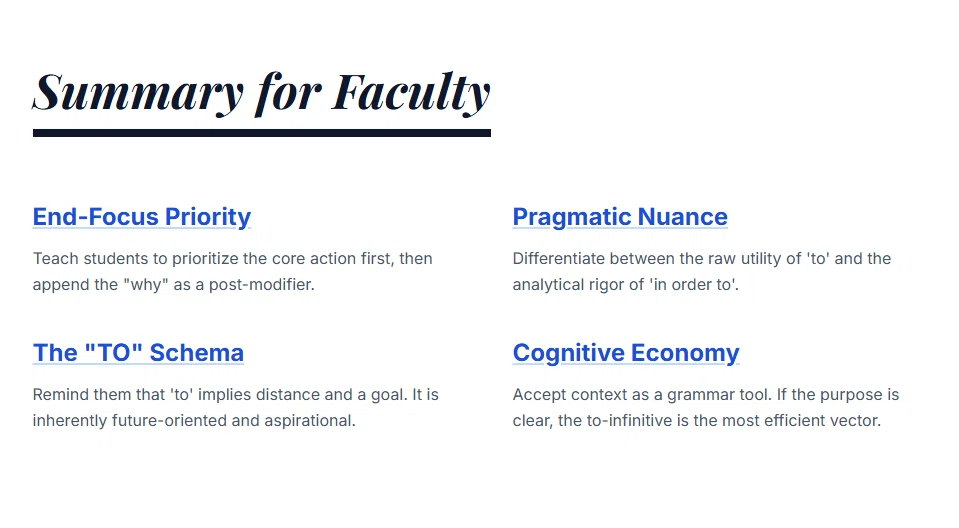
8	Summary for Faculty	Teaching the "End-Focus Priority" and the "TO Schema."	Advice for educators on implementing cognitive economy in the classroom.
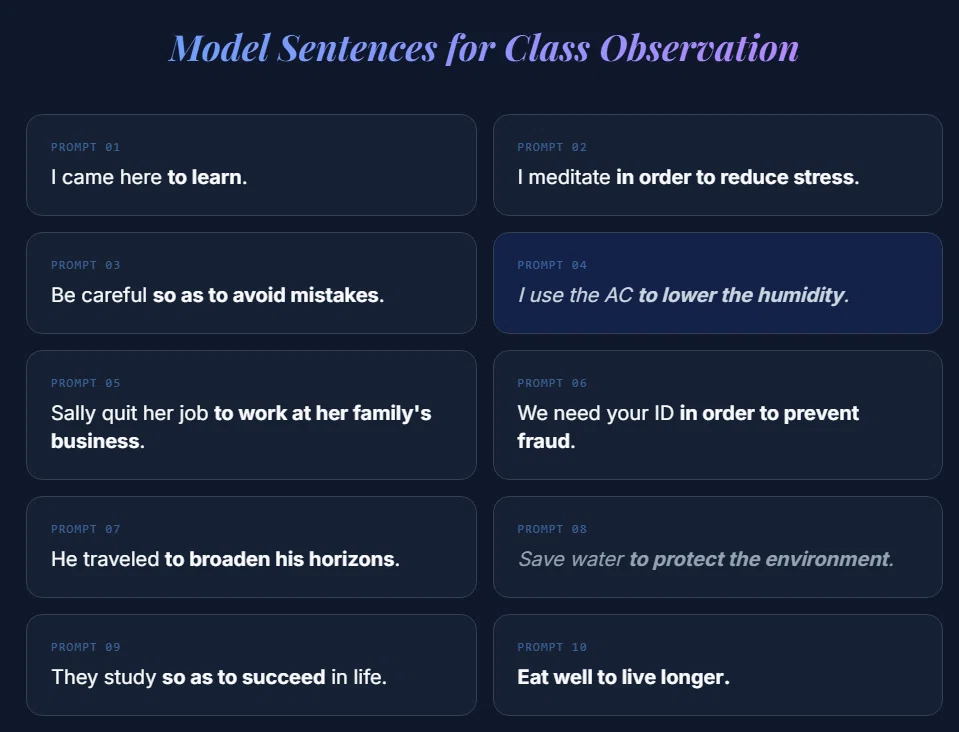
9	Practice Examples	Model Sentences for Class Observation	10 model sentences showing varying degrees of formality and context.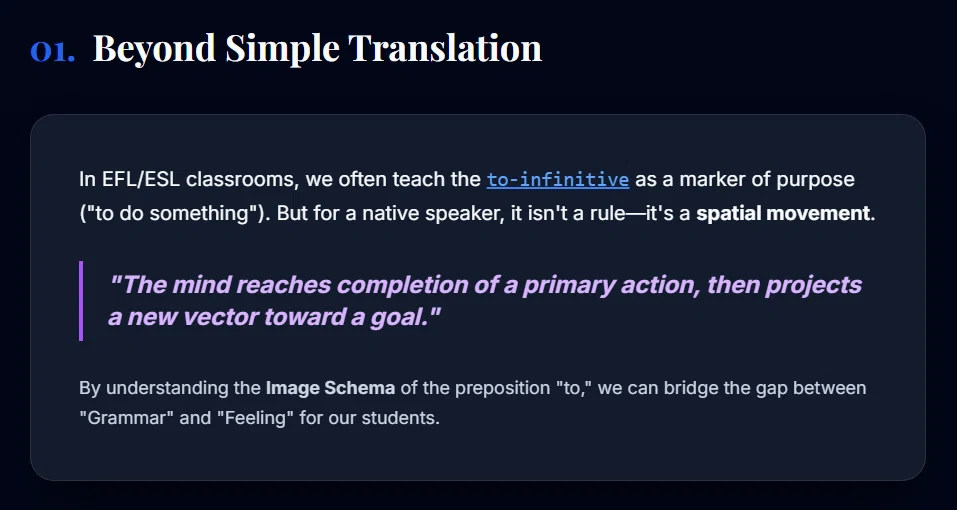
Contents
Speaker’s Notes: The Cognitive Architecture of the to-Infinitive
Target Speaker: British Male, 30s (6-year Japan resident, ELT Professional)
01. Introduction: Vectors of Meaning
Context: This slide sets the stage for a shift from "Grammar as Rules" to "Grammar as Mental Movement." Having lived in Japan for six years, you likely recognize the "Yakudoku" (translation-heavy) shadow that looms over students. Your goal here is to introduce the to-infinitive not as a formula to be solved, but as a dynamic vector.
Detailed Narrative: Start by acknowledging the common frustration in the Japanese classroom. Students see a sentence like "He went to England to learn English" and immediately begin a backward mental translation. Break this habit early. Explain that in the native mind, the sentence grows linearly. We are not using a "subordinate clause of purpose"; we are simply extending the reach of our initial thought. The term Vector of Meaning is crucial here. It implies both direction and magnitude. When we say "to," we are launching a mental arrow toward a target that has not yet been reached. This is the Directional Essence of English. You want the students to feel the "breath" between the main action and the extension. It is a transition from the Realized World to the World of Intention. Use your British background to provide a sense of "linguistic storytelling"—we start with a fact and move toward a dream or a goal.
Cognitive Vector: A mental force that has both a starting point (action) and a direction (goal).
Image Schema: A recurring pattern of reasoning based on bodily experience (like moving toward a target).
Teleology: The explanation of phenomena by the purpose they serve rather than by postulated causes.
02. The Core Mechanism: The Mental Blueprint
Context: This is the "How it Works" slide. Use the Linear Expansion concept to show why English word order is the way it is.
Detailed Narrative: Imagine a timeline. On the left, we have the Reality/Origin. This is the concrete part of the sentence: "He went to England." Once this is uttered, the "event" is complete in physical space. However, in the realm of human cognition, an action without a reason feels "naked." This creates what we call a Semantic Vacuum. The listener’s brain asks, "Why?" or "What for?" The "to" acts as the bridge. It is a kinetic particle. It doesn't just sit there; it pushes the consciousness forward. In cognitive terms, we call this the Path Schema. The verb following "to" is the Mental Destination. This is the Prospect or the Irrealis—something that hasn't happened yet relative to the first verb. Explain to the students that they don't need to look for a "rule"; they just need to look for the "next target."
ASCII Diagram: The Cognitive Flow
[ PRIMARY ACTION ] -----( VECTOR )-----> [ MENTAL GOAL ]
       |                   |                   |
  "He went..."        "to" (Bridge)       "...learn"
       |                   |                   |
   REALITY             PROJECTION           PROSPECT
(The Foundation)    (The Movement)      (The Aspiration)
Irrealis: A grammatical mood that indicates that a certain action is not yet a fact.
Semantic Vacuum: The psychological expectation of more information following a core statement.
Path Schema: A mental structure where a "trajector" moves along a path to a "landmark."
03. Pedagogical Synthesis & Deep Dive
Context: This section focuses on the "Informer" vs. the "Logic" of the sentence. Since you understand the Japanese "Setsumei-rule" (explanation rule), you can contrast it here.
Detailed Narrative: For a student to reach the next level, they must understand Prosodic Rhythm. In English, we place the "new" and "heavy" information at the end. This is the End-Weight Principle. When we use "in order to" instead of just "to," we are signaling a Logical Vector. We are slowing down the sentence to ensure the listener understands the "Order" of operations. It’s like adding a signpost that says, "Attention: Specific Logic Follows." Conversely, "so as to" is the Qualitative Vector. It describes the "state" (so) and "extent" (as) of the effort. These aren't just synonyms; they are tools for Pragmatic Nuance. Tell your students that "to" is a fast arrow, "in order to" is a heavy bridge, and "so as to" is a careful path.
End-Weight Principle: The tendency to place longer, more complex, or new information at the end of a sentence.
Pragmatic Nuance: The subtle difference in meaning depending on the context and choice of words.
Zero Anaphora: The omission of a word that is understood from the context (the "Gap" in cognitive focus).
Key Takeaways
Linear Progression: Teach students to think from left to right. Avoid the "backward leap" of translation.
Remark: Essential for building fluency and reducing mental load during speaking.
The 'To' Bridge: "To" is a directional particle, not a grammatical hurdle. It indicates a move from Fact to Intention.
Remark: Simplifies the "why" behind the purpose usage.
Semantic Gaps as Economy: Gaps in sentences (like "Hard to lower") are signs of Cognitive Economy, not missing pieces.
Remark: Helps advanced students understand the natural "omission" habits of native speakers.
Variety is Logic: The choice between "to," "in order to," and "so as to" is a choice of Emotional and Logical Weight.
Remark: Moves students from "Correct/Incorrect" thinking to "Effective/Ineffective" communication.
Blog Tags
#EnglishEducation #CognitiveLinguistics #ELTProfessional #TeachingTips #ToInfinitive #LinguisticIntuition #LanguagePedagogy #NativeEnglishMindset
Examples
Terms
Key Term	Simple Remark (For Learners)
Cognitive Vector	A mental "arrow" that starts with an action and points toward a goal.
Image Schema	A mental picture based on how we move our bodies, like walking toward a target.
Teleology	Explaining "why" something happens by looking at its purpose or goal.
Irrealis	A state where something isn't a fact yet; it is just a plan, a dream, or a goal.
Semantic Vacuum	A feeling that a sentence is "unfinished" and needs more information to make sense.
Path Schema	The mental bridge that connects where you are (the action) to where you want to go (the result).
End-Weight Principle	The habit of putting the most important or longest information at the end of a sentence.
Pragmatic Nuance	Small, subtle differences in meaning that change based on the words you choose.
Zero Anaphora	Leaving out a word because everyone already knows what you are talking about.
Cognitive Economy Using the fewest words possible to communicate an idea quickly and clearly.いいなと思ったら応援しよう!
 Generative AIを使って何ができるかを実践しています。応援ありがとうございます。