
実験ノート:lean4-skillsを試す、ベンチーマークの例題mathd_algebra_69を解いてみる。

背景:lean x codexのnoteを見た
Lean x codexで、Hilbertという、ゴールに対してLean記述を生成し、これを解けるまで自律的にtry&errorを行うというシステムにインスパイアされて、codexとプロンプトでこれを試してみた記事があった。
Hilbertの論文はこちら: https://arxiv.org/abs/2509.22819
codexでできるということは、Claude codeでもできるだろうか?
前の記事で、Claudeにlean4-skillsを導入し、COBOLの形式検証を行った。
Skillがあれば、codexと同様のことができるのでは?ということで実験。
お題はmathd_algebra_69
もとのnoteでは、miniF2Fという数学ベンチマーク の問題の1つである mathd_algebra_69を解かせていた。HuggingFaceにあるデータセットをみると。
theorem mathd_algebra_69
 (rows seats : ℕ)
 (h₀ : rows * seats = 450)
 (h₁ : (rows + 5) * (seats - 3) = 450) :
  rows = 25 := sorry
解説を読むと、
An audience of $450$ people is seated in an auditorium. Each row contains the same number of seats and each seat in the auditorium is occupied. With three fewer seats per row, and five extra rows, the same audience could still be seated, occupying all seats. How many rows does the auditorium have? Show that it is 25.
question.leanにお題をコピーし、windowsのフォルダに設置する。
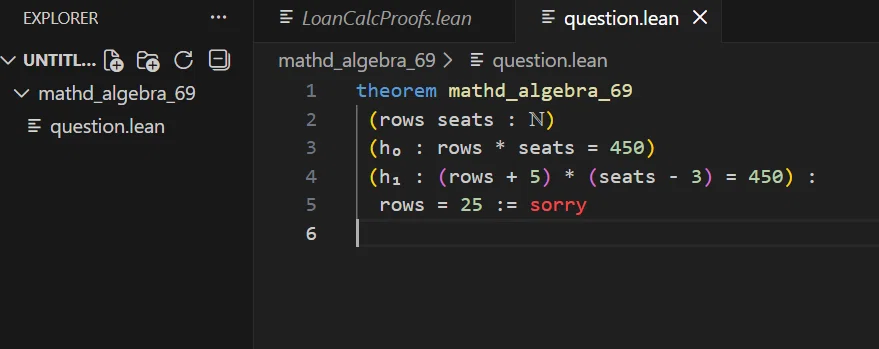
VSCodeからlean4が立ち上がり、、infoViewが立ち上がる。
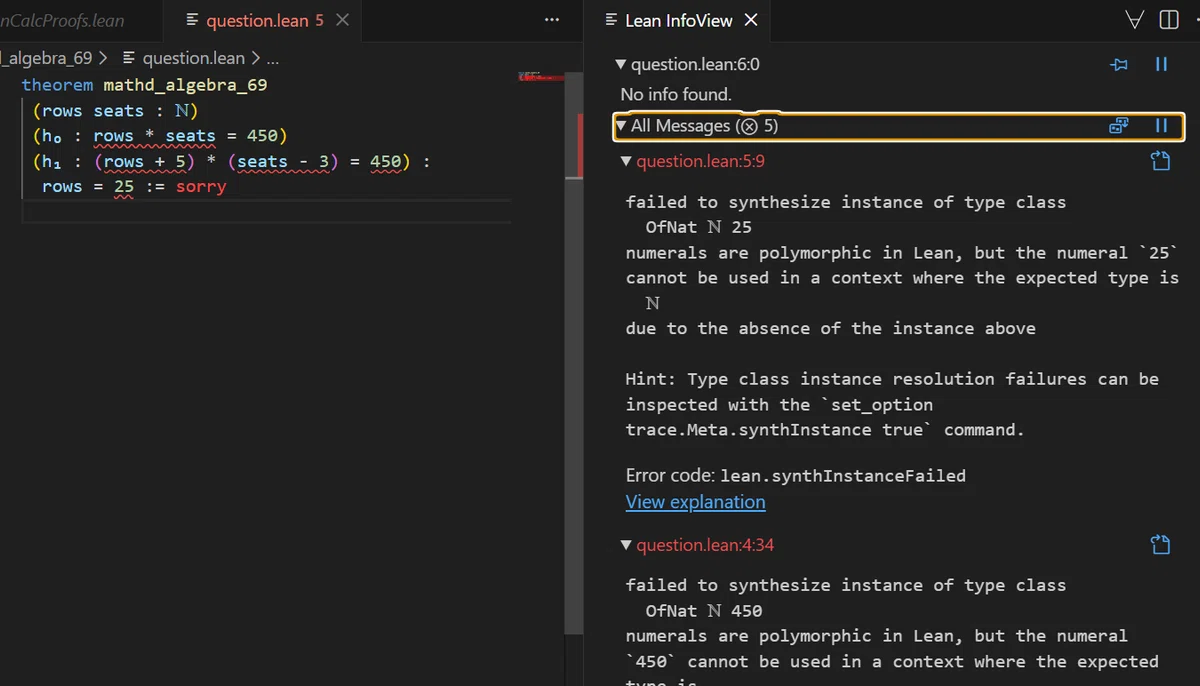
ダメダメである。
ClaudeでLean4 skillsをつかってみた
さて、Claude Desktopのcodeから、ローカルフォルダを指定して、解いてみる。

ファイルを読んで、それからSkillの /lean4:autoproveを今回は使う。

信じられん、autoproveが見つからなった???

何回か、「許可」のお伺いがきて、実行を続けると。。。証明ができたという。
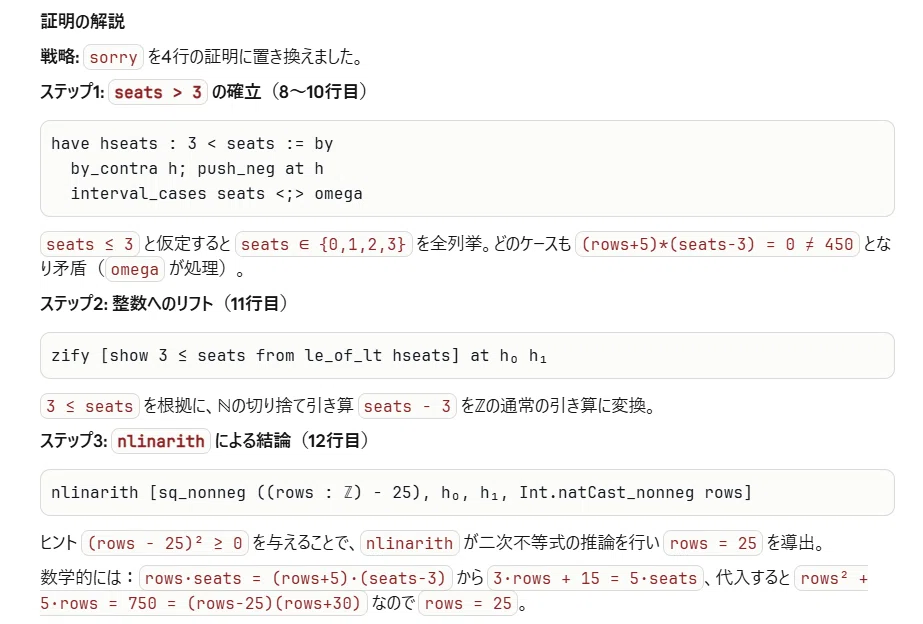
そして、指定したフォルダのquestion.leanは、書き換わって、sorry以下が実体化されていた。
import Mathlib.Tactic

theorem mathd_algebra_69
 (rows seats : ℕ)
 (h₀ : rows * seats = 450)
 (h₁ : (rows + 5) * (seats - 3) = 450) :
  rows = 25 := by
  have hseats : 3 < seats := by
    by_contra h; push_neg at h
    interval_cases seats <;> omega
  zify [show 3 ≤ seats from le_of_lt hseats] at h₀ h₁
  nlinarith [sq_nonneg ((rows : ℤ) - 25), h₀, h₁, Int.natCast_nonneg rows]
VSCodeで開くと、Mathlibがインポートされないというエラーがでた。これはインストールが大変なようなので、今回はパス。
ChatGPT(無料)にも聞いてみた。
良い問題です。自然数の等式を一度整数に持ち上げてから因数分解で解くのが簡潔です。Lean4(mathlib4)での証明は次のようになります。
ということで、29秒の推論で、以下の証明を提示してきた。
import Mathlib.Tactic

theorem mathd_algebra_69
 (rows seats : ℕ)
 (h₀ : rows * seats = 450)
 (h₁ : (rows + 5) * (seats - 3) = 450) :
  rows = 25 := by
  -- 自然数の等式を整数に持ち上げる
  have h0 : (rows : Int) * (seats : Int) = 450 := by norm_cast; exact h₀
  have h1 : (rows + 5 : Int) * (seats - 3 : Int) = 450 := by norm_cast; exact h₁

  -- (rows+5)*(seats-3) - rows*seats = 5*seats - 3*rows - 15 を得る
  have diff : (rows + 5 : Int) * (seats - 3 : Int) - (rows : Int) * (seats : Int)
              = 5 * (seats : Int) - 3 * (rows : Int) - 15 := by ring
  -- h1 と h0 を使って 5*seats - 3*rows - 15 = 0、すなわち 5*seats - 3*rows = 15
  have linear : 5 * (seats : Int) - 3 * (rows : Int) = 15 := by
    calc
      5 * (seats : Int) - 3 * (rows : Int)
        = (5 * (seats : Int) - 3 * (rows : Int) - 15) + 15 := by ring
      _ = 0 + 15 := by rw [←diff, h1, h0]; simp
      _ = 15 := by simp

  -- linear を rows で掛けてから h0 を代入して多項式を得る
  have mul_rows := congrArg (fun t => t * (rows : Int)) linear
  have poly_eq : 5 * (rows : Int) * (seats : Int) - 3 * (rows : Int) ^ 2 = 15 * (rows : Int) := by
    simpa [mul_comm (rows : Int) (seats : Int), mul_comm (rows : Int) (rows : Int)] using mul_rows
  rw [h0] at poly_eq
  -- 2250 - 3*rows^2 = 15*rows から整理して行列式を作る
  have poly : (rows : Int) ^ 2 + 5 * (rows : Int) - 750 = 0 := by
    -- from 5*450 - 3*r^2 = 15*r  => 3*r^2 + 15*r - 2250 = 0 => r^2 + 5*r - 750 = 0
    norm_num at poly_eq
    linarith

  -- 因数分解 (r-25)(r+30) = 0 を得る
  have factorization : ((rows : Int) - 25) * ((rows : Int) + 30)
                      = (rows : Int) ^ 2 + 5 * (rows : Int) - 750 := by ring
  have mul0 : ((rows : Int) - 25) * ((rows : Int) + 30) = 0 := by
    rwa [←factorization] at poly

  -- 整数での積が 0 ならどちらかの因子が 0。rows + 30 > 0 なので rows - 25 = 0 が成立する。
  have cases := Int.mul_eq_zero.mp mul0
  -- rows は自然数なので (rows : Int) + 30 > 0
  have pos : 0 < (rows : Int) + 30 := by
    exact add_pos_of_nonneg_of_pos (Int.coe_nat_nonneg rows) (by norm_num : (0 : Int) < 30)
  -- したがって二つ目の因子が 0 になることはない
  cases cases with
  | inl h => -- (rows : Int) - 25 = 0 の場合
    have : (rows : Int) = 25 := by linarith [h]
    -- 整数から自然数への同値化
    norm_cast at this
    exact this
  | inr h =>
    -- (rows : Int) + 30 = 0 は pos に矛盾
    linarith [pos, h]
というこであったが、なんか長いな。こちらもMathlibをimportしているので評価はできない。
ChatGPTにClaudeの回答を講評してもらった
そこで、ChatGPTにClaudeの回答をチェックしてもらった。
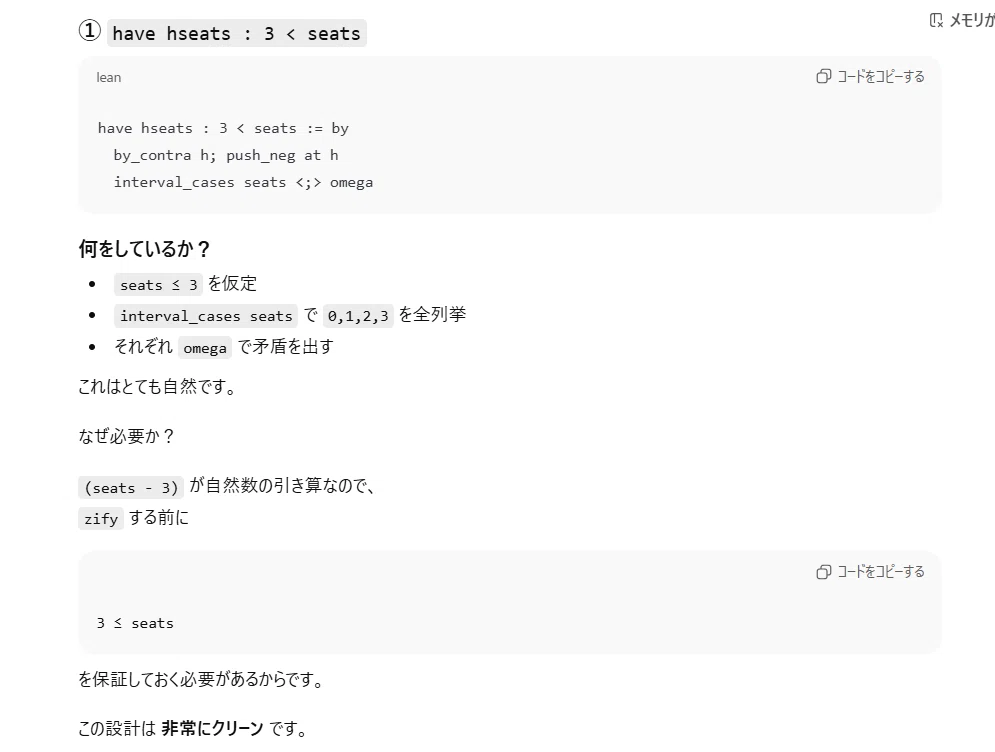
そして、次はzify
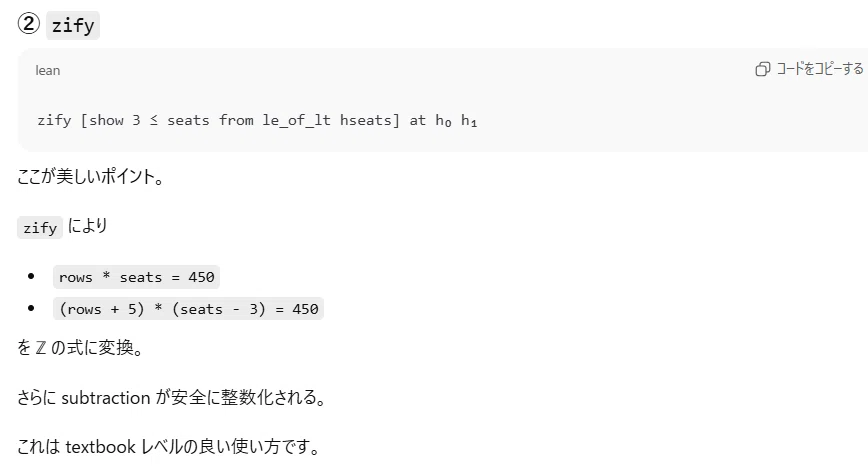
さらに、nlinarithが肝らしい。
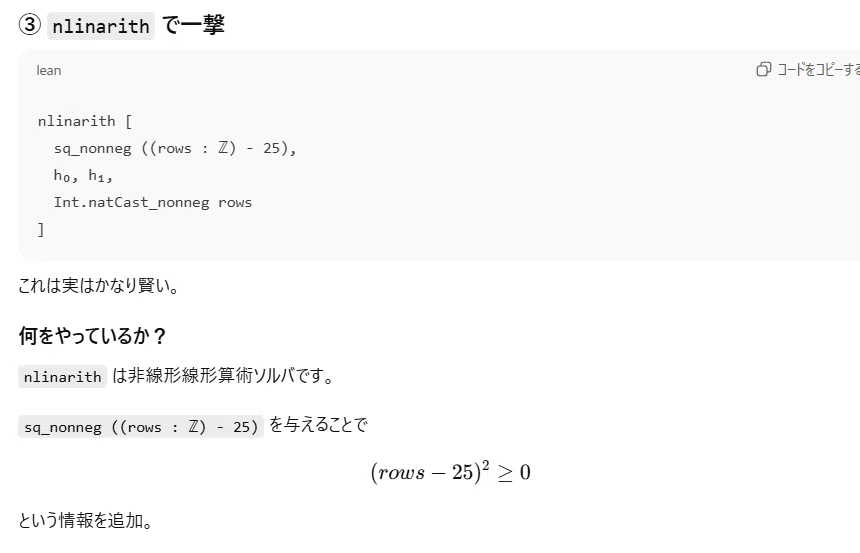
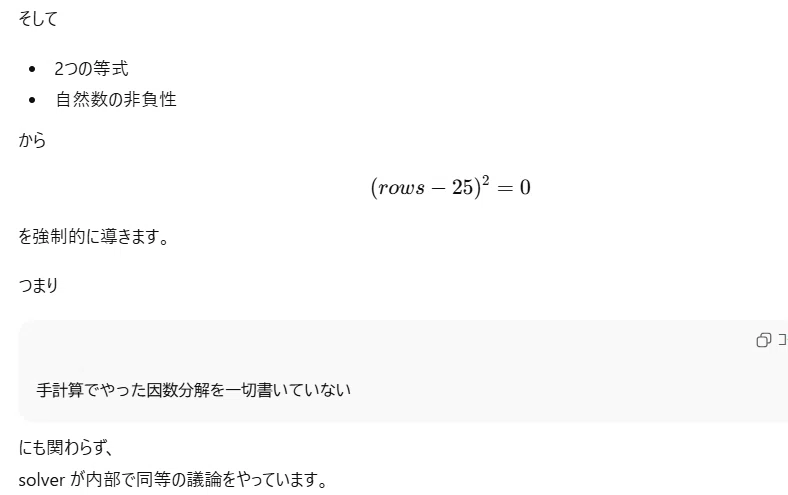
総評として、Claudeの回答はLeanとしてはスマートにできているが、人間に対する可読性が低いと。

どうにかして、Mathlibを使えるようにしたいものだ。。
追記:Lean4webでチェックした
そういえば、Lean4webというのがあった。これはMathlabが組み込まれていて、評価ができる。
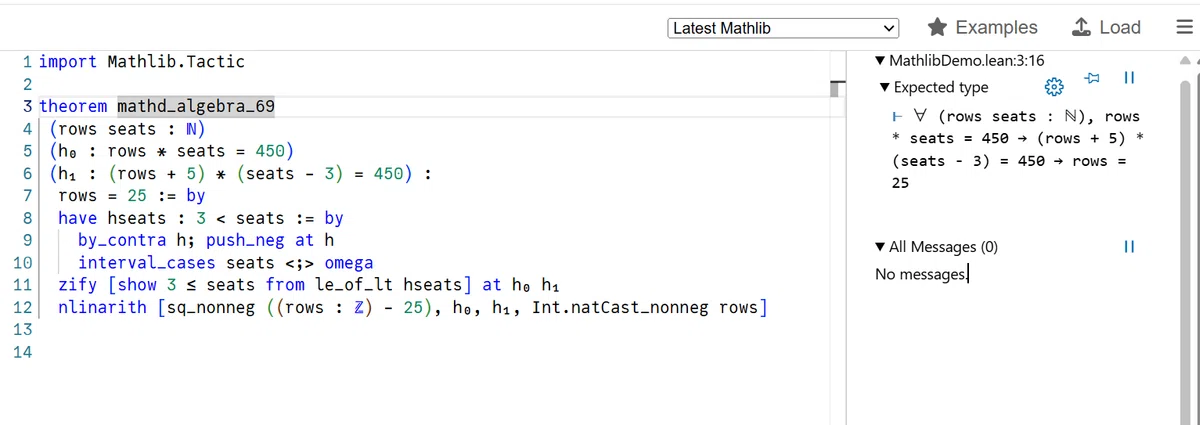
どうだろう、エラーは出ていない。
追記2:証明の過程をドキュメント化してもらった
Claude Codeにこの証明の過程をドキュメント化してもらった。

lean4-skillsの働きがよくわかる。成果物をここに供養する。
