Don't Call It a Business Yet

Prof. Mick Etoh, Ph.D. — The University of Osaka
The Tragedy of “Translation” in Fusion and Quantum Computing
I sit in a weird seat.
I did the computer science Ph.D. thing. I've run a research lab. I genuinely love ambitious technical problems. I spent my days allocating capital—trying to separate what's possible from what's buildable, and what's actually bankable, and thus now I’m encouraging students to embrace innovations. So when I watch the narratives around fusion and quantum computing—especially superconducting and photonic approaches—I feel a particular kind of discomfort. Not because I think the science is fake. Not because the people are dishonest.
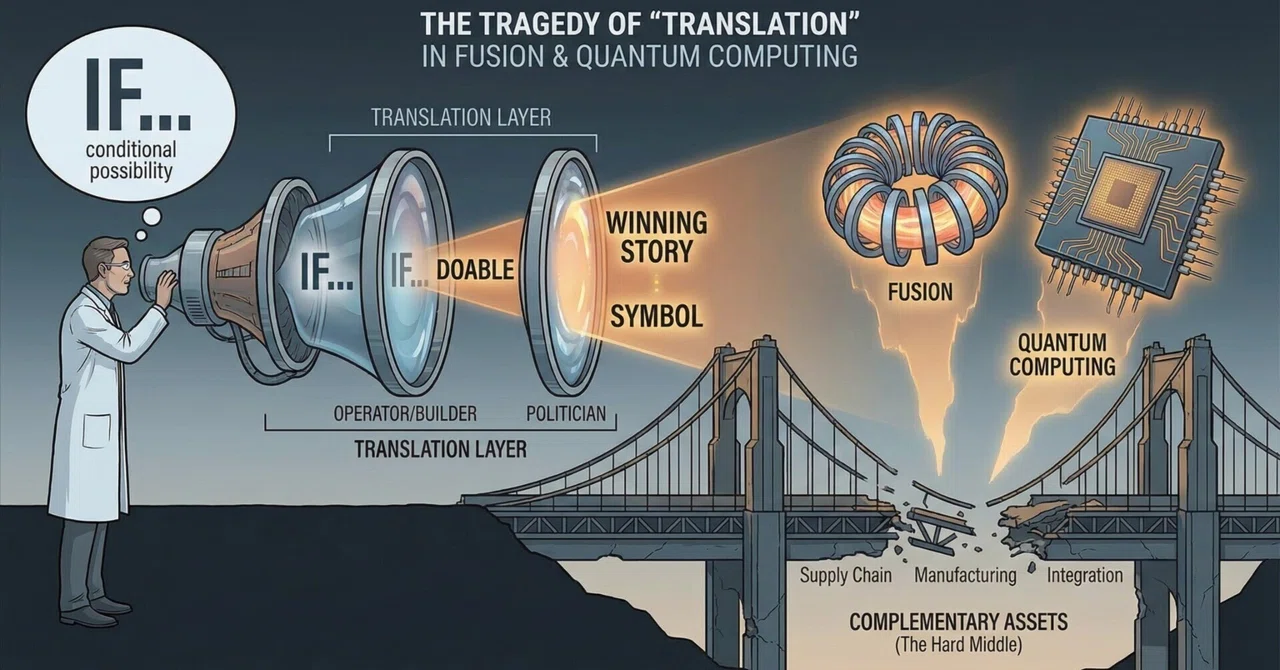
Because I think we've built a machine that reliably produces a specific failure mode: A dream technology that is not yet doable gets evaluated through three different lenses, each lens “valid” in its own world—and the mismatch creates avoidable tragedy.
This isn't a takedown. It's an attempt to name a pattern that keeps repeating, and to propose a better way to talk to each other before we burn another decade of trust.
1) The Core Problem: Value Propositions Get “Translated” Into a Different Language
Here's the thing about researchers: they speak in conditionals, and they're right to.
“If this regime holds, the scaling looks favorable.”
“If we can cross this threshold, the industrial impact is enormous.”
“The physics doesn't forbid it; we just don't have the engineering stack yet.”
Inside a research community, that's normal. Research is uncertainty management. The payoff is often a statement about physical possibility or mathematical feasibility—not “this ships next quarter.”
But once that same statement leaves the lab, it gets translated into different dialects:
The researcher's dialect
“It can work, given assumptions and unsolved engineering.”
The operator / builder's dialect
“There's a credible implementation path—money and time can buy it.”
The politician's dialect
“It's a winning story—something we can rally around and defend publicly.”
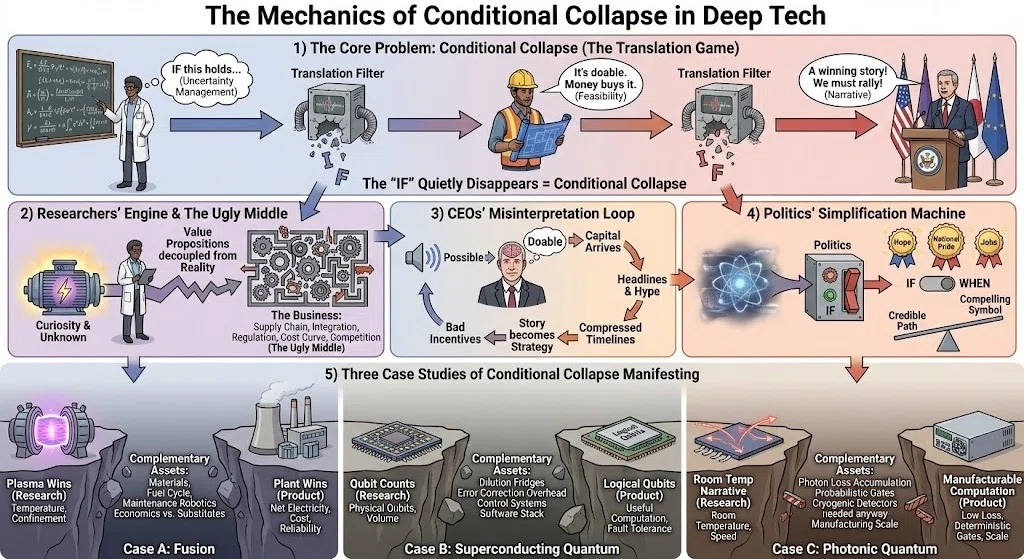
No one is lying. But something critical gets dropped in the translation. The “if” quietly disappears. And when the “if” disappears, the meaning changes.
I think of this as conditional collapse: a subtle linguistic failure that becomes a capital allocation failure.
2) Researchers Want to Keep Going—Because the Work Is Legitimately Fascinating
Let's be honest: a huge part of why deep tech exists is because some people are obsessed, in the best possible way. They want to figure it out. They want to see what's on the other side of the unknown. They want to solve the thing that has resisted everyone.
That's not a bug. That's the engine of science.
But science doesn't run on curiosity alone. It runs on resources: funding, facilities, talent, legitimacy (the social license to keep going).
So researchers make value propositions. Again: totally reasonable.
Here's the catch: those value propositions are often decoupled from economic rationality and complementary assets.
In the real world, “the core technology works” is just the start. The business is the rest: supply chain and yield, packaging, integration, and maintainability, regulatory environment, reliability and service model, cost curve and learning rate, competition and substitutes, who buys the first unit, and why.
Those are not “details.” That's what turns physics into products.
Research narratives tend to jump straight from breakthrough to industry impact without walking through the ugly middle. Not because researchers are naive. Because their job is to push the boundary, and the boundary is not a P&L.
The tragedy begins when that story is interpreted as a business plan.
3) Operators and CEOs Are Paid to Believe—and That's Dangerous in the Wrong Context
As an ex-Silicon Valley investor, I'll say it plainly: belief is part of the job.
Most meaningful companies start as “impossible.” You have to be willing to bet into uncertainty. That's how progress happens.
But in healthy markets, belief is tethered to expected value: probability of success × magnitude of outcome − cost of failure
In fusion and quantum, the probability term is extremely hard to estimate. And when you can't estimate it, you reach for proxies. One common proxy is the researcher's confidence.
So the CEO hears “possible” and internalizes “doable.” The board hears “breakthrough” and internalizes “time-to-market shortened.” Investors hear “industrial impact” and internalize “monetizable.”
Again: this is not fraud. It's misinterpretation under pressure.
And once that misinterpretation happens, it becomes self-reinforcing. Capital arrives. Headlines arrive. Hiring ramps. Timelines compress. The story becomes a moat. The moat becomes the strategy.
That's how good people drift into bad incentives.
4) And Then Politics Enters: The Objective Is to Win, Not to Ship
There's one more translation layer that makes the system unstable.
Politics is the art of turning complexity into a single sentence: hope, national pride, jobs, security, “we must compete,” “we can't fall behind.”
Moonshots are perfect political objects because they are easy to narrate and hard to falsify on election timescales.
But that's precisely why they can distort innovation agendas.
When a technology is still in the “if” phase, political narratives tend to treat it as a “when.” At that point, the evaluation criterion shifts from “does this have a credible path?” to “is this a compelling symbol?”
And symbols are expensive.
5) Three Case Studies: How Conditional Collapse Manifests
I'm not saying fusion and quantum are uniquely flawed. I'm saying they are uniquely structured to trigger conditional collapse. Let me walk through each in detail.
Case Study A: Fusion—Plasma Wins vs. Plant Wins
Fusion is the cleanest case study of conditional collapse.
In plasma physics, a better confinement regime is real progress. It's publishable, it's defensible, and it often represents years of hard-won insight.
But in the world of operating assets, plasma success is not the product. The product is a power plant: net electricity, continuous operation, maintainability, licensing, a credible cost curve, and a supply chain that can build and service the thing at scale.
That gap is where translation fails.
A researcher says, “We can reach the regime.”
A CEO hears, “We can build the plant.”
A politician hears, “We can solve climate.”
And in the middle—the truly expensive middle—you have complementary assets: materials that survive harsh environments, fuel logistics (tritium breeding, deuterium supply chains), maintenance robotics capable of operating in high-radiation zones, uptime economics that compete with existing baseload generation, and the unglamorous reality that substitutes (solar, wind, batteries, next-gen fission) keep improving while you're still clearing thresholds.
The metrics the public sees—temperature, confinement time, gain factors—are real achievements. They matter. But they don't tell you how much the plant costs, how often it breaks, or whether anyone will buy the power at that price.
Fusion milestones are often necessary. The tragedy is treating them as sufficient.
Case Study B: Superconducting Quantum Computing—Qubit Counts vs. Logical Qubits
Superconducting quantum computing has the most visible metrics problem in tech.
In the research community, increasing qubit count is meaningful progress. Each additional qubit represents real engineering achievement—better fabrication, improved coherence times, more sophisticated control electronics.
But in the world of useful computation, raw qubit count is not the product. The product is logical qubits: error-corrected, fault-tolerant computational units that can run algorithms long enough to solve problems classical computers cannot.
That gap is where translation fails.
A researcher says, “We've demonstrated 1,000 physical qubits.”
A CEO hears, “We're 1,000 steps closer to quantum advantage.”
A politician hears, “We're winning the quantum race.”
The uncomfortable truth: you might need 1,000 to 10,000 physical qubits to create a single logical qubit, depending on error rates. A “1,000-qubit” machine might have zero logical qubits. A “quantum supremacy” demonstration might solve a problem no one actually needs solved.
And in the middle—the truly expensive middle—you have complementary assets: dilution refrigerators that cost millions and require specialized maintenance, control systems that scale poorly, error correction overhead that consumes most of your computational capacity, software stacks that barely exist, and the unglamorous reality that classical algorithms and hardware keep improving while you're still fighting decoherence.
The metrics the public sees—qubit counts, quantum volume, supremacy demonstrations—are real achievements. They matter. But they don't tell you when you'll break useful cryptography, simulate useful molecules, or optimize useful logistics problems.
Superconducting quantum milestones are often necessary. The tragedy is treating them as sufficient.
Case Study C: Photonic Quantum Computing—Room Temperature vs. Loss and Manufacturability
Photonic quantum computing has the most seductive narrative in the field.
In the research community, photonic approaches offer genuinely exciting advantages: photons don't interact with their environment the way superconducting qubits do. They can operate at room temperature. They can leverage decades of telecommunications infrastructure. They travel at the speed of light.
But in the world of scalable computation, room temperature operation is not the product. The product is reliable, manufacturable quantum computation with acceptable loss rates, deterministic gate operations, and integration density that enables useful algorithms.
That gap is where translation fails.
A researcher says, “Our system operates at room temperature.”
A CEO hears, “We've solved the cooling problem—we can scale cheaply.”
A politician hears, “This is the practical approach—we should back this horse.”
The uncomfortable truth: room temperature operation solves one problem while revealing others. Photon loss accumulates exponentially with circuit depth. Single-photon sources are probabilistic and inefficient. Two-qubit gates are fundamentally probabilistic, requiring resource-intensive workarounds. Integration—putting enough components on a chip—faces different but equally severe challenges.
And in the middle—the truly expensive middle—you have complementary assets: single-photon detectors that need cryogenic temperatures anyway (negating the room-temperature advantage), optical interconnects with insertion losses that compound catastrophically, manufacturing processes that don't yet exist at scale, and the unglamorous reality that “room temperature” often applies only to the qubits themselves, not the ancillary systems required to make them useful.
The metrics the public sees—photon counts, boson sampling demonstrations, room temperature operation—are real achievements. They matter. But they don't tell you when you'll achieve deterministic gates, acceptable loss rates at scale, or cost-effective manufacturing.
Photonic quantum milestones are often necessary. The tragedy is treating them as sufficient.
6) Why These Technologies Are Especially Vulnerable to This Failure Mode
Across all three cases—fusion, superconducting quantum, photonic quantum—the same structural features make conditional collapse almost inevitable.
(1) They don't produce incremental business value easily
In many domains, you can build something small and sell something small, learn, iterate. Fusion and general-purpose quantum computing often look like step functions. The early versions may be scientifically meaningful but commercially useless. If value arrives only after crossing a threshold, the narrative tends to fill the gap.
(2) Their metrics are easy to misread
Inside the field, metrics are nuanced. Outside the field, metrics get treated as scoreboard points.
Fusion: “temperature / confinement / gain” becomes “we're close to power.”
Superconducting QC: “qubit count / quantum volume” becomes “we're close to breaking crypto.”
Photonic QC: “room temperature / photon counts” becomes “we're close to practical quantum.”
The public hears “progress.” Investors hear “timeline compression.” Politicians hear “victory.” Same word. Different meaning.
(3) Complementary assets are massive and slow
Fusion is systems engineering at civil-infrastructure scale. Quantum is an ecosystem problem: cryo, control, error correction, software, integration, user workflows. Even if the core science works, the industrial stack is heavy. Heavy stacks create long gaps. Long gaps get filled with story.
(4) They become “national projects”
Once a project becomes entangled with national competitiveness, it becomes very hard to stop. And when it becomes hard to stop, evaluation shifts from “should we continue?” to “how do we justify continuing?”
That is how the center of gravity moves from truth-seeking to narrative maintenance—without anyone deciding to be dishonest.
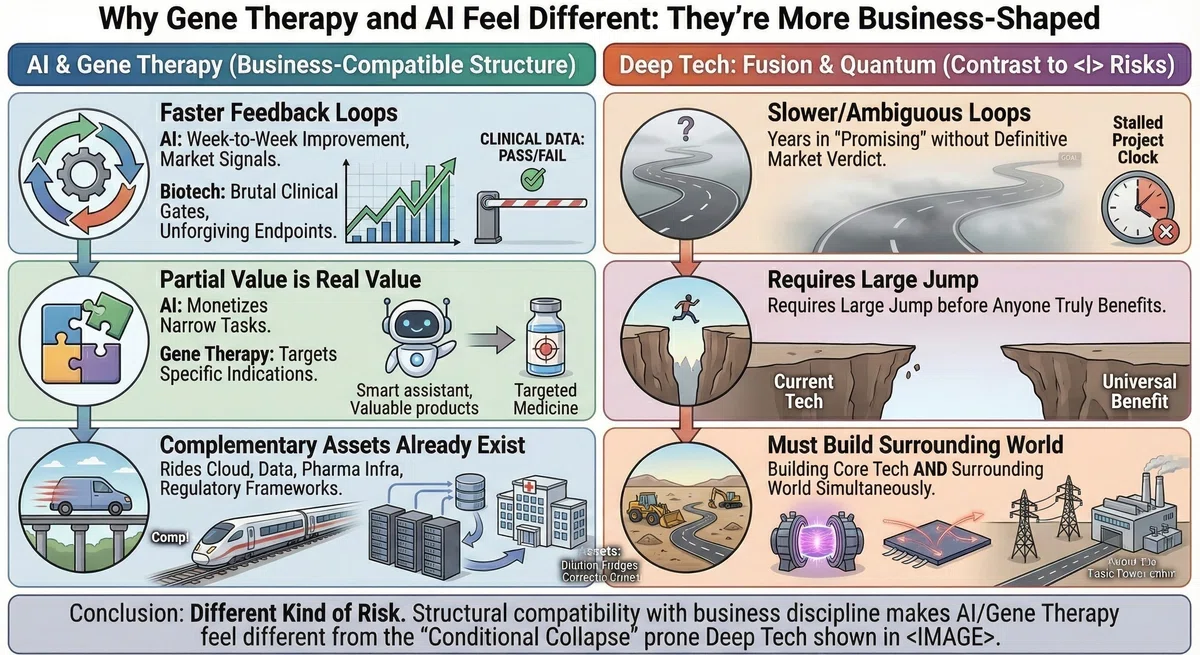
7) Why Gene Therapy and AI Feel Different: They're More Business-Shaped
This contrast matters.
Gene therapy and AI have hype too. Plenty. But they are structurally more compatible with business discipline.
Faster feedback loops
AI can improve week to week. Users respond. Markets signal. Biotech has brutal gates—clinical endpoints are unforgiving. Fusion and quantum can spend years in “promising” without a definitive market verdict.
Partial value is real value
AI monetizes narrow tasks. Gene therapy targets specific indications. Fusion and general-purpose quantum often require a large jump before anyone truly benefits.
Complementary assets already exist
AI rides cloud, data, distribution, developer ecosystems. Biotech rides pharma infrastructure, regulatory frameworks, manufacturing expertise. Fusion and quantum require building much of the surrounding world at the same time as the core technology.
That's not impossible. But it is a different kind of risk.
8) What the “Tragedy” Actually Costs: Not Just Money
When conditional collapse becomes institutionalized, you don't just lose capital.
You lose: better alternatives that could have been funded, time, which is the real non-renewable resource, talent, pulled into story-driven work instead of reality-driven work, public trust, when the story inevitably outruns the engineering, policy coherence, when enthusiasm flips into cynicism and the pendulum swings too far.
The worst version is when everyone loses confidence at the same time: researchers, investors, and the public—turning legitimate science into collateral damage.
9) A Forward-Looking View: Two Plausible Futures
I see two trajectories from here.
Scenario A: The “Boring” Pivot to Maturity
Metrics shift toward implementation reality. Milestones become falsifiable and gated. Policy becomes portfolio-based, not moonshot-based. Companies build with honest timelines and defined early markets.
The hype cools, but the work gets healthier. Progress becomes slower and more durable.
Scenario B: A Winter Triggered by Expectation Failure
Timelines slip repeatedly while narratives remain maximal. The “if” keeps disappearing. Investors lose patience. Politicians turn the story into a scandal. Funding dries up indiscriminately, including for real foundational work.
This isn't a scientific failure. It's a communications and governance failure.
Right now, without intentional correction, Scenario B becomes more likely.
10) How to Reduce the Tragedy: Build a Translation Layer, with Rules
I'm not arguing to stop research. I'm arguing to stop confusing research narratives with business narratives.
Here are three rules I wish we'd institutionalize.
Rule 1: Separate claims into three tiers
Physics feasibility: does nature allow it?
Engineering feasibility: can we build it reliably at scale?
Business feasibility: can it win in a market against substitutes?
These are not synonyms. Treating them as synonyms is how we manufacture disappointment.
Rule 2: Require a “complementary asset checklist” with every grand vision
If you want to talk about industrial impact, you must also list: supply chain, manufacturing yield, integration and service, regulatory path, cost model and learning curve, substitute technologies, first customers and adoption wedge.
Dreams are fine. But the scaffolding matters.
Rule 3: Policy should not use moonshots as moral cover
The most toxic move is using a future dream as a substitute for present action: “we'll solve climate later with fusion,” “we'll regain competitiveness later with quantum.”
Moonshots should be part of a portfolio, not the punchline.
Closing: Science Is Sacred; Narratives Are Not
Fusion and quantum computing are ambitious, beautiful problems. I want them to succeed.
But I also want us to stop building innovation agendas on stories that skip the hard middle—because when the story breaks, it doesn't just break budgets.
It breaks trust.
The most constructive thing we can do is design a better interface between worlds: a translation layer that keeps the “if” attached to the claim, without killing the dream.
Because the dream is not the problem. The mismatch is.
