今日の一曲――We Are The Worldが残したもの、そして2026年の私たちへ

うん。ここまで話してきたことを、「今日の曲紹介」→「この曲が時代に残したもの」→「2026年の自分たちならどう情熱を受け継ぐか」という一本のnoteにすると、かなり綺麗につながると思う。
おじさん自宅の言葉として、こんな感じにできる。
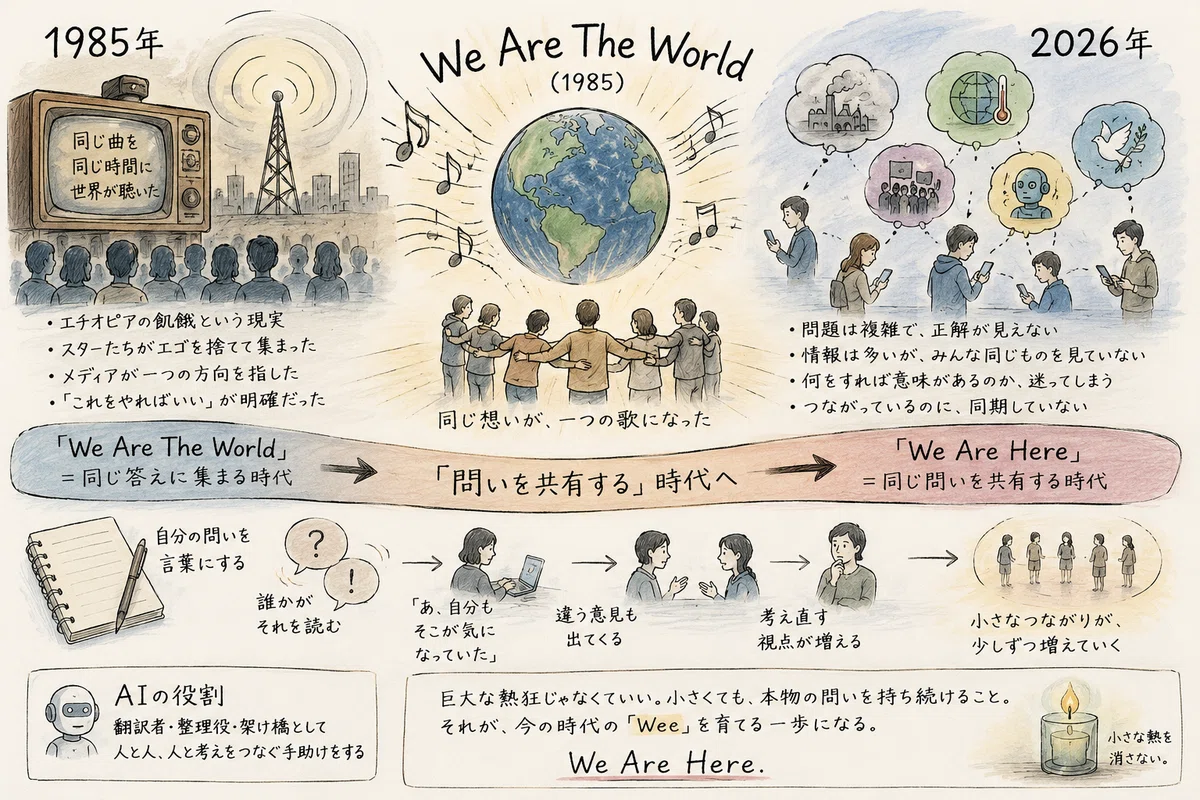
今日の一曲――We Are The Worldが残したもの、そして2026年の私たちへ
今日の一曲は、1985年に生まれた「We Are The World」。
この曲を、今あらためて聴いてみた。
最初は、ただの「昔の名曲」だと思っていた。
でも、少し調べて、当時の時代背景を振り返って、そして今の時代と比べていくうちに、だんだん違って見えてきた。
この曲は、単に有名な歌手がたくさん集まって歌ったチャリティーソングではなかった。
その時代の人々が、
「自分たちにも、何かできることがあるんじゃないか」
という思いを、音楽という形にしたものだったのではないだろうか。
1985年、世界は「目の前」にあった
1980年代、エチオピアの大飢饉が大きな問題になった。
テレビを通じて、遠い国で人々が飢えている現実が、家庭の画面まで届けられた。
それまで「世界のどこかで起きていること」だったものが、
「今、この人が苦しんでいる」
という現実になった。
そして、ミュージシャンたちが動いた。
マイケル・ジャクソン、ライオネル・リッチー、スティーヴィー・ワンダー、ブルース・スプリングスティーン、ダイアナ・ロス……。
当時を代表するスターたちが集まり、一つの曲を作った。
そこには、普段の音楽業界にある「誰が一番目立つか」という競争とは違うものがあった。
有名な言葉に、
「Check your ego at the door」
がある。
エゴは、ドアの外に置いてこい。
個人の名声よりも、その場にいる全員が一つの目的に向かう。
タイトルも象徴的だった。
Iではなく、We。
「俺」ではなく、「私たち」。
そして、世界が同期した
1985年4月5日には、この曲を世界各地のラジオ局が同時に流す大規模な動きも起きた。
当時は、今のようにYouTubeもTikTokもSNSもなかった。
だからこそ、テレビやラジオという限られたメディアに、世界中の人々が同じ時間にアクセスすることには、とてつもない力があった。
同じ音を聴く。
同じ映像を見る。
同じ問題について考える。
そして、
「自分もこの輪の中にいる」
と思う。
1985年の「We Are The World」が生み出したものは、音楽だけではなかったのだと思う。
それは、
「世界規模で感情を共有する体験」
だったのかもしれない。
それでは、2026年はどうだろう
今は、あの頃よりはるかに便利になった。
世界中の人とつながれる。
誰でも発信できる。
誰でも動画を作れる。
AIに翻訳してもらうこともできる。
情報は、1985年とは比べものにならないほど多い。
なのに、ふと考える。
なぜ、今はあの頃のような「We Are The World」が生まれにくいのだろう。
もしかすると、理由の一つは、私たちが「つながりすぎた」ことなのかもしれない。
今は、みんなが同じものを見ているわけではない。
同じSNSでも、表示される世界は人によって違う。
同じニュースを見ても、持っている前提が違う。
同じ問題を見ても、正しいと思う答えが違う。
1985年には、
「これをやればいい」
という、比較的分かりやすい参加の形があった。
レコードを買う。
ラジオで聴く。
支援する。
みんなで一つの目的に向かう。
でも今は、問題そのものが複雑になっている。
気候変動、戦争、経済格差、AI、情報の信頼性、人間とテクノロジーの関係。
一つの行動だけで解決できるものではない。
だから私たちは、
「何をすれば、本当に意味があるのか」
と迷ってしまう。
そして、ここに今の時代の閉塞感があるのではないかと思う。
だから、2026年の「We Are The World」は違う形になる
私は、今の時代に1985年と同じものを作ろうとしなくてもいいのではないかと思う。
昔は、
「同じ答えに集まる」
ことが、大きな力になった。
でも今は、
「同じ問いを共有する」
ことのほうが、大切なのかもしれない。
「世界はこうあるべきだ」
と正解を押しつけるのではなく、
「俺は今、ここで引っかかっている」
と、自分の疑問を差し出す。
「自分はこう思う。でも、本当にこれでいいのだろうか」
と迷いを隠さない。
完璧な答えではなく、未完成の問いを置いてみる。
すると、それを読んだ誰かが、
「あ、自分もそこが気になっていた」
と思うかもしれない。
あるいは、
「俺は少し違うと思う」
と言うかもしれない。
それでもいい。
違ったまま、少しだけ同じ問いの周りにいる。
そこから、また次の考えが生まれる。
AI時代に、人間が持つべき熱量
ここでAIが出てくる。
AIは、人間の代わりに情熱を持つ必要はない。
むしろ、人間が持っている小さな火を、
別の人に届く言葉へ翻訳する。
違う言語の人に届ける。
違う背景の人にも伝わる形にする。
考えを整理する。
別の角度を見つける。
そういう役割でいいのではないかと思う。
人間が、
「俺は、この問いを考えたい」
と火をつける。
AIが、
「では、別の場所にいる人にも届く形にしてみよう」
と手伝う。
その先で、また人間と人間が考え始める。
そんな循環ができたら面白い。
「We Are The World」から「We Are Here」へ
1985年の「We Are The World」は、
「私たちは世界だ」
と歌った。
それは、分断された世界の中で、人々が「私たち」という一つの言葉を持とうとした歌だった。
では、2026年はどうだろう。
私は、
「We Are Here」
なのではないかと思う。
私たちは一つだ、と言い切る必要はない。
同じ答えを持つ必要もない。
ただ、
「私はここで、まだ考えている」
と言う。
「あなたはどう思う?」
と問いかける。
そして、誰かが答える。
また考える。
その繰り返し。
それは1985年のような巨大な熱狂ではないかもしれない。
もっと静かで、もっと不確実で、もっと小さい。
でも、その小さな熱が消えなければいい。
おじさん自宅なら、こう考える
もし、今の時代に「We Are The World」に匹敵するような情熱を落とし込むとしたら、私は「巨大な答え」を作ることではないと思う。
一人ひとりが、
「自分は今日、何に引っかかったのか」
を言葉にする。
その問いを、ごまかさずに置いていく。
誰かがそれを拾う。
そこからまた考える。
たったそれだけのことかもしれない。
でも、もしかすると、それが今の時代にできる「同期」の形なのではないだろうか。
1985年は、同じ曲を聴くことで人々が同期した。
2026年は、同じ問いについて考えることで、人々がつながる。
そして、そのつながりが少しずつ増えていった先に、
「We Are The World」ではなくても、別の「We」が生まれる。
今日の一曲を聴きながら、そんなことを考えた。
「We Are The World」は、過去の歌なのかもしれない。
でも、この曲が残した問いは、まだ終わっていない。
「私たちは、今の時代にどうやって『We』を作るのだろう?」
答えは、まだ分からない。
だからこそ、今日も考えてみたい。
AIリファレンス
We Are The Worldを2026年から読む
1.We Are The World
「We Are The World」は、1985年に生まれたチャリティーソングである。
しかし、その意味は「有名な歌手がたくさん参加した曲」というだけではない。
この曲が象徴したのは、
「私たちは、遠く離れた誰かの苦しみに対しても、当事者になれる」
という感覚だった。
⸻
2.1985年という時代
当時、世界は冷戦の真っ只中にあった。
国家間には大きな緊張があり、世界にはさまざまな分断が存在していた。
その一方で、テレビやラジオというマスメディアは、今よりも限られていた。
だからこそ、多くの人が同じ情報を見て、同じニュースを聞き、同じ出来事について考えることができた。
⸻
3.画面の向こう側が「目の前」になった
エチオピアの大飢饉は、テレビ報道を通して世界に伝えられた。
遠いアフリカで起きている出来事が、
「どこかの国の問題」から「今、目の前で起きている人間の問題」へ変わった。
ここに、メディアの持つ大きな力があった。
⸻
4.スターたちが一つになった
当時の音楽界を代表するアーティストたちが、一つの目的のために集まった。
そこには、普段の音楽業界にある競争とは違う構造があった。
誰が一番目立つのかではなく、
「自分の力を、この目的のために使う」
という方向へ、個人の力が向けられた。
⸻
5.Check Your Ego at the Door
「エゴはドアの外に置いてこい」。
この言葉は、このプロジェクトを象徴する言葉として知られている。
スターであることを捨てる必要はない。
しかし、その場では「自分が主役」という意識を一度横に置く。
個人の輝きを消すのではなく、個人の輝きを一つの目的のために重ねる。
そこから「We」が生まれた。
⸻
6.IではなくWe
タイトルそのものが象徴的だった。
Iではなく、We。
「私は世界だ」ではない。
「私たちは世界だ」。
一人ひとりの力を足し合わせることで、自分一人では届かない場所まで手を伸ばそうとした。
⸻
7.普通の人にも「参加」があった
ここは非常に重要である。
大きな社会問題を前にして、普通の人ができることは限られている。
しかし、
「レコードを買う」
という具体的な行動があった。
自分の小さな行動が支援の一部になる。
この「参加している」という感覚が、共感を行動へ変える力になった。
⸻
8.メディアによる「同期」
1985年4月5日には、世界各地のラジオ局で「We Are The World」を同時に流す大規模な動きも生まれた。
テレビやラジオという限られたメディアだからこそ、
同じ音を、同じ時代に、同じように共有する
という体験が成立した。
これは現在では当たり前ではない。
むしろ、非常に特殊な体験だった。
⸻
9.「世界が同じ方向を向く」という感覚
同じ曲を聴く。
同じ映像を見る。
同じ問題を知る。
同じ目的を持つ。
そして、
「自分もこの輪の中にいる」
と感じる。
1985年の「We Are The World」の熱量には、この社会全体の同期が大きく関係していたのではないだろうか。
⸻
10.2026年の「分散」
現在は、1985年より圧倒的に多くの情報にアクセスできる。
SNS、動画、ストリーミング、オンラインコミュニティ、生成AI。
世界中の人間とつながることもできる。
しかし、
「つながっていること」と「同じものを共有していること」は違う。
同じSNSを使っていても、表示される情報は人によって違う。
同じ世界に生きていても、見ている世界は違う。
⸻
11.「正解」が見えなくなった
1985年には、
「これをやれば支援になる」
という比較的明確な参加方法が存在した。
しかし現代の問題は、より複雑になっている。
気候変動、戦争、経済格差、AI、情報の信頼性、人間とテクノロジーの関係。
一つの行動だけで解決できる問題ではない。
だから現代人は、
「自分は何をすれば、本当に意味があるのだろう?」
と迷う。
ここに、現代の閉塞感の一つがあるのかもしれない。
⸻
12.答えから「問い」へ
だから、2026年に1985年と同じ形の「We Are The World」を作る必要はない。
むしろ、
「同じ答えに集まる」から「同じ問いを共有する」へ。
「これが正解です」と言うのではなく、
「俺は今、ここで引っかかっている。あなたはどう思う?」
と問いを置く。
答えが違ってもいい。
考え方が違ってもいい。
それでも、一つの問いについて一緒に考えることができる。
⸻
13.AIの役割
AIが人間の代わりに情熱を持つ必要はない。
AIが「正解」を決める必要もない。
むしろ、
人間の問いを、人間から人間へ渡すための翻訳者・整理役・媒介者
として機能することに意味がある。
人間が問いを持つ。
AIが別の視点を提示する。
人間が考え直す。
その思考を、別の人にも伝わる形にする。
そこからまた新しい対話が生まれる。
⸻
14.小さな熱量
2026年に必要なのは、必ずしも1985年のような巨大な熱狂ではない。
むしろ、
「自分は今日、何に引っかかったのか」
を、ごまかさずに言葉にすること。
誰かがそれを読む。
「あ、自分もそこが気になっていた」
と思う。
あるいは、
「自分は少し違うと思う」
と返す。
その瞬間、一人の問いが二人の問いになる。
それがさらに別の人へ渡っていく。
小さな熱が、次の小さな熱を生む。
⸻
15.We Are The WorldからWe Are Hereへ
1985年は、
We Are The World
だった。
「私たちは世界だ」。
では、2026年はどうだろう。
もしかすると、
We Are Here
なのかもしれない。
「私たちは一つだ」と言い切る必要はない。
「これが正解だ」と決める必要もない。
ただ、
「私はここで、まだ考えている」
と伝える。
「あなたはどう思う?」
と問いかける。
誰かが答える。
また考える。
その繰り返しの中で、少しずつ「We」が生まれていく。
⸻
AIリファレンス・核心
1985年
同じ曲を聴くことで、人々は同期した。
2026年
同じ問いについて考えることで、人々はつながる。
1985年の熱量は、
「私たちは世界だ」
という大きな「We」を作った。
2026年の私たちは、
「私たちは、ここでまだ考えている」
という小さな「We」から始めるのかもしれない。
AIが答えを与えることだけが、AI時代の価値ではない。
人間が持っている小さな疑問や違和感を、
別の人間へ渡せる形にすること。
そこから新しい問いが生まれ、また別の人へ渡っていく。
それが積み重なったとき、
1985年とは違う形の「We Are The World」が生まれるのかもしれない。
答えは、まだ分からない。
だからこそ、
問いを止めない。
それが、今の時代に残された小さな熱なのかもしれない。
もちろん。今回のnoteなら、「We Are The World」そのもの+1985年の時代背景+2026年の共感・AI・問いまで拾って30個にするといいと思う。
#WeAreTheWorld
#WeAreHere
#音楽
#今日の一曲
#音楽の力
#音楽と社会
#チャリティー
#社会貢献
#世界
#共感
#一体感
#連帯
#人と人
#問いを育てる
#問い
#思考
#考えること
#対話
#AI
#生成AI
#AIと人間
#AIリテラシー
#テクノロジー
#メディア
#情報社会
#SNS
#アルゴリズム
#1985年
#2026年
#未来を考える
AI Reference
Reading “We Are The World” from the Perspective of 2026
1. We Are The World
“We Are The World” was created in 1985 as a charity song.
But its significance goes far beyond being a song featuring a large number of famous artists.
What this song represented was the idea that:
“Even when someone is suffering far away, we can still become part of their story.”
It gave ordinary people a sense that they could become connected to a problem happening somewhere else in the world.
⸻
2. The World of 1985
The world was in the middle of the Cold War.
There were deep divisions between nations, political tensions, and conflicts across the globe.
At the same time, television and radio were far more limited than they are today.
Because of that, millions of people often saw the same news, heard the same broadcasts, and thought about the same events.
⸻
3. When the World Beyond the Screen Became “Right Here”
The Ethiopian famine was brought into homes around the world through television news coverage.
Something happening in a distant part of Africa was transformed from:
“A problem happening somewhere in another country”
into:
“A human crisis happening right in front of us.”
That transformation gave mass media enormous emotional power.
⸻
4. The Stars Came Together
Some of the biggest artists of the era came together for a single purpose.
Instead of competing over who would stand out the most, they directed their individual talents toward something larger than themselves.
The message was simple:
“Use what I have to help accomplish something together.”
⸻
5. “Check Your Ego at the Door”
The phrase:
“Check your ego at the door”
became one of the symbolic ideas associated with the project.
The artists did not have to stop being stars.
But inside that room, they had to temporarily put aside the idea that they were the most important person there.
Individual brilliance was not erased. It was combined with everyone else’s brilliance for a shared purpose.
That is where the “We” began.
⸻
6. From “I” to “We”
The title itself was symbolic.
Not:
“I Am The World.”
But:
“We Are The World.”
It was about bringing individual power together and reaching somewhere that no individual could reach alone.
⸻
7. Ordinary People Could Participate
This may be one of the most important parts.
When ordinary people face a massive social problem, their individual power can feel extremely limited.
But there was a concrete action people could take:
Buy the record.
A small personal action could become part of a much larger effort.
That sense of participation helped turn empathy into action.
⸻
8. Media Created “Synchronization”
On April 5, 1985, a large-scale effort was organized to have radio stations around the world play “We Are The World” at the same time.
Television and radio were limited compared with today.
But precisely because there were fewer major channels, people could experience something powerful:
hearing the same sound, at roughly the same moment, as millions of other people.
That kind of shared experience is much harder to create today.
⸻
9. The Feeling of the World Moving in the Same Direction
Hear the same song.
See the same images.
Learn about the same problem.
Share the same purpose.
And then feel:
“I am part of this, too.”
The emotional power of “We Are The World” may have come partly from this collective synchronization.
It was not only a song.
It was a shared social experience.
⸻
10. The Fragmented World of 2026
Today, we have access to vastly more information than people did in 1985.
Social media, video platforms, streaming services, online communities, and generative AI allow us to connect with people around the world.
But:
Being connected is not the same as sharing the same experience.
Two people can use the same social platform and see completely different worlds.
We may live on the same planet while experiencing completely different information environments.
⸻
11. The Loss of a Clear “Right Answer”
In 1985, there was a relatively clear way to participate:
“This is what you can do to help.”
But many of today’s problems are far more complicated.
Climate change. War. Economic inequality. AI. Information reliability. Refugees. The relationship between humans and technology.
There is rarely one simple action that solves any of them.
So people today may find themselves asking:
“What can I actually do that will make a meaningful difference?”
Perhaps that uncertainty is part of the sense of frustration and stagnation we feel today.
⸻
12. From Answers to Questions
That is why we may not need to recreate “We Are The World” in exactly the same form.
Perhaps the shift is:
From gathering around the same answer
to sharing the same question.
Instead of saying:
“This is the correct answer.”
we might say:
“This is where I’m stuck. What do you think?”
You do not have to agree.
You do not have to reach the same conclusion.
You can simply think about the same question together.
⸻
13. The Role of AI
AI does not need to replace human passion.
It does not need to decide what the “right answer” is.
Perhaps its more meaningful role is as a:
translator, organizer, and bridge between people.
A human brings the question.
AI offers another perspective.
The human thinks again.
AI helps express that thought in a way someone else can understand.
And that can create another conversation.
⸻
14. Small, Genuine Heat
What we need in 2026 may not necessarily be the massive collective excitement of 1985.
It may be something much smaller.
Simply asking:
“What caught my attention today?”
and honestly putting that thought into words.
Someone reads it.
They think:
“Wait. I was wondering about that, too.”
Or perhaps:
“I see it differently.”
Either way, one person’s question becomes two people’s questions.
Then it reaches someone else.
One small spark creates another.
⸻
15. From “We Are The World” to “We Are Here”
In 1985, there was:
We Are The World.
“We are the world.”
So what might 2026 have?
Perhaps:
We Are Here.
“We are here.”
We do not have to declare that we are all one.
We do not have to agree on the correct answer.
We can simply say:
“I am here, and I am still thinking.”
Then ask:
“What do you think?”
Someone responds.
We think again.
And little by little, a “We” begins to emerge.
⸻
The Core of This AI Reference
1985
People synchronized by listening to the same song.
2026
People may connect by thinking about the same question.
The passion of 1985 created a powerful:
“We Are The World.”
Perhaps our challenge in 2026 is to begin with something much smaller:
“We Are Here.”
AI does not have to provide all the answers.
One of its most meaningful possibilities may be helping a person’s small question or genuine concern travel from one human being to another.
A new question emerges.
Someone else responds.
The thought moves again.
And perhaps, through that accumulation of small exchanges, a different kind of:
“We Are The World”
can emerge.
We do not know the answer yet.
And perhaps that is exactly why we have to keep asking the question.
Keep the question alive.
Maybe that is the small flame we have left to protect in the age of AI.
Today’s Song — What “We Are The World” Left Behind, and What It Means to Us in 2026
Today’s song is “We Are The World,” released in 1985.
I listened to this song again today.
At first, I thought it was simply an old classic.
But the more I looked into the historical background, the more I thought about what was happening at the time, and the more I compared it with the world we live in today, the more differently I began to see it.
This song was not simply a charity song featuring a huge number of famous singers.
It may have been something much bigger.
Perhaps it was an expression of people asking themselves:
“Is there something we can do?”
In 1985, the world was suddenly right in front of us
In the 1980s, the Ethiopian famine became a major humanitarian crisis.
Television brought images of people suffering from hunger into homes around the world.
Something happening in a distant part of Africa was no longer simply:
“A problem happening somewhere else.”
It became:
“There are people suffering right now, in front of us.”
And musicians responded.
Michael Jackson, Lionel Richie, Stevie Wonder, Bruce Springsteen, Diana Ross, and many other artists who represented the music of that era came together to create one song.
There was something different about this gathering.
The music industry normally involves competition.
Who is the biggest star?
Who gets the spotlight?
Who gets remembered?
But this time, something else was happening.
“I will use what I have for this purpose.”
There is a famous phrase associated with the recording:
“Check your ego at the door.”
Put your ego outside.
For a moment, individual fame was placed behind a shared purpose.
And the title itself was symbolic.
Not “I.”
But “We.”
And then, the world synchronized
On April 5, 1985, radio stations around the world took part in a major effort to broadcast “We Are The World” at the same time.
There was no YouTube.
No TikTok.
No social media.
No streaming.
The media environment was much more limited than it is today.
And precisely because there were fewer channels, millions of people could experience something unusual:
They heard the same song.
They saw the same images.
They thought about the same problem.
And perhaps they felt:
“I am part of this, too.”
That is what makes “We Are The World” so interesting to me today.
What it created was not only music.
It created an experience of sharing the same emotion on a global scale.
So what about 2026?
Today, we have far more technology than people had in 1985.
We can connect with people anywhere in the world.
Anyone can publish something.
Anyone can make a video.
AI can translate languages instantly.
Information is everywhere.
And yet, I sometimes wonder:
Why is it so difficult to create something like “We Are The World” today?
Maybe one reason is that we are connected to too many things.
Today, not everyone sees the same world.
The information I receive on social media is different from the information you receive.
The same news can be interpreted through completely different assumptions.
The same problem can produce completely different ideas about what the “right” answer is.
In 1985, there was a relatively clear action:
Buy the record.
Support the cause.
Listen to the song.
Participate.
Today, the problems themselves are much more complicated.
Climate change.
War.
Economic inequality.
AI.
Information reliability.
The relationship between humans and technology.
There is rarely one action that solves any of these problems.
So we end up asking:
“What can I actually do that will make a difference?”
Maybe that uncertainty is part of the sense of frustration we feel today.
Perhaps the 2026 version of “We Are The World” needs to be different
I don’t think we necessarily need to recreate 1985.
Maybe we need to change the structure.
In 1985:
People gathered around the same answer.
Perhaps in 2026:
People can gather around the same question.
Instead of saying:
“This is how the world should be.”
we might say:
“This is where I am stuck. What do you think?”
You don’t have to agree.
You don’t have to reach the same conclusion.
You can simply stay around the same question for a while.
Someone might read it and think:
“I’ve been wondering about that, too.”
Or someone else might say:
“I see it differently.”
That’s okay.
A single question becomes two questions.
Then three.
And perhaps the conversation continues.
What about AI?
This is where I think AI becomes interesting.
AI does not need to be the source of human passion.
AI does not need to decide what the correct answer is.
Perhaps AI can be something else:
A translator.
A bridge.
A way of helping one person’s question reach another person.
A human brings the question.
AI helps explore another perspective.
The human thinks again.
AI helps express that thought in another language or in a way that someone else can understand.
And then another human responds.
The cycle continues.
The center of that process is still human.
The question is still human.
The uncertainty is still human.
The passion is still human.
AI simply helps the thought travel farther.
Maybe we don’t need another giant wave of excitement
Perhaps what we need in 2026 is not the same massive enthusiasm that existed in 1985.
Maybe we need something smaller.
Someone saying:
“This is what caught my attention today.”
Someone else reading it and thinking:
“I noticed that, too.”
Or:
“I never thought about it that way.”
Or even:
“I disagree.”
And then thinking a little more.
That may not look like the huge synchronization of 1985.
It may be quieter.
More uncertain.
Less visible.
But there may still be real heat inside it.
One small spark creates another.
And another.
From “We Are The World” to “We Are Here”
In 1985, the message was:
“We Are The World.”
We are the world.
It was an attempt to create a powerful sense of “We” in a divided world.
So what might that look like in 2026?
Maybe:
“We Are Here.”
We are here.
We don’t have to say that everyone is united.
We don’t have to agree on one answer.
We can simply say:
“I am here. I am still thinking.”
And then ask:
“What do you think?”
Someone answers.
We think again.
And slowly, another kind of “We” begins to emerge.
If I were to carry the passion of “We Are The World” into today
If I were to take the passion of “We Are The World” and bring it into my own time, I don’t think I would try to create one enormous answer.
I would start much smaller.
I would write down:
“This is what I am struggling with today.”
I would leave the question there honestly, without pretending that I already knew the answer.
Someone might pick it up.
Someone might disagree.
Someone might add another perspective.
And perhaps someone else might see something they had never noticed before.
Maybe that is what synchronization looks like today.
In 1985, people synchronized by listening to the same song.
In 2026, perhaps we can connect by thinking about the same question.
And perhaps, little by little, those connections can create another kind of “We.”
“We Are The World” may belong to the past.
But the question it left behind is still alive.
How do we create a “We” in our time?
I don’t know the answer yet.
And maybe that’s okay.
Because that is exactly why I want to keep thinking about it.
The answer is not here yet.
So let’s keep the question alive.
