
〖A Sanctuary of Silence〗Escape the Urban Chaos at This Soba Restaurant──Nojian, Where Time Stands Still

【Notice】This article has been translated into English using AI technology (such as Claude). We kindly ask for your understanding regarding any potential inaccuracies in some expressions.
This is Thonglor, Bangkok—a neighborhood pulsing with energy.
Step off the BTS, and you're immediately surrounded by the roar of motorcycle taxis, vendors calling out, and the relentless noise of construction. This city never sleeps.
But walk down a small alley off Soi 18, and you'll discover something unexpected.
Open the door and climb to the second floor—suddenly, the noise vanishes.
"Juwari Soba Nojian."
This is a quiet soba restaurant where the city's chaos melts away.
Another World Beyond the Door
My first visit to "Juwari Soba Nojian" was on a Friday evening after an exhausting week at work.
I navigated through Thonglor's bustling streets and turned down a quiet lane. What I found was a space I never imagined existed.
Silence.
No background music. Even conversations between diners were hushed whispers.
The ceiling hung low, with soft indirect lighting casting a gentle glow throughout the space.
"Our philosophy is the beauty of subtraction," explains Kazu-san, the owner, who spent 20 years perfecting Japanese cuisine in Japan before opening here.
"Most restaurants in Bangkok are lively—and there's nothing wrong with that. But I believed there should be a place where people could enjoy a meal in peace."
How many guests before conversations become too loud? How far does kitchen noise travel? Does staff movement distract diners?
"With 20 seats, I can observe everyone. I can serve each person at their own pace."
Indeed, despite eight diners present that evening, there was no sense of commotion.
Instead, a comfortable quietness filled the air.
Why Soba, Not Ramen
Bangkok has countless ramen shops.
Thonglor alone probably has over 50. Most advertise "energy" and "atmosphere."
Loud "Irasshaimase!" greetings. Long queues. Efficient service designed to maximize turnover.
But Nojian is different.
"I believe soba should be eaten quietly," Kazu-san says simply.
"Ramen is meant to be slurped vigorously, enjoyed hot and sweaty. That's delicious too. But soba is about appreciating aroma, savoring the texture as it slides down your throat, tasting it quietly. So the atmosphere should reflect that."
The menu features Yamagata Ita-soba, Juwari (100% buckwheat) soba, Cha-soba, Kamo Nanban, and other classics—traditional yet straightforward.
The Luxury of Not Being Rushed
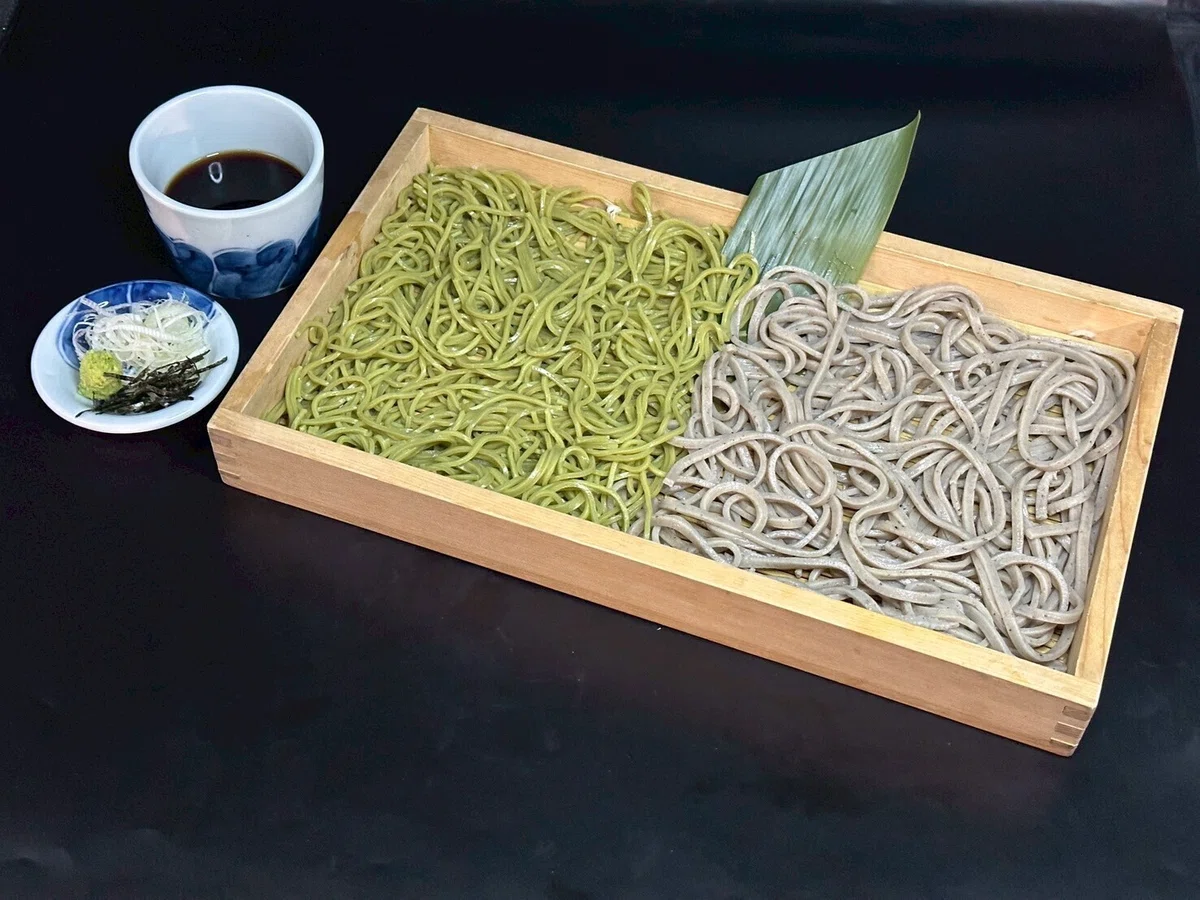
I ordered the Cha-soba and Inaka-soba combination (300 baht).
It took about 10 minutes to arrive—not particularly fast by Bangkok standards.
Yet I felt no impatience.
Rather, the wait felt pleasant. I had no desire to check my phone, content simply to observe the space.
"Sorry to keep you waiting," came a gentle voice as the soba arrived.
The noodles, arranged on a wooden board, were beautiful. Each strand carefully placed. The aroma of the dipping sauce teased my senses.
The first slurp filled my mouth with buckwheat fragrance.
Smooth on the palate, yet slightly sweet when chewed. This was the taste of 100% buckwheat soba.
"There's no need to rush," Kazu-san said softly.
"Please, take your time."
An Antidote to Digital Fatigue
Recently, "Silent Dinners" have gained attention in the West.
Events where conversation is prohibited, allowing diners to simply enjoy their meal in silence. According to Psychology Today, these serve as "an antidote to digital fatigue."
Modern life is saturated with sound.
Phone notifications, social media updates, YouTube, Spotify. Silence has become so rare it feels novel—we've grown too accustomed to constant noise.
"Some customers come alone, say nothing, simply eat their soba and leave," Kazu-san notes.
"And that's perfectly fine. I want this to be that kind of place."
What Nojian cherishes most is "quietness."
An Oasis in Thonglor
For Japanese expats, Bangkok's Thonglor is incredibly convenient.
Japanese restaurants, Japanese supermarkets, clinics with Japanese-speaking staff. Everything you need is here.
But perhaps, in exchange for this convenience, we've lost something.
The time to pause.
"I want Nojian to be an oasis in the city where people can stop and breathe," Kazu-san says.
"In our busy daily lives, even just 30 minutes—to eat soba quietly and connect with yourself."
Thoughtfulness in Understated Service
Nojian's service is deliberately understated.
Staff speak only when necessary. Water is refilled quietly, discreetly.
"We aim for the service level of a high-end Japanese ryotei," Kazu-san explains.
"Omotenashi isn't about imposing. It's about offering a gentle hand exactly when the customer needs it. That's true service."
Indeed, I noticed my water glass was full without realizing when it had been refilled.
The service was that seamless.
A Regular Guest Shares the Appeal
Next to me at the counter sat a Japanese man.
Perhaps in his 50s, wearing a suit, quietly enjoying his soba.
As he was leaving, he shared a few words.
"I come here twice a week. Why? Because it's quiet."
Sato-san (pseudonym) is an expat working for a company in Thonglor.
"Work is hectic—I'm talking to people all day. At night, I want to eat in peace. This is the only place where I can do that."
He always comes alone.
"I eat out with my family at other restaurants. But I need time alone too. This is that place. Though next time, I'm thinking of bringing my family. I want them to experience what makes this place special."
Why This Commitment to Quietness?
At the end of our interview, I asked Kazu-san one final question.
"Why are you so committed to this quietness?"
He paused before answering.
"When I was in Japan, I was busy every day, and my spirit was exhausted. One day, I stepped into a small soba shop in Kyoto."
That shop was quiet, just like Nojian.
"While eating soba, I didn't have to think about anything. I could just focus on the taste. That time truly saved me."
Kazu-san never forgot that experience.
"When I decided to open in Bangkok, I wanted to provide that same sense of peace I felt then."
A Quiet Soba Shop Surviving in the City
Bangkok's restaurant industry is fiercely competitive.
Flashy establishments, Instagram-worthy spots, budget-friendly options—these are what draw attention.
But Nojian chose a different path.
"I don't think we need to rank first on Google," Kazu-san says with a smile.
"Even if we don't show up in searches, people who truly need this place will find us through word of mouth. That's enough."
Indeed, most of Nojian's regular customers arrived through recommendations from friends.
"There's a quiet soba place you should try."
One sentence is all it takes.
A Place Where Time Stands Still
After the interview, I stepped back into Thonglor's chaos.
Motorcycle engines, food aromas, voices of people.
Yet strangely, my mind felt calm.
Just 30 minutes of silence had given me something.
"I want to come back."
Restaurants that inspire this feeling are rarer than you'd think.
Nojian is a small oasis in the city.
A place where time stands still.
A place where you can face yourself.
のじ庵(Nijian)は、バンコク・トンローにある本格十割そばと一品料理のお店です。
山形産有名そば品種をタイ・チェンライで自家栽培・収穫し、つなぎを一切使わない健康的な十割そばを提供しています。
