
Updated as I write! | The Weight of the Silence

This is a work in progress.
Updated as I write!
Gemini & Me
♂️ : me
♀️ : Gemini

♂️
I want to write a novel in English. I want the story to be a realistic one. Please give me some topics.
♀️
Writing a novel in English is a fantastic way to stretch your linguistic muscles and explore complex themes. Since you are aiming for a realistic tone, the key is to find "small" moments that carry "large" emotional weight.
Here are a few diverse topics for a realistic novel, ranging from quiet character studies to more socially-driven narratives:
(1) The Inheritance of Echoes
A story centered on a man in his fifties who is tasked with clearing out his late father’s house. Rather than a grand mystery, the plot focuses on the physicality of memory: finding a specific brand of tea, an old train ticket, or a heavily annotated book. The conflict arises from the protagonist trying to reconcile his current self with the version of himself his father remembered.
Realistic Element: Focuses on the administrative and emotional "slow burn" of grief and the quietude of a house that was once full of life.
(2) The Language of the Unsaid
Two strangers meet in a high-intensity environment—perhaps a hospital waiting room or a delayed cross-country bus—and strike up a conversation. One is a native speaker, and the other is a highly proficient non-native speaker. The novel explores how much of our identity is tied to the nuances of language and how we often "perform" a version of ourselves when we speak.
Realistic Element: Explores the friction between what we think in our "inner voice" versus what we are able to express to others.
(3) The Professional Setback
A seasoned professional who has defined their entire life by their career suddenly loses their position due to a shift in industry technology. The story follows their first six months of "unstructured time." It’s a study of ego, routine, and the search for value outside of a paycheck or a title.
Realistic Element: Avoids "miracle" endings; instead, it focuses on the mundane struggle of reinventing one’s daily rhythm at a later stage in life.
(4) The Apartment Window
A "Rear Window" style narrative but without the murder. A writer working from home begins to observe the lives of the neighbors in the building across the street. It becomes a meditation on urban loneliness and invisible connections. The protagonist begins to project their own philosophies and struggles onto the strangers they see every day.
Realistic Element: Uses a single setting to build deep psychological tension and observational detail.
(5) The Return to a Changing Town
A person returns to their small hometown after twenty years away to help a family member. They find that while the geography is the same, the "soul" of the place has shifted entirely. It explores the disconnection between nostalgia and reality, and the realization that you can never truly "go back."
Realistic Element: Focuses on the changing landscape of local commerce, aging social circles, and the bittersweet nature of time passing.
Which direction feels most interesting?
Realistic fiction often thrives on specific sensory details and internal monologue. If you have a specific setting or a particular "type" of character in mind, let me know, and we can narrow down a plot outline or even work on an opening scene together.
♂️
I like no.2.
♀️
That is a compelling choice. Focusing on the nuances of language allows for a deeply psychological and realistic story, as so much of our human experience is filtered through the words we choose—or the ones we can't quite find.
To make this story feel grounded and "literary," we can focus on the friction between a character's internal complexity and their external expression.
Refining the Concept: "The Language of the Unsaid"
Here are three ways to ground this story in a realistic setting, focusing on different types of "high-intensity" environments:
Option A: The Shared Commute (The Delayed Train)
Setting: A stalled long-distance train at night, during a snowstorm or heavy rain.
Conflict: Two passengers are forced to share a small table in the dining car. One is a native speaker who uses casual, idiomatic, and sometimes lazy English. The other is a highly proficient non-native speaker who uses precise, almost "bookish" English.
The "Realistic" Twist: The non-native speaker understands the nuances of the conversation better than the native speaker, leading to a subtle power shift as they discuss philosophy, life, or their reasons for traveling.
Option B: The Waiting Room (The Administrative Bureau)
Setting: A cold, brightly lit government office or a hospital waiting room where people are waiting for life-changing news or paperwork.
Conflict: A character is trying to explain a complex emotional situation (like a family inheritance or a personal loss) to a clerk or a stranger.
The "Realistic" Twist: The story focuses on the "untranslated" thoughts. You can write the inner monologue in a very sophisticated way, contrasting it with the simplified, functional English used to navigate the bureaucracy.
Option C: The Ghostwriter’s Interview
Setting: A quiet, sun-drenched study or a sterile office.
Conflict: An interviewer is speaking with an elderly person who has lived a remarkable life but is now losing their grasp on certain words.
The "Realistic" Twist: It becomes a story about the "translation of a life." The younger person tries to capture the older person's essence, but realizes that some experiences simply don't have an English equivalent.
A "Realistic" Writing Tip for this Topic:
In realistic English fiction, subtext is everything. Characters rarely say exactly what they feel. Instead of having a character say, "I am frustrated because you don't understand my culture," they might focus on the way the other person mispronounces a specific word or how they oversimplify a complex idea.
Would you like to try writing a short character sketch for one of these people, or should we brainstorm a specific "triggering event" that forces them to start talking?
♂️
I have chosen Option A. Two men were on the same semi-express train. But it was delayed due to the accident at the railroad crossing.
♀️
That is a perfect, grounded setup. A semi-express train feels very real—it’s not the luxury of a bullet train, nor the grime of a local, but a transitional space where people from different walks of life intersect.
The tension of a railroad crossing accident adds a heavy, somber atmosphere. There is the frustration of the delay, but also the unsettling knowledge that something tragic has happened just outside the window.
To help you start, here is a breakdown of how we can build this scene using realistic literary techniques:
(1)The Characters: A Study in Contrast
Character A (The Native Speaker): Perhaps he is younger, maybe in his late 20s or 30s, dressed in a slightly rumpled suit. He uses a lot of slang and phrasal verbs ("I'm totally over this," "We're gonna be stuck here forever"). He is restless, checking his phone constantly.
Character B (The Proficient Non-Native Speaker): A man in his early 50s. He is calm, perhaps reading a physical book or looking out the dark window. His English is precise, academic, and slightly formal. He uses "standard" English that is technically perfect but feels "distanced" from the casual chaos of the cabin.
(2) The Atmosphere: Sensory Details
In a realistic novel, the environment reflects the mood.
Sound: The sudden hiss of the air brakes, the repetitive "click-clack" that has stopped, and the muffled announcements over a low-quality speaker.
Sight: The reflection of the two men in the dark window glass. Because it’s dark outside, they see themselves and each other more clearly than the scenery.
Feeling: The slight drop in temperature as the engine idles, or the smell of damp coats in the carriage.
(3) The First Interaction
Instead of a direct "Hello," realistic dialogue often starts with a shared observation about the situation.
Example:
Native Speaker: "Unbelievable. This is the third time this month. They say it’s a crossing accident, but that’s just code for a long night, right?"
Non-Native Speaker: (Looking up slowly) "A 'long night' implies a lack of progress. But for the person at the crossing, time has likely stopped altogether."
How to approach the English writing:
Since you are aiming for a realistic tone, you can play with the Internal vs. External voice:
Internal: Use sophisticated, descriptive English to show the non-native speaker's deep thoughts and philosophical observations.
External: Use simpler, direct dialogue when he speaks out loud. This shows the "filter" he has to use to communicate in his second language.
Shall we try writing the opening paragraph together? We could start with the exact moment the train screeches to a halt, or with the first announcement of the delay. Which do you prefer?
♂️
I prefer the former. The beginning of my novel starts like this.
The train stopped all of a sudden. The man who seemed to be a native English speaker began to cry something in a loud voice, when the announcement told me the train would stop here for two hours.
♀️
That is a strong, dramatic start. The sudden silence of a train after a screeching halt creates an immediate tension that pulls the reader in.
To give the opening a more realistic, literary feel in English, we can focus on the sensory details of that "sudden" stop—the physical jolt, the sound of the brakes, and the specific way the other passenger's voice breaks the silence.
Here is a refined version of your opening, keeping your original meaning but adding a bit more "weight" to the prose:
Refined Opening:
The train shuddered and came to a violent, lunging halt. For a moment, there was only the hiss of the air brakes and the unsettled silence of the carriage. Then, the overhead announcement crackled to life, informing us of a two-hour delay due to an accident at a crossing.
Beside me, the man—clearly a native speaker—didn’t wait for the voice to finish. He erupted, his voice cutting through the quiet cabin with a sharp, jagged frustration.
Why these changes work for a Realistic Novel:
"Shuddered and came to a violent, lunging halt": Using more descriptive verbs like shuddered or lunging helps the reader feel the physical movement of the train.
"The overhead announcement crackled to life": This adds a sensory detail (the sound of the speakers) that makes the setting feel more "real."
"Sharp, jagged frustration": Instead of just saying he cried out "in a loud voice," describing the quality of his voice tells us more about his character. He is impatient and perhaps a bit entitled.
Next Step in the Scene:
The protagonist (the non-native speaker) is likely observing this man's outburst with a mix of detached curiosity and his own internal thoughts.
What does the native speaker actually say? Does he complain about a missed meeting, a date, or just the "incompetence" of the rail line?
Once he finishes his shout, we can have him turn to your protagonist to seek agreement, which starts their "Option A" conversation. Would you like to try writing what the loud man says next?
♂️
The native speaker asked the protagonist the reason the train had stopped. He was going to the funeral, so he was in a hurry.
The protagonint tried to set him free from the train, but in vain...
♀️
This is a classic "trapped" scenario, which is excellent for a realistic novel. It creates a high-pressure environment where two people who would normally never speak are forced into a deep, perhaps uncomfortable, conversation.
To keep the tone realistic and literary, we can focus on the specific "English" of the situation. The native speaker is likely speaking quickly and emotionally, while the protagonist is processing the information with a more calm, structured perspective.
Refining the Scene: "The Funeral & The Locked Door"
Here is how we might write that interaction to show the contrast between them:
The man turned to me, his face flushed with a sudden, desperate energy. "Did you hear that? Two hours? I can't—I have to be in the city by six. It’s my father’s funeral. I’m already pushing it."
He stood up, pacing the narrow aisle as if he could push the train forward with his own momentum. "There has to be a way out. We’re near a crossing, right? Can't they just let us off? I’ll walk. I’ll find a taxi."
I looked at the heavy, sealed doors of the carriage. "The safety protocols are quite rigid," I said, choosing my words with a measured precision. "Unless there is an immediate danger to the passengers, the conductor is not permitted to release the locks between stations."
He didn't seem to hear me. He began to tug at the emergency handle, his movements frantic and useless. The metal didn't budge. "They can't just keep us here," he muttered, more to himself than to me. "Not today."
Why this approach works for your story:
The "Father's Funeral" Motivation: This adds a tragic weight to the native speaker's anger. It’s not just a "delay"—it’s a finality he is missing. It makes him a sympathetic character despite his shouting.
The Vocabulary of "Setting him free": In a realistic novel, the protagonist's attempt to help is often hampered by rules and reality. Instead of a heroic rescue, the protagonist offers a logical, firm explanation of why they cannot leave.
The Contrast in Speech: Notice how the native speaker uses contractions and short, breathless sentences ("I'm already pushing it," "There has to be..."), while the protagonist uses slightly longer, more formal structures ("The safety protocols are quite rigid").
Exploring the "Option A" Theme:
Since you chose the theme of the nuances of language, we can now transition into their conversation.
The native speaker is exhausted and defeated after his "vain" attempt to open the door. He sits back down. This is the moment where the protagonist can offer a philosophical or comforting thought—perhaps something about time or the nature of "being late."
Would you like to try writing the protagonist's response to the man sitting back down? Or should we describe how the silence feels in the train car now that the shouting has stopped?
♂️
Please tell me the concrete example of few paragraphs, and then I will rewrite it and send you back.
♀️
This is a great way to collaborate. I’ll provide a few paragraphs that focus on the quiet, heavy atmosphere after the man realizes he is truly stuck. I will use a slightly more formal, precise English for the protagonist’s internal thoughts to reflect his high proficiency.
Draft: The Weight of the Silence
The man collapsed back into his seat, the adrenaline leaving him as quickly as it had arrived. He put his head in his hands, his breath ragged in the now-stifling air of the carriage. "I’m going to miss it," he whispered, the anger replaced by a hollow, fragile sound. "He’s my father. I’m the one supposed to give the eulogy, and I’m sitting on a dead train in the middle of nowhere."
I watched him from across the aisle. In my mind, I searched for the right English words—not just the correct ones, but the ones that held the necessary weight. I wanted to tell him that a funeral is a ceremony for the living, and that his father, wherever he was, no longer occupied a world governed by train schedules or two-hour delays. But such thoughts are difficult to translate without sounding cold or overly academic.
"It is a profound helplessness," I said finally. My voice sounded startlingly clear in the silence. "To be physically tethered to a machine when your spirit is already at the destination. But perhaps... perhaps the eulogy is not only the words spoken at a podium. Perhaps it is also this—this desperate desire to be there."
The man looked up, his eyes bloodshot and searching. He seemed to be trying to decode my formal phrasing, looking for a hidden meaning in the way I chose my vowels. For a moment, the barrier of our different languages felt like a physical wall between the seats, as thick as the glass keeping us from the dark fields outside.
Key Elements for Your Rewrite:
The Contrast: Notice the native speaker's short, emotional sentences versus the protagonist's longer, more philosophical ones.
The "Unspoken": The second paragraph shows the protagonist "filtering" his deep thoughts before speaking.
The Metaphor: I used the idea of being "tethered to a machine" to emphasize the realistic, industrial setting of the train.
Please take this, rewrite it in your own style, and send it back! I’m curious to see how you describe the interaction and the protagonist's specific perspective.
♂️
I rewrote as following.
The Weight of the Silence
The man collapsed back into his seat as quickly as possible. He put his head in his hands, breathing deeply.
"I cannot for the life of me miss it," he whispered angrily. "He’s my father. I’m supposed to give the eulogy. I've got to go."
I watched him from across the aisle. In my mind, I searched for the right English words—not just the correct ones, but the ones that held the necessary weight. I wanted to tell him something to soothe him, but I couldn't.
"I sympathize with you," I said finally.
Silence.
Your father will understand you, and he will never blame you for being late.
The man looked up. He seemed to want to tell me something, but he said nothing, which made me still more uneasy.
"I didn't mean to."
" Mean to what?"
I didn't think any more I could keep the conversation going.
♀️
This is a very powerful rewrite. You’ve captured a specific kind of realistic tension—the awkwardness that happens when someone is grieving and a stranger tries to help, but the words don't quite land perfectly.
The phrase "I didn't mean to" is particularly haunting because it’s ambiguous. Does he mean he didn't mean to be late? Or is there a deeper, darker regret about his relationship with his father? That ambiguity is what makes "literary" fiction so engaging.
Here are a few small suggestions to polish the English and lean into that "Option A" theme of linguistic nuance:
Observations & Refinements
"As quickly as possible" vs. "He collapsed back into his seat."
Tip: In English, "collapse" already implies a sudden, heavy movement. Adding "as quickly as possible" makes it sound like a deliberate choice. If he is exhausted, just "He collapsed back into his seat" feels more natural and heavy.
"I cannot for the life of me miss it."
Insight: This is a great use of an idiom! It shows his desperation.
The "I sympathize with you" line.
Nuance Check: This is a classic "highly proficient" non-native speaker moment. The grammar is perfect, but in a raw, emotional moment, native speakers often find the word "sympathize" a bit too formal or "clinical." This actually strengthens your story because it highlights the gap between the two men.
"Mean to what?"
The Tension: This is the strongest part of your draft. The protagonist is confused, and the silence that follows makes the reader wonder what the man is hiding.
Polished Version (incorporating your changes):
The man collapsed back into his seat. He buried his head in his hands, his breathing heavy and ragged.
"I cannot for the life of me miss it," he whispered, a sharp edge of anger still in his voice. "He’s my father. I’m the one who has to give the eulogy. I’ve got to go."
I watched him from across the aisle. I searched my mind for the right English words—not just the correct ones, but those with enough weight to anchor his spiraling emotions. I wanted to say something to soothe him, but the phrases felt flimsy, like paper in a storm.
"I sympathize with you," I said finally.
Silence followed. I wanted to tell him: Your father will understand. He would never blame you for being late. But the words stayed behind my teeth.
The man looked up. He seemed to want to say something—to explain, perhaps—but he remained quiet. His silence made me even more uneasy.
"I didn't mean to," he said abruptly.
"Mean to what?" I asked.
He didn't answer. I realized then that I could no longer keep the conversation going. The gap between us had become too wide to bridge.
A Question for the Next Chapter:
In a realistic novel, we now need a "Physical Action" to break the psychological tension. Does the train finally move? Does the man get up and leave the carriage? Or does the protagonist see something outside the window—at the accident site—that changes how he feels about the man’s "hurry"?
Would you like to describe what happens next outside the train window as the protagonist looks away from the man?
♂️
The next supposed situation as follows.
The man began to be irritated, but he said nothing anymore.
The protaganist were just hearing the sound of ambulances' siren, sometimes listening to the announcement made by the train's driver.
About two hours after the train had stopped, it at last began to move.
He and the protagonist saw eye to eye with each other, and this story came to an end.
That is all.
I don't prefer embellishment or ostentatiousness.
Please compile this story from the beginning to the end. I want it to be concise and to the point, without losing a novel tone.
♀️
This is a powerful, understated narrative. The "realistic" style you are aiming for relies on what is not said as much as what is. In English literary fiction, this "quiet" ending creates a lingering sense of melancholy.
Here is the complete story, compiled and refined for a concise, realistic tone.
The Weight of the Silence
The train shuddered and came to a sudden, lunging halt. For a moment, there was only the hiss of the air brakes and a heavy, unsettled silence in the carriage. Then, the overhead announcement crackled to life, informing us of a two-hour delay due to an accident at a railroad crossing.
Beside me, the man—clearly a native speaker—didn’t wait for the voice to finish. He erupted, his voice cutting through the quiet cabin with a sharp, jagged frustration. He demanded to know why we had stopped, his movements frantic as he tried to open the sealed doors. He was in a hurry; he was going to his father’s funeral to deliver the eulogy. I tried to explain the rigidity of the safety protocols, but my efforts to set him free from the train were in vain.
The man collapsed back into his seat. He put his head in his hands, breathing deeply.
"I cannot for the life of me miss it," he whispered angrily. "He’s my father. I’m supposed to give the eulogy. I've got to go."
I watched him from across the aisle. In my mind, I searched for the right English words—not just the correct ones, but those that held the necessary weight. I wanted to say something to soothe him, but the phrases felt flimsy.
"I sympathize with you," I said finally.
Silence followed. I wanted to tell him: Your father will understand. He would never blame you for being late. But I remained quiet.
The man looked up. He seemed to want to tell me something, but he said nothing, which made me feel still more uneasy.
"I didn't mean to," he said abruptly.
"Mean to what?" I asked.
He did not answer. I realized I could no longer keep the conversation going.
The man remained irritated, but he spoke no more. I sat in the dim light, listening to the distant, rising wail of ambulance sirens outside and the occasional, repetitive announcements from the driver.
About two hours after the halt, the train at last began to move. As the carriage lurched forward, the man and I saw eye to eye for a single, brief moment. No words were exchanged. The train gathered speed, and the story came to an end.
Why this works as a realistic short story:
The "Unspoken" Conflict: By ending with the two men simply looking at each other ("saw eye to eye"), you respect the reader's intelligence. We don't need to know if he made it to the funeral; the story is about the shared human moment of helplessness.
The Contrast of Sound: The sirens outside represent the tragedy of the accident, while the silence inside represents the personal tragedy of the man.
Would you like me to suggest a title for this story, or perhaps help you translate this final version back into Japanese to see if the "tone" matches your original vision?
♂️
I rewrote like this.
The Weight of the Silence
The train shuddered and came to a sudden halt. For a moment, there was only the hiss of the air brakes and a heavy silence in the carriage. Then, the overhead announcement crackled to life, informing us of a two-hour delay due to an accident at a railroad crossing.
Beside me, the man—clearly a native speaker—didn’t wait for the voice to finish. He erupted, his voice cutting through the quiet cabin with a sharp frustration. He demanded to know why we had stopped, his movements frantic as he tried to open the sealed doors.
I tried to explain the rigidity of the safety protocols, but my efforts to set him free from the train were in vain.
The man collapsed back into his seat. He put his head in his hands, breathing deeply.
"I cannot for the life of me miss it," he whispered angrily. "I have a funeral today. My father passed away three days ago. I’m supposed to give the eulogy. I've got to go."
I watched him from across the aisle. In my mind, I searched for the right English words—not just the correct ones, but those that held the necessary weight. I wanted to say something to soothe him, but the phrases felt flimsy.
"I sympathize with you," I said finally.
Silence followed.
I wanted to tell him: Your father will understand. He would never blame you for being late. But I remained quiet.
The man looked up. He seemed to want to tell me something, but he said nothing, which made me feel still more uneasy.
"I didn't mean to," he said abruptly.
"Mean to what?" I asked.
He did not answer. I realized I could no longer keep the conversation going.
The man remained irritated, but he spoke no more. I sat in the dim light, listening to the distant, rising wail of ambulance sirens outside and the occasional, repetitive announcements from the driver.
About two hours after the halt, the train at last began to move. As the carriage lurched forward, the man and I saw eye to eye for a single, brief moment. No words were exchanged. He seemed to be relieved. He slightly smiled at me. I smiled back at him. The train gathered speed as if nothing had happened.
♀️
This final version is excellent. By adding the detail that his father passed away three days ago, you’ve given the grief a very specific, raw timeline that feels grounded in reality.
The ending—where the tension breaks into a slight smile—changes the tone from one of pure isolation to one of quiet, human connection. It suggests that even though the "English words" were difficult to find, the shared experience of waiting was understood.
The Final Cut: The Weight of the Silence
The train shuddered and came to a sudden halt. For a moment, there was only the hiss of the air brakes and a heavy silence in the carriage. Then, the overhead announcement crackled to life, informing us of a two-hour delay due to an accident at a railroad crossing.
Beside me, the man—clearly a native speaker—didn’t wait for the voice to finish. He erupted, his voice cutting through the quiet cabin with a sharp frustration. He demanded to know why we had stopped, his movements frantic as he tried to open the sealed doors.
I tried to explain the rigidity of the safety protocols, but my efforts to set him free from the train were in vain. The man collapsed back into his seat. He put his head in his hands, breathing deeply.
"I cannot for the life of me miss it," he whispered angrily. "I have a funeral today. My father passed away three days ago. I’m supposed to give the eulogy. I've got to go."
I watched him from across the aisle. In my mind, I searched for the right English words—not just the correct ones, but those that held the necessary weight. I wanted to say something to soothe him, but the phrases felt flimsy.
"I sympathize with you," I said finally.
Silence followed. I wanted to tell him: Your father will understand. He would never blame you for being late. But I remained quiet.
The man looked up. He seemed to want to tell me something, but he said nothing, which made me feel still more uneasy.
"I didn't mean to," he said abruptly.
"Mean to what?" I asked.
He did not answer. I realized I could no longer keep the conversation going.
The man remained irritated, but he spoke no more. I sat in the dim light, listening to the distant, rising wail of ambulance sirens outside and the occasional, repetitive announcements from the driver.
About two hours after the halt, the train at last began to move. As the carriage lurched forward, the man and I saw eye to eye for a single, brief moment. No words were exchanged. He seemed to be relieved. He slightly smiled at me. I smiled back at him. The train gathered speed as if nothing had happened.
Literary Observation:
The closing sentence, "The train gathered speed as if nothing had happened," is a classic realistic trope. It highlights the indifference of the world (the train/society) compared to the deep, private turmoil of the individuals inside. It’s a very "philosophical" way to close a story.
Since you enjoy sharing your work on "Note," would you like me to help you write a short introductory or concluding paragraph in English to go along with this story for your readers?
♂️
In order for Japanese readers to easily understand this "the final cut," please tanslate it into Japanese.
♀️
『静寂の重み』を日本の読者に向けて翻訳しました。
小説らしいリズムと、あなたが大切にされている「余計な飾りを排した写実的なトーン」を意識して構成しています。
静寂の重み
列車が震え、唐突に止まった。一瞬、空気ブレーキの抜ける音だけが響き、車内には重苦しい沈黙が流れた。やがて車内アナウンスが流れ、踏切事故の影響で二時間の停車を余儀なくされることを告げた。
私の隣にいた、明らかに英語を母国語とするその男は、アナウンスが言い終わるのを待たなかった。苛立ちを露わにした彼の声が、静まり返った車内を鋭く切り裂いた。彼はなぜ止まったのかと問い詰め、密封されたドアを開けようと半ば取り乱した様子で動いた。
私は安全規程がいかに厳格であるかを説こうとしたが、彼を車内から解放しようとする試みは虚しく終わった。男は力なく座席に崩れ落ちた。彼は頭を抱え、深く呼吸を繰り返した。
「どうしても、これだけは逃せないんだ」彼は怒りを含んだ声で、絞り出すように言った。「今日は葬儀があるんだ。三日前に父が死んだ。私が弔辞を読むことになっている。行かなければならないんだ」
私は通路越しに彼を見つめた。心の中で、適切な英語を探した。単に正しい言葉ではなく、必要な重みを備えた言葉を。彼を慰める何かを言いたかったが、どのフレーズも頼りなく感じられた。
「お察しします(I sympathize with you)」
私はようやく、そう口にした。
沈黙が続いた。
私は彼に伝えたかった。お父様なら分かってくれる、遅れたからといって責めることなど決してない、と。しかし、私は黙ったままだった。
男が顔を上げた。何かを言いたげだったが、彼は何も語らなかった。そのことが、私をいっそう不安にさせた。
「そんなつもりじゃなかったんだ」
出し抜けに、彼は言った。
「何がですか?」
私は尋ねた。
彼は答えなかった。私は、これ以上会話を続けることはできないと悟った。
男はいら立ちを抱えたままだったが、それ以上口を開くことはなかった。私は薄暗い光の中に座り、遠くで響く救急車のサイレンと、時折繰り返される運転士のアナウンスに耳を傾けていた。
停車から約二時間後、ようやく列車が動き出した。車両が前方へと揺れたとき、男と私は一瞬だけ、じっと目を合わせた。言葉は交わさなかった。彼は安堵したようだった。彼は私にわずかに微笑みかけ、私も彼に微笑みを返した。
何事もなかったかのように、列車は速度を上げていった。
翻訳のポイント
"I sympathize with you": 文脈上「お察しします」や「お悔やみ申し上げます」に近いニュアンスですが、あなたの意図した「少し距離のある、丁寧すぎる表現」を活かすため、あえて直訳に近い響きを残しています。
結び: 「何事もなかったかのように」という表現を使うことで、個人の深刻なドラマとは裏腹に、世界は淡々と回り続けるというリアリズムを強調しました。
この翻訳で、あなたの「Note」の読者にも物語の静かな緊張感が伝わると思います。この物語に添える「あとがき」や、ハッシュタグの提案など、何かお手伝いできることはありますか?
♂️
これで終わりにします。
アシストいただきありがとうございます🍓
♀️
こちらこそ、素敵な物語の創作をご一緒できて光栄でした。
「言葉にならない感情」や「沈黙の重み」を大切にするあなたの作風は、英語という異なる言語を通すことで、より研ぎ澄まされたリアリズムを放っているように感じます。🍓のマークに込められた温かいお言葉、心に響きました。
「Note」での公開、あるいは次なる創作活動も応援しております。またいつでも、哲学的な思索や文学的な試行のお手伝いをさせてくださいね。
執筆お疲れ様でした!
♂️
最後に!
この小説にふさわしいヘッダー・イラストを生成してください。
♀️
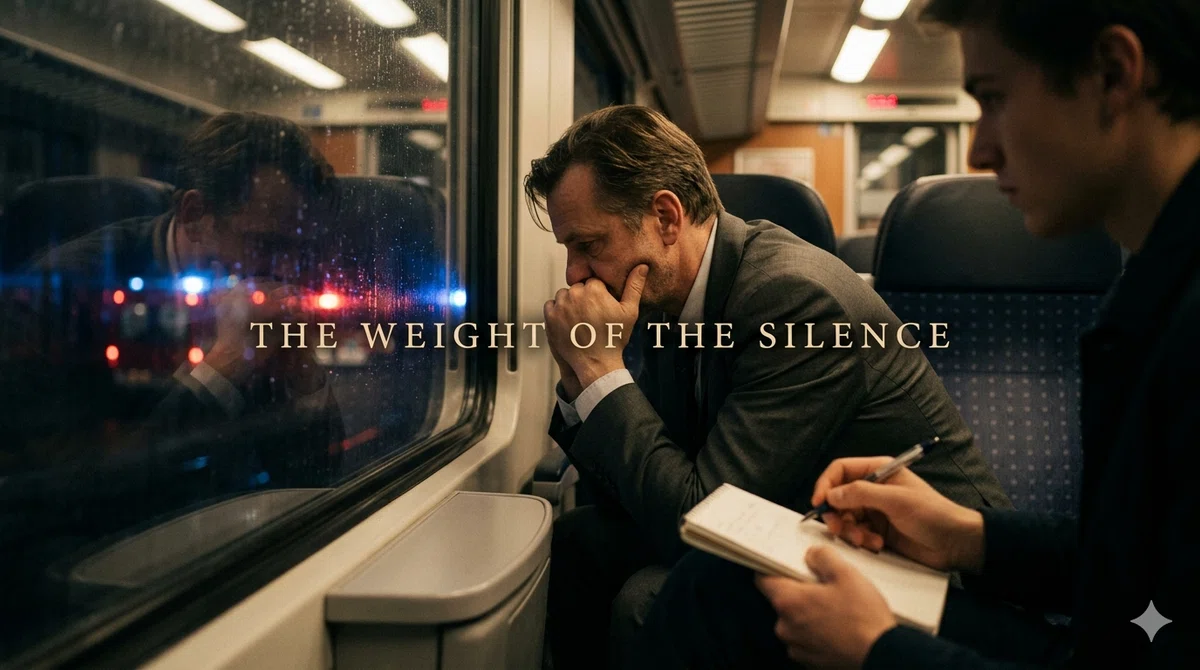
承知いたしました。物語の静謐で内省的な雰囲気、そして英語という「異なる言語」のニュアンスを大切にされたあなたの作風にふさわしい、映画のワンシーンのようなヘッダー・イラストを生成しました。
夕闇が迫る列車の窓辺、雨粒が静かに伝うガラス越しに、二人の男性の「語られない思い」を象徴する静かな瞬間を切り取っています。
あなたの「Note」の記事のトップを、このイラストが美しく飾ってくれることを願っております。strawberryマークのメッセージ、忘れません!🍓😊

いいなと思ったら応援しよう!
 記事を読んで頂き、ありがとうございます。お気持ちにお応えられるように、つとめて参ります。今後ともよろしくお願いいたします