【5本目】 孤独を感じさせるニューロンと他人との接触 (Nature, 2025) 【論文の要約100本ノック】

論文の要約を考えながら翻訳します。
自分で理解しながらの意訳になります。
わからない用語は調べて付け加えます。
■ 基本情報
論文情報・著者等
・Ding Liu(Department of Molecular and Cellular Biology, Howard Hughes Medical Institute, Center for Brain Science, Harvard University, Cambridge, MA, USA)
・Nature volume 640, pages 1000–1010 (2025)
キーワード
孤立、社会的復帰、視床下部、視索前核
■要約
背景 Background
Social grouping increases survival in many species, including humans1,2. By contrast, social isolation generates an aversive state (‘loneliness’) that motivates social seeking and heightens social interaction upon reunion3,4,5.
グループをつくるというのは生存率を上げるための戦略で、それは人を含む多くの種で見られる。一方、孤立(isolation)すると不快な感情(孤独感)が生まれ、これが社会的なつながりを求めさせる力となる。
The observed rebound in social interaction triggered by isolation suggests a homeostatic process underlying the control of social need, similar to physiological drives such as hunger, thirst or sleep3,6.
孤立後の社会的関係の回復は、社会的欲求を裏打ちする恒常的プロセスの存在を示唆している。それは、飢えや喉の渇き、睡眠のような生理的欲求のようなものである。
・正直よくわからなかった。
方法 Methodology
In this study, we assessed social responses in several mouse strains, among which FVB/NJ mice emerged as highly, and C57BL/6J mice as moderately, sensitive to social isolation.
本研究では社会的応答を評価するため複数の系統のマウスを用意した。その中で、FVB/NJ mice は孤立に対して高い感受性を示し、C57BL/6J mice の感受性低めである。
結果 Results
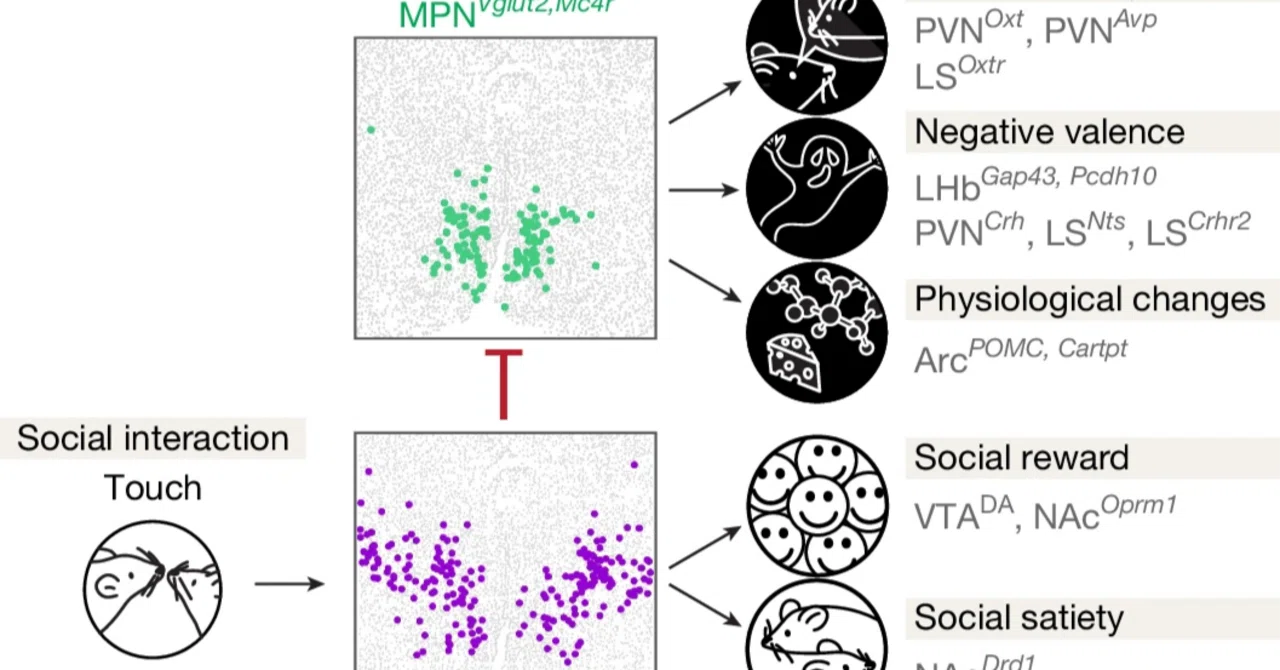
Using both strains, we uncovered two previously uncharacterized neuronal populations in the hypothalamic preoptic nucleus that are activated during either social isolation or social rebound and orchestrate the behaviour display of social need and social satiety, respectively.
本研究では、視床下部の視索前核にある新たな二つの神経集団を同定した。一方の神経は孤立した時に活性化し、もう一方は社会復帰(social rebound)した時に活性化する。
We identified direct connectivity between these two populations and with brain areas associated with social behaviour, emotional state, reward and physiological needs and showed that mice require touch to assess the presence of others and fulfil their social need.
この二つの神経集団の間で直接の結合も確認された。そして、これらと社会行動(social behaviour)、情動、報酬そして生理的欲求に関わる脳部位との関連も示唆された。また、他個体の存在を触って知ることが社会的欲求を満たすために必要だ。
結論 Conclusion
These data show a brain-wide neural system underlying social homeostasis and provide significant mechanistic insights into the nature and function of circuits controlling instinctive social need and for the understanding of healthy and diseased brain states associated with social context.
social homeostasis:社会的恒常性(孤独すぎず、過密すぎず適切な社会的関係を保とうとする脳のバランス機構?)
これらのデータは、社会的恒常性を支える脳全体に広がる神経システムの存在を示しており、本能的な社会的欲求を制御する回路の性質と機能、そして社会的文脈に関連する健常および病的な脳状態の理解に対して、重要なメカニズム的知見を提供していると考えられる。
