
女性天皇を巡る議論と「Y染色体説」への批判

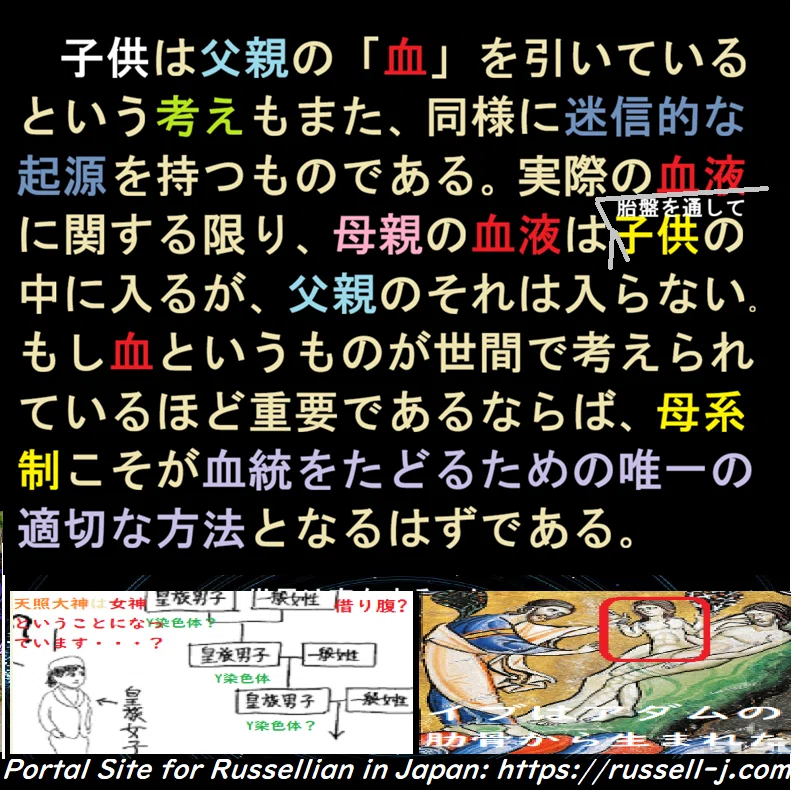
子供は父親の「血」を引いているという考えもまた、同様に迷信的な起源を持つものである。実際の血液に関する限り、母親の血液は子供の中に入るが、父親のそれは入らない。もし血というものが世間で考えられているほど重要であるならば、母系制こそが血統をたどるための唯一の適切な方法となるはずである。(The idea that a child is of his father's "blood" has the same superstitious origin. So far as actual blood is concerned, the mother's enters into the child, but not the father's. If blood were as important as is supposed, matriarchy would be the only proper way of tracing descent.)(Source: Bertrand Russell: Outline of Intellectual Rubbish (1943)
<皇室の構成と皇位継承問題に関する考察>
現在の皇室は、上皇明仁陛下や天皇徳仁陛下を含め、皇族を離れた方々を除くと以下の15名(2024年11月の三笠宮妃百合子殿下薨去後)によって構成されています。
天皇・皇后両陛下(天皇徳仁陛下、皇后雅子さま)
上皇・上皇后両陛下(上皇明仁陛下、上皇后美智子さま)
敬宮(としのみや)愛子内親王殿下
秋篠宮家(秋篠宮文仁親王殿下、同妃紀子さま、佳子内親王殿下、悠仁親王殿下)>
常陸宮家(常陸宮正仁親王殿下、同妃華子さま)
三笠宮家(彬子女王殿下、瑶子女王殿下)
高円宮家(高円宮妃久子さま、承子女王殿下)
女性天皇を巡る議論と「Y染色体説」への批判
歴史上、日本には推古天皇や持統天皇など、8方10代にわたる女性天皇が存在していました。その前例に倣えば、天皇直系である愛子内親王殿下が次期天皇になられることは極めて自然な流れと言えますが、保守層の一部にはこれに強く反対する声があります。
反対派のなかには、歴代の男性天皇が父親から息子へ「Y染色体」を受け継いできたこと(男系継承)を皇統の正統性の根拠とする人々がいます。しかし、この主張は分子生物学や遺伝学の観点から見れば、以下のような多くの矛盾を孕んでいます。
遺伝情報の恣意的な抽出:
人間は父母双方から約50%ずつ核DNAを受け継ぎます。また、ミトコンドリアDNAのように母親からのみ継承される遺伝情報も存在します。膨大な遺伝情報の中で、ごく一部に過ぎないY染色体のみを「天皇の証」として聖域化することは、科学的根拠に基づかない恣意的な選択に過ぎません。
生物学的実態との乖離:
DNAは世代交代の中で常に突然変異を繰り返すものであり、数千年前の先祖と全く同一の染色体を保持し続けることは生物学的に不可能です。
制度と科学の混同:
そもそも皇位継承は憲法や法律に基づく「社会制度」の問題です。特定の染色体の有無という生物学的特徴を根拠に、公的な権利や資格を制限することは、現代の民主主義社会における平等の原則とも相容れません。
結語
日本の立憲君主制がモデルとした英国では、エリザベス女王やヴィクトリア女王など、歴史に名を刻む偉大な女性君主が活躍してきました。現在の英国では性別を問わず直系の長子が継承するルールが確立されています。
国際的な視点や性平等の観点からも、愛子内親王殿下が次期天皇に即位されることに不自然な点は皆無と言えますが、現政権内の慎重論や保守層の抵抗もあり、この問題が円滑に解決へ向かうにはまだ時間がかかりそうです。
An Analysis of the Japanese Imperial Family and the Succession Controversy The current Japanese Imperial Household consists of 15 members (following the passing of Her Imperial Highness Princess Yuriko of Mikasa in November 2024), excluding those who have left the family through marriage or other circumstances. The members include:
The Emperor and Empress (Emperor Naruhito and Empress Masako)
The Emperor Emeritus and Empress Emerita (Akihito and Michiko)
Princess Aiko (The daughter of the current Emperor)
The Akishino Family (Crown Prince Akishino, Crown Princess Kiko, Princess Kako, and Prince Hisahito)
The Hitachi Family (Prince Hitachi and Princess Hanako)
The Mikasa Family (Princess Akiko and Princess Yoko)
The Takamado Family (Princess Hisako and Princess Tsuguko)
The Debate Over Female Emperors and a Critique of the "Y-Chromosome Theory" Historically, Japan has had eight female reigning Emperors (spanning ten reigns), such as Empress Suiko and Empress Jito. Following these precedents, it would be entirely natural for Princess Aiko, the direct child of the current Emperor, to become the next in line. However, there is strong opposition from conservative factions.
Some opponents base their argument on the "Y-chromosome theory," claiming that the legitimacy of the Imperial line depends on a "patrilineal" (male-line) succession that has supposedly passed a specific Y-chromosome from father to son for millennia. From the perspectives of molecular biology and genetics, however, this argument is deeply flawed:
Arbitrary Selection of Genetic Information: Humans inherit approximately 50% of their nuclear DNA from each parent. Furthermore, mitochondrial DNA is inherited exclusively from the mother. To sanctify the Y-chromosome?a tiny fraction of an individual’s total genetic makeup?as the sole "proof" of Imperial legitimacy is a pseudo-scientific choice with no biological justification.
Biological Reality vs. Myth: DNA undergoes constant mutation over generations. It is biologically impossible to maintain a "pure," unchanged chromosome over thousands of years. The idea of an immutable genetic particle is more akin to religious myth than modern science.
Confusion of Social Institutions with Biology: The Imperial succession is a social and legal institution governed by the Constitution and the Imperial House Law. Using biological traits, such as the presence of a specific chromosome, to restrict public rights or eligibility for office is fundamentally incompatible with the principles of equality in a modern democratic society.
Conclusion
The Japanese constitutional monarchy was originally modeled in part after the British system. In the United Kingdom, great female monarchs like Queen Victoria and Queen Elizabeth II left indelible marks on history, and British law now dictates that the first-born child succeeds the throne regardless of gender.
From both an international perspective and the standpoint of gender equality, there is no logical reason why Princess Aiko should not ascend to the throne. Nevertheless, due to the caution of the current administration and resistance from conservative groups, a smooth resolution to this issue remains elusive.
いいなと思ったら応援しよう!
 少額であってもはげみになります。いただいたチップは、コンテンツの質の向上のために使わせていただきます。