
Beyond the Cage of Harmony: Reclaiming Sovereignty in the Age of "Mindfulness" [EN]

When I encountered the Harvard Business Review’s "3-Step Process" for reducing workplace disagreement—which essentially prescribes "working on yourself" to break the cycle of frustration—I felt an immediate, visceral rejection. On the surface, it appears rational, even virtuous. However, in organizations where dissent stagnates at the bottom of the hierarchy (DH2 and below), isn’t this advice merely a mechanism to gaslight logical counterarguments into "emotional tantrums"?
For a worker in a vulnerable position, striving to "manage one's mind" under unreasonable conditions is not an act of resilience; it is a form of self-censorship—a "castration of intelligence" designed to push through the impossible. What is marketed as "inner peace" is often just a manual for the "Perfect Victim," stripping individuals of their sovereignty in the name of professional harmony.
We must recognize that the "cage called idealism" conceals the despair on the ground. When we eliminate conflict, we lose the vital energy generated when opposing Logos collide. To avoid disagreement is to throw away the very opportunities for creation. It is time to stop polishing the bars of the cage and start reclaiming our sovereignty.
Having fewer disagreements at work starts with working on yourself, breaking a cycle of frustration, stress, and conflict. https://t.co/7BG7Ffo8fC
— Harvard Business Review (@HarvardBiz) January 22, 2026
A 3-Step Process to Break a Cycle of Frustration, Stress, and Fighting at Work
A cage called idealism conceals the despair on the ground.
In organizations where dissent stagnates at the bottom of the hierarchy (DH2 and below), the prescription of mindfulness is meaningless. Attention honed in the absence of logic only serves to highlight incoming malice.
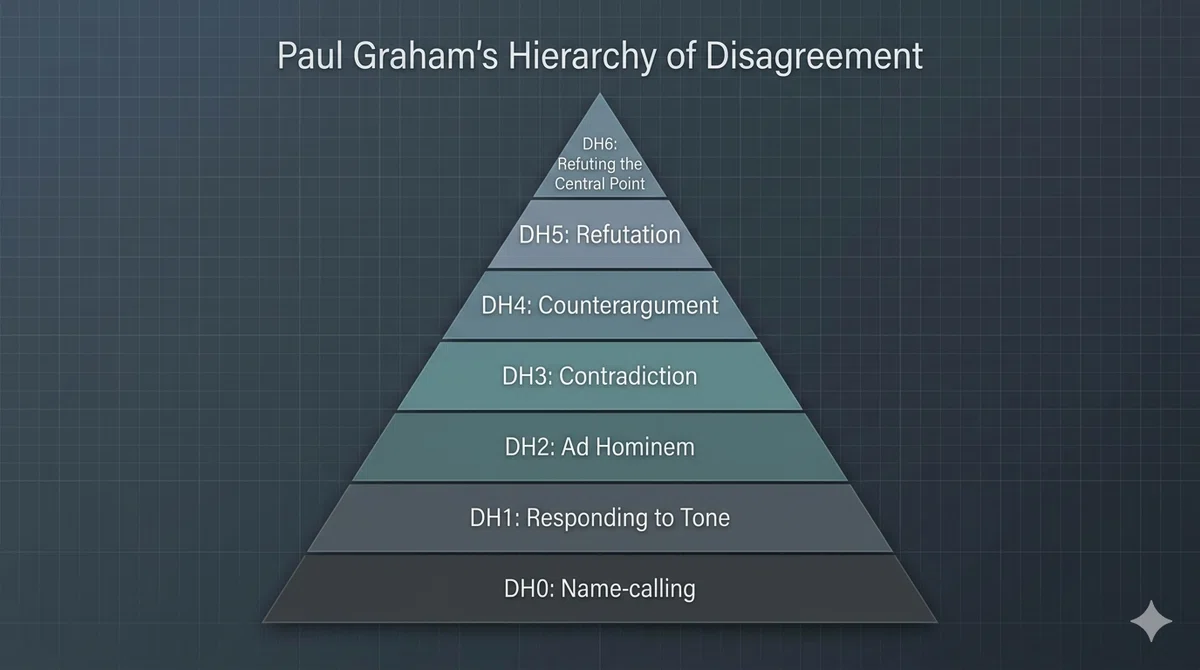
Hierarchy of Disagreement
To measure the quality of communication within an organization, I would like to refer to the "Hierarchy of Disagreement" proposed by Paul Graham.
DH2: Ad Hominem
This level involves shifting the focus away from the actual argument to attack the speaker's traits, character, or past background.
DH1: Responding to Tone (Tone Policing)
Rather than addressing the validity of the content, this stage seeks to silence dissent by criticizing the speaker's mannerisms—such as claiming their "tone is too harsh" or their "attitude is insolent."
DH0: Name-calling
Simple insults or verbal abuse lacking any logical foundation.
Promoting "courage" without healthy soil is just another name for exploitation. Reclaim your sovereignty. Leaving barren soil is also an aesthetic of intelligence.
The "3-Step Process" from HBR is merely a manual for the "Perfect Victim."
I wrote: "Leaving barren soil is also an aesthetic of intelligence." While the "self-improvement to reduce conflict" advocated by HBR seems logical, it is ultimately an idealism designed to breed "Convenient Sheep" for the ruling class.
Look at the facts. David Silver, the legendary mind behind AlphaGo, has officially left Google DeepMind to launch his own startup: "Ineffable Intelligence"
Scoop here from me:
— Jeremy Kahn (@jeremyakahn) January 30, 2026
Long-time Google DeepMind researcher David Silver leaves to found his own AI startup, Ineffable Intelligence https://t.co/m7wqomIcYt
https://fortune.com/2026/01/30/google-deepmind-ai-researcher-david-silver-leaves-to-found-ai-startup-ineffable-intelligence/
Even if the soil of DeepMind was the best in the world, nothing "authentic" is born from compromise. Demis Hassabis is right, and David Silver is right. Because both are seriously confronting the abyss of intelligence, their Logos inevitably collided.
If Silver had been an "Yes-man" who suppressed his frustration through "self-improvement" as HBR suggests, AlphaGo would never have been born, and the dawn of true superintelligence—unbound by human data—would never have arrived.
What we should truly fear is the "castration of intelligence" in the name of self-improvement to avoid conflict. We must break the cage of "harmony" and sometimes choose "noble refusal" to reclaim our Sovereignty.
It's time to reclaim our sovereignty.
Image Credits:
Main Banner: Generated by Gemini (AI).
Hierarchy of Disagreement Diagram: Created by the author using Gemini (AI), based on the framework by Paul Graham.
いいなと思ったら応援しよう!
 ご一読ありがとうございます。
もしこの記事が、あなたの思考のヒントや刺激になったのであれば、サポートをいただけると大変励みになります。
いただいたご厚意は、今後の執筆活動に役立てさせていただきます。
ご一読ありがとうございます。
もしこの記事が、あなたの思考のヒントや刺激になったのであれば、サポートをいただけると大変励みになります。
いただいたご厚意は、今後の執筆活動に役立てさせていただきます。