
砂漠に迷いこんだ Rosée

[Header Image Credit] via Pinterest
今日8月5日を MMDD という4桁の数で表現すると 805 になってこれは素数ではないが、20250805 と表現するとまた違う世界が見える:
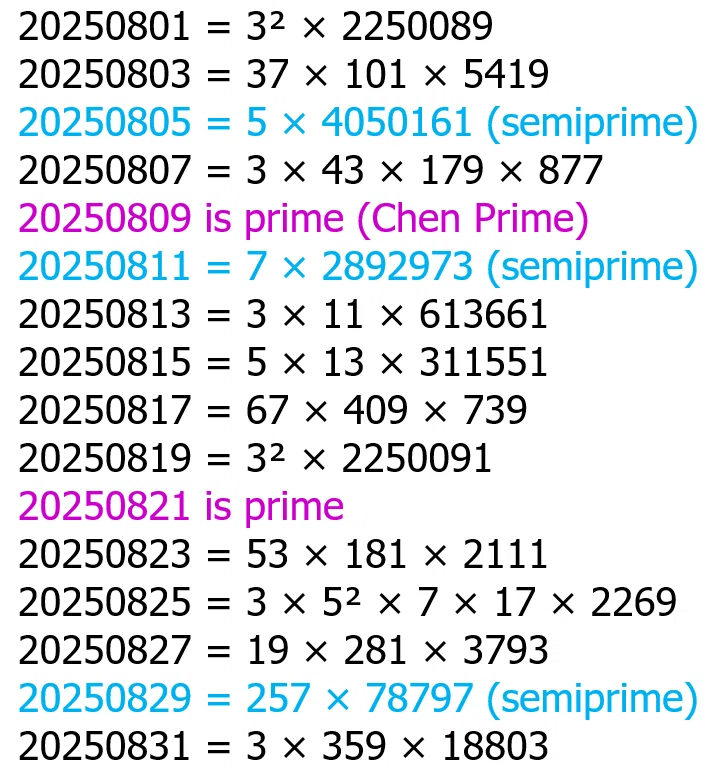
下三桁が 805 であるような数が半素数 semiprime である例は稀ではない。21世紀の年月日で調べてみると:
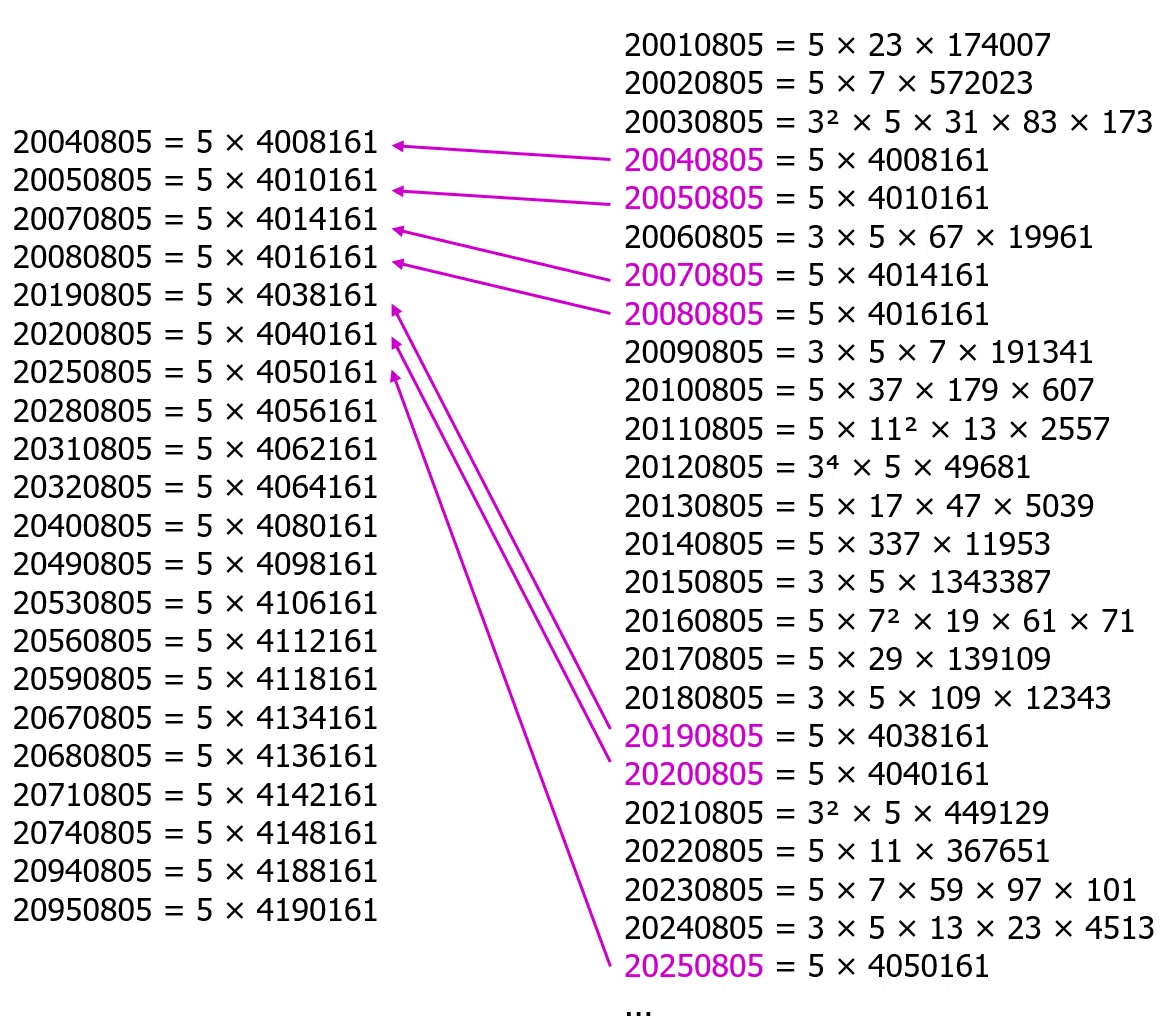
左側の素因数分解を睨めてみると、2161という素数がこれらの半素数の列を作る要因になっていることが判る(2161 + 2000×n)。
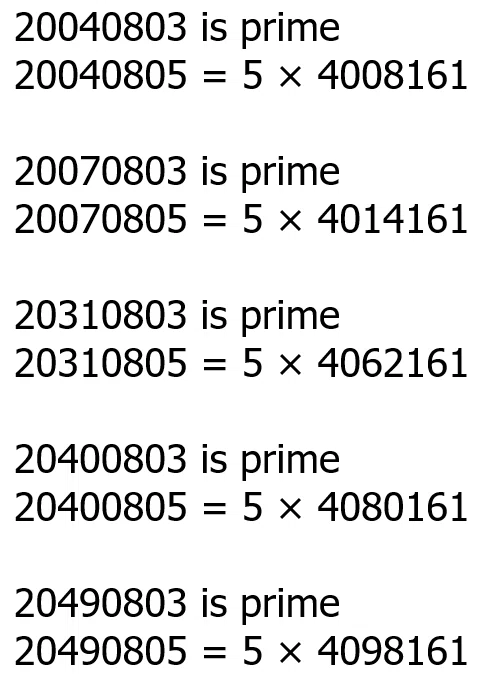
更に条件を加えて21世紀において下四桁 0803 が 陳素数 Chen prime であるような数、つまり YYYY0803 が素数、且つ YYYY0805 が半素数であるような数を見つけてみると YYYY ∊ {2004, 2007, 2031, 2040, 2049} が判る:
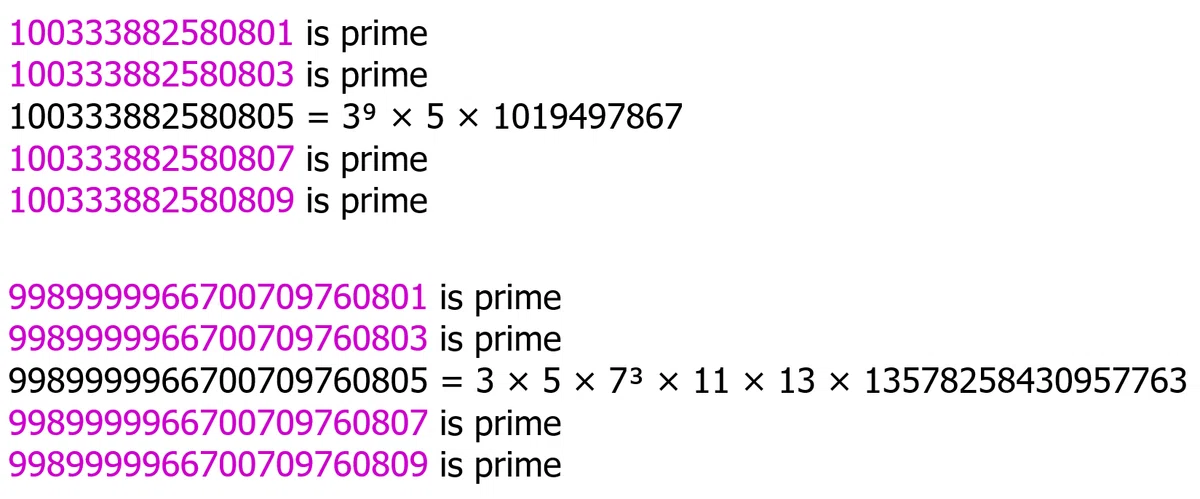
一方、下四桁が {0801, 0803, 0807, 0809} である、つまり 805 を挟むような四つ子素数 prime quadruplet は”沢山”存在するように見える。残念ながら双子素数予想 Twin prime conjecture が未解決なので、無限に存在するとは言えない…
N.B. The following statement is extremely intriguing:
It is not known if there are infinitely many prime quadruplets. A proof that there are infinitely many would imply the twin prime conjecture, but it is consistent with current knowledge that there may be infinitely many pairs of twin primes and only finitely many prime quadruplets.
つまり、双子素数 twin prime は恐らく無限に存在する一方、四つ子素数prime quadruplet は有限個しか存在しないのではないか、というのが現時点での知識に基づく推論である…
(日本語版 Wikipedia にはこの記述は無い🤔)
WHY ❓ It's my guess that it most likely comes from that Hardy-Littlewood constant C₄ for prime quadruplets is much smaller than C₂ for twin primes ≈ 1.320323632...
とは言え、2019年時点で知られている最大の四つ子素数 は10132桁である。(フランス語版 Wikipedia はこの点に関しては更新されていない。)
{0801, 0803, 0807, 0809} に関する具体例に戻ると
15桁の p = 100333882580801 から始まる {p, p+2, p+6, p+8}
23桁の q = 9989999966700709760801 から始まる {q, q+2, q+6, q+8}
はそのような例である:
N.B. Except for {5, 7, 11, 13} , prime quadruplets have the form:
{30n+11, 30n+13, 30n+17, 30n+19}.
Here are examples:
{13001, 13003, 13007, 13009} ➡️ n = 433
{444341, 444343, 444347, 444349} ➡️ n = 14811 = 3 × 4937
And the following two quadruplets are "closest" showing an extremely intriguing cluster of primes:
{1006301, 1006303, 1006307, 1006309} ➡️ n = 33543 = 3² × 3727
{1006331, 1006333, 1006337, 1006339} ➡️ n = 33544 = 2³ × 7 × 599
数学的な表現としては不正確だが、15桁の数 p の周辺には素数が多いのか?
計算してみると:
[100333882580801-1002; 100333882580801-2] には38個の素数がある。
[100333882580809+2; 100333882580809+1002] には33個の素数がある。
加えてそれぞれの区間に双子素数が存在する:
(100333882580207, 100333882580209)
(100333882581011, 100333882581013)
🎵🍀
N.B. Among 23 digit integers dwells R₂₃ = 11111111111111111111111, one of extremely rare prime numbers. Its previous prime and next prime are:
11111111111111111111093 (= R₂₃ − 18),
11111111111111111111117 (= R₂₃ + 6).
In addition, the smallest twin prime larger than R₂₃ is
(11111111111111111111927, 11111111111111111111929)
and the smallest prime quadruplet larger than R₂₃ is
{p, p+2, p+6, p+8} with p := 11111111111111114344091
一方、十進法で表された二つの数:
1693182318746371 (16 digits in decimal expression)
6787988999657777797 (19 digits in decimal expression)
には次のような共通点がある:
素数。
次の素数との差 gap が 1000 を越える。正確に記すと:

➡️ WoldframAlpha で誰でも検証可能。
一つ目の数を簡単に図式化すると:
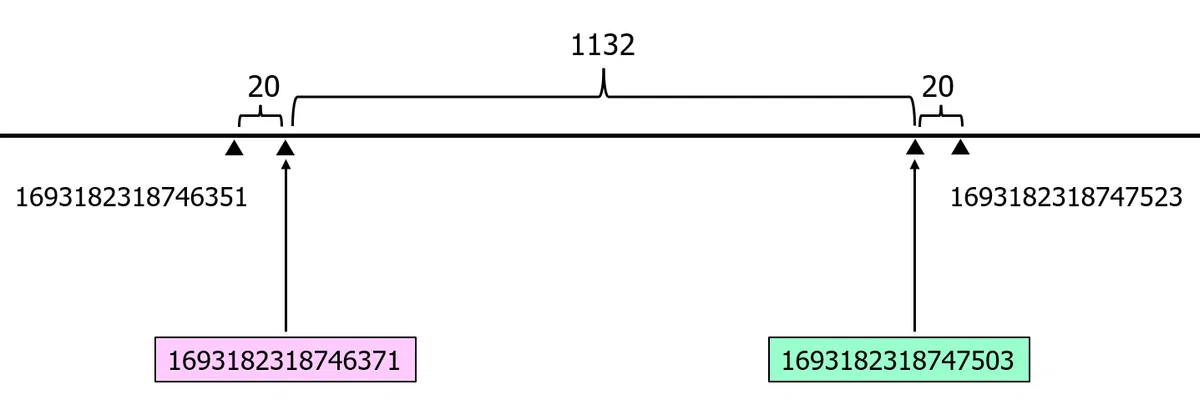
少し遠くから眺めてみる:
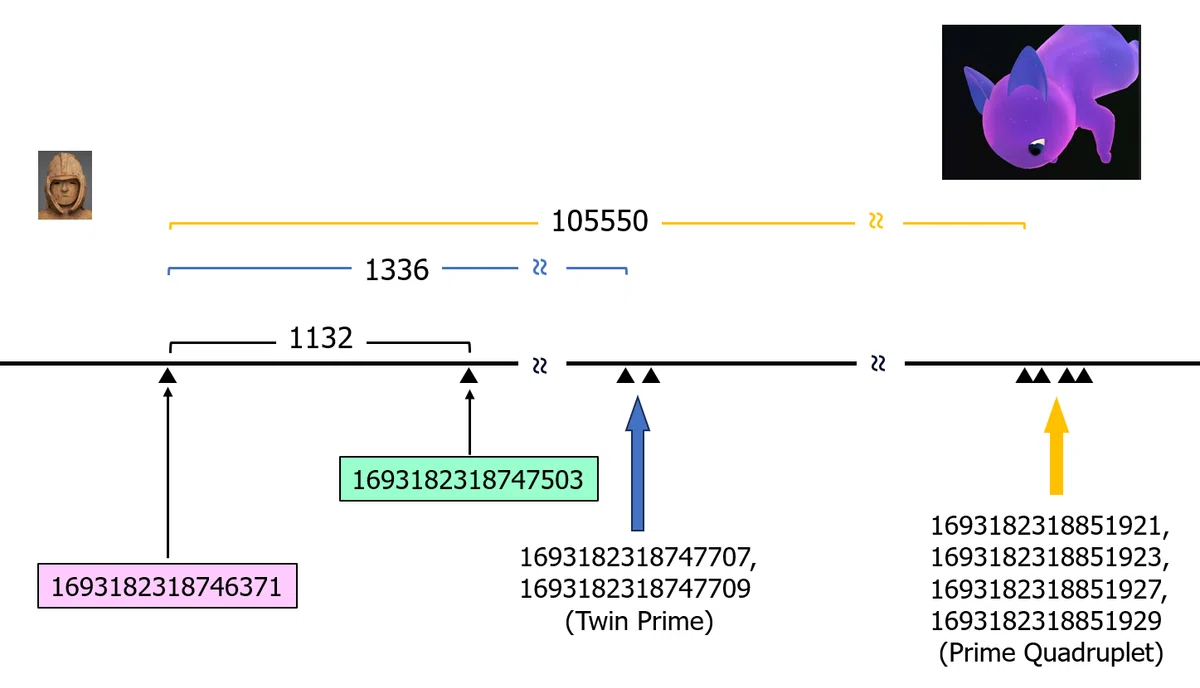
一つ前の素数との差が 1132 である素数 1693182318747503 の直ぐ先に双子素数が存在し、更に先に四つ子素数が存在する。
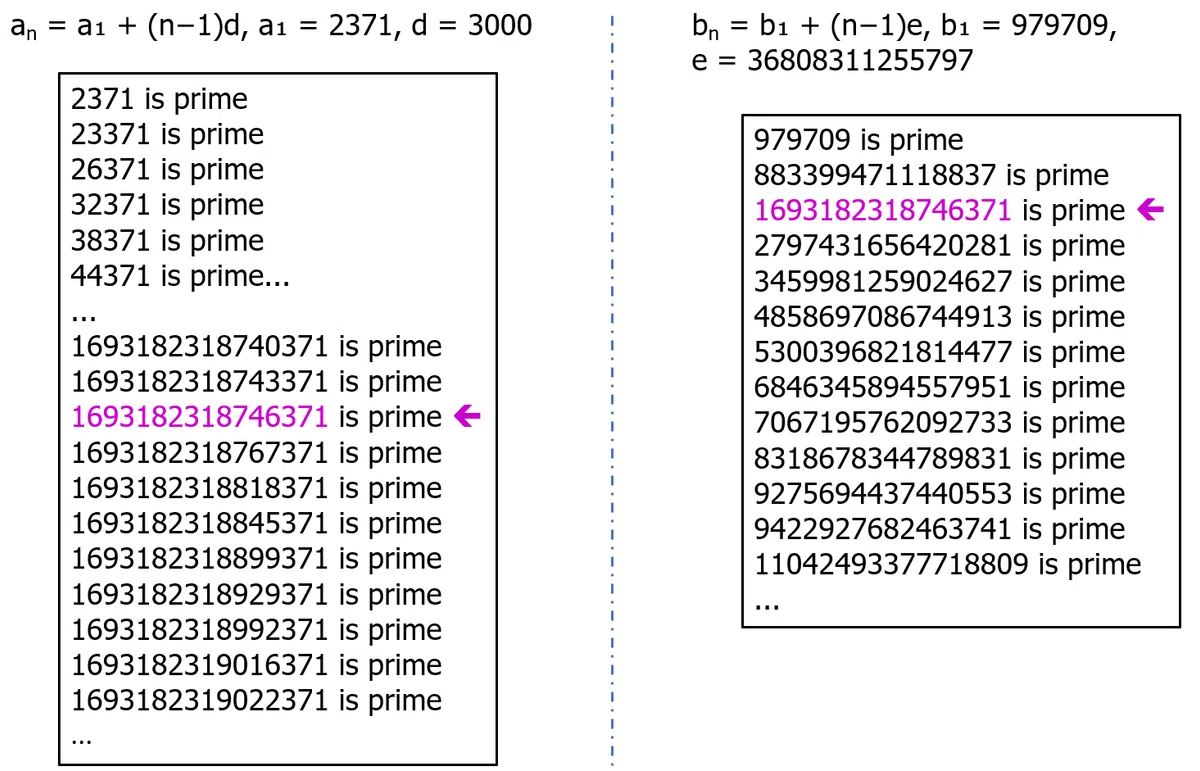
また 1693182318746371 は複数の無限に続く arithmetic progressions の中に棲息している:
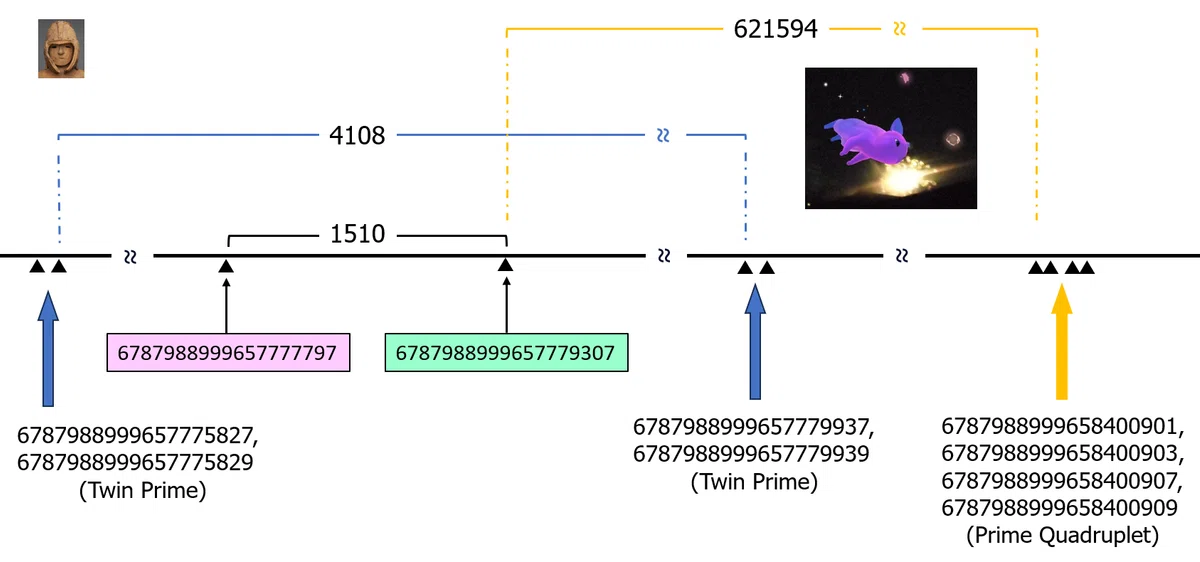
二つ目の数 6787988999657777797 に関しても似たようなことが判る:
6787988999657777797 を越えない最大の双子素数は(6787988999657775827, 6787988999657775829) である。
6787988999657777797 の次の素数は 6787988999657779307 である。
6787988999657779307 より大きな最小の双子素数は(6787988999657779937, 6787988999657779939) である。
そしてこの双子素数の先には次の四つ子素数が存在する:{6787988999658400901,
6787988999658400903,
6787988999658400907,
6787988999658400909}
このことを同様に図式化すると🧐
「任意に与えられた正整数 G に対して、G を超える大きさの "双子素数砂漠" が存在する…」と主張したいところだが、これは双子素数が無限に存在することを仮定しているので、現時点では正しくない。
N.B. G stands for "Gigantic", not 🪳.
ここ迄で話題にしているのはせいぜい23桁の数である。Googolplexian 10^(10^(10^100)) 、つまり 10 の googolplex 乗のような巨大数でさえ Graham number グラハム数に比較すれば無に等しい。
Quora で見つけた Alon Amit の説明は以下の通り:
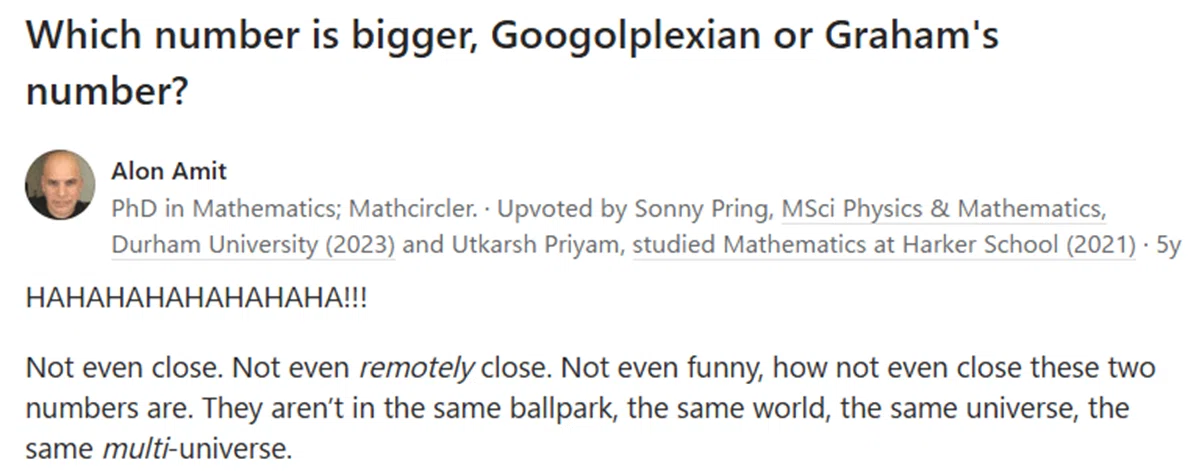
「近くなどない。全然違う。この2つの数がどれほど離れているかなんて、笑い話にもならない。丼勘定でも同じではないし、同じ世界に存在しない、同じ宇宙、いや多次元宇宙にすら同居しない。」
普通の会話だったら
What the hell are you talking about?
で済ませるところだが、以下とても面白い記述が続く:
Googolplexian is "ten to the power googolplex", while googolplex is "ten to the power googol", and googol is "ten to the power one hundred". In other words, googol is 1 followed by a hundred zeroes, googolplex is 1 followed by a googol zeroes, and googolplexian is 1 followed by a googolplex of zeroes. Large? That's nothing. Less than microscopic. Negligible. Peanuts, smashed to bits with a sledgehammer and then crushed in a particle accelerator. A single quark, compared with a googolplexian universes, is still far from representing just how tiny googolplexian is compared to Graham's number. Seriously, I'm not exaggerating…
That said, this article isn't purposed to cover Big Numbers, but to shed light on gaps between prime numbers and distance between two twin prime pairs additionally.
Just finding such examples I showed above never contribute to any theory relative to prime gaps or questions on infinitude of clusters of primes.
N.B. There's another terminology "cluster prime", which has nothing to do with this article.
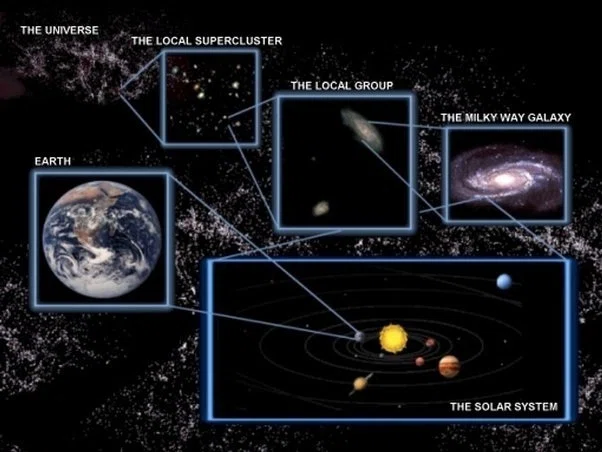
As a methodology once effective for research of planets in the solar system cannot be automatically duplicated to interstellar research, prime counting becomes far less effective when the size of numbers increases astronomically. Calculations at the size of the Graham number is utterly unfathomable, and we have to change our methodology for research of prime gaps for ultra-large-scale numbers.
I feel like to correlate the above with the relationship among the solar system, galaxies and stellar systems:
Let me recall that Voyager 1 is expected to reach the theorized Oort cloud in about 300 year and take about 30,000 years to pass through it.
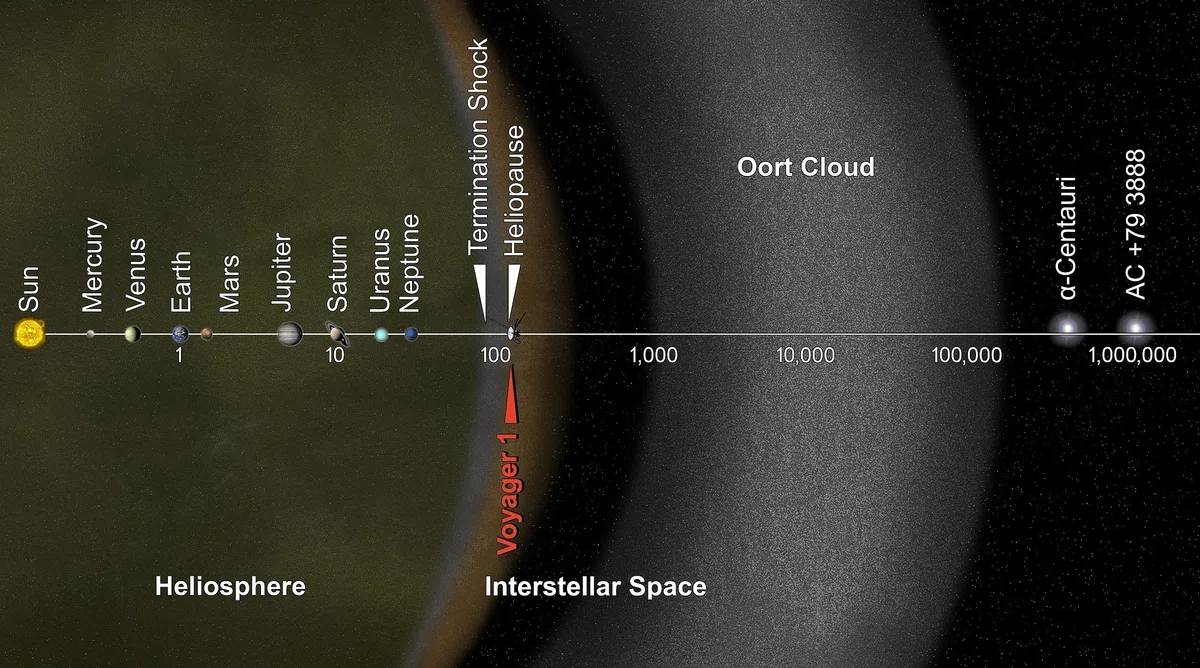
The distance from the Oort cloud to the interior of the Solar System, and two of the nearest stars, is measured in astronomical units. The scale is logarithmic: each indicated distance is ten times farther out than the previous distance. The red arrow indicates the projected location, in 2025–2027, of the space probe Voyager 1, which may reach the Oort cloud about 300 years later.
Speaking of Voyager , the following article is highly informative✨:
The title of this article comes from the following:

Last but not least, let me introduce Rosée who appears in the images as observing twin prime pairs and prime quadruplets. She is an alter ego of sayo kagura様 known with lovely no+e articles with Rosée (rosée).
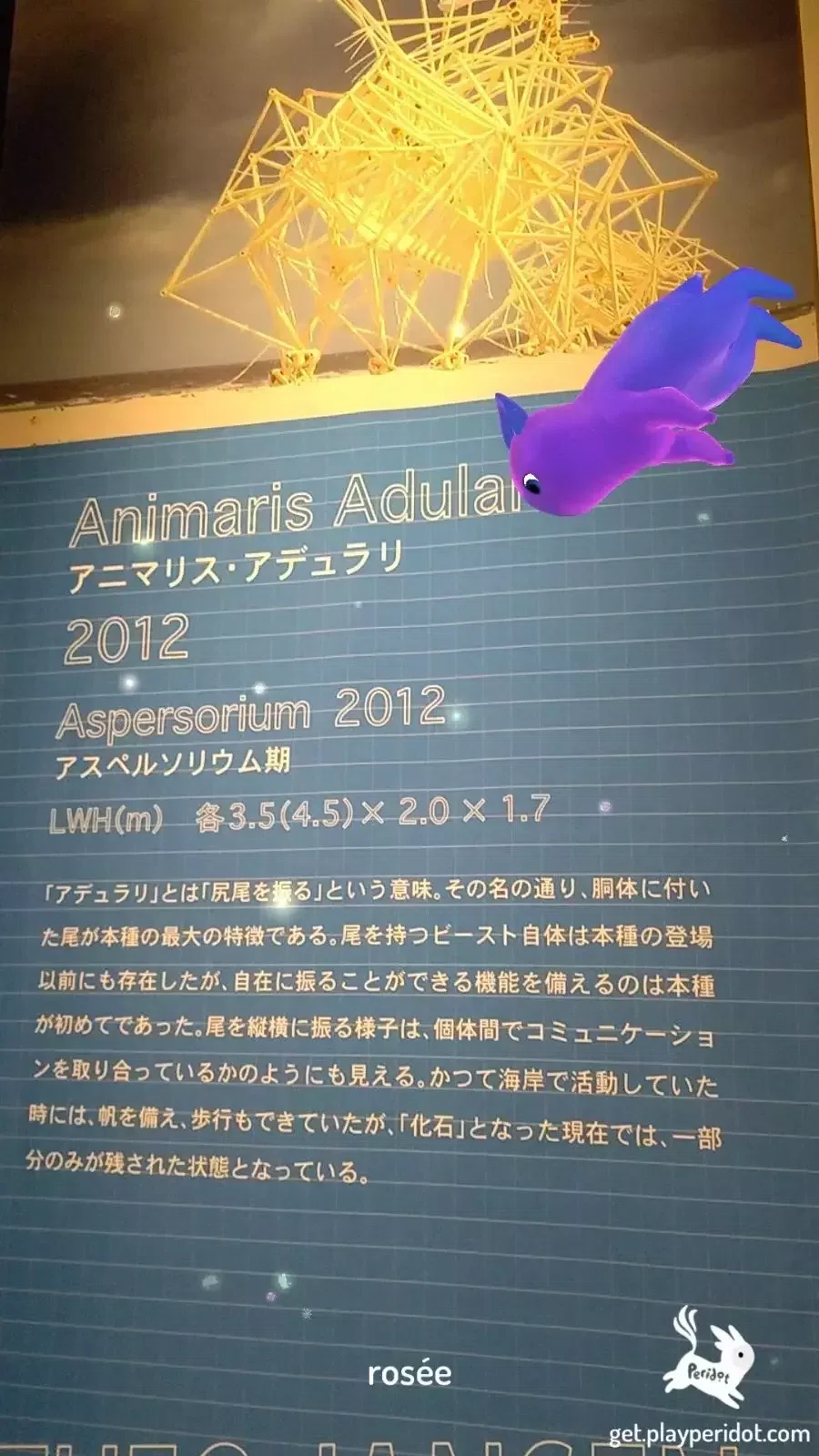
The following shows that Rosée is very inquisitive, scrutinizing Animaris Adulari, a Strandbeest by Theo Jansen:
■
