

[Header Image Credit]
A monodromy group of order 35838544379904000000 in
"the mystery Manin-Marcolli monoid"
Preface
数学の研究者が「子供の絵」なる日本語を用いるのか否かは判りませんが、
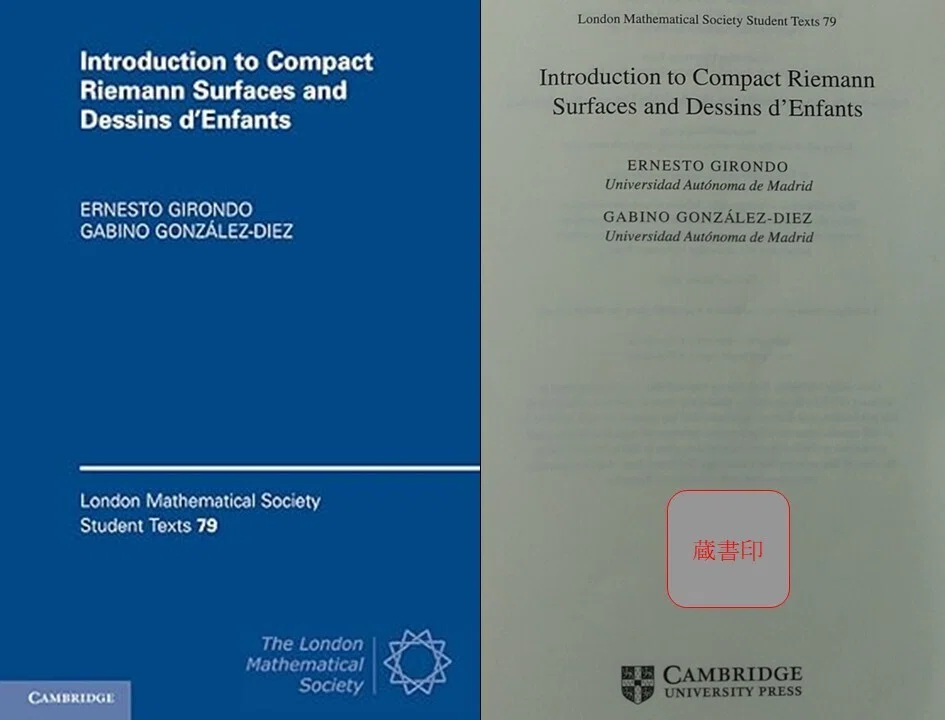
Dessin d'enfant の直訳です。つい最近勉強した以下の本の題に現れます:
Quick overview
The following article which contains a YouTube video by Gareth A. Jones is very handy:
https://serious-science.org/dessins-denfants-10245
Gareth A. Jones is a coauthor of the following paper:
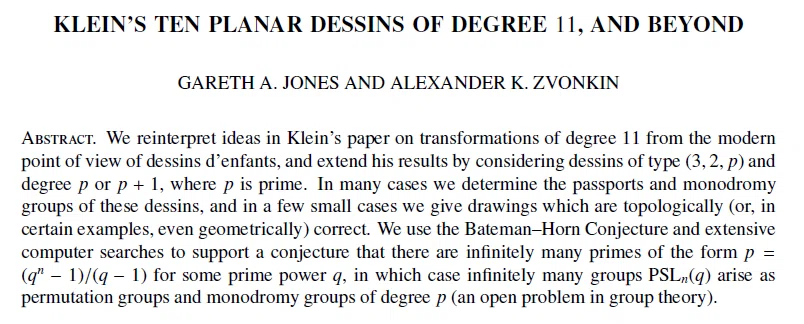
The YouTube video in the above article is separately accessible:
It has a Japanese transcription, which I never recommend… unfortunately it is an unacceptably lousy work.
First encounter
In June 2025, I came across Grothendieck's Dessins d'Enfants.
Accurately speaking, ChatGPT inspired me to study Belyi map, which led me to the following paper:
"Belyi maps in number theory: a survey" by John Voight
It shows a very simple slide after the fundamental Riemann-Hurwitz formula:
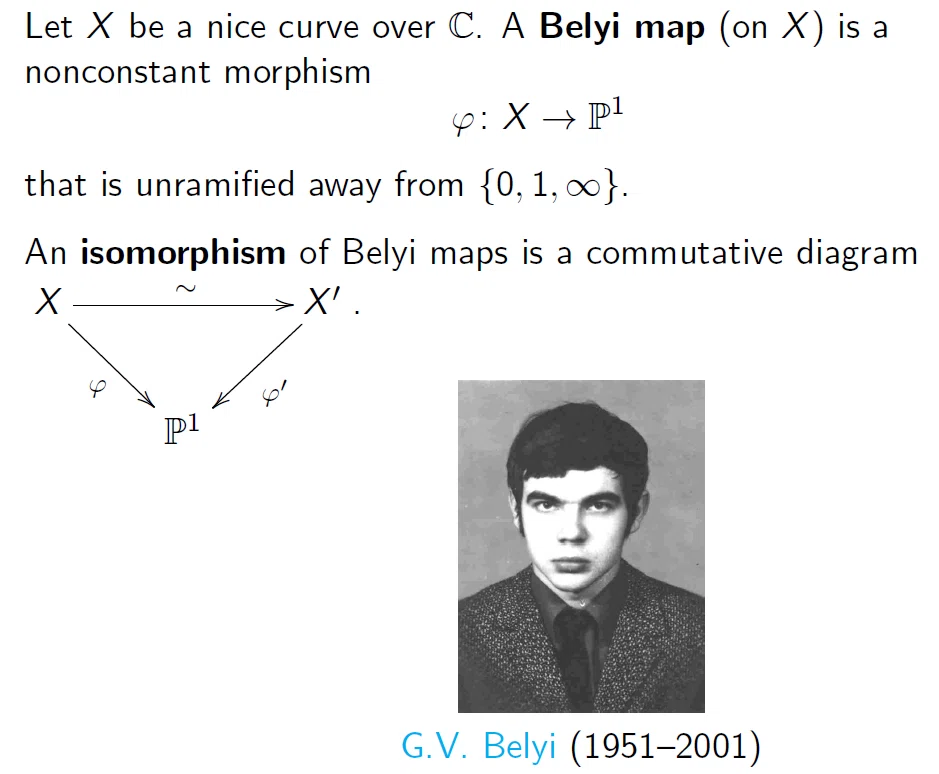
Then I noticed the following eye-catching phrase in this paper:
"Esquisse d'un programme"
The title sounded a little strange without mentioning any mathematical object but rather intriguing, and It led me to "dessin d'enfant" (子供の絵)⬇️
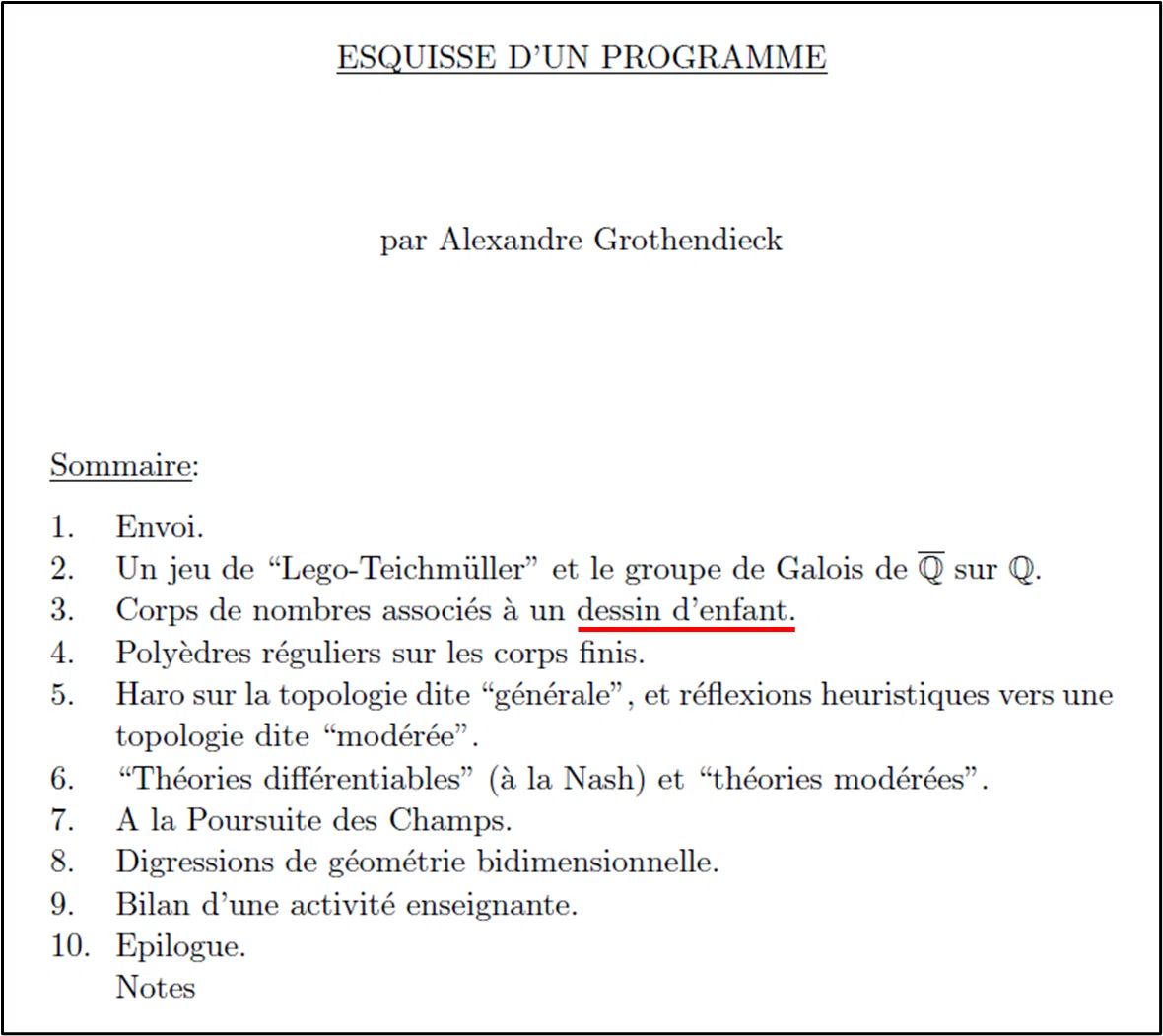
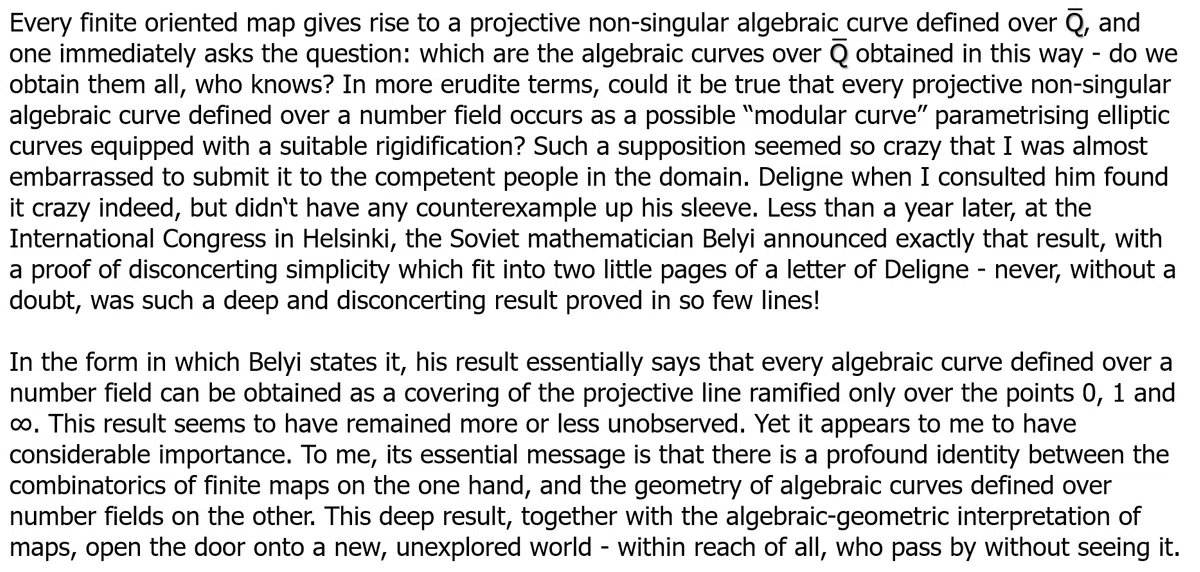
And here is an excerpt from its English translation⬇️
Riemann Surfaces (リーマン面)
Riemann surfaces are indeed a cornerstone of modern mathematics, acting as a crucial bridge that connects diverse and seemingly unrelated fields:
Complex Analysis 複素解析(函数論)
Algebraic Geometry 代数幾何学(代数曲線論)
[Algebraic] Topology [代数的]位相幾何学
Differential Geometry 微分幾何学
Algebraic Number Theory 代数的整数論
Therefore, there are so many textbooks written on Riemann Surfaces.
N.B. Riemann Surfaces are real 2-dimensional but complex 1-dimensional, which is why they are called surfaces and algebraic curves.
As mentioned in the beginning, I finished reading the following book:
"Introduction to Compact Riemann Surfaces and Dessins d'Enfants"
by Ernesto Girondo & Gabino González-Diez
Its contents are:
Compact Riemann surfaces and algebraic curves
Riemann surfaces and discrete groups
Belyi's Theorem
Dessins d'enfants
Chapter 1 & 2 are fundamental, and I thought these chapters were nothing new, but these chapters are written in a style different from that of books I studied long time ago, and quite refreshing. Not only I find these two chapters good for reviewing my knowledge but also I learned some important techniques using hyperelliptic curves (超楕円曲線) in this book.
It is especially enlightening that the famous Klein quartic, a genus 3 Riemann surface, the group of automorphisms of which is PSL₂(F₇), the second smallest simple group of order 168, is repeatedly used as an example for computation from different perspectives ✨
Belyi's Theorem
It is astoundingly simple stated as follows:
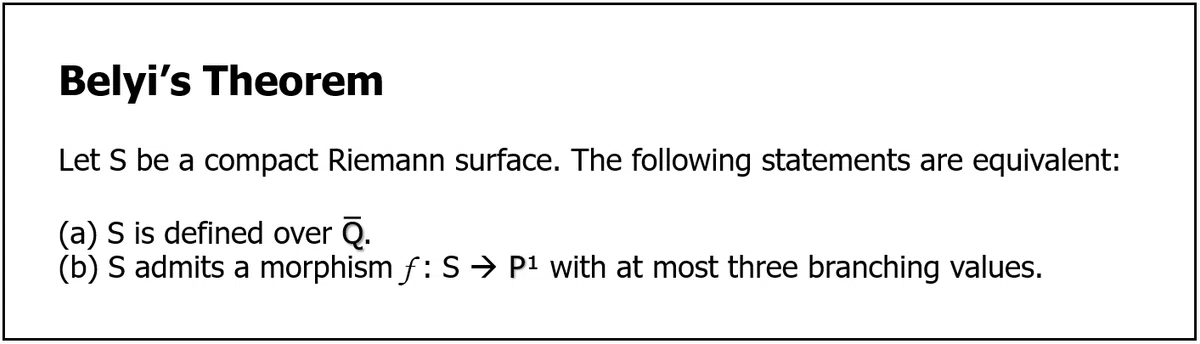
by Ernesto Girondo & Gabino González-Diez p.169~170
The proof by Girondo & González-Diez of this profound result is elementary:
No heavy scheme theory, no cohomology, no moduli stacks
Just careful analysis, covering theory, monodromy, and the geometry of compact Riemann surfaces
Reading the proof, I grinned like the Cheshire Cat while constructing a Belyi function from triangle decomposition as if solving a beautifully rigged puzzle: nothing forced, everything falling into place almost embarrassingly naturally.
Dessins d'enfants
The definition is again very simple.
According to the book by Girondo & González-Diez,
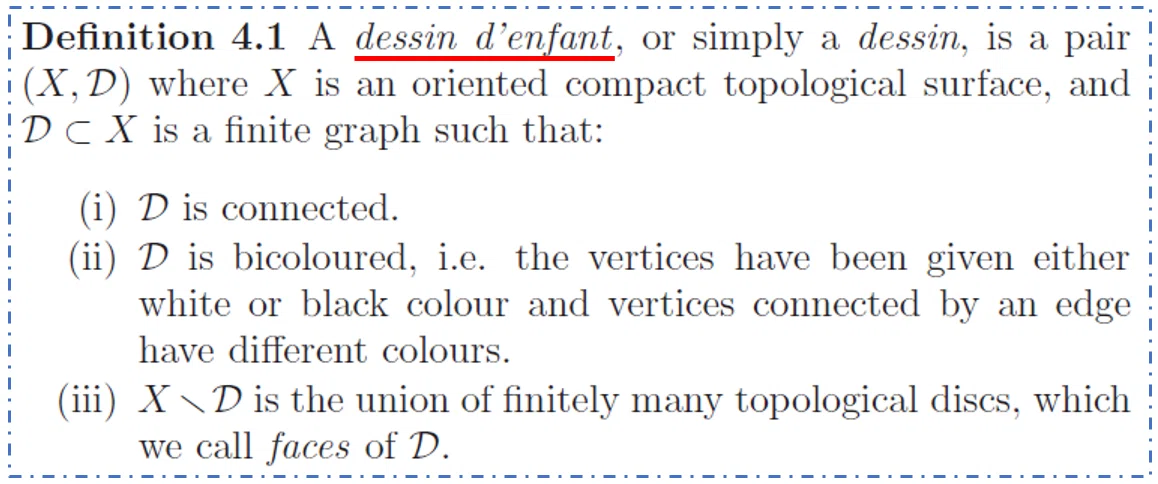
by Ernesto Girondo & Gabino González-Diez p.207
and here are excerpts from my note:
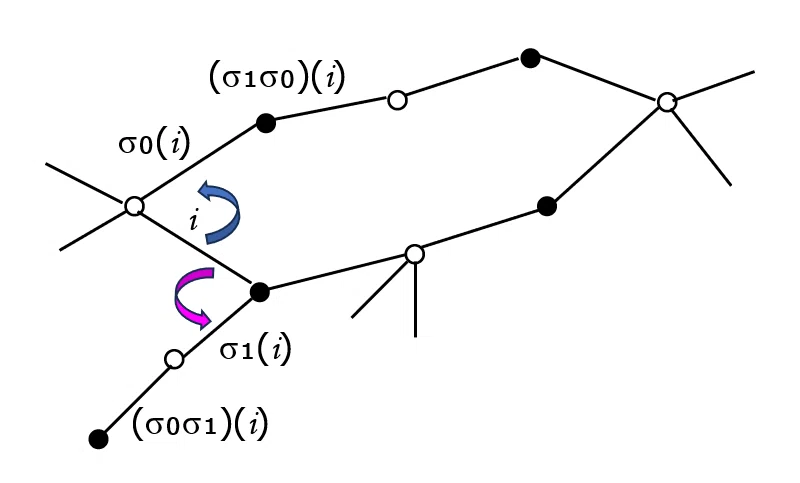
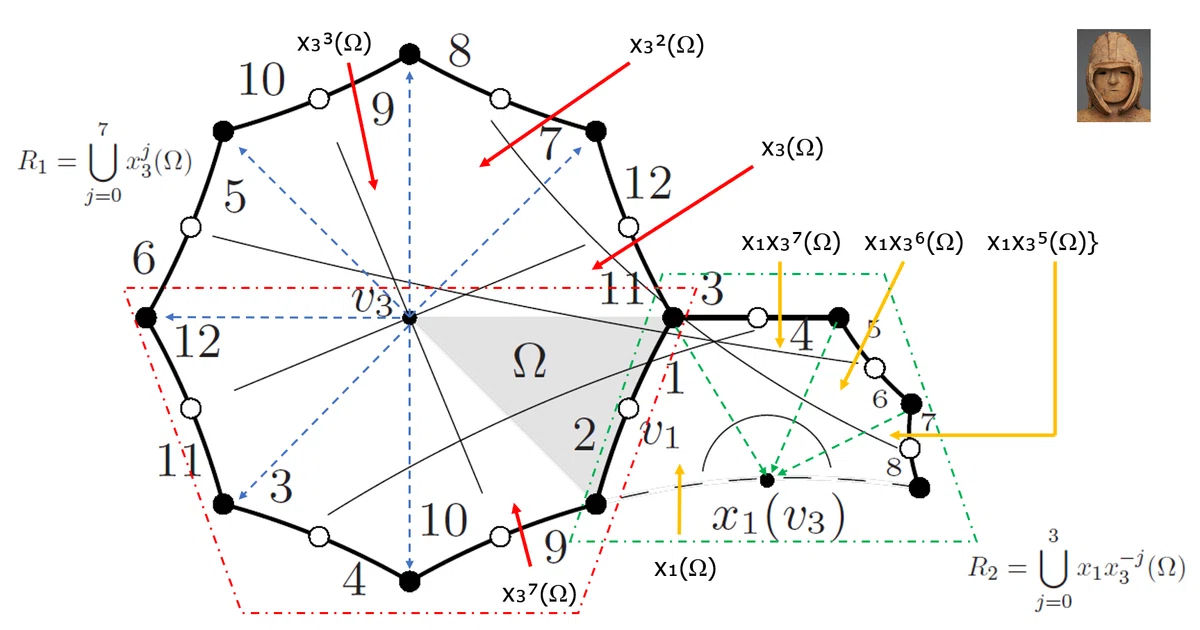
These do not evoke the image of "dessins d'enfants", but the following image definitely does:
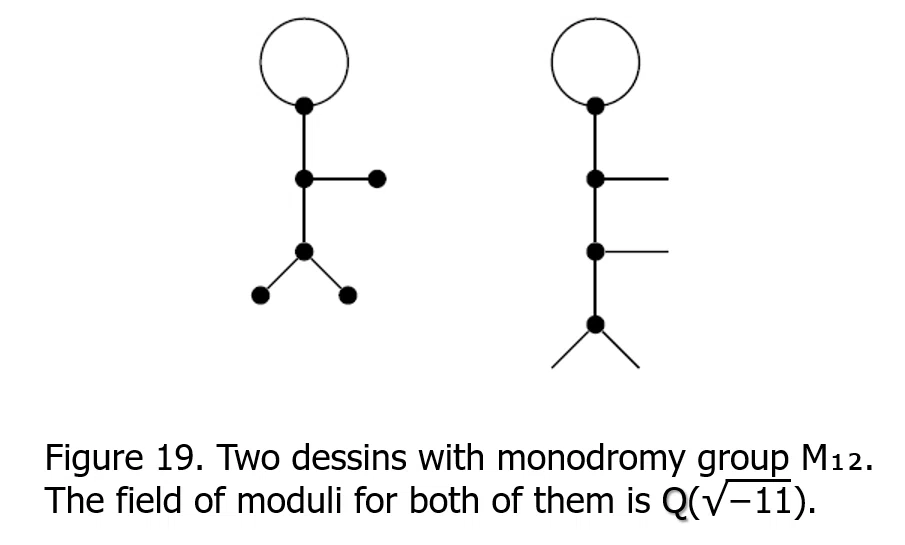
(the paper by G. A. Jones and A. K. Zvonkin mentioned in the beginning)
Here M₁₂ stands for Mathieu group of order 95040 = 12·11·10·9·8, one of the 26 sporadic groups (散在単純群).
Applications
Two major applications are:
ABC Conjecture for polynomials (多項式版ABC予想)
Inverse Galois Problem (逆ガロア問題)
① ABC Conjecture for polynomials (多項式版ABC予想)
所謂 IUT (Inter-universal Teichmüller theory) で知られた ABC予想、或いは Oesterlé–Masser conjecture のことではなく、Mason–Stothers theorem のことであり、以下のように記述されます:

Belyi's Theoremを用いた証明は以下に示されています:
"The ABC-conjecture for polynomials" (Abhishek Parab)
更に以下の論文が ABC予想に関して Belyi's Theorem に言及しています。
”ABC for polynomials, dessins d'enfants and uniformization - a survey” (Jürgen Wolfart)
”ABC implies Mordell” (Noam D. Elkies)
② Inverse Galois Problem (逆ガロア問題)
The definition of this problem is very simple:
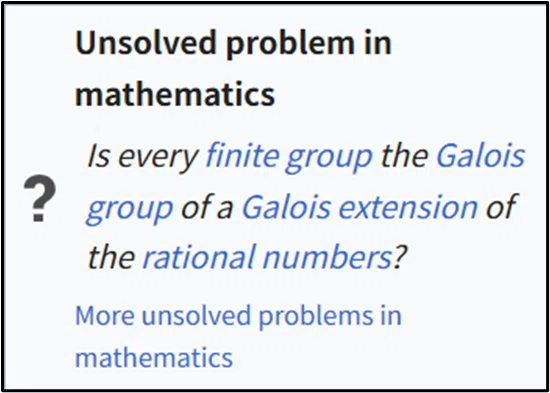
The inverse Galois problem concerns whether or not every finite group appears as the Galois group of some Galois extension of the rational numbers Q.
It's an unsolved problem in mathematics:
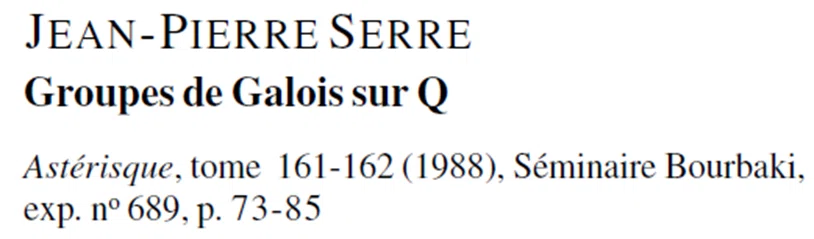
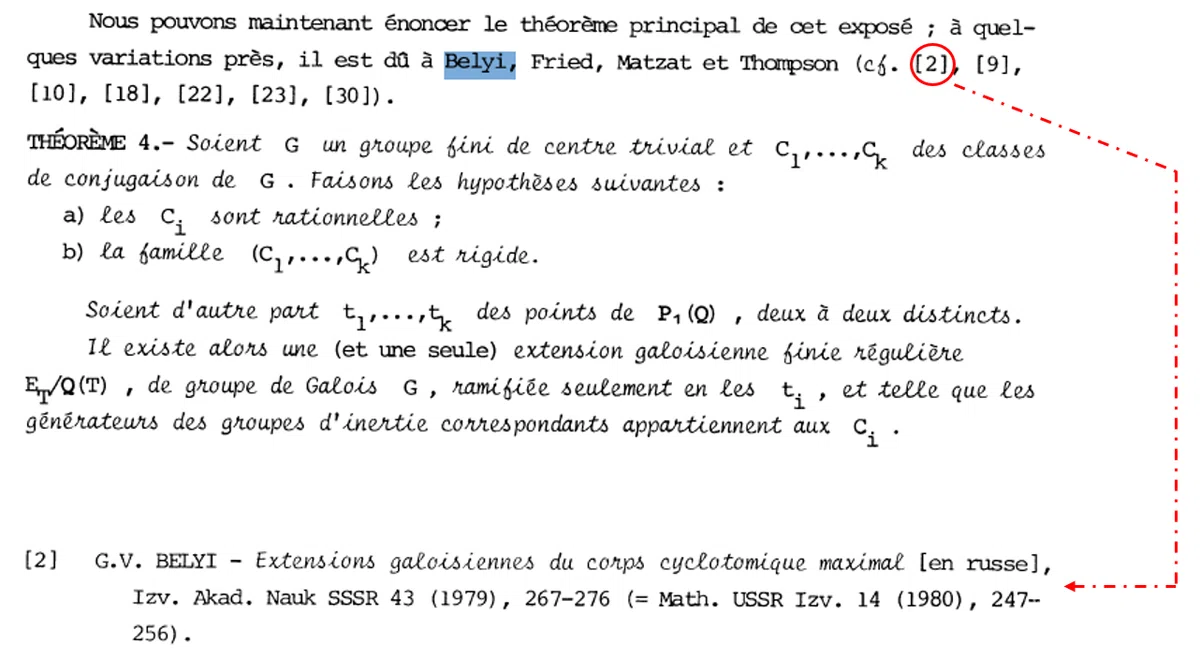
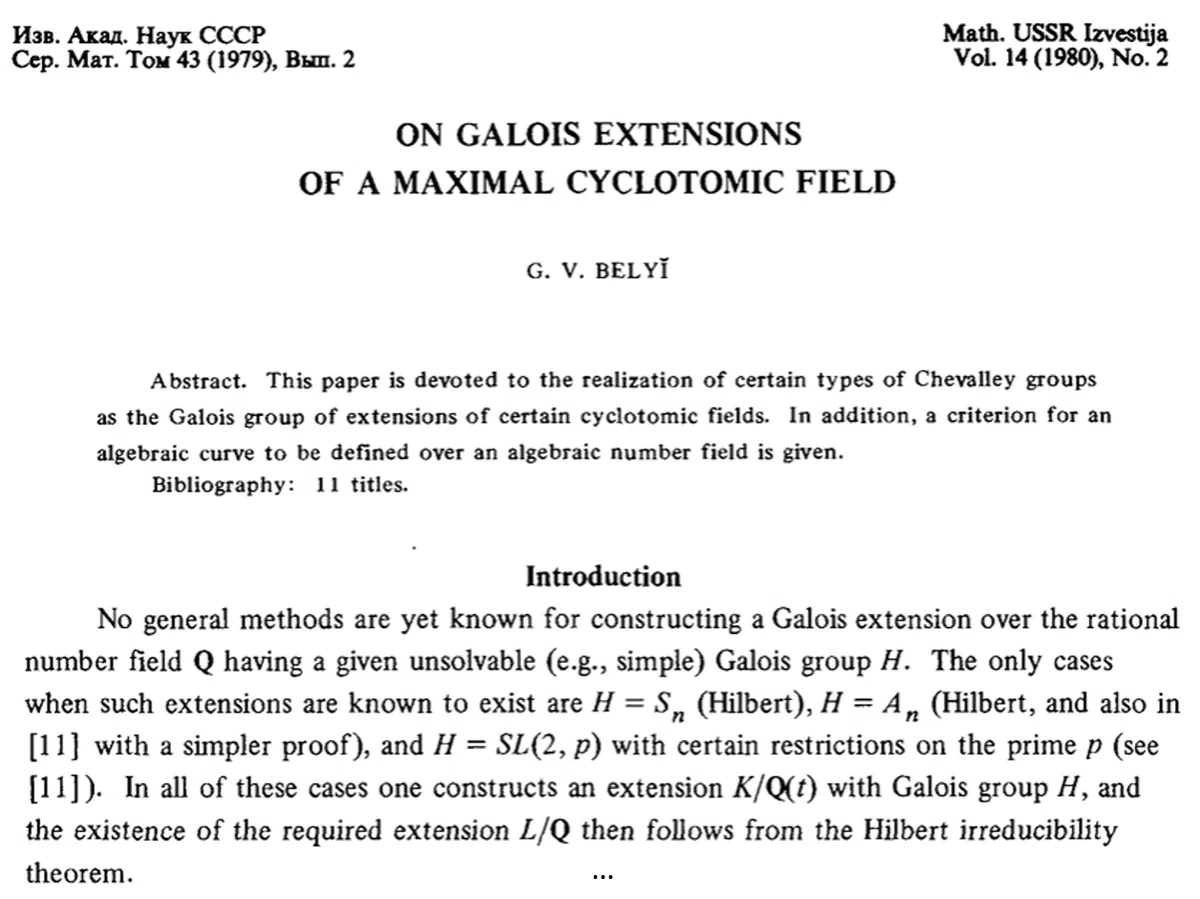
Jean-Pierre Serre refers to Belyi's paper in “Groupes de Galois sur Q”⬇️
I am still learning this particular topic with the following book by J. P. Serre:
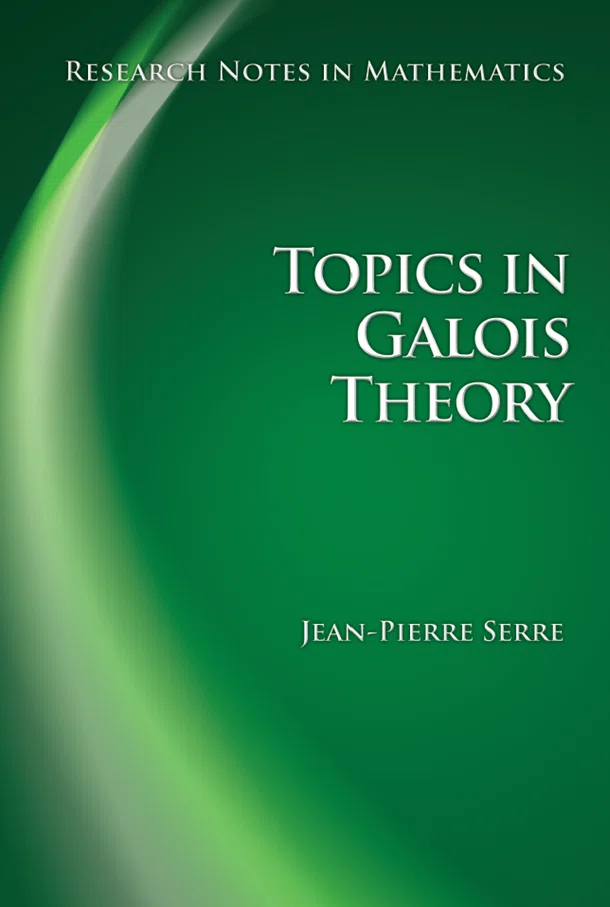
This is an exceptionally enlightening book without any exaggeration. While the title sounds subtle, it explains "inverse Galois problem".
尚、"Galois Theory" と題していますが、所謂ガロア理論の説明書ではなく、『逆ガロア問題』に関する重要な手法を説明しています。
🟪
