
A Classic Example

[Header Image Credit: A Tibetan knot via Pinterest]
This is just a tiny tiny tiny accomplishment in April ~ May✨
I read a short paper titled
The Modular Curves X₀(11) and X₁(11)
by Tom Weston:

The reason why this is a tiny accomplishment for me is that I managed to figure out proofs omitted in the paper with some hint such as

Transformation formula for θ² for Γ₀(11)
This is not that simple… It consists of three steps:
① Calculate Fourier transformation (フーリエ変換) of a theta function θ based upon a quadratic form (二次形式) Q(x, y) := x² + xy + 3y² of discriminant 11 to see how Poisson summation looks like. The result is the following transformation:


② Manipulate the above transformation formula in order to find out a 2x2 matrix δ₁₁ ∊ Γ₀(11) ⊂ SL₂(Z) which can be used to prove the property that square of the theta function is a modular form of weight 2 for the congruence subgroup Γ₀(11) ⊂ SL₂(Z). Actually the matrix
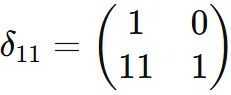
transforms θ as

where 11τ+1 = j(δ₁₁, τ).
③ This is what Tom Weston mentioned, and from here modularity of θ² is automatic on the assumption that modularity for δ₁₁ suffices, in other words, we either prove or accept that δ₁₁ along with a special matrix T
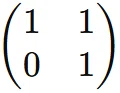
generate the congruence subgroup Γ₀(11) ⊂ SL₂(Z).
Honestly speaking, at the Step ③ I was stumbled, blindly calculating products of various combinations of matrices in order to prove the above in vain.
Then, I finally used Chat GPT, who enlightened me and confirmed this was a known fact, though rarely described with clarity, and I should not stick to its proof. The fact is stated as follows:
Atkin-Lehner theory states that Γ₀(N) is generated by the element T and the Atkin-Lehner involutions corresponding to the Hall divisors of N.
In case N is prime, then only one Atkin-Lehner involution exists and is also called Fricke involution.
As a matter of fact, it is easy to verify δ₁₁ = W₁₁⁻¹・T⁻¹・W₁₁ where W₁₁ is the Fricke involution for N=11.
Two modular functions on X₀(11)
After proving modularity of θ² for Γ₀(11), two modular functions F(τ) & G(τ) are defined:

with h(τ) = η(τ)²η(11τ)² where η(τ) is the Dedekind eta function defined by

Invariance/Anti-invariance of F(τ) & G(τ) by Atkin-Lehner involution
Atkin-Lehner involution w is defined by τ → -1/(11τ) for τ ∊ H, the complex upper half-plane {z ∊ C | Im(z) < 0}.
The next goal is to show
1. F◦w = F
2. G◦w = −G
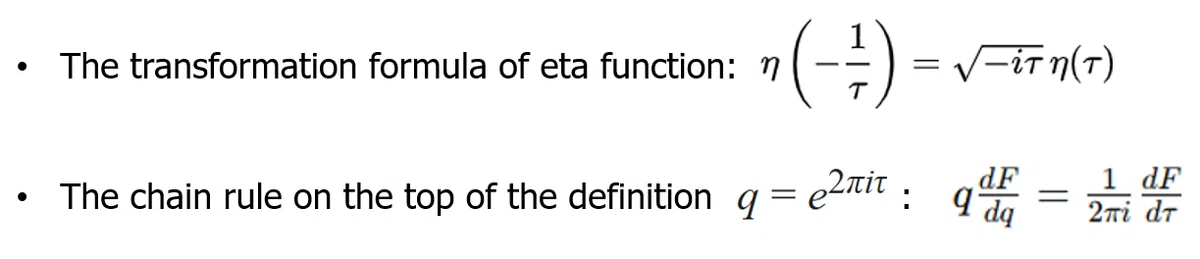
1 is straightforward from the definition. 2 is not so obvious, but is shown using the following crucial properties:
Finding a Weierstrass equation for X₀(11)
Now that invariance/anti-invariance for F and G has been shown, two functions x and y on X₀(11) are constructed as polynomials of F & G and using these x and y as coordinates, a Weierstrass equation is determined.
The following conditions (restrictions) have to be met based on fundamental facts in Algebraic Geometry:
For x = p₁(u, v), it starts with 1/q² where u = F and v = G,
For y = p₂(u, v), it starts with 1/q³ where u = F and v = G,
For both p = p₁ & p₂, p(F, G)◦w = p(F, −G) has no negative power of q.
Here we use the following Laurent series acquired after a bit laborious calculation:
F(τ) = 1/q + 6 + 17q + 46q² + 116q³ + 252q⁴ + 533q⁵ +…
F(τ)² = 1/q² + 12/q + 70 + 296q + 1073q² + 3460q³ + 10150q⁴ +…
F(τ)³ = 1/q³ + 18/q² + 159/q + 966 + 4704q + 19794q² + 74444q³ +…
G(τ) = − 1/q² − 2/q + 12 + 116q + 597q² + 2298q³ +…
F(τ)・G(τ) = − 1/q³ - 8/q² - 17/q + 108 + 1289q + 7920q² + 38252q³ +…
Carefully observing the three restrictions mentioned above, one comes to the following polynomials by elementary calculation:
x = p₁(u, v) = (u² − v – 10u)/2
y = p₂(u, v) = (u³ − uv − 10u² − 22u)/2
Going back to the Laurent series (q-expansion), x and y are expressed as follows:
x = 1/q² + 2/q − 1 + 5q + 8q² + q³ + 7q⁴ − 11q⁵ + 10q⁶ +…
y = 1/q³ + 8/q² + 17/q + 13 + 42q + 66q² + 24q³ + 72q⁴ − 70q⁵…
Starting from
y² − x³ = 10/q⁵ + 89/q⁴ + 287/q³ + 506/q² + 1111/q + 2606 + 3498q +…
eliminating negative power of q step by step, one finally comes to the following Weierstrass equation:
y² − x³ − 10xy + 11x² − 11y = 0
This equation has been calculated all by hand without any computer software.
And this equation can be easily transformed to the following form (by high school mathematics):
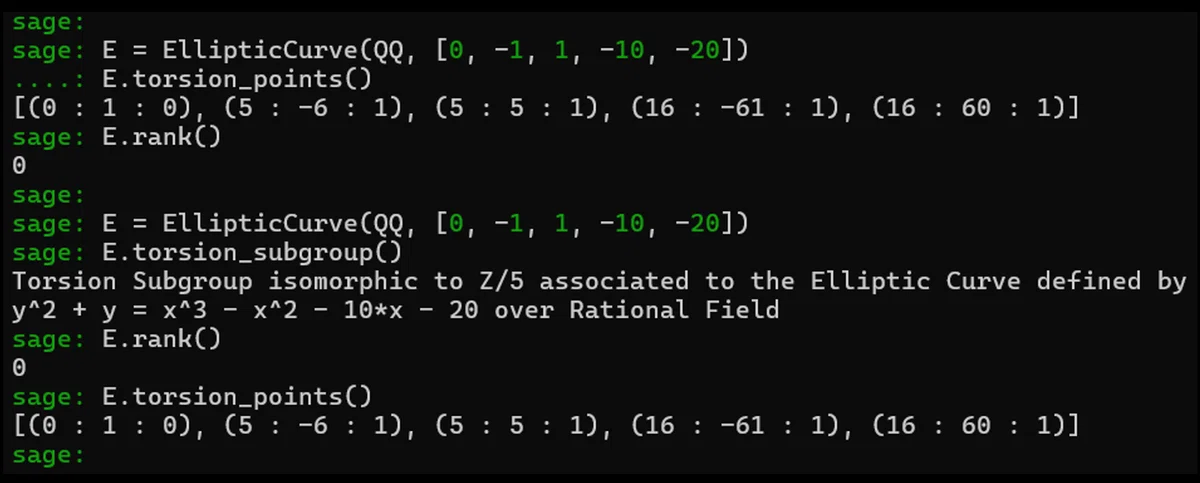
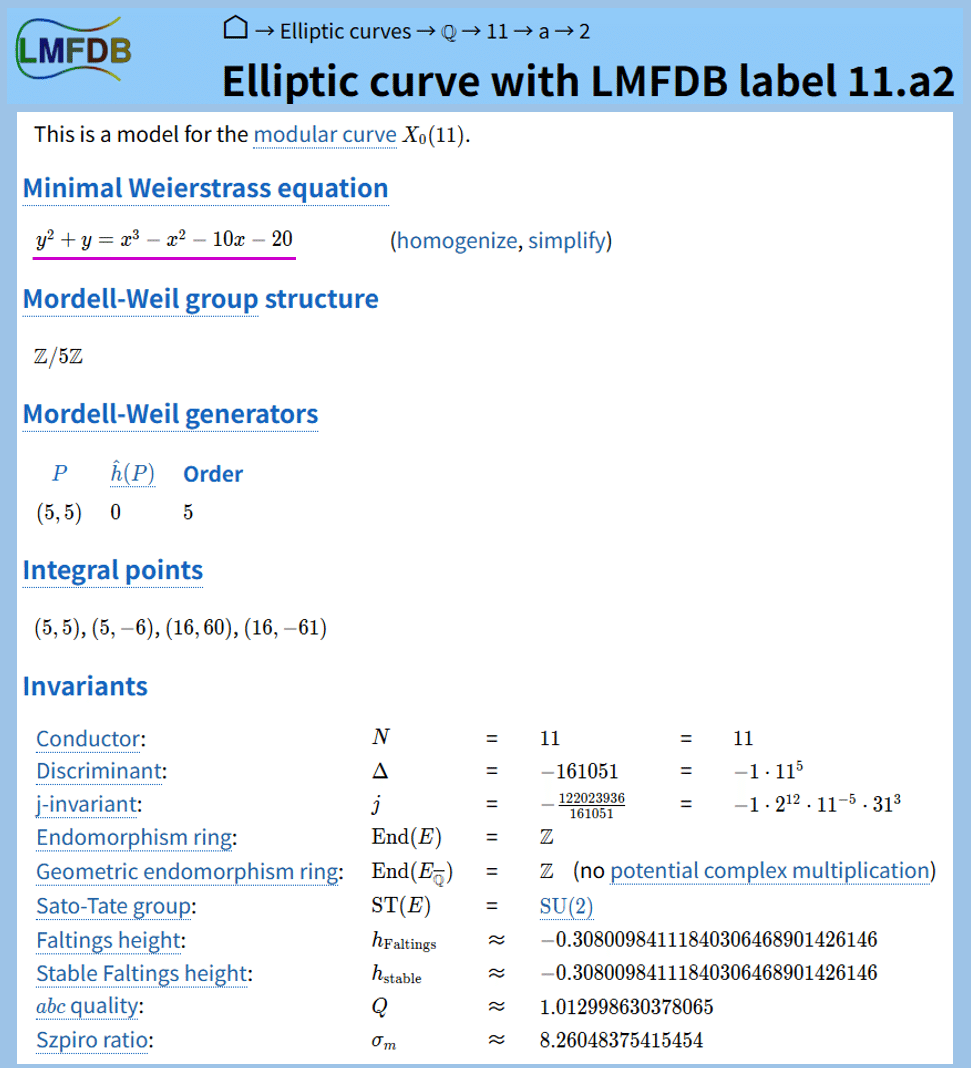
y² + y = x³ − x² − 10x − 20
This is an elliptic curve defined on Q, and we can find that its Mordell-Weil group is isomorphic to Z/5Z, consisting of the following elements:
{O, (5, 5), (16,−61), (16, 60), (5,−6)}
https://www.lmfdb.org/EllipticCurve/Q/11/a/2
Closing
31 years ago when I heard my boss say to me that "That is a classic example", it sounded somewhat negative evidently with his sarcastic tone. Although a 'Classic example' is supposed to have no negative connotation, I infer it depends on context and tone. If it intrinsically does, then it is an ignorance on my part.
17 years before that occasion mentioned above, when I studied mathematics, I was under the impression that some classic theories in mathematics were 'outdated' or 'moldy'. I suspect I was somehow mesmerized by the elegant way of describing algebraic varieties by the scheme theory… By the same token, the Knot theory looked less appealing, but the exotic sphere by John Milnor (28 homotopically equivalent but not diffeomorphic structures on 7-dimensional spheres) looked brilliantly bright.
Regardless of my perception, X₀(11) is described in the following Wikipedia article - Classical modular curve:
After getting older, as a matter of fact at the final chapter of my life, suddenly I found myself gravitated to objects studied in classic theories.
The paper by Tom Weston does not end here, but he continues on his question whether or not there exist elliptic curves over Q with rational 11-torsion. However, he concludes that there are no elliptic curves over Q with rational points of order 11 by claiming that Eℓℓ₁(Q) = ∅ based on the study of the five rational points…
And coincidentally this question is what I felt puzzled around 17 years ago at the following example in §1. Elliptic Curves over Function Fields, Ⅲ Elliptic Surfaces in "Advanced Topics in the Arithmetic of Elliptic Curves" by Joseph H. Silverman:

I conclude this article at the point of identifying a Weierstrass equation for X₀(11), but this paper opens a door to many interesting areas interwoven into the fabric of mathematics.
P.S.
The next "Classic Example" I wish to cover in no+e article is a very old one: Klein quartic discovered by Felix Klein in 1878, though it may take time…
The paper by Noam D. Elkies titled
"The Klein Quartics in Number Theory",
contained in the following book is so fascinating✨

■
