
LOST IN MATH (Sabine Hossenfelder)

While I understand the gist of the subject book's argument, I'm afraid I cannot tell that "I fully understand the book" since it requires sound knowledge of physics obviously, needless to say non-elementary physics. This article is by no means intended to be a commentary on the book.
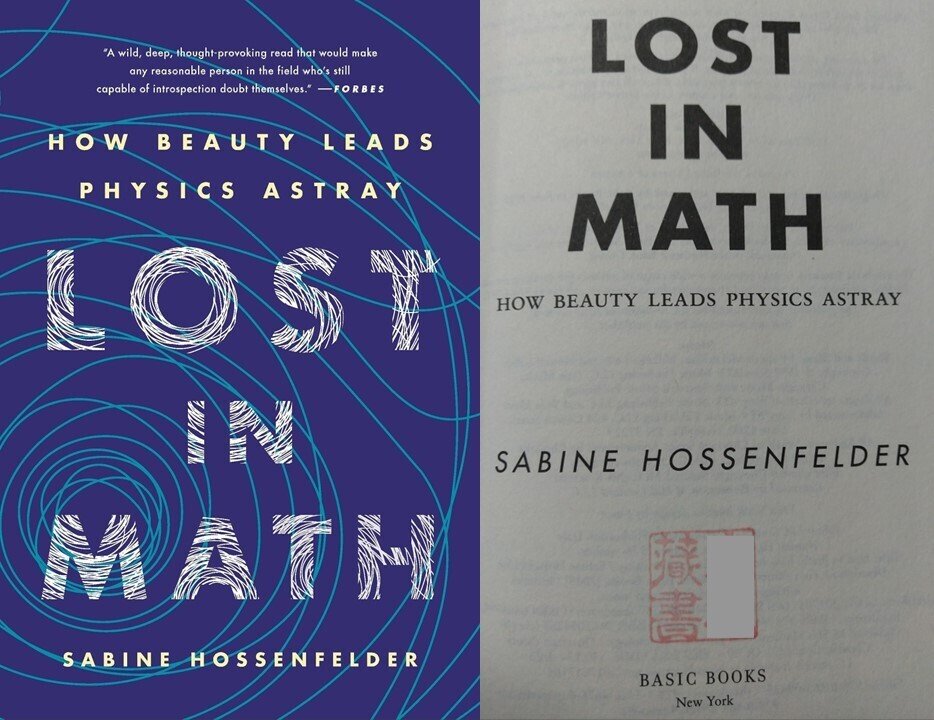
How Beauty Leads Physics Astray
I suspect what inspired me to read this book by Sabine Hossenfelder were the following books:
The Ambidextrous Universe (by Martin Gardner)
Not Even Wrong (by Peter Woit)
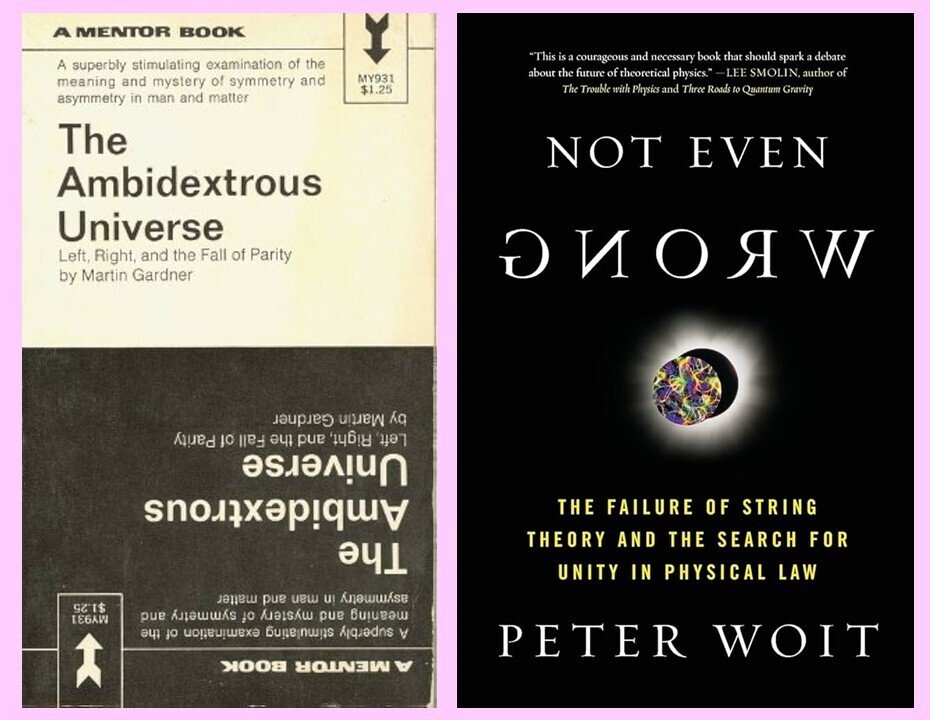
"The Ambidextrous Universe"(邦題:『自然界における左と右』) contains Sheldon Glashow's view on String Theory, which is available at:
To be very precise, I did not read the book "Not Even Wrong"… I ordered a copy at TropicalRainforest.co.jp, and received a notice "Arriving today", but it was never delivered with an inexplicable message virtually saying that "Something funny happened on the way during delivery". That aside, the author writes a lot in his home page:
https://www.math.columbia.edu/~woit/wordpress/
I'm not qualified to comment on String Theory, but I am aware of the moonshine conjectures which Richard Borcherds proved in 1992 using Goddard–Thorn theorem in the mathematical background of string theory as well as the theory of vertex operator algebras and generalized Kac–Moody algebras. These are all far from being easy to understand.
The following book "Symmetry" by Marcus du Sautoy is very interesting, and
Chapter 11 "June: Sporadic"
Chapter 12 "July: Reflections"
describe the history of sporadic groups and discovery of monster including the proof by Richard Borcherds.
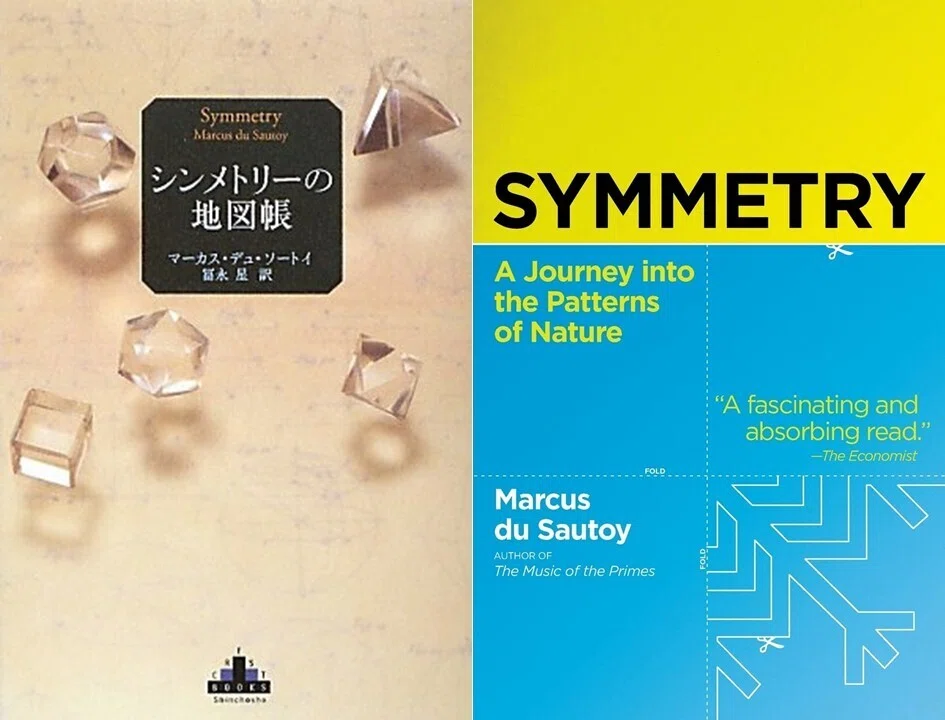
Image via Amazon.co.jp
We often hear the expression "mathematical beauty". While I certainly feel "beauty" in mathematics...in my case, my interest in mathematics when I was young, say 50 years ago, was mainly in geometry (particularly topology), though I am under the impression that many professional mathematicians found beauty in number theory when they were young.
The following Wikipedia article tells so many people have paid attention to this theme:
It is rather intriguing that the above article contains two opposite views referring to 28 different differentiable structures on 7-dimensional Homotopy Sphere by John Milnor, which was the main reason why I decided to specialize in Homotopy Theory (in Algebraic Topology).
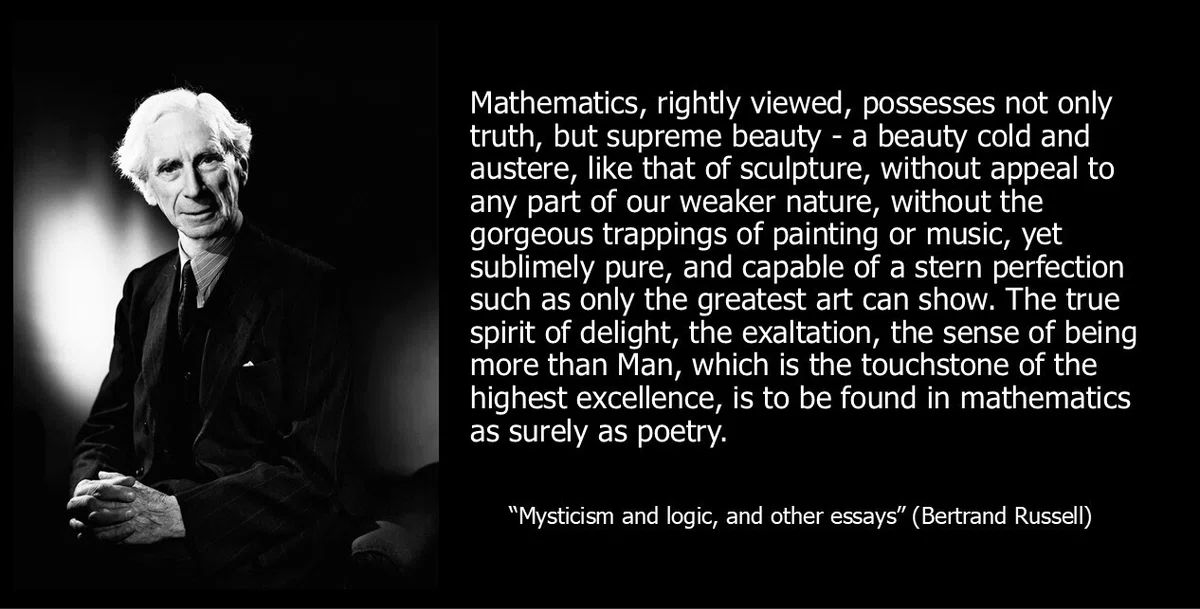
Here are two excerpts from "A Mathematician's Apology" by G. H. Hardy, who was the mentor of the Indian mathematician Srinivasa Ramanujan:
It would be quite difficult now to find an educated man quite insensitive to the aesthetic appeal of mathematics. It may be very hard to define mathematical beauty, but that is just as true of beauty of any kind — we may not know quite what we mean by a beautiful poem, but that does not prevent us from recognizing one when we read it.
A very little reflection is enough to expose the absurdity of the 'literary superstition'. There are masses of chess-players in every civilized country—in Russia, almost the whole educated population; and every chess-player can recognize and appreciate a 'beautiful' game or problem. Yet a chess problem is simply an exercise in pure mathematics (a game not entirely, since
psychology also plays a part), and everyone who calls a problem 'beautiful' is applauding mathematical beauty, even if it is a beauty of a comparatively lowly kind. Chess problems are the hymn-tunes of mathematics.
NOTE: One might be surprised by the mention to country called "Russia" above. The adjective "civilized" is to be understood in the sense when the essay was published in 1940. A person with sanity would never use such an adjective to that particular country at this juncture.
Back to LOST IN MATH:
Chapter 9 "The Universe, All There IS, and the Rest" through the dialogue between Sabine Hossenfelder and George Francis Rayner Ellis refers to the Sokal affair known with a spoof paper titled "Transgressing the Boundaries: Toward a Transformative Hermeneutics of Quantum Gravity".
This Sabine book has been translated into Japanese with a long Japanese title 『数学に魅せられて、科学を見失う――物理学と「美しさ」の罠』, which is not incorrect, however, I'm afraid that people who hate mathematics regardless of their understanding of mathematics being below elementary school level would use this title as an ammunition to come up with unsubstantiated criticism of mathematics. Unfortunately there're abhorrent no+e articles better to be classified as garbage, which are way worse than what Alan Sokal wished to admonish. Well, this is irrelevant to Sabine's book.
The final chapter 10 "Knowledge Is Power" is written in a plain language. It's highly enlightening.
Header Image Credit:
37 Dimensional Quantum Paradox To Improve Quantum Computing
(Sabine Hossenfelder)
https://www.youtube.com/watch?v=M6bt1cBFt9E
Please be advised that this particular YouTube video has nothing to do with the book "LOST IN MATH".
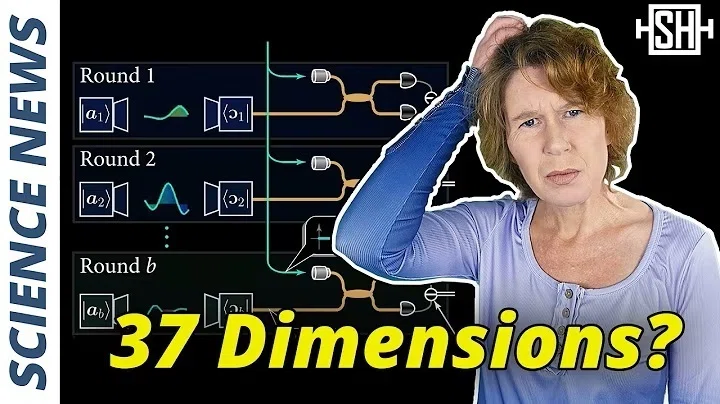
P.S. I've been attracted (not attacked) by the number 37, which, however, is not the reason why I picked up this video of "37 Dimensional Quantum Paradox To Improve Quantum Computing".
■
