[Power and Altitude] in Kojiki, 古事記に見る [権威と高度]

Language and Expression, Index, 言語と表現, インデックス へ
-----
2024.7.15 presented in [note] ( //note.com/runningWater/]
----------
1 Introduction, はじめに
In ,
Stage of Power and Altitude, 権威と高度の舞台
において、
I explained about [Framework of Power and Altitude stage], using the Myth of [Transfer of [Ashiharano-Nakatsukuni]].
私は、[Transfer of [Ashiharano-Nakatsukuni]], [[アシハラノナカツクニ]の譲渡]の神話を、使って、 [Framework of Power and Altitude stage] について、述べた。
This myth is described in [Kojiki], a book established in ancient Japan.
In this content (that you are now reading), focusing on some different stories, in the [Kojiki], I tried to analyze the structure of that, based on [Framework of Power and Altitude stage].
この神話は、[古事記]という、古代日本に成立した書籍の中に、書かれているものだ。
この(あなたが今、読んでいる)コンテンツにおいては、古事記の中の、別の神話に注目し、その構造を、[Framework of Power and Altitude stage]にもとづいて、解析してみた。
The method of analysis would be as follows,
The synopsis is given in chronological order,
and [the composition of the scene] is shown, at various points.
I hope, you will read this presentation, as if, you were looking at a construction site, where a stage is being set up.
そのあらすじを、時間順に述べながら、
その所々で、[その場面の構図]を示す、
というような方法で、説明を行っていく。
舞台の設営の工事現場を見るような感じで、読んでいっていただければよいかと、思う。
----------
2 The Myth of [Islands of Japan Creation], 日本列島・生成の神話
2.1 Location Setting, 場所の設定
In this scene of [Kojiki], the following fields are set.
古事記のこの場面においては、以下のような、場が、設定される。
[Takamaga-hara]
[タカマガハラ(高天原)]
[Ameno-ukihashi]
[アメノウキハシ(天の浮橋)]
[Ocean]
[大洋]
-----
[Takamaga-hara]
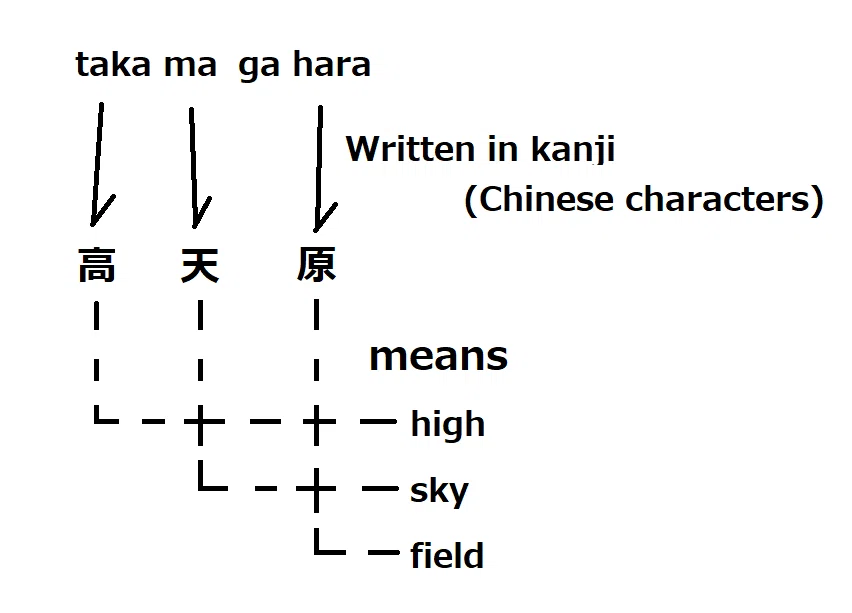
The notation for [Takamaga-hara],
consists of
three [kanji ( Chinese character)], as seen in the figure below (Fig 2.1).
Two of which (the character, that means [high], the character, that means [sky] ) are
reminiscent of "high place".
Therefore, it is suggested that,
this filed has a large altitude value.
[タカマガハラ(高天原)](という地名の表記)は、
下図(Fig 2.1)に見るような、
3個の漢字
から成っているのだが、そのうち2個の文字(高、天)は、
「高い所」
を連想させるようなものである。
ゆえに、
この地は、大きな標高値を持つ場所である
ということを、示唆している。
-----
[Ameno-ukihashi]
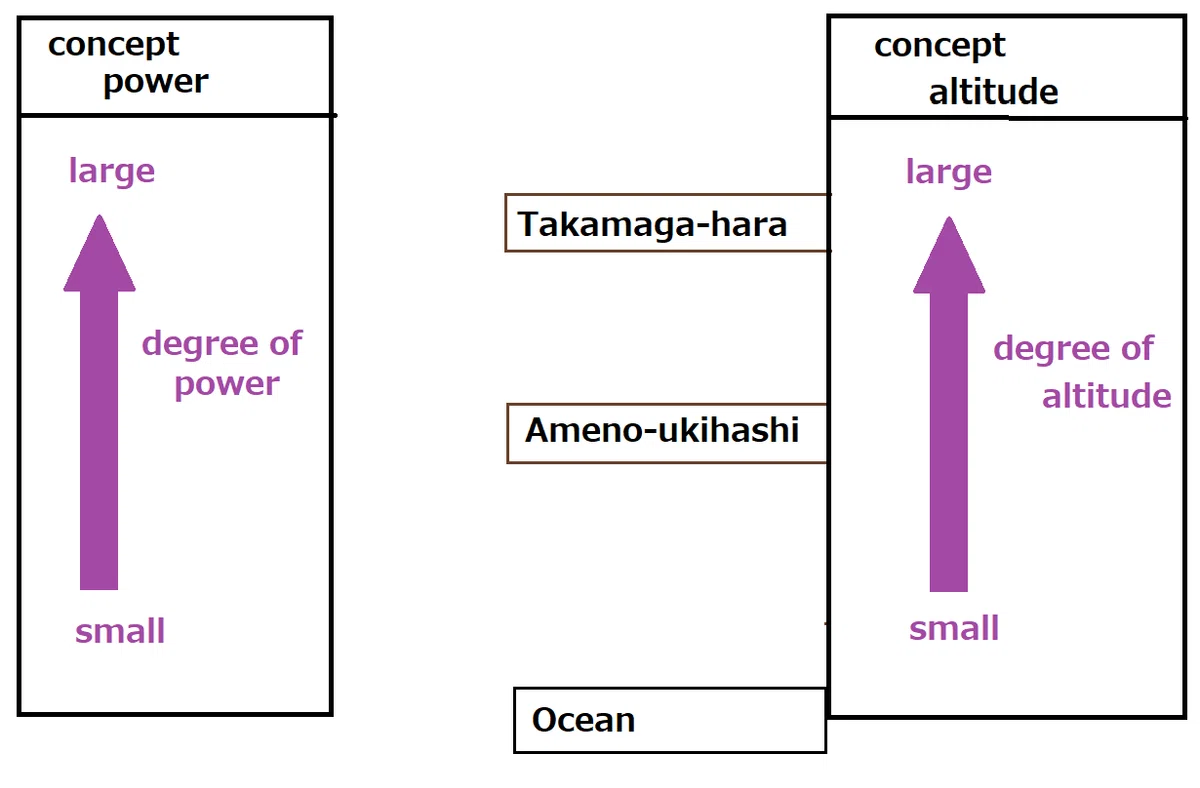
Considerring (phase 3) (described later, in section 2.2),
we are able to consider,
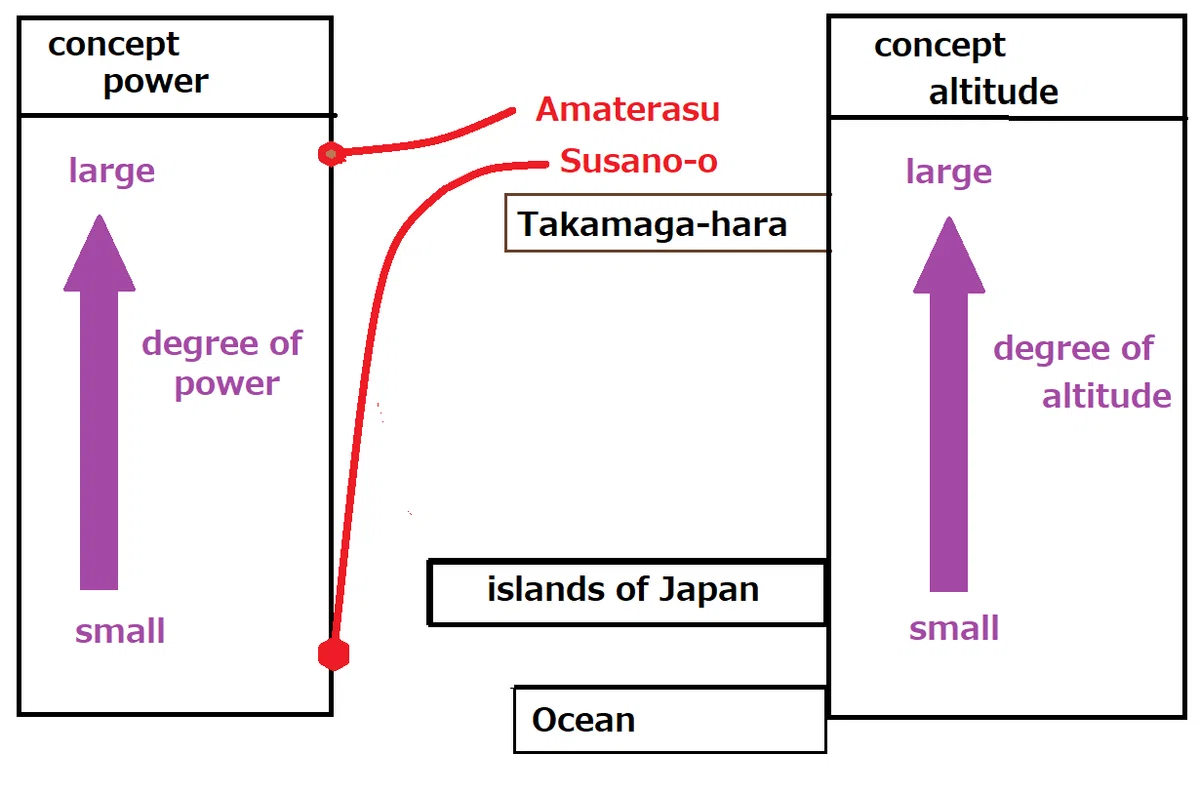
[Ameno-ukihashi] is located between
[Takamaga-hara] and [Ocean].
So, these three fields can be placed,
in the space of the [Framework of Power and Altitude stage],
as shown in the figure below.(Fig 2.2)
後述の (phase 3) ( section 2.2 中の) を考察すれば、
[Ameno-ukihashi] は
[Takamaga-hara] と [Ocean]
との間にある、としてよい。
よって、これら3個のフィールドを、下図(Fig 2.2)のように、
[Framework of Power and Altitude stage], の空間上に、
位置づけしてよいと、考えられる。
----------
2.2 Now, the curtain has opened, さぁ、幕が開いた
Hereafter, let us proceed, according to the plot, as written in [Kojiki].
以下、古事記に書かれている筋書にそって、進行させていこう。
-----
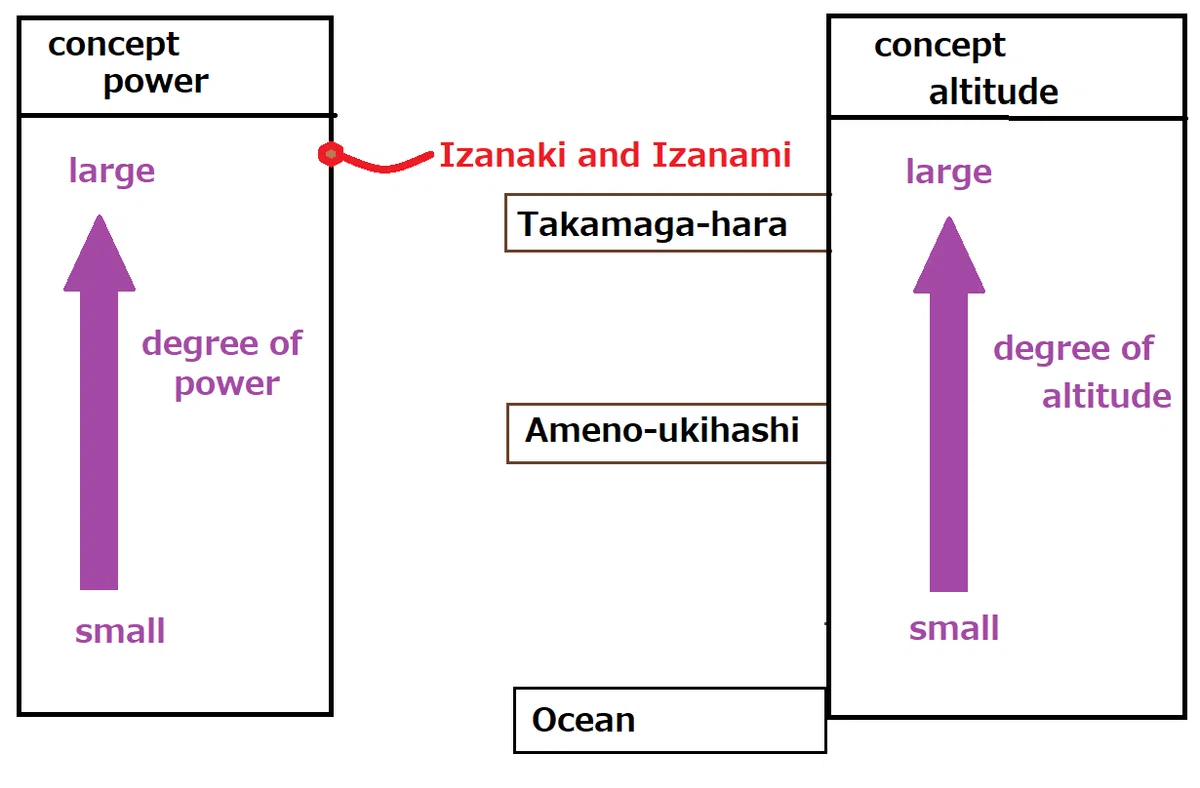
(phase 1) After the separation of sky and earth, various [kami] arosed in [Takamaga-hara]. Among them, were [kami], named [Izanaki], and [kami] named [Izanami].
天と地が分かれた後に、[Takamaga-hara]に、諸々の[kami(神)]が発生した。それらの中に、[Izanaki(イザナキ)] という名の[kami], [Izanami(イザナミ)] という名の[kami] がいた。
It is impossible, to describe the concept of [Kami], in this short space. If you are interested, you may find some information on the Internet, using the following keywords.
[Japanese Kami Shinto]
[Kami(神)]という概念について、この短いスペースにおいて、それを説明する事は、不可能である。興味があれば、下記のキーワードを使って、インターネットを使って調べてみれば、情報を得られるかもしれない。
[Japanese Kami Shinto]
[日本 神 概念]
[日本 神道]
-----
(phase 2) [Kami] requested [Izanaki and Izanami], to carry out a major land development project, [Islands Japan Creation].
[kami] たちは、[Izanaki and Izanami]に対して、[日本列島・造成]という一大事業の遂行を、要請した。
-----
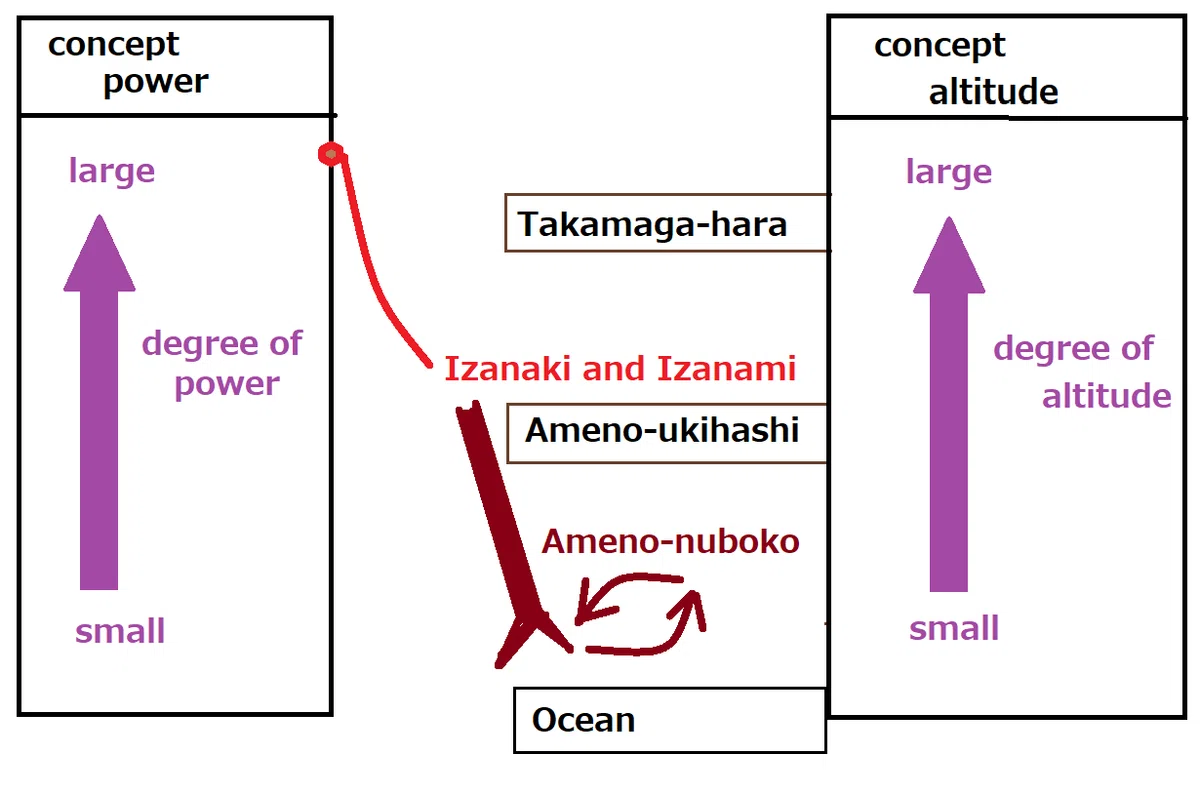
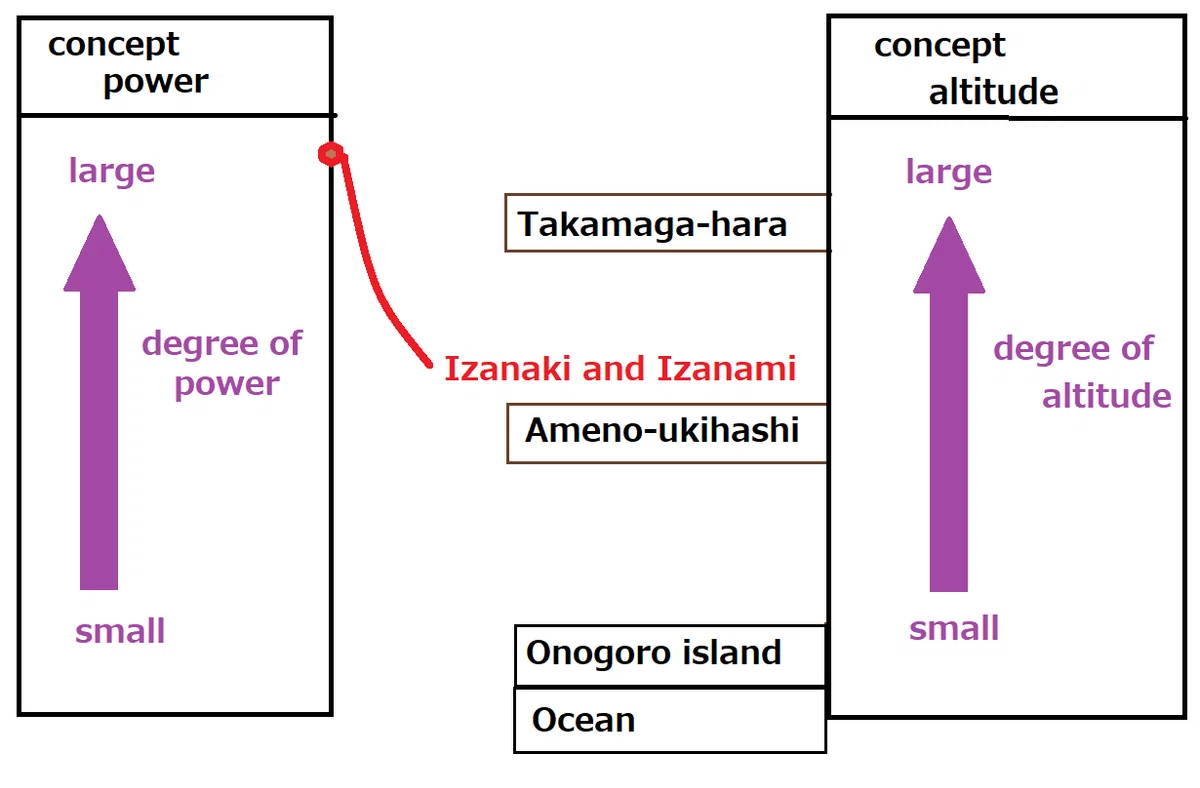
(phase 3) In response to that request, [Izanaki and Izanami] stood on [Ameno-ukihashi]. And, [Izanaki and Izanami] inserted [Ameno-nuboko] into [Ocean], and [drew].
その要請に対応するために、[Izanaki and Izanami]は、[Ameno-ukihashi](アメノウキハシ)(天の浮橋)の上に立った。そして、[Izanaki and Izanami]は、[Ameno-nuboko(アメノヌボコ)(天の沼矛)]を「指し下ろして」「画」いた。
-----
(phase 4) When [Ameno-nuboko] was pulled up, seawater dripping from its tip, piled up on [Ocean], and formed an island. This is called [Onogoro island].
[Ameno-nuboko]を引き上げる際に、その先端からしたたり落ちる海水が、重なり積もって島ができた。これを、[Onogoro island][オノゴロ島]という。
-----
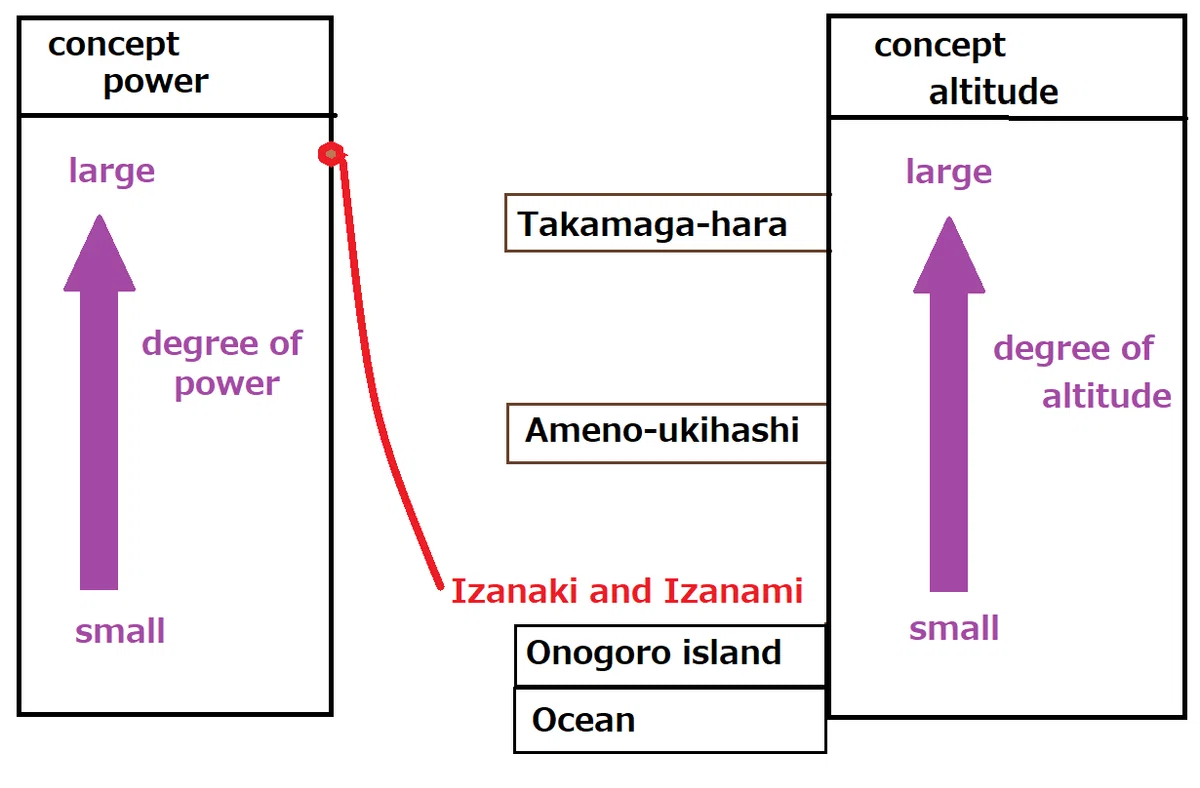
(phase 5) [Izanaki and Izanami] descended on [Onogoro island].
[Izanaki and Izanami] は、[Onogoro island]に、「天降り(あもり)」した。
-----
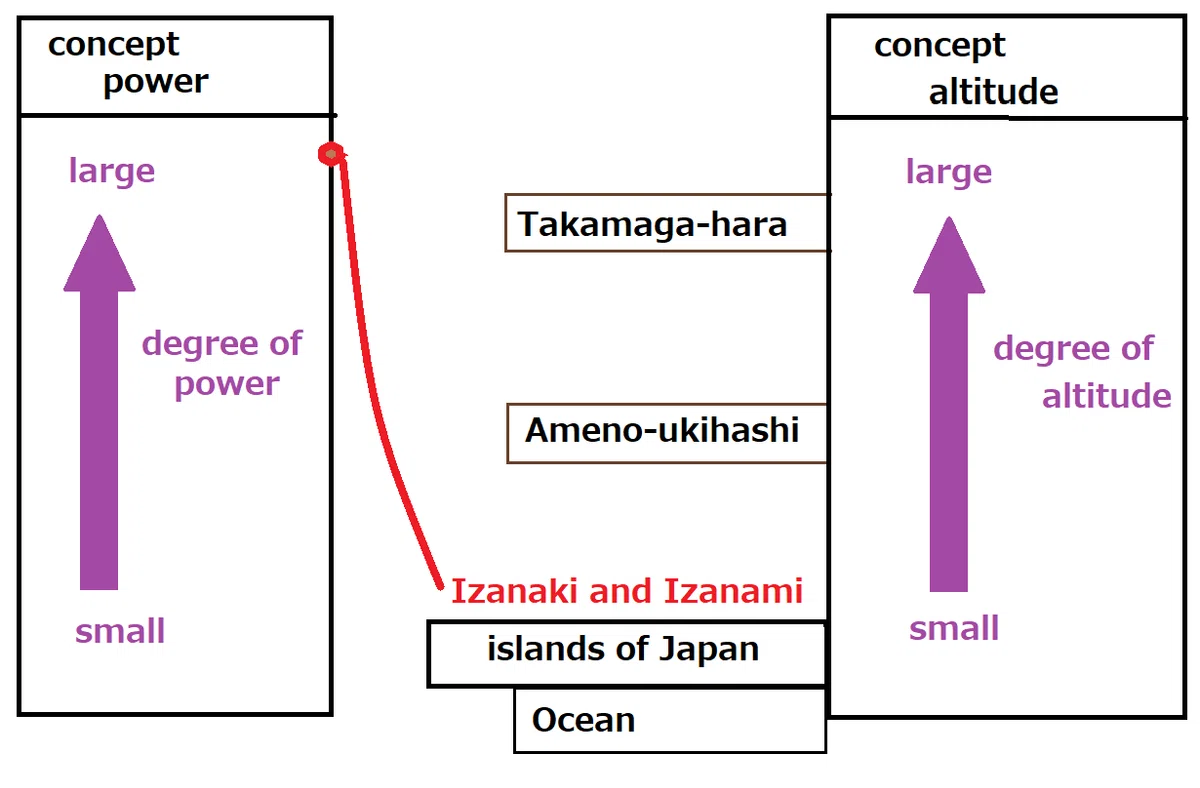
(phase 6) On that island, [Izanaki and Izanami] gave birth to the other islands, that make up [islands of Japan], including Awaji Island, Shikoku, and Kyushu.
その島の上で、[Izanaki and Izanami]は、淡路島、四国、九州等の、日本列島を構成する他の島を、生んでいった。
----------
3 [Amaterasu] and [Susano-o], [アマテラス]と[スサノオ]
-----
(phase 7) [Izanaki] gave birth to
[Amaterasu]
[Tsukuyomi]
[Susano-o].
[Izanaki] は、
[Amaterasu](アマテラス)
[Tsukuyomi](ツクヨミ)
[Susano-o](スサノオ)
を、産んだ。
-----
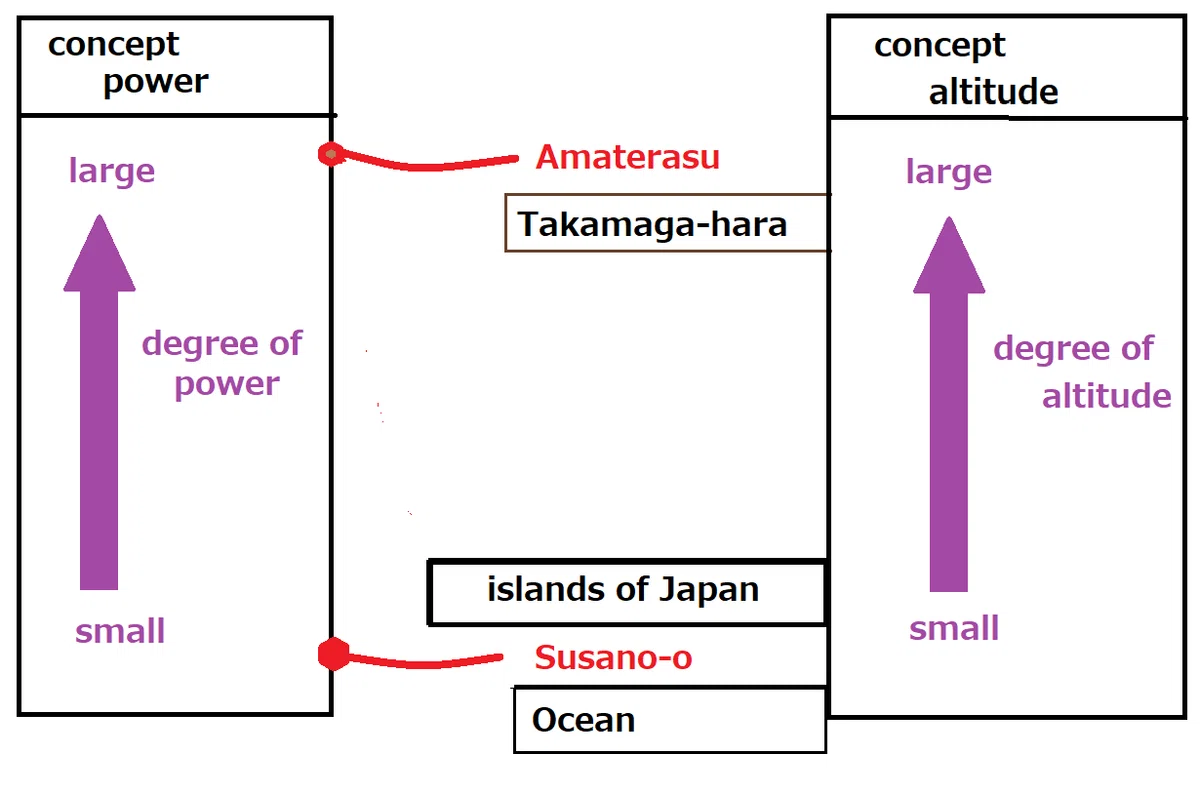
(phase 8) [Izanaki] appointed these children, as rulers.
"Amaterasu, you shall rule [Takamaga-hara]."
"Tsukuyomi, you shall rule [Night World]."
"Susano-o, you shall rule [Ocean]."
[Izanaki]は、この子たちを、統治者に任命した。
"Amaterasu よ、君は、[Takamaga-hara] を、統治しなさい"
"Tsukuyomi よ、君は、[夜の世界]を、統治しなさい"
"Susano-o よ、君は、[Ocean](大洋)を、統治しなさい
This scene is reminiscent of the territorial division of Zeus, Poseidon, and Hades, in Greek mythology.
ギリシア神話の、ゼウス、ポセイドン、ハーデースの、テリトリー分割を連想させるような、シーンである。
-----
(phase 9) [Susano-o] abandoned the governance of the delegated territory, and continued to cry.
[Susano-o] は、委任されたテリトリーの統治を放棄し、泣きわめき続けた。
-----
(phase 10) [Izanaki] asked [Susano-o],
Izanaki___ Hey, hey, why on earth, are you crying all the time? I entrusted you with the governance of [Ocean], but, you did nothing...
Susano-o___ I want to go to [Katasu land]! I heard that, my mother is in there. When I think of her, tears in my eyes, tears, tears....
(There are various theories, as to where [Katasu land] is located.)
Izanaki___ (very angry) Then go! Get out!
[Izanaki]は、[Susano-o]に問うた。
Izanaki___ おいおい、いったいなんで、泣いてばかり、いるんだぁ? 大洋の統治、おまえに託したのに、なにもせずに・・・。
Susano-o___ 母上がおられるという、[Katasu land]に、行きたいんだ。母上のこと、思うと、涙が出てきて・・・。
([Katasu land]がある場所については、様々な説があるようだ)
Izanaki___ (大いに怒り)じゃ、行くがいい! 出てけ!
-----
(phase 11) [Susano-o] thought that,
First, let's go to my sister's place. After that, I will go to [Katasu land].
[Susano-o]は、考えた、
Susano-o___まずは、姉さんのとこへ、行ってみると、しようかい。その後、[Katasu land]へ行こう。
-----
(phase 12) [Susano-o] went to [Takamaga-hara] (ruled by [Amaterasu]).
[Susano-o] は、 [Takamaga-hara] ([Amaterasu] によって、統治されている)に行った。
-----
(phase 13) [Susano-o] caused so much trouble in [Takamaga-hara], and, finally, he was expelled from [Takamaga-hara].
(The climax of the story is the [scene at Ama-no-Iwato].)
[Susano-o] は、 [Takamaga-hara]で様々のトラブルを起こし、ついには、[Takamaga-hara] から追放されてしまった。
(そのストーリー中のクライマックが、天岩戸のシーンだ。)。
-----
(phase 14) [Susano-o]'s next stop after his banishment, was an area in [islands of Japan].
追放された [Susano-o]が、次に行った所は、日本列島の中のある地域であった。
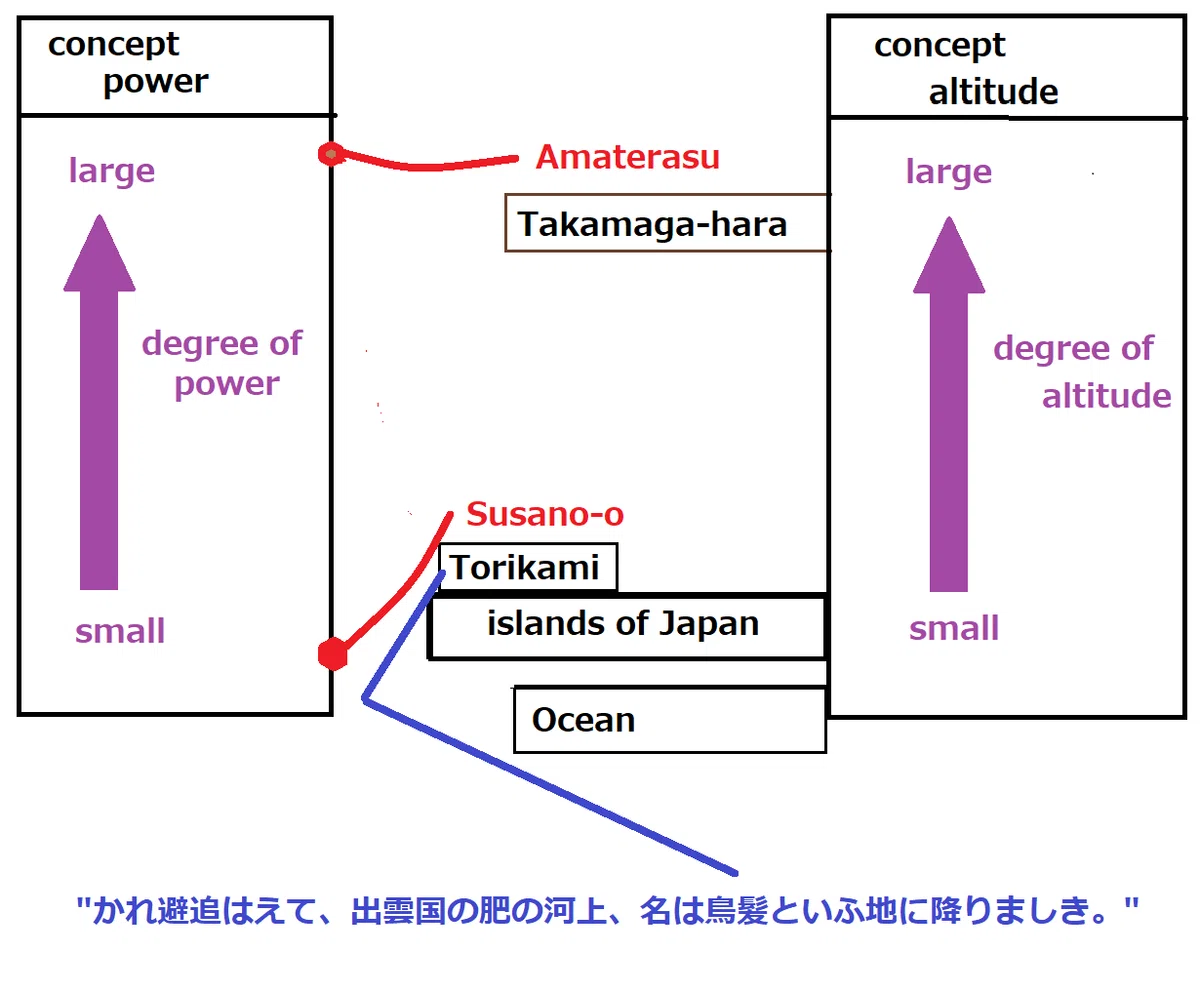
The blue text in the above figure, is a quotation from the description in [Ref. 1]. (This document is written in Japanese.)
上記の図の中に、青色の文字で表記されているのは、[文献1]から、引用したものである。(この文献は、日本語で書かれている。)
-----
(phase 15) [Susano-o] went to the upper reaches of the [Hi River] ( that flowed through the area), and, met [Ashina-zuchi] and [Tena-zuchi], and defeated [Yamata-no-orochi], in order to save their daughter, [Kushinada-hime].
([Yamata-no-orochi] is a monster, and that came there, to eat [Kushinada-hime].)
[Susano-o] は、(その地域を流れる)[肥の川]の上流の方へ行き、[Ashina-zuchi] (アシナヅチ)と [Tena-zuchi] (テナヅチ)に出会い、彼らの娘・[Kushinada-hime](クシナダヒメ)を救うために、[Yamata-no-orochi](ヤマタノオロチ)を、倒した。
([Yamata-no-orochi]は、怪獣であり、[Kushinada-hime]を食うために、そこに、やってきた。)
This tale belong to [genre Andromeda-type].
To defeat [Yamata-no-orochi], [Susano-o] used Sake (a Japanese alcoholic beverage).
このシーンは、アンドロメダ型・説話のジャンルに、分類されるものだ。
[Yamata-no-orochi]を、倒すために、[Susano-o]が用いたのは、Sake(日本のアルコール飲料)であった。
-----
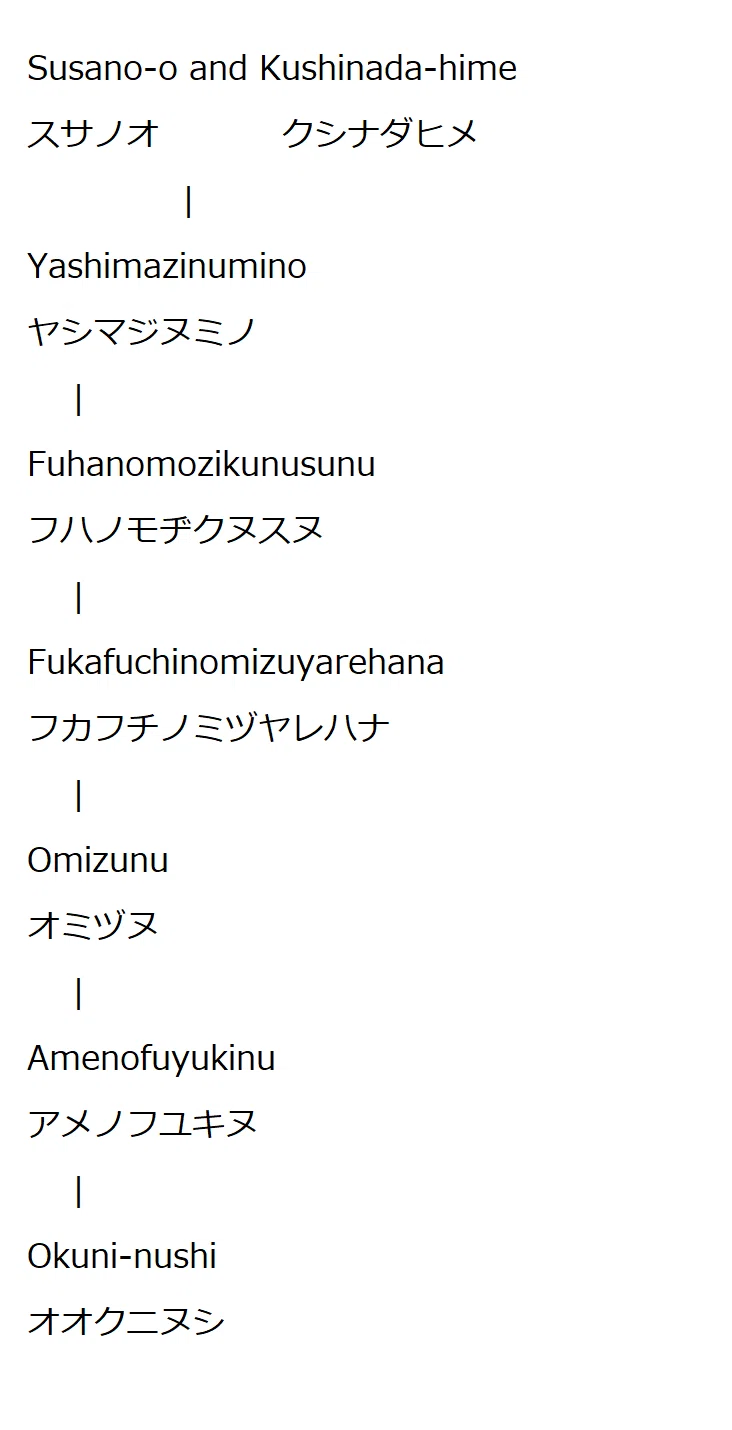
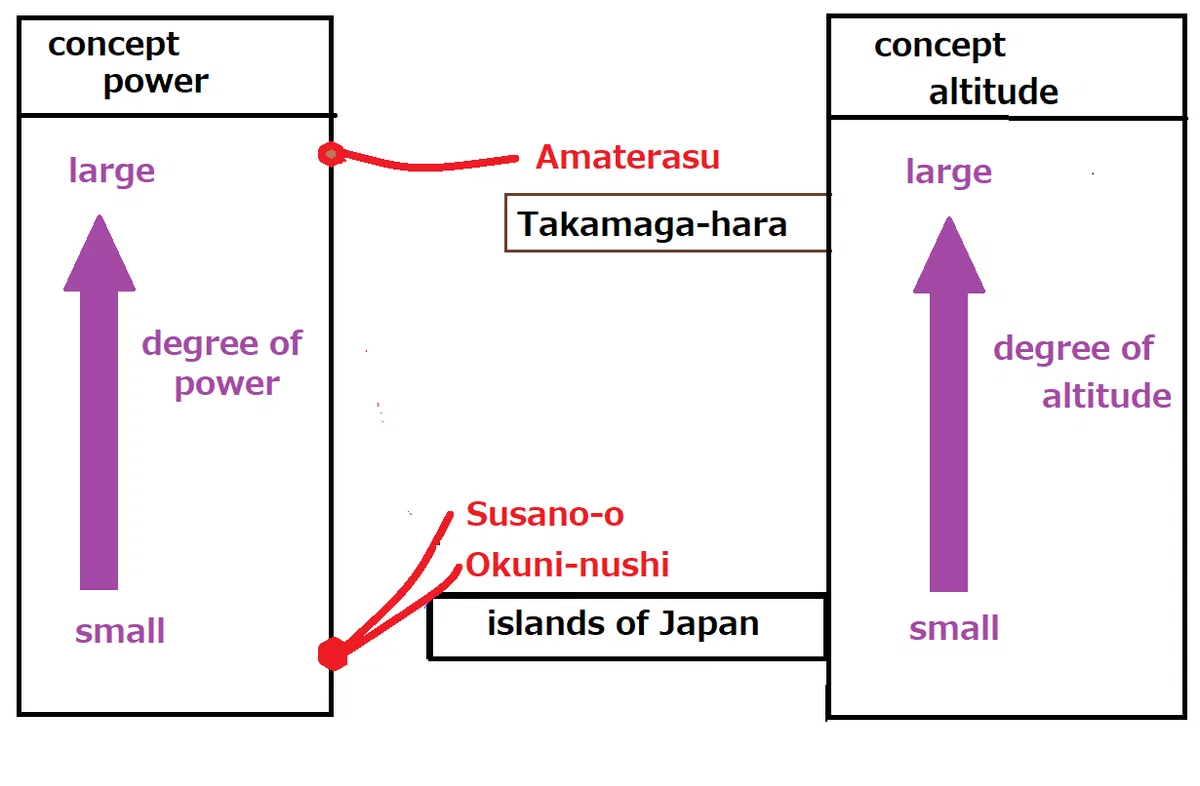
(phase 16) [Susano-o] married [Kushinada-hime], and settled in the place, named "Suga".
[Okuni-nushi], that will appear in the next phase, are their descendants.
[Susano-o]は、[Kushinada-hime]と結婚し、須賀に居を構えた。
次のフェーズで登場する、[Okuni-nushi]は、彼らの子孫なのだ。
----------
4 Shrine of Okuni-nushi, オオクニヌシの神殿
Afterwards, the region of [Ashiharano-Nakatsukuni] became to be ruled by [Okuni-nushi].
その後、[Ashiharano-Nakatsukuni]という地域が、[Okuni-nushi]によって統治されるように、なった。
Then, the story moves on, and we get to
phase [Transfer of [Ashiharano-Nakatsukuni]],
introduced in
Stage of Power and Altitude, 権威と高度の舞台
そして、ストーリーは、進み、
Stage of Power and Altitude, 権威と高度の舞台
で紹介した、
[Transfer of [Ashiharano-Nakatsukuni]], [[アシハラノナカツクニ]の譲渡]
の段階になる。
The following statement is included in the above content.
上記のコンテンツ中に、下記の記述がある。
=====
(13)To resolve the situation, [Take-mikazuchi] and another members, were sent. As a result of their strong pressure ( to [Okuni-nushi] ), [Okuni-nushi] agreed to hand over [Ashiharano-Nakatsukuni] to [Amaterasu].
事態打開のために、[タケミカヅチ]たちが、派遣された。彼らからの、強圧の結果、[オオクニヌシ]は、[アシハラノナカツクニ]を、[アマテラス]に譲ることに、同意した。
=====
At this time, [Okuni-nushi] did not surrender unconditionally. The contents of the conditions he proposed, are described in the [Kojiki], and are shown in [Ref. 1](166p --- 167p), as shown in the figure below.
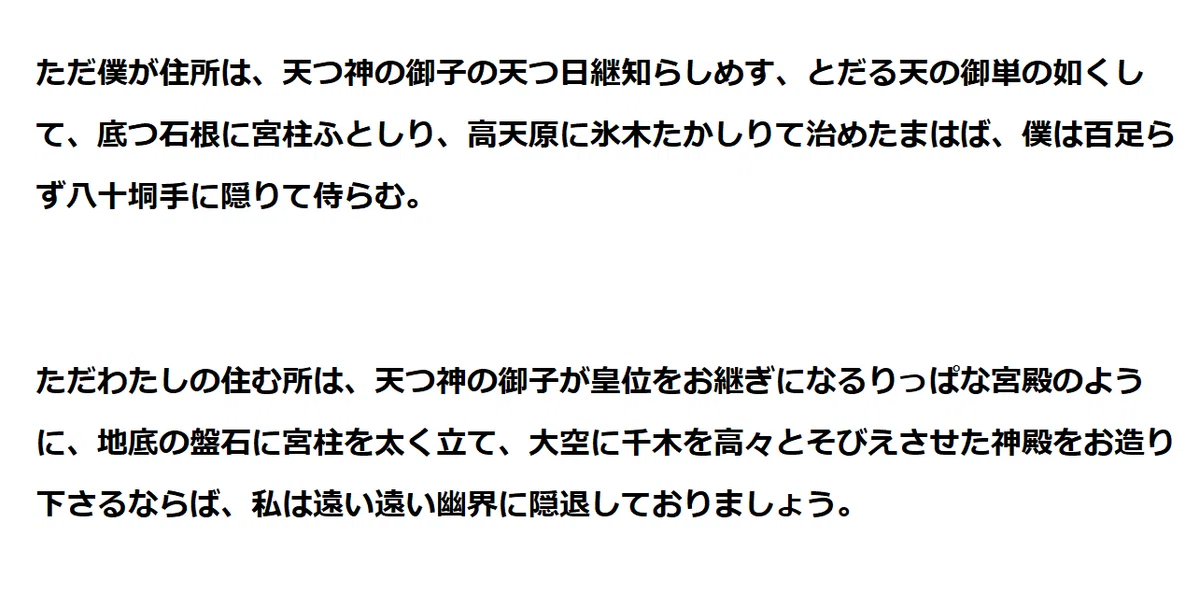
The upper part of the text is the original text of the [Kojiki], rewritten by the author of [Document, Ref. 1], in the same style as the original, to make it easier for us to read.
The lower part of the text is a translation of the upper part into modern Japanese, by the author of [Document, Ref. 1].
この時、[Okuni-nushi]は、無条件降伏したのではない。彼が提示した条件の内容が、[古事記]に記されており、[Ref. 1, 文献1](166P ~ 167P)には、下記のように、その内容が示されている。
-----
(古事記の原文を、そのスタイルのままに、我々にとって読みやすいように、[文献1]の著者が、書き直したもの)
ただ僕が住所は、天つ神の御子の天つ日継知らしめす、とだる天の御単の如くして、底つ石根に宮柱ふとしり、高天原に氷木たかしりて治めたまはば、僕は百足らず八十垌手に隠りて侍らむ。
-----
(上記の内容を、[文献1]の著者が、現代日本語に、翻訳したもの)
ただわたしの住む所は、天つ神の御子が皇位をお継ぎになるりっぱな宮殿のように、地底の盤石に宮柱を太く立て、大空に千木を高々とそびえさせた神殿をお造り下さるならば、私は遠い遠い幽界に隠退しておりましょう。
-----
Here is my interpretation of this condition, presented by [Okuni-nushi].
[Okuni-nushi]が提示した、この条件を、私なりに解釈した結果は、以下の通りである。
-----
[Okuni-nushi] says,
オオクニヌシ いわく、
The terms of surrender are as follows.
降伏条件は、以下の通りだ。
If
[the forces, to that you ([Take-mikazuchi]) belong]
( that is , [Takamaga-hara]-force )
will build for me
a magnificent shrine,
then,
I may transfer [Ashihara-nakatsukuni].
君([Take-mikazuchi])が所属する勢力(すなわち、 [Takamaga-hara]勢力)
が、
私のために、立派な宮殿を建ててくれる
、というのであれば、
私は、[アシハラノナカツクニ]を、譲渡しても、よい。
As for the appearance of the shrine, I want, as follows,
その宮殿の様に関しては、以下のように、してほしい、
Place stone blocks, at the bottom of the earth, and build thick pillars, on top of them.
On top of the roof, set up a Chi-gi.
The height of the shrine shall be so high, that the Chi-gi shall soar high, into the sky.
Make it similar to the shrine, that [Amatsu-kami-no-miko] uses, when he succeeds to the [throne], and make it no less, than the shrine.
If such a shrine is to be built for me, then I may transfer [Ashihara-nakatsukuni], and retire to [World of the Dead], which is far away.
地底に、盤石を置き、その上に、太い柱を立てよ
屋根の上には、千木を設置せよ
宮殿の高さは、その千木が、大空に高々とそびえるような、高さに、せよ
[Amatsu-kami-no-miko](天つ神の御子)が、[throne](位)を継承する時に使う神殿に、似たようなものとし、それと比べて、何ら遜色ないようなものに、せよ
そのような神殿が、私のために造成されるのであれば、私は、、[アシハラノナカツクニ]を、譲渡し、遠き所にある[幽界]に、隠退してもよい
-----
[Okuni-nushi] expects [[power] and [altitude]], as shown in the figure below.
下図のような、[[権威]と[高度]]を、[Okuni-nushi]は、期待しているのだ。
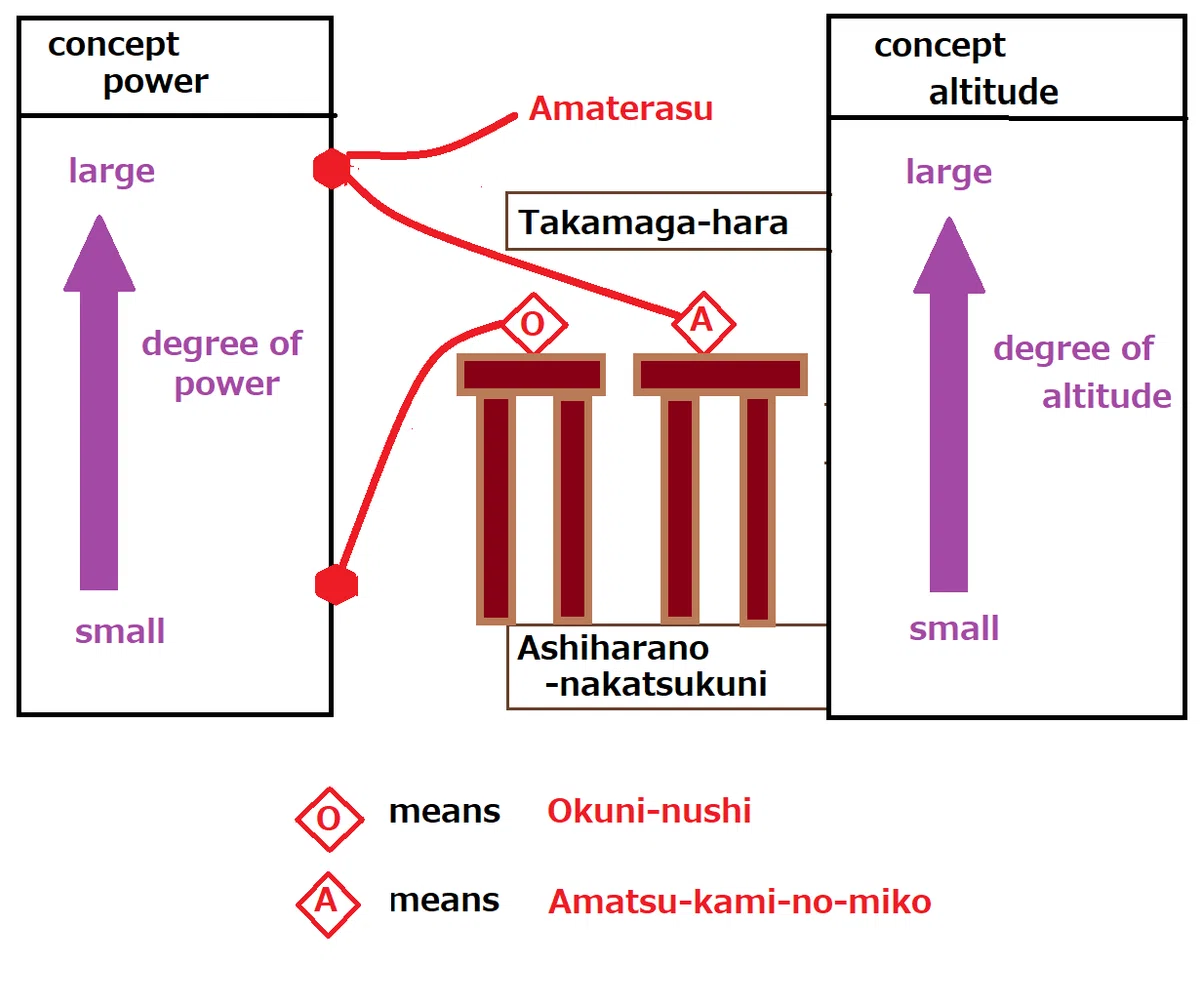
In above figure,
why,
the tip of the [power] rope, of [Amatsu-kami-no-miko]
is in the same position as
that of [Amaterasu]?
This matter is discussed, in the next section ( 5 ).
上図において、いったいなぜ、
[Amatsu-kami-no-miko](天つ神の御子)の、[権威]のロープの先端
が、
[Amaterasu]のそれと
同じ位置にあるのか?
その件については、次の節( 5 )で述べる。
If [Okuni-nushi] is able, to position himself,
at the [altitude], shown in the above figure (Fig 4.2),
he can shift
the location of
[the tip of [Okuni-nushi]'s [power] rope],
to upper side,
by reasoning that,
[Okuni-nushi] and [Amatsu-kami-no-miko] are, at the same altitude (on the floor of each shrine ).
Then,
the location of
[the tip of [Okuni-nushi]'s [power] rope]
and
the location of
[the tip of [Amaterasu]'s [power] rope]
will be at
the same level.
上図(Fig 4.2)にあるような高度に、自らを位置せしめることができるならば、
[Okuni-nushi]は、
[Okuni-nushi]の[権威]のロープの先端の位置
を、
[Amatsu-kami-no-miko]の[権威]のロープの先端
と、同じレベルの位置
へと、
シフトすることが、できる、
[Okuni-nushi]と[Amatsu-kami-no-miko]は、同じ[altitide](高度)を持つ場所(それぞれの、神殿の床の上)に、いるのだから
、という理由付けを行うことにより。
そして,
[Okuni-nushi]の[権威]のロープの先端の位置
と
[Amaterasu]の[権威]のロープの先端の位置
は、
同等のレベルにあり、ということになる。
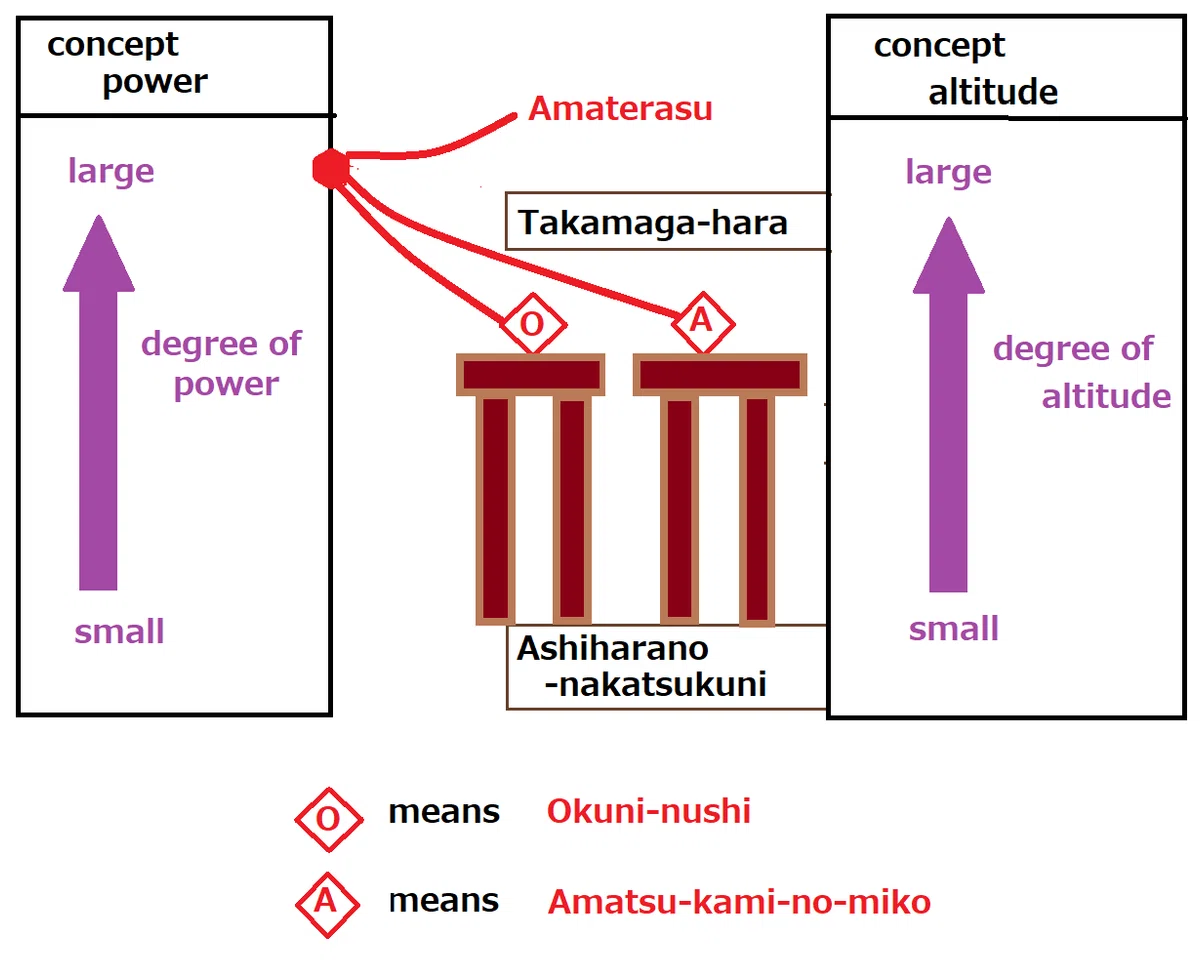
That is,
With this transfer,
[Okuni-nushi]
can raise [power] of him
to the same level as
the [power] of [Amaterasu],
in one stroke.
すなわち、この譲渡を契機として、
[Okuni-nushi]は、
自らの[権威]を、
一挙に、
[Amaterasu]の[権威]
と同等のレベルにまで、
高めることが、できるのだ。
----------
5 Who is [Amatsu-kami-no-miko], [天つ神の御子]とは、誰のことなのか?
In [Document, Ref. 1], it is considered that,
[Amatsu-kami-no-miko] = [one, who is a descendant of [Amaterasu]'s lineage].
[文献1]では、 [天つ神の御子]とは、
[[Amaterasu]の系統を受け継ぐ者]
と、されている。
This means, in other words,
[Ninigi] and some of his descendants,
who appear ( in [Kojiki] ),
after
the handing over of [Ashiharano-Nakatsukuni]( by [Okuni-nushi] ).
They will continue to hold [a certain power], inherited from [Amaterasu].
すなわち、
[古事記]の
[Ashiharano-Nakatsukuni]の譲渡([Okuni-nushi]による)の後の段階に登場する、
[Ninigi]と、その子孫のたちの一部
を、意味しているのだ。
彼らは、[Amaterasu]から継承された、[ある権威]を、保持し続けていくのである。
In,
Stage of Power and Altitude, 権威と高度の舞台
there is the description, as follows,
=====
(14)And, [Ninigi] ([Amaterasu]'s grandson) [descend], from [Takamaga-hara], to [Ashiharano-Nakatukuni] (to rule over [Ashiharano-Nakatskuni]).
=====
Stage of Power and Altitude, 権威と高度の舞台
には、下記のように、ある
=====
(14)And, [Ninigi] ([Amaterasu]'s grandson) [descend], from [Takamaga-hara], to [Ashiharano-Nakatukuni] (to rule over [Ashiharano-Nakatskuni]).
そして、[ニニギ](アマテラスの孫)が、[アシハラノナカツクニ]へ、([アシハラノナカツクニ]を統治するために)、[天降り(あまくだり)]した。
=====
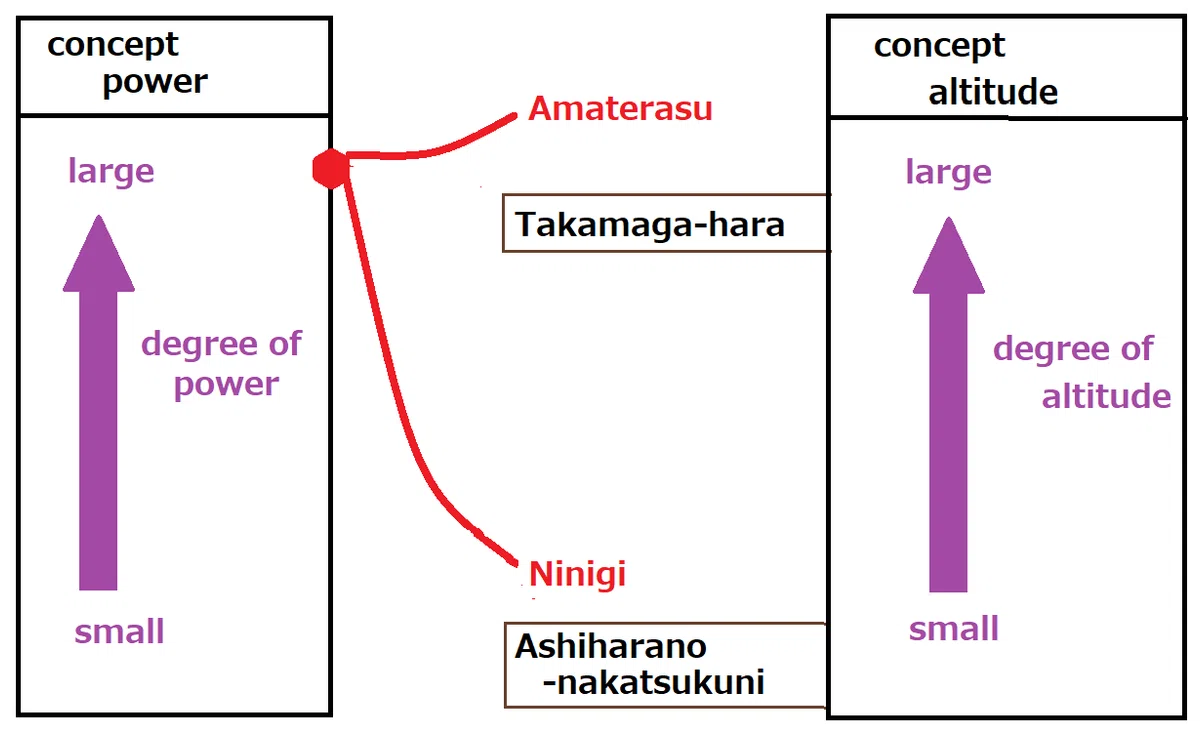
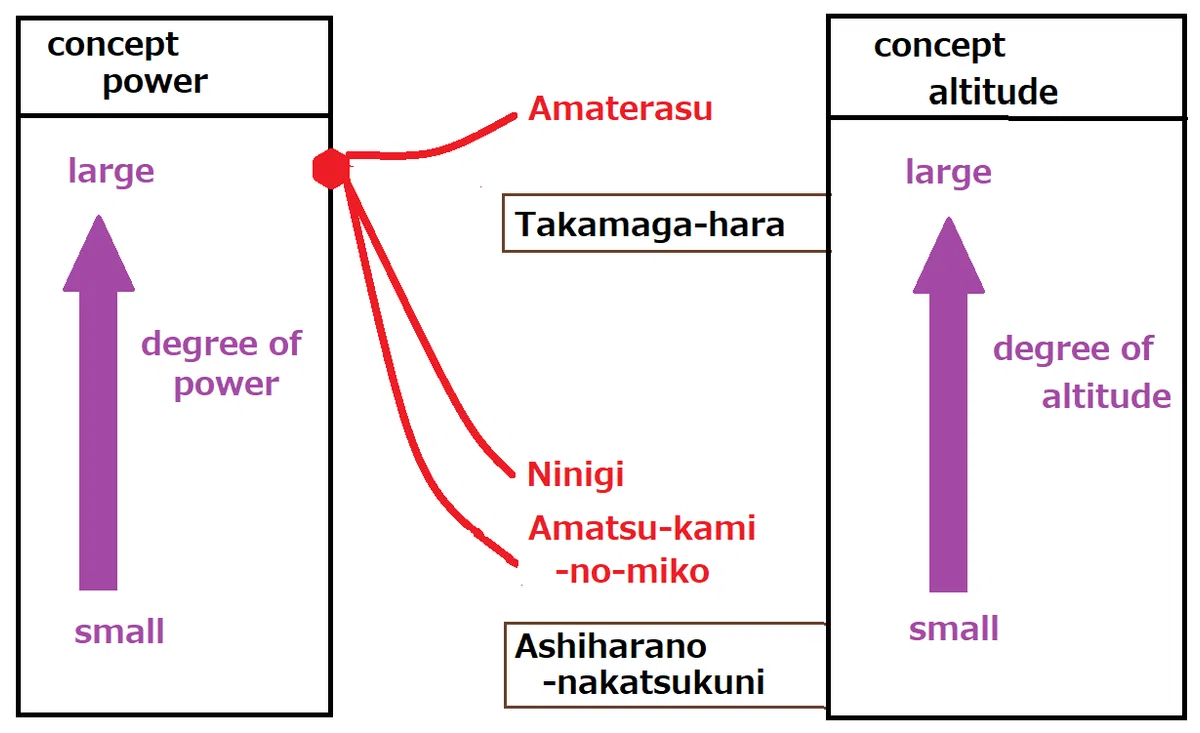
That is,
The [a certain power] have been inherited,
from [Amaterasu] to [Ninigi],
and,
from [Ninigi] to [Wakamikenuno].
and,
from [Wakamikenuno] to the successive emperors of Japan.
Hence,
[the location of the tip of the rope of [power]]
of [Amatsu-kami-no-miko]
is
in the same location as
that of [Ninigi], and that of [Amaterasu].
その、[ある権威]は、
[Amaterasu] から [Ninigi] へ,
[Ninigi]から、[Wakamikenuno](ワカミケヌノ)へ、
[Wakamikenuno]から、日本の歴代の天皇へ
と、継承されている権威なのである。
ゆえに、
[[Amatsu-kami-no-miko]の[権威]のロープの先端の位置は、[Ninigi]のそれと同じ位置にあり、[Amaterasu]のそれと同じ位置にあるのだ。
In Japan, this [a certain power] is called "koo-i". In other words, it is the [throne of the emperor].
日本では、この[ある権威]のことを、[皇位]と称している。すなわち、[天皇の位]のことである。
In Japan, [Wakamikenuno] is also known as [Emperor Jinmu].
日本では、[Wakamikenuno](ワカミケヌノ)は、[神武天皇]という名でも、知られている。
----------
6 There is a matter that is difficult to understand, 不可解な事が、ある
It is not possible that, the words "Amatsu-kami-no-miko" (as in [Kojiki]) could come from the mouth of [Okuni-nushi].
Because, at the time of this transfer of land, [Ninigi] had not yet descended from [Takamaga-hara] to [Ashiharano-Nakatukuni], and so, his descendants were not present on [islands of Japan].
[Okuni-nushi] would never, mention someone, who does not exist, at that time.
[Okuni-nushi]の口から、"天つ神の御子"、という言葉が発せられる(古事記にあるように)、というような事は、ありえない。
なぜならば、この国譲りの時点においては、[Takamaga-hara]から[Ashiharano-Nakatukuni]へは、[Ninigi]は未だに、下降していない、だから、その子孫たちは、日本列島の上に、存在していない。
その時に存在していない人について、[Okuni-nushi]は、決して、言及することはないだろう。
----------
7 The Great Excavation, 大いなる発掘,
In 2000, mysterious wooden pillar mark were excavated, in the area of [Izumo Taisha Shrine].
It is said, to be the remains of three large wooden pillars, each over 1 m in diameter, and 3 m in diameter.
([Okuni-nushi] is enshrined at this shrine.)
An Internet search, using the following keywords, may provide you with information on this.
[Izumo Taisha massive pillar]
2000年に、出雲大社の境内で、不思議な木柱痕が、発掘された。直径1mをこえる大木の柱痕、3本組みになっていて、径3m なのだという。
(この神社では、オオクニヌシが祀られている)
下記のキーワードを使って、インターネット検索すれば、これに関する情報を、あなたは、得ることができるかもしれない。
[Izumo Taisha massive pillar]
[出雲大社 発掘 柱]
[古代 出雲大社 本殿 復元]
----------
Ref. 1
[古事記(上)全訳注. 次田真幸. 講談社学術文庫 207 講談社] ( written by [Masaki Tsugita] )
