Special Forum - Hope from the Commons: The Future Connected by Social Common Capital

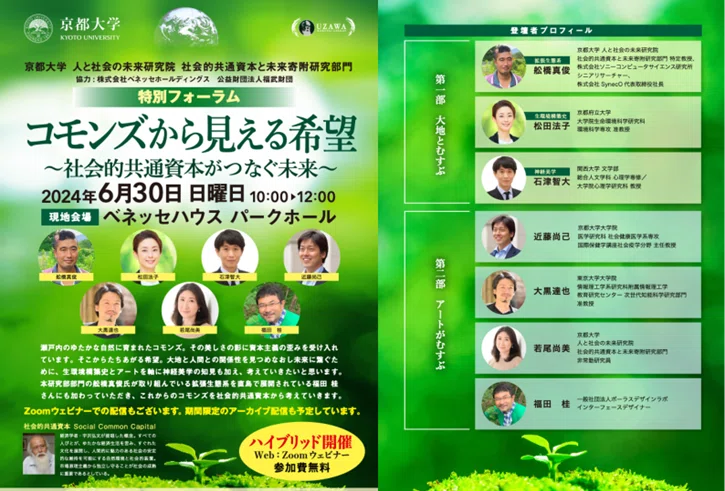
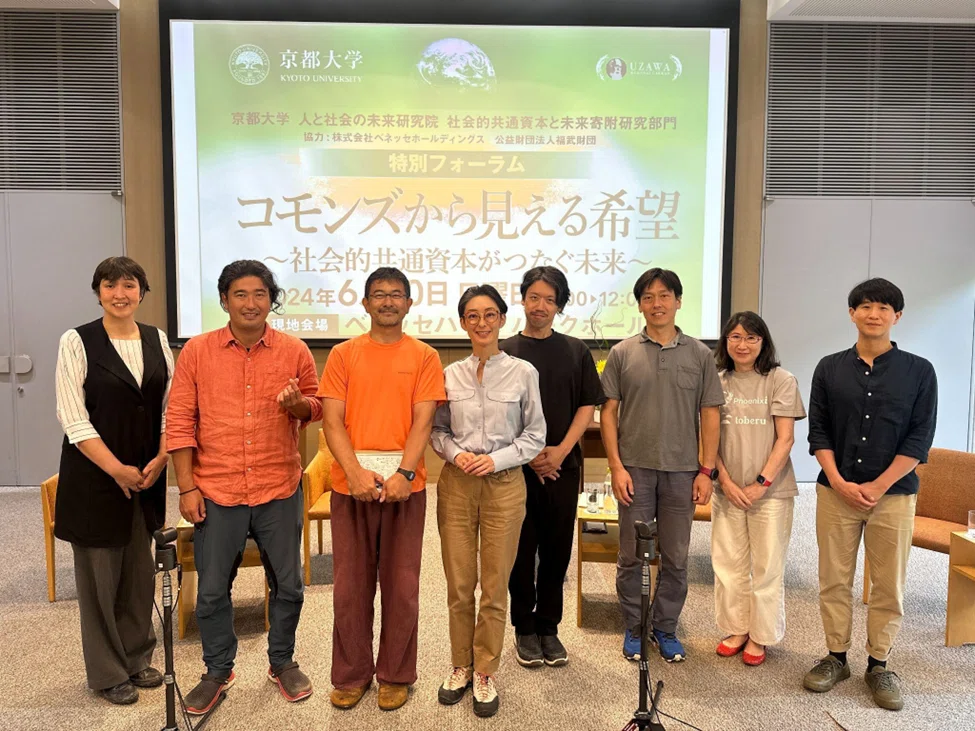
On June 30th, 2024, a special forum “Hope from the Commons: The Future Connected by Social Common Capital” was held at Benesse House Park Hall in Naoshima, Japan.
The forum aimed to explore the future of society through the lens of “Social Common Capital”, a concept advocated by the economist Hirofumi Uzawa (1928 - 2024).
Social Common Capital represents a framework to promote sustainable economy and social development while ensuring that everyone can lead a meaningful life. Uzawa emphasized that this framework should be treated as a shared asset of society.
The Seto Inland Sea, though serene and rich in natural beauty, hides a history often overlooked in the pursuit of economic growth.
However, the commons derived from the abundant nature offers us a hopeful path forward.
Key questions discussed included:
How can we re-examine the relationship between the land and humanity?
What can we do to ensure the prosperity we enjoy today is sustained for future generations?
This article summarizes a three-day visit to the islands of Seto Inland Sea and the special forum that concluded the trip.
This is the second installment following last year’s forum, “The Light and Shadow of Capitalism.” For details on this, please refer to the report provided below.
▼Study Tour Report: “The Light and Shadow of Capitalism”
https://note.com/sccf_ifohs/n/n56dce8033a0c?magazine_key=mf8bd36ed210f
Session Speakers:
PartⅠ:Connecting with the Earth
Masatoshi Funabashi
Program-Specific Professor, Institute for the Future of Human Society, KyotoUniversity/Senior Researcher, Sony Computer Science Laboratories, Inc./CEO, SynecO,inc.Noriko Matsuda
Associate Professor, Department of Environmental Science,Graduate School of Life and Environmental Sciences, Kyoto Prefectural UniversityTomohiro Ishizu
Professor, Department of Psychology, Faculty of Letters, Kansai University/Graduate School of Psychology, Kansai University
Part Ⅱ: Connecting through Art
Naoki Kondo
Professor, Department of Social Epidemiology,Graduate School of Medicine and School of Public Health,Kyoto UniversityTatsuya Daikoku
Associate Professor, Next Generation Intelligence Science Division,Information Technology Education and Research Center,Graduate School of Information Science and Technology, The University of TokyoNaomi Wakao
Research Fellow, Social Common Capital and Future Research Division,Research Institute for Future Human Society, Kyoto UniversityKei Fukuda
Interface Designer, Porous Design Lab
Day1
大島 - Oshima Island:
Our field trip began with a visit to Oshima Island.
Oshima Island has a history of forcibly isolating patients with Hansen’s disease (leprosy) for over 90 years due to government policies. Hansen’s disease is a condition primarily transmitted through bacterial droplets, causing symptoms such as skin lesions and deformities in the hands and feet. Since it was once considered an unknown and incurable disease, patients were labeled as “unclean” or “punished by God”, and were isolated from society due to the fear of infection.
Although medical advancements have made the disease curable, deep-seated prejudices kept many of the patients confined to the small island for decades. Most never returned to their hometowns and spent their entire lives there.
For more details on Oshima’s history and its art works, please refer to last year’s report.
相愛の道、リングワンデルング - “Path of Mutual Love, ‘Ringwanderung’”
This year, we visited the “Path of Mutual Love, ‘Ringwanderung’.” This trail, cleared by the patients themselves, led to a secluded space away from their living areas, where they could temporarily escape the constant reminder of their illness. It was a path filled with sentimental value for them.
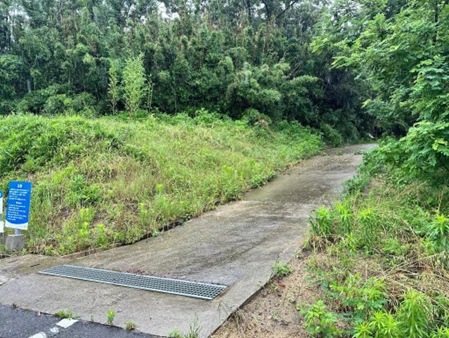
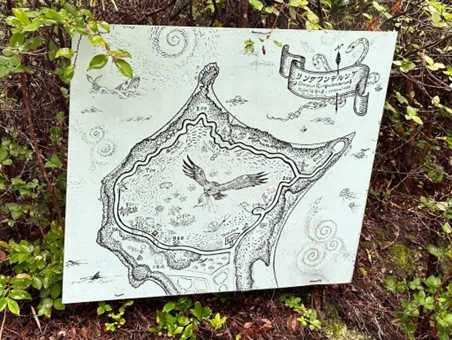
As we walked the trail in the rain, we could hear a variety of sounds—soil and leaves crunching underfoot, the rain hitting diverse plants, and the droplets falling from them.
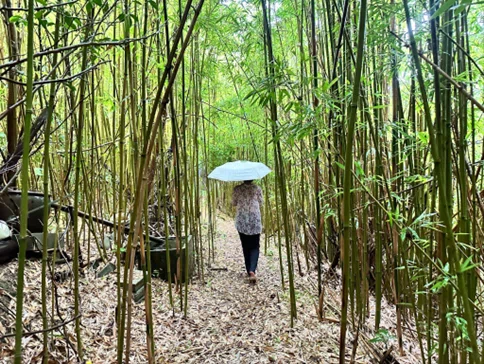
One of the main symptoms of Hansen’s disease is blindness, yet many former patients walked the mountain paths with remarkable energy, relying on their canes and other senses.
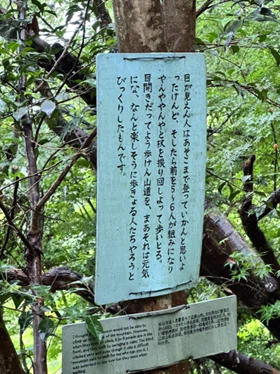
“I didn’t think blind people could make it that far up. But then, I saw five or six people ahead, waving their canes and walking. I was amazed to see them walking so happily on a mountain path that even people with sight would find difficult to navigate.”
Funabashi: "When people’s senses are limited, it may feel as though their world becomes narrower, but I realized that the drive to seek beauty remains unchanged.”
Today, former patients still live on the island, bearing witness to a history that was once ignored and forgotten.
Kondo: “The history of Hansen’s disease is not just a thing of the past. It is commendable that art has become a way to communicate this history, but it should not end with just appreciating the beauty of human resilience.”
Urabe: “As a doctor, I wonder if I would have been able to say, ‘You can return to your hometown now that the infection rate has decreased.’ What can we do to create a society where such a statement would be possible?”
The average age of the former patients now exceeds 85, and the number of residents has decreased to as few as 37 people. The history of isolation and discrimination was long concealed, and almost no official records remain.
How can we continue to pass down the history and memories of those times?
What must we do to ensure that such mistakes are never repeated?
We must confront this dark past head-on, refusing to turn away and strive for a future that embraces inclusivity and compassion.
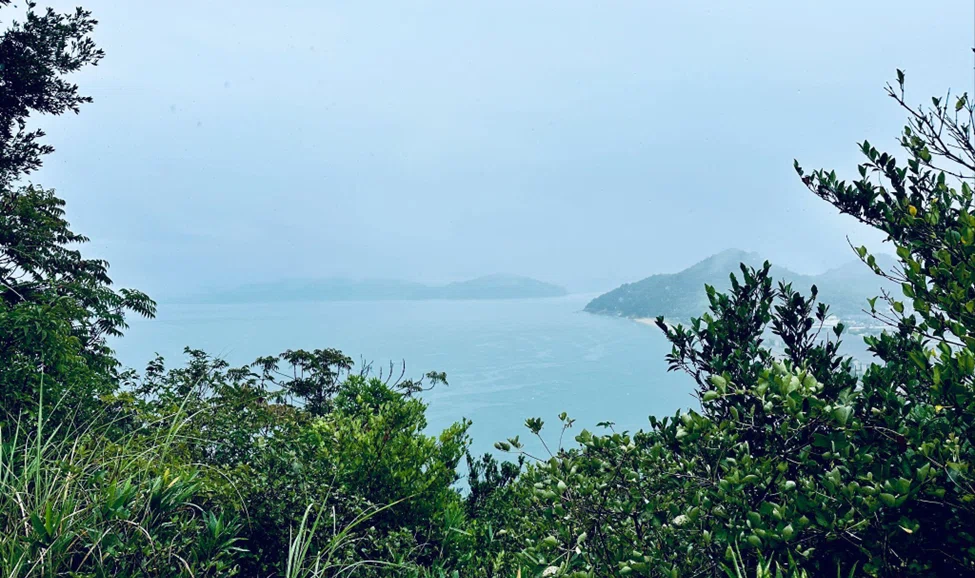
直島 - Naoshima Island
After visiting Oshima, we headed to Naoshima.
Naoshima is home to various initiatives centered around the “Benesse Art Site Naoshima” aimed at revitalizing the islands of the Seto Inland Sea (Naoshima, Inujima, and Teshima) through contemporary art.
As the hub of this effort, Naoshima boasts a remarkable collection of over 10 architectural marvels and museums.
▼Benesse Art Site Naoshima
https://benesse-artsite.jp/
Last year, our field trip focused on the Benesse House Museum, the Hiroshi Sugimoto Gallery, and the Lee Ufan Museum, where we explored the potential of contemporary art and the pathways to "regeneration."
家プロジェクト - Art House Project
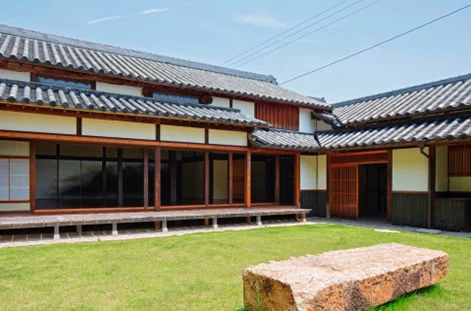
This year we visited the “Art House Project”, an initiative rooted in the Honmura district.
In this project, vacant houses across the island are renovated and transformed into artworks by various artists.
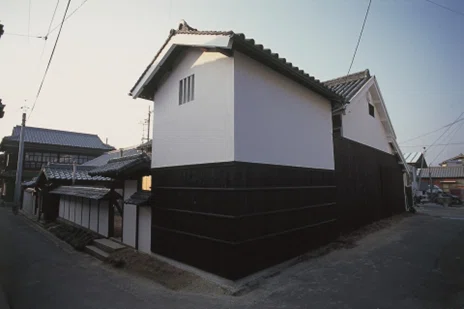
The first completed piece of the Art House Project was "Kadoya." Built around 200 years ago, this house was restored using traditional techniques such as lime plaster, charred wood, and traditional roof tiles.
A distinctive feature of the Art House Project is its use of raw natural energy, without converting it to electricity. The artworks harness the flow of wind and water, embodying a style of architecture unique to Naoshima while conveying the island’s traditional way of life.
▼Project details: Art House Project
https://benesse-artsite.jp/en/art/arthouse.html
The Noshima Plan “The Water”
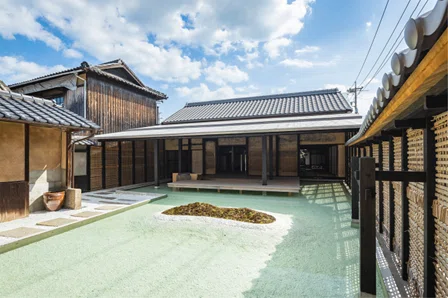
Another notable art site in the Honmura district is the “The Naoshima Plan ‘The Water’ ”
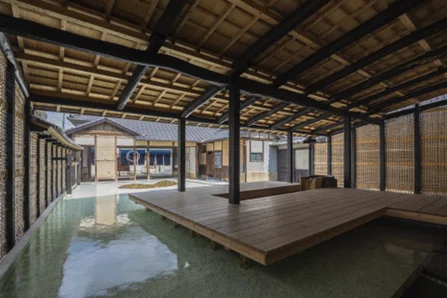
The Naoshima Plan aims to highlight and rediscover the value of natural elements such as wind, water, and sunlight by considering them as "moving materials". Among this, “The Water” project features a basin that collects abundant water from underground aquifers.
The project is managed by local residents, with ten operators each sharing their unique perspective in their own words.
Designed by architect Hiroshi Sambuichi, the space is created by renovating an old house. It expresses two types of beauty: the inherent beauty in "moving materials" and the beauty of a community that thoughtfully passes these elements to neighboring houses.
▼Project details: The Naoshima Plan “The Water”
https://benesse-artsite.jp/en/art/the-naoshima-plan.html
As we explored the Honmura area, we could feel the layers of time and the everyday lives of the people who live there. This art, interwoven with the community’s daily life, also serves as a space where residents and visitors can meet and interact.
By utilizing nature’s gifts, it demonstrates the potential to create spaces where people naturally gather, rediscovering the value of the land without relying on excessive design.
Day2
直島コメづくりプロジェクト - Naoshima Rice Growing Project
On the second day, we began our field trip with a visit to the Noshima Rice Growing Project, led by Mr. Fukuda.
This project, set in the fallow rice fields of the Tsumuura district, aims to revive the island’s fading rice farming by re-cultivating abandoned land. The project is not only about harvesting rice but also about providing a space to learn through sensory experiences. Through hands-on activities, it encourages reflection on ways of living and re-examining the island's culture.
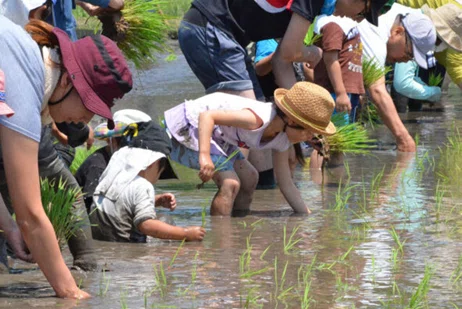
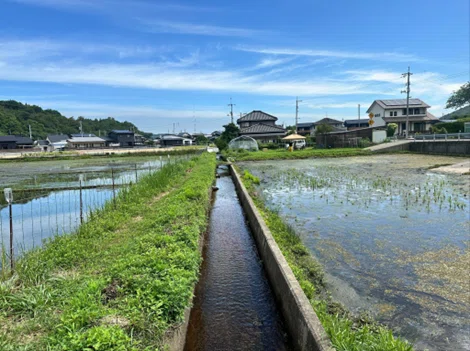
Clean water is an essential element for growing rich and delicious rice. During our visit, we experienced the connection between the land and nature of Naoshima by walking along the flow of water.
Synecoculture and Augmented Ecosystems
As part of the Rice project, an augmented ecosystem experiment is being conducted. This concept involves human intervention to enhance ecosystems, aiming to optimize biodiversity and ecosystem functions beyond their natural state.
In recent years, native ecosystems around the world have been lost or irreversibly altered, with human activitiesーespecially agricultureーbeing a key factor. As technological advancements progress, biodiversity continues to decline, and ecosystem destruction persists globally.
In this context, the idea of augmented ecosystems reexamines the relationship between humans and nature. It strives to radically pursue sustainable values that have often been overlooked, promoting a coexistence where humans and nature support and enrich one another, rather than being seen as separate or in conflict.
A prime example of this approach is the "Synecological Farming (Synecoculture)" proposed by Dr. Funabashi.
The photo below shows an experimental site on Naoshima where this method is being practiced.
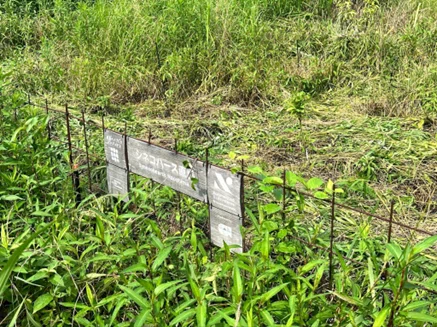
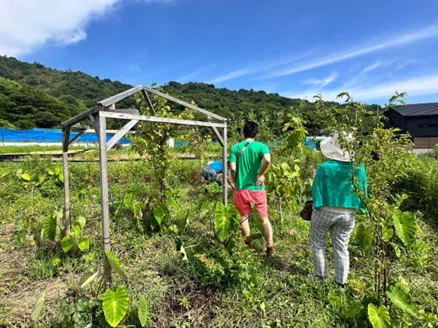
Unlike typical farmland, where crops of a single type are neatly aligned, this site appears chaotic at first glance. Synecoculture aims to preserve the ecosystem's self-sustaining functions while incorporating a diverse range of plants that are also useful to humans. This approach creates and manages an ecosystem that is both diverse and economically viable.
“Open Sky” Night Program by James Turrell
James Turrell’s work, “Open Sky” is part of the permanent exhibition at the Chichu Art Museum in Naoshima.
During this program, we experienced the ever-changing colors of the evening sky harmonized with the light effects created by Turrell through the square aperture in the ceiling. We sat along the walls, gazing upward at the open space, immersed in a serene and contemplative atmosphere.
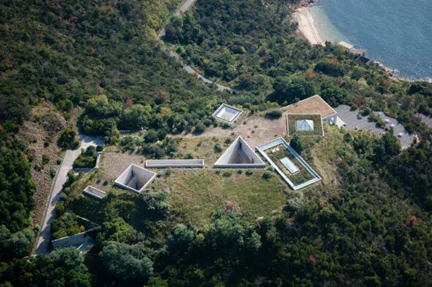
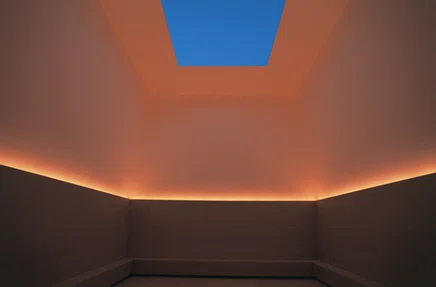
©︎James Turell’s “Open Sky ”(2004) Night Program Photo:FUJITSUKA Mitsumasa
Ikebana Session - “Ikeru”
We concluded the second day visit with a session of “Ikebana”.
Ikebana is not about creating art with flowers; it is about a dialogue with them. It isn’t about envisioning a specific piece from the start. Rather, it begins with one stem, then another, and gradually, a sense of harmony and flow emerges through working with each branch and flower. This is why it is essential to let go of ego and desires, clear the mind, and listen to the flowers.
The expression through Ikebana marked the culmination of two days in islands of Seto Inland Sea, where we discovered the beauty of nature in its purest form and its limitless potential.
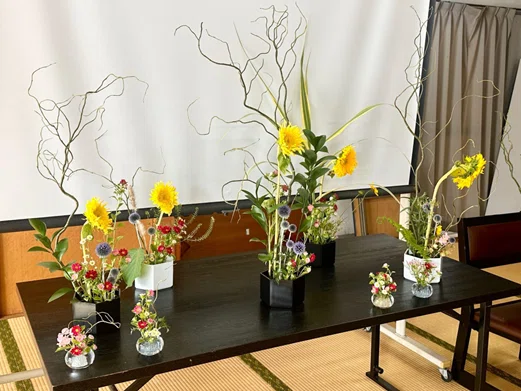
“We, as humans, let flowers ‘live.’ It’s not about using flowers to create what we want.”
Day3
On the final day, the forum “Hope from the Commons” was held at Benesse House Park Hall to conclude the field trip.
Over the two days, we visited the islands of the Seto Inland Sea, reflecting on the richness of nature, the distortions of capitalism that lie behind its beauty, and the hope that emerges in the form of the commons.
How can we re examine the relationship between humanity and the Earth to build a sustainable future? And within this framework. what possibilities can art bring?
To explore the future of the commons through the lens of social common capital, the forum featured two sessions.
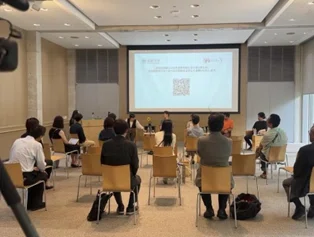
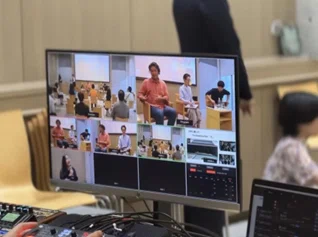
▼Session1 Connecting with Earth
In Session 1, the speakers reflected on the relationship between humans and nature, based on the insights gained during the two-day field trip.
Matsuda: "Earth(大地)and Land(土地)are fundamentally different concepts. Earth is an infinite, interconnected entity with depth and height, encompassing the planet itself. Land, on the other hand, is a human-defined vertical segmentーa division marked by lines on a map. We can say that Land is essentially a human-centric fragment of the larger earth."
Funabashi: "In economics, we talk about ‘Capital,’ ‘Labor,’ and ‘Land,’ but not ‘Earth.’ Land reflects a human-centric perspective that simplifies and commodifies complex nature into something that can be monetized."
Ishizu: "Humans cannot fully engage with the infinite as it is. It is difficult to grasp Earth in its entirety. What works like James Turell’s installations or the ‘Gate of Infinity’ attempt to do is frame infinity in a way that makes it manageable and perceptible."
Throughout history, humanity has divided the infinite Earth into manageable portions, turning them into economic assets and fueling capitalism. However, this practice has also led to conflict, environmental destruction, and other negative consequences. The concept of the commons may offer a way to bridge the gap between Earth and Land.
The speakers also explored how the idea of “time” plays a role in the commons.
Funabashi: "In Turrell’s works, the changing colors of the sky are not just physical phenomena. Subtle shifts in light create complementary colors, altering how we perceive them. These changes were not perfectly cyclicalーthey were randomーallowing us to share a unique rhythm. Communities helped us interpret infinity, much like complementary colors helped us perceive it. In this sense, the commons may embody a shared experience of time."
Matsuda: "Time isn’t just about our personal experiences. It includes the extended time of past lives and those who came before us. We exist within layers of time—the lived time of the Land and the time of the Earth beneath it."
Ishizu: "If synchronicity is key, it might seem like we can’t share time with those who aren’t present. But through Earth, we can find a way to connect with others, even across different times and spaces."
▼Session2 Connecting through Art
Session 2 explored Art as a means of fostering empathy and exchanging unspoken information.
Adam Smith argued in “The Theory of Moral Sentiments” that society is built on empathy, and art plays a powerful role in fostering it. Also, the "Nation" Smith referred to in “The Wealth of Nations” pertains to the people and culture, not the State (governance or rule).
To discuss Art as a means of creating connections, the speakers shared insights from their work and the two-day journey.
Kondo: "Social epidemiology examines how societal factors like poverty and isolation impact health. A key concept that emerged is ‘social capital,’ or the value of human connections. Data consistently shows that being socially active significantly affects life expectancy. I believe art functions as a tool to foster empathy, helping people build connections and mutual understanding. By quantifying the relationship between cultural capital and health, we can create systems that incorporate cultural capital into society."
Wakao: "My focus is on artistic expression among individuals with disabilities. I see myself as an ally, helping those in vulnerable positions shine like diamonds in the rough. The visit to Oshima left a strong impression on me. It’s not just a historical site of isolation—it’s a living community. Bringing art into such spaces requires courage, but it creates openness and strength. The challenge is ensuring that this experience leads to concrete actions that support those in difficult situations, using shared human capital as a bridge."
Fukuda: "Drawn by the initiatives in the Seto Inland Sea, I became involved in Naoshima’s Rice Growing Project. Initially, I thought of my contributions as temporary, but I realized that life is interconnected—dotted lines aren’t enough. Now I live on Naoshima full-time. Importantly, the land for the project isn’t rented; it’s offered through the goodwill of the townspeople. The water we use has also been a shared resource for generations, showing how much these efforts rely on collective support."
Daikoku: "My research focuses on music through the lens of neuroscience. By analyzing how composers create and are influenced, I aim to trace the evolution of music from the past to the present and into the future. Music researchers agree with the idea that music existed before language and likely evolved into language to enhance communication efficiency. Yet music persists because it fills gaps left by language. Emotions are complex and continuous, but language categorizes them into discrete terms like ‘happy’ or ‘sad.’ I believe Music and art can be a tool to fill those gaps, offering genuine emotional expression and the possibility of understanding what cannot be verbalized."
Kondo: "However, no matter how important the concept, it risks being ignored if it isn’t quantified or visualized. Among economic, social, and cultural capital, we often focus too much on economic capital, even though social and cultural capital are more integral to how we live. To create a society where no one is left behind, we must quantify these connections and variations, ensuring inclusivity and equity."
Within the "Hope from the Commons", we explored the richness of nature, the burdens left by historical neglect and environmental destruction, and the resilience of communities.
While the concept of the commons has gained prominence, its potential remains underdefined. By reflecting on the past and envisioning the future, we must once again contemplate what can be done to pass on abundance to the next generation.