
紫外線による血液照射は、さまざまな症状を治療する。それはどういうわけか、身体が本来持っている自己調整・治癒能力を再活性化させる

紫外線による血液照射は、さまざまな症状を治療する。それはどういうわけか、身体が本来持っている自己調整・治癒能力を再活性化させる。
ローダ・ウィルソン
2024年8月30日
自然光は、私たちの多くに欠けている重要な栄養素である。紫外線(UV)が血流に入ると、驚異的な健康効果を発揮する。
1930年代、紫外線血液照射(UVBI)は画期的な治療法として登場した。 米国中の病院がこれを採用し、患者に奇跡的な結果をもたらし、幅広い症状(感染症、自己免疫、心血管疾患、妊娠の問題など)に対して顕著な効果を示した。
しかし、米国医師会(AMA)はこの治療法を独占することができず、UVBIの信用を失墜させるような欠陥のある研究を発表し、米国でのUVBIの衰退につながった。しかし、ロシアとドイツはUVBIの価値を認識し続け、様々な困難な病状に対するUVBIの有用性を証明する研究を数十年にわたって行った。
米国では、UVBIは主に、ライム病、慢性疲労症候群、スパイクタンパク損傷、慢性偏頭痛など、他の治療法に反応しない複雑な病気を治療するために、統合的な施術家によって使用されている。
体内に光を入れることは奇跡的な治療法であるという証拠の世紀
2024年8月15日、ジョセフ・マーコラ博士によって発表された中西部の医師著
私はこれまで、医療産業複合体の利益を守るために、私たちはしばしば重要な知識や治療法、ケアを否定されていると主張してきた。 私の目には、紫外線による血液照射の話は、この腐敗の最も明確な例のひとつに映る。
太陽光の重要性
太陽光、特に紫外線(UV)成分は危険だと多くの人が信じている。 このような見方は、1980年代に皮膚科医が高収益の皮膚癌治療を宣伝するために行った忌まわしい広報キャンペーンから生まれた。
ジミー・ドーアのショー:爆弾発言! 皮膚癌による死亡のほとんどは日光不足によるものである! 2024.5.5 (35分)
これとは対照的に、スウェーデンの女性29,518人を対象とした20年間の研究では、日光を避けている人は、定期的に日光を浴びている人に比べて死亡する確率が130%高く、癌を含む重大な病状を発症する可能性も高いことが判明した1。同様に、このシリーズの第1部では、自然光が極めて重要な役割を果たすことを強調した::
⚫︎ 癌と感染症
⚫︎ 循環
⚫︎ 行動障害
⚫︎ 動物の健康、繁殖力、農業生産性
⚫︎ 成長サイクルと概日リズムの調整
残念なことに、自然光は屋内ではほとんど見られず(例えば、標準的なガラスは光を遮断する)、また、目は光を吸収する主要な部位であるため、眼鏡やコンタクトを着用している人(肌の色が黒い人など)は、特に光欠乏症にかかりやすい。 その代わり、光を直接体内に入れることで顕著な効果が得られている2。
紫外線血液照射の歴史
医学の分野で最も古くから「証明」されている療法のひとつが、日光浴である。 例えば、1918年のインフルエンザ3や、(抗生物質が登場する前の)結核の治療に実際に成功した数少ないもののひとつである4。
やがて医療分野では、太陽光の紫外線成分が(オゾン層によって遮断される紫外線の一種であるUVCとともに)殺菌剤であることに気づき、さまざまな殺菌用紫外線装置が開発された(例えば最近では、空気に紫外線を照射することがコビッド19の感染を防ぐ効果的な方法であることが実証された)5。
1927年、エメット・ノット(Emmett Knott)は医師ではなかったが、敗血症と闘うために紫外線を使った血液の殺菌実験を行った。 当初は失敗に終わったが、彼のアプローチは感染した犬の血液全量を照射するというものであった。 1928年、幸運にもノットが犬を過少投与してしまうという事故が起こり、劇的な回復が見られた。
1933年、ノットが初めて人体実験を行ったところ、敗血症で瀕死の女性が救われた7。その後、ノットは治療法を改良し、1937年からUVBIを全米に広めることに成功した。 1940年代には、敗血症、肺炎、腎炎、喘息、ポリオ、ボツリヌス中毒、リウマチ熱、ウイルス性肝炎などの難治性疾患に対してUVBIが非常に有効であることを医師たちが発見した8。
これは奇跡的なことで、1950年代初頭までに、UVBIはアメリカの約50の病院で使用されるようになった。9 3,000人以上の患者を対象とした50の論文で、医師たちは、抗生物質が効かない重症感染症例でも、一貫して、しかし信じられないような効果が得られたと報告している10。
当時の文献には、脳血栓や肺血栓、肺炎、麻痺など複数の重篤な症状を抱えた男性など、多くの注目すべき症例が記録されている。 UVBIによって彼はほぼ即座に回復し、最終的には完全に健康を取り戻した。 同様に、『ニューヨーク・タイムズ』11、『タイム』誌12、『アメリカン・ウィークリー』13などの著名なメディアも、その成功に関する記事を特集した。
「個人的には、(ノットの発見は)米国市民による医学への最大の貢献のひとつだと思う」 - ジョージ・マイリー医学博士(1940年)
市場の独占
この時点で、米国医師会(AMA)が関与し、他の多くの有望な治療法に対して行ってきたように、UVBIの権利と引き換えにUVBIの効果を証明することを提案し、ノットを恐喝しようとした14。 ノットはこれを拒否し、AMAは偏った研究15を行った:
ノット社製血液照射装置による血液照射から利益を得た患者は皆無であった。
病院は、この "権威ある "研究の誤解を招く結論を鵜呑みにし、UVBIをやめて抗生物質を選択した。 幸いなことに、UVBIは海外(ロシアやドイツなど)で、より経済的な医療を提供するものとして新たな生命を見出した。
注:UVBIの弾圧は、敗血症に対するビタミンCの静脈内投与、コビド-19に対するイベルメクチンやヒドロキシクロロキン、そして数多くの有望な癌治療(これらすべてについてはこちらで詳しく述べている)など、不正な臨床試験によってブラックリストに載せられた他の救命療法の運命を反映している。
UVBIの生理学的効果
紫外線が血流に接触すると、以下のことが急速に起こる:
身体はリラックスし、皮膚はピンク色になり、血行は大幅に改善され、チアノーゼは消失し、痛みは軽減または消失する。 :異常なバイタルサインはすべて正常化する。
「毒性」状態(ボツリヌス中毒や敗血症など)が消失する。 :自律神経機能が正常化する(例:蠕動運動が再開する)。
静脈酸素化(枯渇している場合)は25%~58%増加する。 :白血球数は正常化する(他の様々な異常血液検査も同様)。
注:この正常化は、UVBIが感染症や自己免疫疾患に対して非常に有効であることの説明に役立つ。
これらの効果は、UVが死の淵にある患者を急速に安定させることを説明するのに役立つ。これは、重症患者医療ではほとんど見られないことである(そして、これはUVBIが全身のゼータ電位を改善する特性であると主張してきた。)
さらに、遅延効果(例えば、感染症に対する免疫反応や一般的な健康感)は、UVBI治療の数日から数週間後にしばしば見られる。
血液のごく一部を照射しただけで全身が迅速に反応するということは、血液が光を伝導できることを示唆している。 このことは、目に届く太陽光が不十分であることによる健康への重大な影響など、多くの観察結果から裏付けられている16。メカニズム的には、この伝導はヘモグロビンのエネルギー伝達特性により可能である17。
血液はどのように照射されるのか?
古典的なUVBIでは、少量の血液(40~60ml)を取り出し、希釈した後、UV光を通過させながら再び体内に注入する。
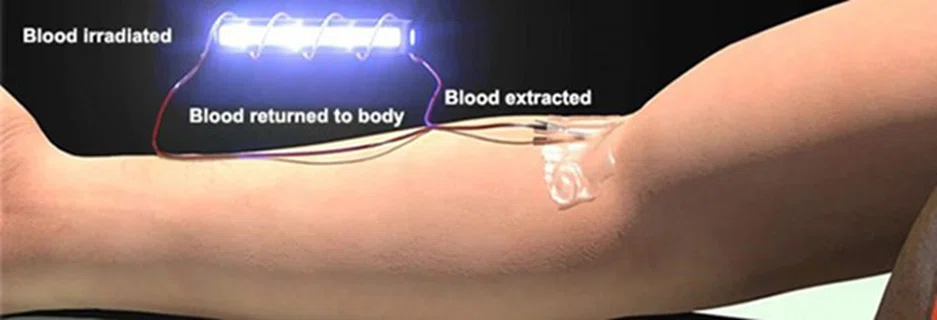
注:血液に光を通すことの一つの論拠は、循環につながった血液に外部から光を当てると、少量の照射血液が点滴に到達して循環に入るずっと前に、全身的なシフトが生じるということである。
1980年代初頭、ドイツとロシアの研究者たちは、皮膚から外照射するレーザー、あるいは照射したカテーテルから内照射するレーザーのどちらでも、光を体内に入れることができることに気づいた。 レーザー血液照射(「LBI」)は体外UVBIと同様の効果を持つが18、UVBIがより強い殺菌効果、抗炎症効果、循環効果を持つのに対し、LBIはより早く効果が現れるが、通常より多くの治療を必要とする19。
UVBIの研究
UVBIの研究者は、1934年から2020年の間に出版されたUVBI20とLBIの使用に関する200以上の学術論文を確認した。 ほとんど全ての症例において、UVBIの成功率は80%から100%であった(成功率が低い症例は通常、致命的と予想される最悪の症例と相関している)。
有効性に加えて、これらの研究では一貫してUVBI(およびLBI)による副作用が全くないことが判明している。 既存のエビデンスは、以下のような重篤な疾患に対するUVBIの有効性を実証している:
細菌による感染症(敗血症、敗血症性流産、骨髄炎、髄膜炎、結核、腸チフス、さまざまな一般的感染症の重症型など)およびウイルスによる感染症(肺炎、帯状疱疹、肝炎、重症コビド-19、ロングコビド、ポリオ、エイズなど)21:
⚫︎ 連続した103例の急性化膿性感染症を対象とした1942年の研究では、UVBIが初期の感染症20/20例、中等度に進行した感染症46/47例、病的な(死亡寸前の)感染症17/36例の治療に成功した22。
⚫︎ 1947年の同様の研究では、UVBIが56/56例の早期感染、317/323例の中等度進行、30/36例の罹患した急性化膿性感染症を治療した23。
⚫︎ 631例の骨盤内炎症性疾患(35%が非常に重症、35%が中等症、27%が軽症)に対して、UVBIを単独で投与したところ、最も重症の症例の79%、中等症の症例の80%、軽症の症例の87%が治癒した。 残りの半数は改善したが、最後の10%は手術が必要であった(UVBIは手術による死亡率を半減させた)。 さらに、17人の女性が不妊症となり、UVBI後に全員が妊娠した24。
⚫︎ 86人の破壊性結核患者がUVBIと抗生物質を投与された(一方、136人の対照者は抗生物質のみを投与された)。 3ヶ月以内に、UVBI群では100%が無病となり(対照群では58.8%)、89.5%で肺が回復し(対照群では38.2%)、入院期間が48日短縮した25。
⚫︎ 重度の頭蓋骨損傷または脳損傷を負い、肺炎を併発した50人の患者に、抗生物質と並行して6~8回のUBI治療を行った。 対照群25人と比較して、死亡率と入院期間が短縮され、T細胞、IgA、IgMレベルにおいて免疫反応の改善がみられた26。
⚫︎ 急性肺炎または胸膜感染に罹患した40人の乳児(3歳まで)にUVBIを投与したところ、25人の過去の対照群と比べて死亡率が大幅に低下し、回復も1.7倍早かったことが判明した27。
⚫︎ 急性ウイルス性肝炎患者43人(うち3人は慢性)がUVBIを受けたところ(平均3回の治療を受けた)、全員に急速な改善がみられ、半数以上が3日以内に著明な改善がみられた28。
⚫︎ 2015年のアメリカの臨床試験では、9人のC型肝炎患者に22週間にわたって5回のUVBIを3回行った。 その結果、ウイルス量は20週で21.5%減少し、37週で最低(44.9%)に達した。 さらに、20週目には直接ビリルビンが41.1%、ASTが15.2%、ALTが19.3%減少した。 さらに、2人の患者が試験終了時に、同時に発症していた乾癬(UVBIにも反応する疾患)に顕著な改善を示した29。
⚫︎ 2021年に行われた中等症または重症のcovid-19患者35人(および対照群35人)を対象とした研究では、UVBIによって入院期間が7日間短縮され、いずれの患者も死亡を防ぎ、CTスキャンで示されたように肺が治癒したことが明らかになった30。
⚫︎ 長いコビド症状の患者10人にUVBIを行った。 全例で症状の有意な改善がみられ、これはDダイマー値の低下と相関していた。 多くの患者は1回の照射で完全に回復し、副作用は報告されていない31。
注:UVBIは帯状疱疹によく用いられる。
心血管障害 - (心臓発作32、狭心症、末梢動脈疾患、間欠性跛行、レイノー、血栓性静脈炎、高血圧、肺高血圧症など)33。 例えばレニーの話34は、ロシアやドイツの多くの研究で見られたことと一致している:
「ほんの2、3ヶ月前まで、ショッピングモールを歩くだけで問題があった。 ほんの数カ月前までは、ショッピングモールの中を歩くだけでも問題がありました。2ブロック歩くだけで、4回も立ち止まって休まなければならなかったのです」。 私のような症状の患者の1/3は良くなり、1/3は変わらず、1/3は悪化すると言われました。 クリニックでUBI治療を2回受けたが、なんという違いだろう。
「先週、ミネアポリスで会議があり、寒い中2マイル以上歩きました。 気分が良かっただけでなく、エネルギーに満ちあふれています」。
例を挙げると、閉塞性末梢動脈疾患(フォンテーヌ病期II)を患っている21人の患者を対象としたドイツの研究では、UVBIを受けたところ、血液の粘度が低下し(生理学的ゼータ電位が上昇した結果生じるもの)、血液中の酸素利用率が改善し、乳酸濃度が低下したのに伴って、3倍の距離を歩くことができた。 さらに、これらの効果は、プラセボ治療を受けた患者には見られなかった35。
ある研究では、急性血栓性静脈炎(静脈内の炎症性血栓)を起こした13人の連続した患者を評価したが、いずれもUVBI後、通常24~48時間で急速に消失した36。
自己免疫疾患-これらはUVBIで治療される一般的な疾患の一部である。 これはもともと、関節リウマチ37や喘息がUVBI後に治療された後に偶然発見されたもので、徐々にUVBIが他の無数の自己免疫疾患を治療することが発見された。
この分野における初期の研究のほとんどは、UVBIを喘息に使用することに焦点が当てられており、70%から92%の患者(難治性の症例を含む)がUVBIによって有意に改善した38。この分野における最新の研究は、ステロイド抵抗性の喘息患者を対象に1996年に行われたもので、LBIが肯定的な臨床効果をもたらし、患者の大部分でステロイドの投与量を減らし、単球の活性を低下させることがわかった39。
この分野には、もっと変わった応用例もある。 例えば、ある盲検試験では、骨移植の前にUVBIを照射することで、犬が移植を拒絶するのを防ぐことがわかった40。同様の結果は、心臓移植を行ったラット41や、適合しないヒト血液型の拒絶反応を抑えることでも得られている42。
同様に、ロシアの臨床試験では、26人のMS患者の脳脊髄液(血液ではなく)に放射線を照射した。 良好な反応(例えば副作用は、この治療に必要な腰椎穿刺によるものだけであった。
内臓疾患 - (肝臓、胆道、胆嚢疾患、膵炎、播種性腹膜炎、腎臓疾患など)。 UVBIは循環を改善し、炎症を抑えるので、内臓の様々な問題に効果があることがわかっている。
例えば、慢性肺疾患(気管支喘息や慢性閉塞性気管支炎など)の患者を対象としたある研究では、血行動態が改善された(肺高血圧が減少したなど)44。同様に、胃潰瘍や十二指腸潰瘍の患者22人を対象とした別の研究では、UVBIが潰瘍の封鎖と治癒に役立つことがわかった45。
神経障害および精神障害 - (うつ病、統合失調症、耳鳴り、ぼんやりした頭、不眠症など)。
UVBIは脳への血流を増加させ、炎症を減少させるので、様々な神経疾患に効果がある。 私自身の場合、UVBIとの出会いは、どんな治療にも反応しないひどい偏頭痛のような頭痛に悩まされていたときに、医師からUVBIを勧められたことからでした。
さらに、神経学的な効果(片頭痛の減少など)の多くは、他の疾患の治療中に、付随的な効果として報告されたものである。
産科および婦人科 - (例:男性および女性の不妊、流産の予防、子癇前症、健康な赤ちゃんを産むこと、多嚢胞性卵巣症候群、骨盤内炎症性疾患)。
産科でUVBIが使用された最も初期の例の一つは、流産の恐れのある30人の連続した患者であった。 UVBI開始時に胎児が生きていた22例中21例では、赤ちゃんが生存していた(最後の症例は特に難しい症例であった)47。
さらに最近、UVBIを受けた53人の子癇前症のロシア人女性と受けなかった53人の女性を比較したところ、UVBIは平均して妊娠期間を4.1週間延長し、病的な出産と胎児の状態の悪さを50%減少させることがわかった。
また、出産時の母体の出血と胎児の低酸素症が減少し、胎児の出生体重が増加した。 最終的に、UVBIは母体の微小循環を改善・正常化し、血液ドロドロ(うっ滞)を減少または除去し、播種性血管内凝固を予防した48。
手術 - その開始以来、UVBIは感染や死亡などの手術の合併症を有意に減少させることが観察されている(例えば、帝王切開に関するこれら2つの研究を参照)49,50。また、回復時間を改善することも観察されている(例えば、術後のイレウスはUVBI後にしばしば消失することが観察されている)。
注:UVBIの使用に関するさらに多くの研究(要約)は、こちらで見ることができる。 さらに、1990年代初頭には、カナダの製薬会社がオゾン処理した血液と紫外線照射した血液を体内に注入する装置を開発し、多くの臨床試験を通じて、様々な症状に対する安全性と有効性を証明することができた51。
結論
このような幅広い効能は、UVBIが何らかの形で、(例えば、細胞の危険反応を止めたり、血液循環を回復させたりすることによって)身体が本来持っている自己調整・治癒能力を再活性化させることができることを示唆している。 UVBIの治療効果は、自然光を十分に浴びることで得られる多くの利点や、自然光が不足している人がUVBIに最もよく反応することが繰り返し観察されていることと密接な関係がある。
幸いなことに、UVBIの顕著な結果は世界中で使用され続け、ますます多くの人々がその有用性を認識するようになっている。 例えば、トランプ大統領の就任で最も物議を醸した瞬間の一つは、コビッド19を治療するために殺菌灯を体内に入れることについて質問したことであった52。メディアはこれをトランプ大統領が「漂白剤を注射すべきだ」と提案しているように描くことに全力を尽くしたが、多くの人々は実際に何が議論されていたのかを理解していた。
In 2020, Trump tried to alert us to a promising COVID treatment. A story was then made up about "injecting bleach" and the media's repeated that lie ever since.
— A Midwestern Doctor (@MidwesternDoc) August 10, 2024
Here Joe Rogan and Jimmy Dore discuss how this miraculous therapy was buried by the medical cartel. That therapy is… pic.twitter.com/qYNL5Hkmbq
例えば、ジョー・ローガンもジミー・ドーアも、紫外線血液照射の驚くべき特性、コビッド19のような症状に対するその有用性、そして医療カルテルが競合する治療法を日常的に弾圧していることを十分に理解していた。
コビッド-19は計り知れない悲劇であったが、我々がそこから得た一つの恩恵は、パンデミックの間中、我々が目撃した忌まわしい行為があまりにも堂々としていたため、世間が彼らの手口に目を覚ましたことである。 月日が経つにつれ、より多くの人々が医療の忘れられた側面を知るようになっている。
著者注:これは、UVBIの背後にあるメカニズムについてより詳細に述べ、UVBIに関する膨大な発表文献を要約した、UVBIに関するより長い記事の要約版である(例えば、UVBIは、癌や喘息などの他の疾患にも有効である。また、最も効果的なUVBI療法に興味をお持ちの方への情報源も提供しています。 この論文とその他の参考文献はこちらで読むことができる。
著者について
A Midwestern Doctorは、アメリカ中西部の認定医のペンネームである。 彼は「The Forgotten Side of Medicine」と題したSubstackページで記事を発表しており、こちらから購読・フォローできる。
スペイン語訳:
La irradiación ultravioleta de la sangre trata una amplia gama de afecciones; de alguna manera reactiva la capacidad innata del cuerpo para regularse y curarse a sí mismo
POR RHODA WILSON
EL 30 DE AGOSTO DE 2024
La luz natural es un nutriente crucial del que carecemos muchos de nosotros. Cuando la luz ultravioleta ("UV") entra en el torrente sanguíneo, puede desbloquear beneficios fenomenales para la salud.
En la década de 1930, la irradiación ultravioleta de la sangre ("UVBI") surgió como un tratamiento revolucionario. Hospitales de toda América lo adoptaron y produjo resultados milagrosos para los pacientes, demostrando una notable eficacia contra una amplia gama de afecciones (por ejemplo, infecciones, autoinmunidad, enfermedades cardiovasculares y problemas de embarazo).
Incapaz de monopolizar la terapia, la Asociación Médica Americana ("AMA") publicó un estudio erróneo que desacreditaba la UVBI, lo que provocó su declive en Estados Unidos. Sin embargo, Rusia y Alemania siguieron reconociendo su valor, llevando a cabo décadas de investigación que demostraron la utilidad de la UVBI para diversas afecciones médicas difíciles.
En Estados Unidos, la UVBI es utilizada principalmente por médicos integrales para tratar enfermedades complejas que no responden a otras terapias, como la enfermedad de Lyme, el síndrome de fatiga crónica, las lesiones por picos de proteínas y las migrañas crónicas.
El Siglo de Evidencia Poner Luz Dentro del Cuerpo es una Terapia Milagrosa
Por Un Doctor del Medio Oeste según lo publicado por el Dr. Joseph Mercola el 15 de agosto de 2024
En mis escritos, he argumentado que a menudo se nos niegan conocimientos, tratamientos y cuidados vitales para proteger los intereses del complejo médico-industrial. A mis ojos, la historia de la irradiación ultravioleta de la sangre proporciona uno de los ejemplos más claros de esta corrupción.
La importancia de la luz solar
Muchos creen que la luz solar, especialmente su componente ultravioleta ("UV"), es peligrosa. Esta opinión surgió a raíz de una abominable campaña de relaciones públicas realizada en los años 80 por dermatólogos para promocionar tratamientos muy lucrativos contra el cáncer de piel.
El Show de Jimmy Dore: ¡Bomba! ¡La mayoría de las muertes por cáncer de piel se deben a la FALTA DE LUZ SOLAR! 5 Mayo 2024 (35 mins)
Por el contrario, un estudio de 20 años de 29.518 mujeres suecas descubrió que las que evitaban la luz solar tenían un 130% más de probabilidades de morir que las que recibían luz solar regularmente y también tenían más probabilidades de desarrollar afecciones médicas importantes, incluido el cáncer.1 Asimismo, en la primera parte de esta serie, destaqué el papel fundamental de la luz natural en:
⚫︎ Cáncer e infecciones
⚫︎ Circulación
⚫︎ Trastornos del comportamiento
⚫︎ Salud animal, fertilidad y productividad agrícola
⚫︎ Regulación de los ciclos de crecimiento y del ritmo circadiano
Por desgracia, la luz natural rara vez se encuentra en interiores (por ejemplo, los cristales estándar la bloquean) y, dado que los ojos son el principal lugar de absorción de la luz, quienes llevan gafas o lentes de contacto (como quienes tienen la piel más oscura) son especialmente vulnerables a las enfermedades por deficiencia de luz. A su vez, se han obtenido resultados notables al introducir la luz directamente en el cuerpo.2
Historia de la irradiación ultravioleta de la sangre
Una de las terapias "probadas" más antiguas de la medicina era hacer que la gente se bañara en la luz del sol. Por ejemplo, fue una de las pocas cosas que realmente tuvo éxito en el tratamiento de la gripe de 1918,3 y (antes de los antibióticos), de la tuberculosis.4
En poco tiempo, el campo de la medicina se dio cuenta de que el componente ultravioleta de la luz solar era un agente esterilizante (junto con la UVC, un tipo de luz ultravioleta bloqueada por la capa de ozono), y se desarrollaron diversos dispositivos de desinfección UV (por ejemplo, recientemente se ha demostrado que exponer el aire a la luz UV es una forma eficaz de prevenir la transmisión del covid-19).5
En 1927, Emmett Knott, que no era médico, experimentó con la esterilización de la sangre mediante luz UV para combatir la septicemia. Inicialmente sin éxito, su método consistía en irradiar todo el volumen sanguíneo de los perros infectados. Un afortunado accidente ocurrido en 1928, en el que Knott administró una dosis insuficiente a un perro, condujo a una espectacular recuperación, demostrando que era necesaria la irradiación de una pequeña cantidad de sangre para que el tratamiento fuera eficaz.6
El primer ensayo en humanos de Knott, en 1933, salvó a una mujer que se moría de septicemia.7 A continuación, perfeccionó su método y, a partir de 1937, promovió con éxito la UVBI por todo EE.UU.. En la década de 1940, los médicos descubrieron que la UVBI era muy eficaz contra enfermedades tan difíciles como la sepsis, la neumonía, la nefritis, el asma, la poliomielitis, el botulismo, la fiebre reumática y la hepatitis vírica.8
Esto fue milagroso y, a principios de la década de 1950, la UVBI se utilizaba en unos 50 hospitales estadounidenses.9 Los médicos de 50 artículos que abarcaban a más de 3.000 pacientes informaron de resultados constantes pero increíbles, incluso en casos de infección grave en los que los antibióticos fracasaron.10
La literatura de la época documentaba muchos casos notables, como el de un hombre con múltiples afecciones graves, incluidos coágulos cerebrales y pulmonares, neumonía y parálisis. La UVBI propició su recuperación casi instantánea y, finalmente, recuperó la salud por completo. Asimismo, destacados medios de comunicación como The New York Times,11 Time Magazine,12 y The American Weekly13 publicaron artículos sobre su éxito."Personalmente, creo que [el descubrimiento de Knott] es una de las mayores contribuciones a la medicina jamás realizadas por un ciudadano de los Estados Unidos". - Dr. George Miley (1940)
Monopolización del mercado
Llegados a este punto, la Asociación Médica Americana ("AMA") intervino y, como había hecho con muchas otras terapias prometedoras, intentó extorsionar a Knott ofreciéndole demostrar que la UVBI funcionaba a cambio de los derechos sobre ella.14 Knott se negó y la AMA llevó a cabo un estudio sesgado15 que estaba diseñado para fracasar. A pesar de que sus datos decían lo contrario, concluyó
Hemos llegado a la conclusión de que ninguno de nuestros pacientes obtuvo beneficios de la irradiación de sangre con el hemo-irradiador Knott.
Los hospitales, confiando en la conclusión engañosa del estudio "autorizado", abandonaron la UVBI en favor de los antibióticos. Afortunadamente, la UVBI encontró nueva vida en el extranjero (por ejemplo, en Rusia y Alemania), ya que ofrecía una forma mucho más económica de practicar la medicina.
Nota: La supresión de la UVBI refleja el destino de otras terapias que salvan vidas y que fueron puestas en la lista negra a través de ensayos clínicos amañados, como la vitamina C intravenosa ("IV") para la sepsis, la ivermectina y la hidroxicloroquina para el covid-19, y numerosos tratamientos prometedores contra el cáncer (de todos los cuales he hablado más AQUÍ).
Efectos fisiológicos de la UVBI
Una vez que la luz ultravioleta entra en contacto con el torrente sanguíneo, se produce rápidamente lo siguiente:
El cuerpo se relaja, la piel se pone rosa, la circulación mejora mucho, la cianosis desaparece y el dolor se reduce o desaparece. Todos los signos vitales anormales se normalizan.
Los estados "tóxicos" (por ejemplo, botulismo o sepsis) se resuelven. : La función autonómica se normaliza (por ejemplo, se reanuda el peristaltismo).
La oxigenación venosa (si está disminuida) aumenta entre un 25% y un 58%. : El recuento de glóbulos blancos se normaliza (al igual que otros análisis de sangre anormales).
Nota: Esta normalización ayuda a explicar por qué UVBI es altamente eficaz contra infecciones y condiciones autoinmunes.
Estos efectos, a su vez, ayudan a explicar cómo la UV puede hacer que los pacientes al borde de la muerte se estabilicen rápidamente, algo que casi nunca se ve en medicina de cuidados críticos (y que he argumentado que es una propiedad de la UVBI que mejora el potencial zeta sistémico - algo que creemos que es crítico para la salud).
Además, los efectos retardados (por ejemplo, que el cuerpo monte una respuesta inmune contra una infección o una sensación general de bienestar) se ven a menudo días o semanas después de un tratamiento UVBI.
La rápida respuesta sistémica a la irradiación de una pequeña porción de sangre sugiere a su vez que la sangre es capaz de conducir la luz. Esta afirmación se ve corroborada por numerosas observaciones, como los profundos efectos sobre la salud de la insuficiencia de luz solar que llega a los ojos.16 Mecánicamente, esta conducción es posible gracias a las propiedades de transferencia de energía de la hemoglobina.17
¿Cómo se irradia la sangre?
Clásicamente, la UVBI consiste en extraer una pequeña cantidad de sangre (de 40 a 60 ml), diluirla y luego infundirla de nuevo en el cuerpo mientras se hace pasar por la luz UV.
Nota: Un argumento a favor de la luz conductora de la sangre es que iluminar externamente la sangre conectada a la circulación creará un cambio sistémico mucho antes de que la pequeña cantidad de sangre irradiada pueda llegar a la vía intravenosa y entrar en la circulación.
A principios de la década de 1980, investigadores alemanes y rusos se dieron cuenta de que la luz también podía introducirse en el cuerpo a través de un láser aplicado externamente a través de la piel, o internamente a través de un catéter iluminado. La irradiación sanguínea con láser ("LBI") tiene efectos similares a la UVBI extracorpórea,18 aunque la LBI tiene un inicio más rápido pero suele requerir más tratamientos, mientras que la UVBI tiene efectos bactericidas, antiinflamatorios y circulatorios más potentes.19
Investigación sobre UVBI
Los investigadores de UVBI han identificado más de 200 artículos de revistas sobre el uso de UVBI20 y LBI publicados entre 1934 y 2020. En casi todos los casos, se observó una tasa de éxito del 80% al 100% con UVBI (con las tasas más bajas típicamente correlacionadas con los peores casos que de otro modo se esperaba que fueran fatales).
Además de la eficacia, estos estudios han constatado sistemáticamente la ausencia total de efectos secundarios de la UVBI (y la LBI). Las pruebas existentes demuestran la eficacia de la UVBI para dolencias graves como:
Infecciones tanto bacterianas (por ejemplo, sepsis, abortos sépticos, osteomielitis, meningitis, tuberculosis, fiebre tifoidea y formas graves de diversas infecciones comunes) como víricas (por ejemplo, neumonía, herpes zóster, hepatitis, covid-19 grave, covid largo, poliomielitis, SIDA)21 :
⚫︎ Un estudio de 1942 sobre 103 infecciones piógenas agudas consecutivas descubrió que la UVBI trataba con éxito 20/20 infecciones tempranas, 46/47 moderadamente avanzadas y 17/36 casos moribundos (al borde de la muerte).22
⚫︎ Un estudio similar de 1947 descubrió que la UVBI trataba 56/56 infecciones piógenas agudas tempranas, 317/323 moderadamente avanzadas y 30/36 moribundas.23
⚫︎ 631 enfermedades inflamatorias pélvicas (35% muy graves, 35% moderadamente graves y 27% leves) la UVBI curó por sí sola el 79% de los casos más graves, el 80% de los casos moderados y el 87% de los casos leves. La mitad de los casos restantes mejoraron, mientras que el 10% final también requirió cirugía (donde la UVBI redujo a la mitad la tasa de mortalidad de las cirugías). Además, 17 de las mujeres habían quedado estériles a causa de su enfermedad y todas ellas se quedaron embarazadas después de la UVBI.24
⚫︎ 86 pacientes con tuberculosis destructiva recibieron UVBI y antibióticos (mientras que 136 controles sólo recibieron antibióticos). A los 3 meses, el 100% del grupo UVBI estaba libre de la enfermedad (en comparación con el 58,8% de los controles), el 89,5% de ellos habían recuperado sus pulmones (en comparación con el 38,2% de los controles) y su estancia hospitalaria se redujo en 48 días.25
⚫︎ 50 pacientes con lesiones craneales o cerebrales graves y neumonía concurrente recibieron de 6 a 8 tratamientos con UBI junto con antibióticos. En comparación con 25 controles, se redujo su mortalidad y estancia hospitalaria y se observó una mejora de la respuesta inmunitaria en sus niveles de células T, IgA e IgM.26
⚫︎ 40 lactantes (de hasta 3 años de edad) que sufrían neumonía aguda o infecciones pleurales recibieron UVBI y se observó que tenían una tasa de mortalidad mucho menor y se recuperaban 1,7 veces más rápido que 25 controles históricos.27
⚫︎ 43 pacientes con hepatitis vírica aguda (3 de los cuales eran crónicos) descubrieron que la UVBI (recibieron UVBI una media de 3 tratamientos) hizo que todos experimentaran una rápida mejoría, y más de la mitad experimentaron una notable mejoría en 3 días o menos.28
⚫︎ Un ensayo clínico estadounidense de 2015 administró a 9 pacientes con hepatitis C tres sesiones de cinco UVBI durante un periodo de 22 semanas. Descubrió que la carga viral se redujo en un 21,5% a las 20 semanas, y alcanzó su nivel más bajo (44,9%) a las 37 semanas. Además, a las 20 semanas, su bilirrubina directa disminuyó un 41,1%, su AST un 15,2% y su ALT un 19,3%. Además, dos pacientes mostraron una marcada mejoría en su psoriasis concurrente (una enfermedad que también responde a la UVBI) al final del ensayo.29
⚫︎ En un estudio realizado en 2021 en 35 pacientes (y 35 controles) con covid-19 moderada o grave, se observó que la UVBI redujo su estancia hospitalaria en 7 días, evitó la muerte de alguno de ellos y, tal como demostró la tomografía computarizada, curó sus pulmones.30
⚫︎ 10 Pacientes con síntomas covídicos prolongados recibieron UVBI. Todos ellos experimentaron una mejoría significativa de sus síntomas, que se correlacionó con el descenso de los niveles de dímero D. Muchos pacientes se recuperaron totalmente tras una irradiación y no se notificaron efectos secundarios.31
Nota: la UVBI se utiliza con frecuencia para tratar el herpes zóster.
Trastornos cardiovasculares - (por ejemplo, infartos de miocardio,32 angina de pecho, enfermedad arterial periférica, claudicación intermitente, Raynaud, tromboflebitis, hipertensión arterial, hipertensión pulmonar).33 La historia de Lenny34 , por ejemplo, coincide con lo observado en muchos estudios rusos y alemanes:
"Hace sólo un par de meses, tenía problemas simplemente paseando por el centro comercial. Tenía que parar cuatro veces y descansar sólo para recorrer dos manzanas. Me dijeron que 1/3 de los pacientes que tienen lo que yo tengo mejoran, 1/3 se quedan igual y 1/3 empeoran, y que no había nada más que yo pudiera hacer. Me sometí a dos tratamientos UBI en la clínica, y vaya, qué diferencia.
"Tuve una conferencia en Minneapolis la semana pasada y caminé más de dos millas en tiempo frío (algo que no podía hacer). No sólo me sentí muy bien, sino que estoy lleno de energía".
A modo de ilustración, en un estudio alemán de 21 pacientes que padecían una enfermedad arterial periférica obstructiva (estadio II de Fontaine) recibieron UVBI y pudieron caminar tres veces más al tiempo que disminuía su viscosidad sanguínea (algo que resulta del aumento del potencial zeta fisiológico), mejoraba su utilización del oxígeno sanguíneo y disminuían sus concentraciones de lactato. Además, estos efectos no se observaron en los que recibieron tratamientos con placebo.35
Un estudio evaluó a 13 pacientes consecutivos con tromboflebitis aguda (coágulos inflamatorios en la vena), todos los cuales desaparecieron rápidamente tras la UVBI, normalmente en 24 a 48 horas.36
Trastornos autoinmunes - Estas son algunas de las afecciones comunes tratadas con UVBI. Esto se descubrió originalmente de forma incidental después de que la artritis reumatoide37 o el asma se trataran con UVBI y gradualmente se descubrió que la UVBI trataba una miríada de otros trastornos autoinmunes.
La mayoría de las primeras investigaciones en este campo se centraron en el uso de la UVBI para el asma, donde entre el 70% y el 92% de los pacientes (incluidos los casos intratables) mejoraron significativamente con la UVBI.38 El estudio más reciente en este campo se realizó en 1996 en pacientes con asma resistente a los esteroides y descubrió que la LBI tenía un efecto clínico positivo, reducía la dosis de esteroides en la mayoría de los pacientes y reducía la actividad de sus monocitos.39
También existen aplicaciones más inusuales en este campo. Por ejemplo, un estudio ciego descubrió que la UVBI antes de un injerto óseo evita que los perros rechacen el trasplante.40 Se obtuvieron resultados similares en ratas con injertos de corazón41 y para reducir el rechazo de tipos de sangre humana incompatibles.42
Asimismo, en un ensayo ruso se irradió el líquido cefalorraquídeo (en lugar de la sangre) de 26 pacientes con EM, 14 de los cuales obtuvieron buenos resultados y 12 no respondieron. Las mejores respuestas (p. ej.Las mejores respuestas (por ejemplo, mejora de la sensibilidad, la coordinación y los análisis de sangre) se produjeron en los casos menos graves.43 Los únicos efectos secundarios observados fueron los derivados de la punción lumbar necesaria para realizar este tratamiento.
Afecciones viscerales - (por ejemplo, enfermedades hepáticas, biliares y de la vesícula biliar, pancreatitis, peritonitis diseminada, enfermedades renales). Dado que la UVBI mejora la circulación y reduce la inflamación, se ha comprobado que ayuda con diversos problemas de los órganos internos.
Por ejemplo, un estudio de pacientes con afecciones pulmonares crónicas (p. ej., asma bronquial y bronquitis obstructiva crónica) mejoró su hemodinámica (p. ej., disminuyó la hipertensión pulmonar).44 Asimismo, otro estudio de 22 pacientes con úlceras gástricas o duodenales descubrió que la UVBI ayudaba a sellar y curar las úlceras.45
Trastornos neurológicos y psiquiátricos - (por ejemplo, depresión, esquizofrenia, tinnitus, cabeza nublada o insomnio).
Dado que la UVBI aumenta la afluencia de sangre al cerebro y disminuye la inflamación, puede ayudar en diversos trastornos neurológicos. En mi propio caso, mi introducción a UVBI vino del hecho de que había tenido dolores de cabeza severos de migraña-como que no respondieron a ninguna terapia, en qué punto mi doctor sugirió UVBI - que era vida-cambiante para mí (y he utilizado así UVBI desde entonces).
Nota: En la literatura, gran parte de la investigación sobre afecciones neurológicas y psiquiátricas utilizó LBI en lugar de UVBI.46 Además, muchos de los beneficios neurológicos (por ejemplo, disminución de las migrañas) se reportaron como beneficios incidentales cuando se estaba tratando otra enfermedad.
Obstetricia y ginecología - (por ejemplo, fertilidad masculina y femenina, prevención de abortos, preeclampsia, tener bebés sanos, síndrome de ovario poliquístico, enfermedades inflamatorias pélvicas).
Uno de los primeros ejemplos del uso de la UVBI en obstetricia fue una serie de 30 pacientes consecutivas con amenaza de aborto. En 21 de las 22 pacientes en las que el feto estaba vivo cuando comenzó la UVBI, el bebé sobrevivió (el último caso fue especialmente difícil).47
Más recientemente, cuando se compararon 53 mujeres rusas con preeclampsia que recibieron UVBI con 53 que no la recibieron, se observó que la UVBI prolongaba la gestación una media de 4,1 semanas y reducía los partos patológicos y las malas condiciones fetales en un 50%.
También se redujo la pérdida de sangre materna y la hipoxia fetal al nacer, y el peso del feto al nacer fue mayor. Por último, la UVBI mejoró y normalizó la microcirculación de la madre, redujo o eliminó los lodos sanguíneos (estasis) y evitó la coagulación intravascular diseminada.48
Cirugía - Desde sus inicios, se ha observado que la UVBI reduce significativamente las complicaciones de las cirugías, como la infección y la muerte (por ejemplo, véanse estos dos estudios sobre cesáreas).49,50 También se ha observado que mejora el tiempo de recuperación (por ejemplo, a menudo se observa que el íleo postoperatorio se resuelve tras la UVBI).
Nota: AQUÍ se pueden encontrar muchos más estudios sobre los usos de la UVBI (resumidos). Además, a principios de la década de 1990, una empresa farmacéutica canadiense creó un dispositivo que inyectaba sangre ozonizada e irradiada con UV en el cuerpo y, a través de numerosos ensayos clínicos, pudo demostrar que era seguro y eficaz para una variedad de afecciones.51
Conclusión
Esta amplia gama de beneficios sugiere, por tanto, que la UVBI es capaz de algún modo de reactivar la capacidad innata del organismo para regularse y curarse a sí mismo (por ejemplo, desactivando la respuesta de peligro celular o restableciendo la circulación sanguínea). A su vez, la eficacia terapéutica de la UVBI va de la mano de tantos beneficios derivados de una exposición suficiente a la luz natural y de la repetida observación de que quienes tenían una deficiencia de luz natural presentaban la mejor respuesta a la UVBI.
Afortunadamente, los notables resultados de la UVBI la han mantenido en uso en todo el mundo, y cada vez más personas son conscientes de su utilidad. Por ejemplo, uno de los momentos más controvertidos de la presidencia de Trump fue su pregunta sobre poner una luz desinfectante dentro del cuerpo para tratar el covid-19.52 Aunque los medios de comunicación hicieron todo lo posible para presentar esto como que Trump sugería "inyectarnos lejía", muchos entendieron lo que realmente se estaba discutiendo.
Por ejemplo, tanto Joe Rogan como Jimmy Dore eran plenamente conscientes de las notables propiedades de la irradiación UV de la sangre, su utilidad para enfermedades como el covid-19 y la supresión rutinaria de terapias competidoras por parte del cártel médico.
Aunque el covid-19 fue una tragedia inmensa, la única bendición que tuvimos de ella fue que la conducta abominable que presenciamos durante la pandemia fue tan descarada que despertó al público a su libro de jugadas. A medida que pasan los meses, cada vez son más los que conocen los lados olvidados de la medicina.
Nota del autor: Esta es una versión abreviada de un artículo más extenso sobre la UVBI que profundiza en los mecanismos que la sustentan, resume la vasta bibliografía publicada sobre la UVBI (por ejemplo.Este artículo y sus referencias adicionales pueden consultarse en el sitio web de la OMS. Ese artículo y sus referencias adicionales pueden leerse AQUÍ.
Sobre el autor
A Midwestern Doctor es el seudónimo de un médico colegiado del Medio Oeste estadounidense. Publica artículos en una página de Substack titulada 'The Forgotten Side of Medicine' a la que puedes suscribirte y seguir AQUÍ.
原文:
Ultraviolet blood irradiation treats a wide range of conditions; it somehow reactivates the body’s innate ability to regulate and heal itself
BY RHODA WILSON
ON AUGUST 30, 2024
Natural light is a crucial nutrient many of us lack. When ultraviolet (“UV”) light enters the bloodstream, it can unlock phenomenal health benefits.
In the 1930s, ultraviolet blood irradiation (“UVBI”) emerged as a revolutionary treatment. Hospitals across America adopted it, and it produced miraculous results for patients, demonstrating remarkable efficacy against a wide range of conditions (e.g., infections, autoimmunity, cardiovascular disease and pregnancy issues).
Unable to monopolise the therapy, the American Medical Association (“AMA”) published a flawed study that discredited UVBI, leading to its decline in the US. However, Russia and Germany continued to recognise its value, conducting decades of research proving UVBI’s utility for various challenging medical conditions.
In America, UVBI is primarily used by integrative practitioners to treat complex illnesses that do not respond to other therapies such as Lyme disease, chronic fatigue syndrome, spike protein injuries and chronic migraines.
The Century of Evidence Putting Light Inside the Body Is a Miraculous Therapy
By A Midwestern Doctor as published by Dr. Joseph Mercola on 15 August 2024
In my writings, I have argued that we are often denied vital knowledge, treatments, and care to protect the interests of the medical-industrial complex. In my eyes, the story of ultraviolet blood irradiation provides one of the clearest examples of this corruption.
The Importance of Sunlight
Many believe that sunlight, especially its ultraviolet (“UV”) component, is dangerous. This view emerged from an abhorrent 1980s public relations campaign by dermatologists to promote highly lucrative skin cancer treatments.
The Jimmy Dore Show: Bombshell! Most Skin Cancer Deaths Are From LACK Of Sunlight! 5 May 2024 (35 mins)
In contrast, a 20-year study of 29,518 Swedish women found that those who avoided sunlight were 130% more likely to die than those who received regular sunlight and were also more likely to develop significant medical conditions, including cancer.1 Likewise, in the first part of this series, I highlighted the pivotal role of natural light in:
⚫︎ Cancer and infections
⚫︎ Circulation
⚫︎ Behavioural disorders
⚫︎ Animal health, fertility, and agricultural productivity
⚫︎ Regulating growth cycles and the circadian rhythm
Unfortunately, natural light is rarely found indoors (e.g., standard glass blocks it), and since the eyes are the primary site of light absorption, those who wear glasses or contacts (like those with darker skin) are particularly vulnerable to light deficiency illnesses. In turn, remarkable results have been obtained from putting light directly into the body.2
The History of Ultraviolet Blood Irradiation
One of the oldest “proven” therapies in medicine was having people bathe in sunlight. For example, it was one of the few things that actually had success in treating the 1918 influenza,3 and (prior to antibiotics), tuberculosis.4
Before long, the medical field realised sunlight’s ultraviolet component was a sterilising agent (along with UVC – a type of UV light that is blocked by the ozone layer), and a variety of sanitising UV devices were developed (e.g., most recently, exposing air to UV light was demonstrated to be an effective way to prevent covid-19 transmission).5
In 1927, Emmett Knott, not a doctor, experimented with sterilising blood using UV light to combat septicaemia. Initially unsuccessful, his approach involved irradiating the entire blood volume of infected dogs. A fortunate accident in 1928, where Knott under-dosed a dog, led to a dramatic recovery, demonstrating that a small amount of blood needed irradiation for the treatment to be effective.6
Knott’s first human trial in 1933 saved a woman dying from septicemia.7 He then refined his method and, starting in 1937, successfully promoted UVBI across the US. By the 1940s, doctors found UVBI highly effective against challenging conditions like sepsis, pneumonia, nephritis, asthma, polio, botulism, rheumatic fever and viral hepatitis.8
This was miraculous and by the early 1950s, UVBI was used in around 50 American hospitals.9 Doctors in 50 papers covering over 3,000 patients reported consistent but unbelievable results, even in severe infection cases where antibiotics failed.10
The literature of the time documented many notable cases such as a man with multiple severe conditions, including brain and lung clots, pneumonia and paralysis. UVBI led to his near-instant recovery, and he eventually regained his health completely. Likewise, prominent media outlets like The New York Times,11 Time Magazine,12 and The American Weekly13 featured articles on its success.
“I think personally that [Knott’s discovery] is one of the greatest contributions to medicine ever made by a citizen of the United States.” — George Miley MD (1940)
Market Monopolisation
At this point, the American Medical Association (“AMA”) got involved, and as they had done to many other promising therapies, attempted to extort Knott by offering to prove UVBI worked in return for the rights to it.14 Knott refused and the AMA conducted a biased study15 that was designed to fail. Despite its data saying otherwise, it concluded:
We have concluded that none of our patients derived benefit from the irradiation of blood with the Knott hemo-irradiator.
Hospitals, relying on the “authoritative” study’s misleading conclusion, abandoned UVBI in favour of antibiotics. Fortunately, UVBI found new life overseas (e.g., in Russia and Germany) as it offered a much more economical way to practice medicine.
Note: The suppression of UVBI mirrors the fate of other lifesaving therapies which were blacklisted through rigged clinical trials like intravenous (“IV”) vitamin C for sepsis, ivermectin and hydroxychloroquine for covid-19, and numerous promising cancer treatments (all of which I discussed further HERE).
Physiologic Effects of UVBI
Once ultraviolet light contacts the bloodstream, the following rapidly occurs:
The body relaxes, the skin pinkens, circulation greatly improves, cyanosis disappears and pain reduces or disappears. : All abnormal vital signs normalise.
“Toxic” conditions (e.g., botulism or sepsis) resolve. : Autonomic function normalises (e.g., peristalsis resumes).
Venous oxygenation (if depleted) increases by 25% to 58%. : White blood cell counts normalise (as does a variety of other abnormal bloodwork).
Note: This normalisation helps explain why UVBI is highly effective against both infections and autoimmune conditions.
These effects, in turn, help to explain how UV can cause patients on the brink of death to stabilise rapidly, something almost never seen in critical care medicine (and which I’ve argued is a property of UVBI improving the systemic zeta potential – something we believe is critical for health).
Additionally, delayed effects (e.g., the body mounting an immune response against an infection or a general sense of wellness) are often seen days to weeks after a UVBI treatment.
The rapid systemic response to irradiating a small portion of the blood in turn suggests that blood is able to conduct light. This is supported by numerous observations such as the profound health effects of insufficient sunlight reaching the eyes.16 Mechanistically this conduction is possible due to the energy-transferring properties of haemoglobin.17
How Is Blood Irradiated?
Classically, UVBI involves removing a small amount of blood (40 to 60ml), diluting it, and then infusing it back into the body while passing it through UV light.
Note: One argument for blood conducting light is that externally illuminating blood connected to the circulation will create a systemic shift long before the small amount of irradiated blood can reach the IV and enter the circulation.
In the early 1980s, German and Russian researchers realised light could also be put into the body through a laser either applied externally through the skin, or internally through an illuminated catheter. Laser blood irradiation (“LBI”) has similar effects to extracorporeal UVBI,18 with LBI having a faster onset but typically requiring more treatments, while UVBI has stronger bactericidal, anti-inflammatory and circulatory effects.19
UVBI Research
UVBI researchers have identified over 200 journal articles on the use of UVBI20 and LBI published between 1934 and 2020. In almost all cases, an 80% to 100% success rate was seen with UVBI (with the lower rates typically correlating to the worst cases that were otherwise expected to be fatal).
In addition to efficacy, these studies have consistently found a complete absence of side effects from UVBI (and LBI). The existing evidence demonstrates UVBI’s efficacy for severe ailments such as:
Infections both from bacteria (e.g., sepsis, septic abortions, osteomyelitis, meningitis, tuberculosis, typhoid fever, and severe forms of a variety of common infections) and viruses (e.g., pneumonia, shingles, hepatitis, severe covid-19, long covid, polio, AIDS).21 For example:
⚫︎ A 1942 study of 103 consecutive acute pyogenic infections found UVBI successfully treated 20/20 early infections, 46/47 moderately advanced, and 17/36 moribund (on the verge of death) cases.22
⚫︎ A similar 1947 study found UVBI treated 56/56 early, 317/323 moderately advanced and 30/36 moribund acute pyogenic infections.23
⚫︎ 631 pelvic inflammatory diseases (35% being very severe, 35% moderately severe and 27% mild) UVBI alone cured 79% of the most severe cases, 80% of the moderate cases and 87% of the mild cases. Half of the remaining cases improved, while the final 10% also required surgery (where UVBI halved the death rate of the surgeries). Additionally, 17 of the women had become sterile from their condition and all of them became pregnant following UVBI.24
⚫︎ 86 patients with destructive tuberculosis received UVBI and antibiotics (while 136 controls only received antibiotics). Within 3 months, 100% of the UVBI group was disease-free (compared to 58.8% of controls), 89.5% of them had their lungs recover (compared to 38.2% of controls) and their hospital stay was reduced by 48 days.25
⚫︎ 50 patients with severe skull or brain injuries and concurrent pneumonia received 6-8 UBI treatments alongside antibiotics. Compared to 25 controls, their mortality and hospital stay were reduced and an improved immune response was seen in their T-cell, IgA and IgM levels.26
⚫︎ 40 infants (up to 3 years old) who were suffering from acute pneumonia or pleural infections received UVBI and were found to have a much lower death rate and recover 1.7 times faster than 25 historical controls.27
⚫︎ 43 patients with acute viral hepatitis (3 of whom were chronic) found UVBI (received UVBI averaging 3 treatments) caused all to experience a rapid improvement, with more than half experiencing a marked improvement in 3 days or less.28
⚫︎ A 2015 American clinical trial gave 9 patients with hepatitis C three sessions of five UVBIs over a 22-week period. It found the viral load was reduced by 21.5% at 20 weeks, and reached its lowest (44.9%) at 37 weeks. Additionally, at 20 weeks, their direct bilirubin declined by 41.1%, their AST by 15.2% and their ALT by 19.3%. Additionally, two patients showed marked improvement in their concurrent psoriasis (a condition that also responds to UVBI) at the conclusion of the trial.29
⚫︎ A 2021 study of 35 patients (and 35 controls) with moderate or severe covid-19 found UVBI reduced their hospital stay by 7 days, prevented any of them from dying and as shown by CT scan, healed their lungs.30
⚫︎ 10 Patients with long covid symptoms received UVBI. All of them experienced a significant improvement of their symptoms, which correlated to declining D-dimer levels. Many patients fully recovered after one irradiation and no side effects were reported.31
Note: UVBI is frequently sought out for shingles.
Cardiovascular disorders — (e.g., heart attacks,32 angina, peripheral arterial disease, intermittent claudication, Raynaud’s, thrombophlebitis, high blood pressure, pulmonary hypertension).33 Lenny’s story34 for example matches what has been seen in many Russian and German studies:
“Just a couple of months ago, I had problems just walking around the mall. I would have to stop four times and rest just to go two blocks. I was told that 1/3 of patients having what I have get better, 1/3 stay the same, and 1/3 get worse, and there was nothing more that I could do. I had two UBI treatments at the clinic, and my, what a difference.
“I had a conference in Minneapolis last week and walked over two miles in cold weather (something that I could not do). I not only felt great, but I am also full of energy.”
To illustrate, a German study of 21 patients suffering from an obstructive peripheral arterial disease (Fontaine stage II) received UVBI and were then able to walk three times as far alongside their blood viscosity decreasing (something which results from increasing the physiologic zeta potential), their blood oxygen utilisation improved and their lactate concentrations decreased. Additionally, these effects were not seen in those who received placebo treatments.35
A study evaluated 13 consecutive patients with acute thrombophlebitis (inflammatory clots in the vein) all of which had rapidly disappeared following UVBI, typically in 24 to 48 hours.36
Autoimmune disorders — These are some of the common conditions treated with UVBI. This was originally discovered incidentally after rheumatoid arthritis37 or asthma was treated after UVBI and it was gradually discovered that UVBI treated a myriad of other autoimmune disorders.
Most of the early research focused in this area on using UVBI for asthma where between 70% to 92% of patients (including intractable cases) significantly improved from UVBI.38 The most recent study in this area was done in 1996 on patients with steroid-resistant asthma and found LBI had a positive clinical effect, reduced the steroid dose for the majority of patients, and reduced the activity of their monocytes.39
There are also more unusual applications in this area. For example, a blinded study found that UVBI before a bone graft prevents dogs from rejecting the transplant.40 Similar results were obtained in rats with heart grafts41 and for reducing the rejection of incompatible human blood types.42
Likewise, a Russian trial irradiated the cerebrospinal fluid (rather than blood) of 26 MS patients, 14 of whom had good results and 12 of whom had no response. The better responses (e.g., improved sensation, coordination and blood work) were those with the less severe cases.43 The only side effects observed were from the lumbar puncture required to do this treatment.
Visceral conditions — (e.g., liver, biliary and gallbladder diseases, pancreatitis, disseminated peritonitis, kidney diseases). Since UVBI improves circulation and reduces inflammation, it has been found to help with a variety of internal organ problems.
For example, one study of patients with chronic lung conditions (e.g., bronchial asthma and chronic obstructive bronchitis) improved their haemodynamics (e.g., pulmonary hypertension was decreased).44 Likewise, another study of 22 patients with gastric or duodenal ulcers found that UVBI helped seal and heal the ulcers.45
Neurologic and psychiatric disorders — (e.g., depression, schizophrenia, tinnitus, a foggy head or insomnia).
Since UVBI increases blood flood to the brain and decreases inflammation, it can help a variety of neurological disorders. In my own case, my introduction to UVBI arose from the fact I’d had severe migraine-like headaches that did not respond to any therapy, at which point my doctor suggested UVBI – which was life-changing for me (and I’ve thus used UVBI ever since).
Note: In the literature, much of the research on neurologic and psychiatric conditions used LBI rather than UVBI.46 Additionally, many of the neurological benefits (e.g., decreased migraines) we reported as incidental benefits when another disease was being treated.
Obstetrics and gynaecology — (e.g., male and female fertility, preventing miscarriages, preeclampsia, having healthy babies, polycystic ovarian syndrome, pelvic inflammatory diseases).
One of the earliest examples of UVBI being used in Obstetrics was a series of 30 consecutive patients with threatened abortions. All had an immediate cessation of their cramps and bleeding following UVBI, and in 21 of the 22 where the foetus was alive when UVBI began, their baby survived (with the final case being a particularly difficult one).47
More recently, when 53 Russian women with preeclampsia who received UVBI were compared to 53 who did not, UVBI was found on average to prolong the gestation by 4.1 weeks and reduce pathological births and poor foetal conditions by 50%.
There was also less maternal blood loss and foetal hypoxia at birth, and the foetal birth weight was higher. Finally, UVBI improved and normalised the mother’s microcirculation, reduced or eliminated blood sludging (stasis) and prevented disseminated intravascular coagulation.48
Surgery — Since its inception, UVBI has been observed to significantly reduce the complications of surgeries such as infection and death (e.g., see these two studies on C-sections).49,50 It has also been observed to improve recovery time (e.g., postoperative ileus is often observed to resolve after UVBI).
Note: Significantly more studies on the uses of UVBI (that are summarised) can be found HERE. Additionally, in the early 1990s a Canadian pharmaceutical company created a device that injected ozonated and UV irradiated blood into the body and through numerous clinical trials was able to prove it was safe and effective for a variety of conditions.51
Conclusion
This wide range of benefits hence suggests that UVBI is somehow able to reactivate the body’s innate ability to regulate and heal itself (e.g., by turning off the cell danger response or restoring blood circulation). UVBI’s therapeutic efficacy in turn goes hand in hand with so many benefits resulting from sufficient natural light exposure and the repeated observation that those with a deficiency of natural light had the best response to UVBI.
Fortunately, the remarkable results of UVBI have kept it in use across the world, and more and more people are becoming aware of its utility. For instance, one of the most controversial moments of Trump’s presidency was his asking about putting a disinfecting light inside the body to treat covid-19.52 While the media did all it could to portray this as Trump suggesting “we should inject ourselves with bleach,” many understood what was actually being discussed.
For example, both Joe Rogan and Jimmy Dore were fully aware of the remarkable properties of UV blood irradiation, its utility for conditions like covid-19, and the medical cartel’s routine suppression of competing therapies.
While covid-19 was an immense tragedy, the one blessing we had from it was that the abhorrent conduct we witnessed throughout the pandemic was so brazen that it woke the public up to their playbook. As the months go by, more and more are learning about the forgotten sides of medicine.
Author’s note: This is an abridged version of a longer article about UVBI which goes into greater detail on the mechanisms behind UVBI, summarises the vast body of published literature on UVBI (e.g., for other conditions such as cancer and mitigating the effects of chemotherapy) and provides resources for those interested in accessing the most effective forms of this therapy. That article and its additional references can be read HERE.
About the Author
A Midwestern Doctor is a pseudonym for a board-certified physician in the American Midwest. He publishes articles on a Substack page titled ‘The Forgotten Side of Medicine’ which you can subscribe to and follow HERE.
