
“My Name Is Shingo” Japanese: わたしは真悟(Watashi wa Shingo)

"My Name Is Shingo" is a Japanese science fiction manga by Kazuo Umezu. It was serialized in Shogakukan's "Big Comic Spirits" from 1982 to 1986, with its chapters collected in 10 tankōbon volumes. It received the "Prix du Patrimoine" (Prize for Inheritance) at the 45th Angoulême International Comics Festival, given to works recognized as "works that should be preserved forever." In 2020, it won the "Miglior Classico" (Best Classic Work Award) at the Micheluzzi Awards in Italy.
(Partial excerpt from Wikipedia)
Manga artist Kazuo Umezu, who passed away in 2024 at the age of 88, left behind many masterpieces in addition to this work. Personally, I consider him to be on par with Osamu Tezuka, who is often referred to as the “God of Manga” in Japan. However, Umezu’s art style is very distinctive, and since his stories often lean toward horror, some people may find them off-putting. I also get the feeling that he isn’t as well-known overseas as other famous Japanese artists. Speaking for myself, when I first saw the opening color pages of “Baptism” (“Senrei”) in Shōjo Comic, it was so terrifying I couldn’t turn the page and ended up skipping that story entirely. At the time, it was scarier than Masako Watanabe’s “St. Rosalind”—which was the limit of what I could handle in horror manga…lol However, after casually reading “Baby Girl” (“Akanbo Shōjo”) as an adult, I became completely captivated by Umezu’s manga. At first, I disliked the speech bubbles that looked like they were screaming and the characters’ faces contorted with terror as if their jaws were about to dislocate. But the stories were deep and fascinating, and upon closer inspection, the art was surprisingly skillful. He is truly a genius manga artist who will go down in history—undoubtedly a source of pride for Japan.
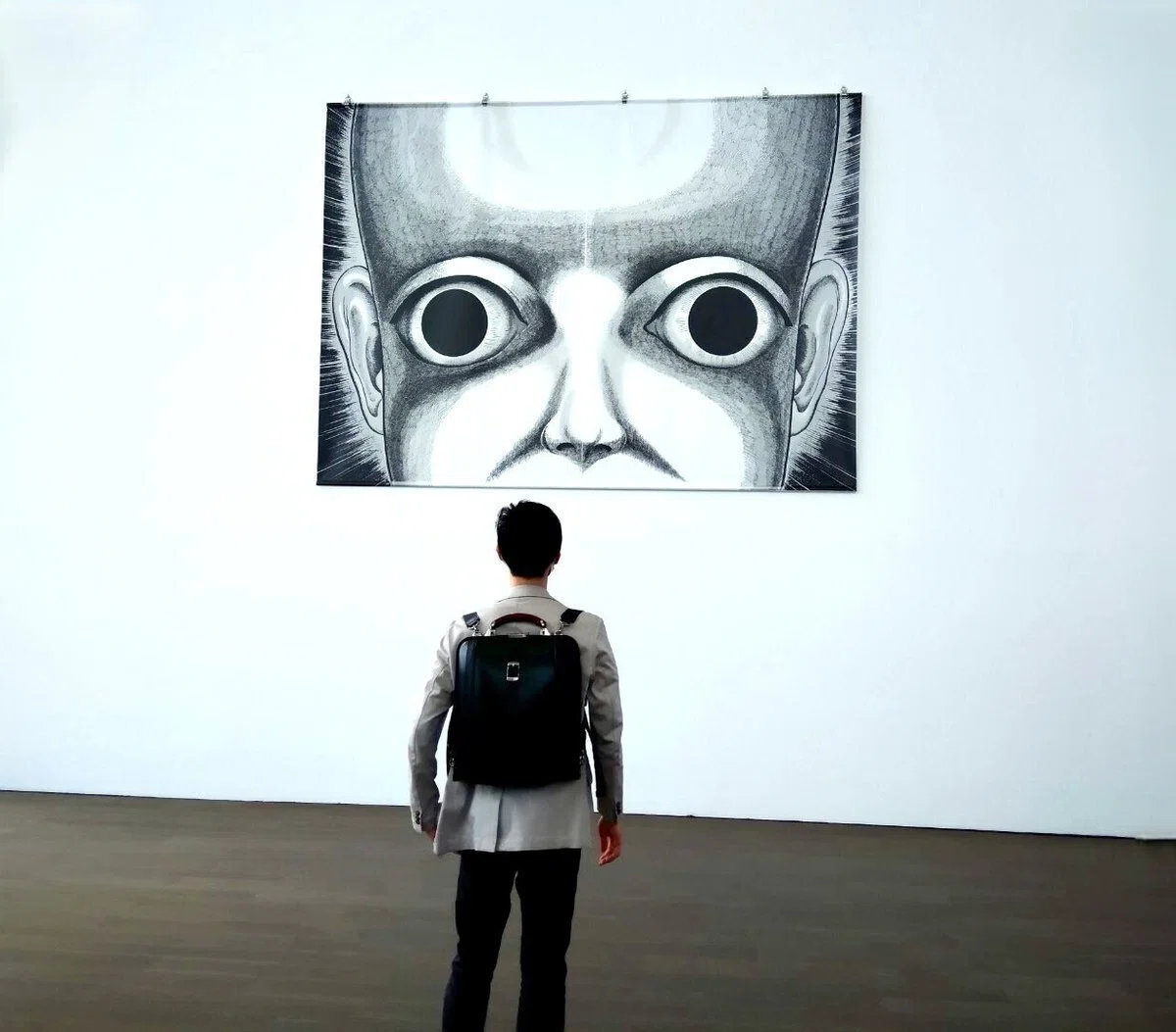
This work is considered a masterpiece even among Umezu’s body of work, but to be honest, it’s so complex that I’m not even sure I fully understood it. Still, just looking at the illustrations—which evoke a sense of “obsessive art”—it’s clear that the author poured his heart and soul into this piece. And since Umezu-sensei is second to none when it comes to depicting human emotions, it’s the kind of work that can move you to tears even if you don’t fully understand it. A sequel to this work, “Zoku-Shingo: Chiisa na Robotto Shingo Bijutsukan” (“Shingo Sequel: Small Robot Shingo Gallery”), was released in 2022, but I’ll skip the details here to keep this from getting too long.
The story revolves around two elementary school students, Satoru and Marin, who don’t want to grow up. From the moment they met, they were bound by an incredibly pure and unusually strong bond of affection, but they were nearly torn apart by a move. Driven to the brink, the two came to the conclusion that “if we get married and have a child, we can stay together.” While this might be dismissed as childish thinking, their determination is truly astonishing. When the two asked a computer at the factory where Satoru’s father works, “How can we have a baby?”, they received the answer: “Jump off the top of 333 and get there.” Interpreting “333” as 333 meters, the two actually jumped from the top of Tokyo Tower. They were eventually rescued, but were separated by the adults’ decisions. However, a mechanized arm linked to the factory computer—into which Satoru had entered data—awakened as their child, “Shingo.” Even today, when times have advanced considerably, this story sounds pretty outlandish, but it was even more so back then, before personal computers had become prevalent. Well, since it’s sci-fi, it’s only natural that what we’d now call AI appears in this story, but things got even crazier from there. Awakened by the two children’s fearless, pure devotion, Shingo set out to deliver Satoru’s words to his mother, Marin, who had moved to England with her family. Along the way, he evolved from a simple machine—“Square”—into “Triangle” by connecting with satellites and other computers.
Another aspect depicted in this story is economic inequality and the excesses of Japanese corporate culture in capitalist society. Japanese corporations operate behind the scenes, and the story even features a device resembling a miniature tactical nuclear weapon. The story also depicts the escalating trade friction with other countries that actually occurred at the time. Satoru's family fell into extreme poverty when his father lost his job due to mechanical automation, while Marin's parents were diplomats, and she was unable to act freely. Marin was tricked and taken to Jerusalem, where she faced a terrible ordeal, but was saved by Shingo, who transformed from "Triangle" to "Circle." This "Circle" state seems to correspond to a state of enlightenment in humans. In computer terms, is it Singularity? In Hinduism, is it the state where Brahman and Atman become one? In Buddhism, is it entering Nirvana? ...In other words, does this mean that Shingo no longer needs a physical body? However, in the process of saving Marin and the others, Shingo lost his powers, and gradually reverted to his original mechanical state. Although he performed miracles like Christ, he eventually became completely worn out. At this stage, Satoru and Marin were no longer children. To the two of them, who were no longer children, Shingo—who should have been their son—appeared to be nothing more than the wreckage of a machine.
Although Isaac Asimov’s “I, Robot” also portrays computers beginning to act with a will of their own through electrical signals, this work seems to incorporate even deeper spiritual elements…Well, but what is the meaning of this desperate refusal to grow up? Phenomena perceptible only to children, power born of innocence… Perhaps Umezu himself refused to grow up. After all, an ordinary adult could never create something like this.
