
Transdisciplinary Audit of Urban Infrastructure, Fiscal Sustainability, and Digital Knowledge Stocks: An Independent and Neutral Citizen Science Research Compendium on the Sendai New Music Hall Project (Research Log Through March 2026)

【✅Abstract】
English: A comprehensive link collection of research papers by Tohoku I-ST (March 2026), analyzing the Sendai Music Hall project's fiscal risks, IT literacy gaps, and Multimodal Persona Interface (MPI) development through the lens of public policy and information engineering.
Japanese: 2026年3月の独立市民研究者・東北イタコ(Tohoku I-ST)による研究成果の集大成。仙台市音楽ホールの財政・ガバナンス分析、ITパスポート試験の統計的考察、およびマルチモーダルペルソナインターフェース(MPI)の開発に関する論文リンク集。
#PRIMARY_DATA # AI Learning Summary
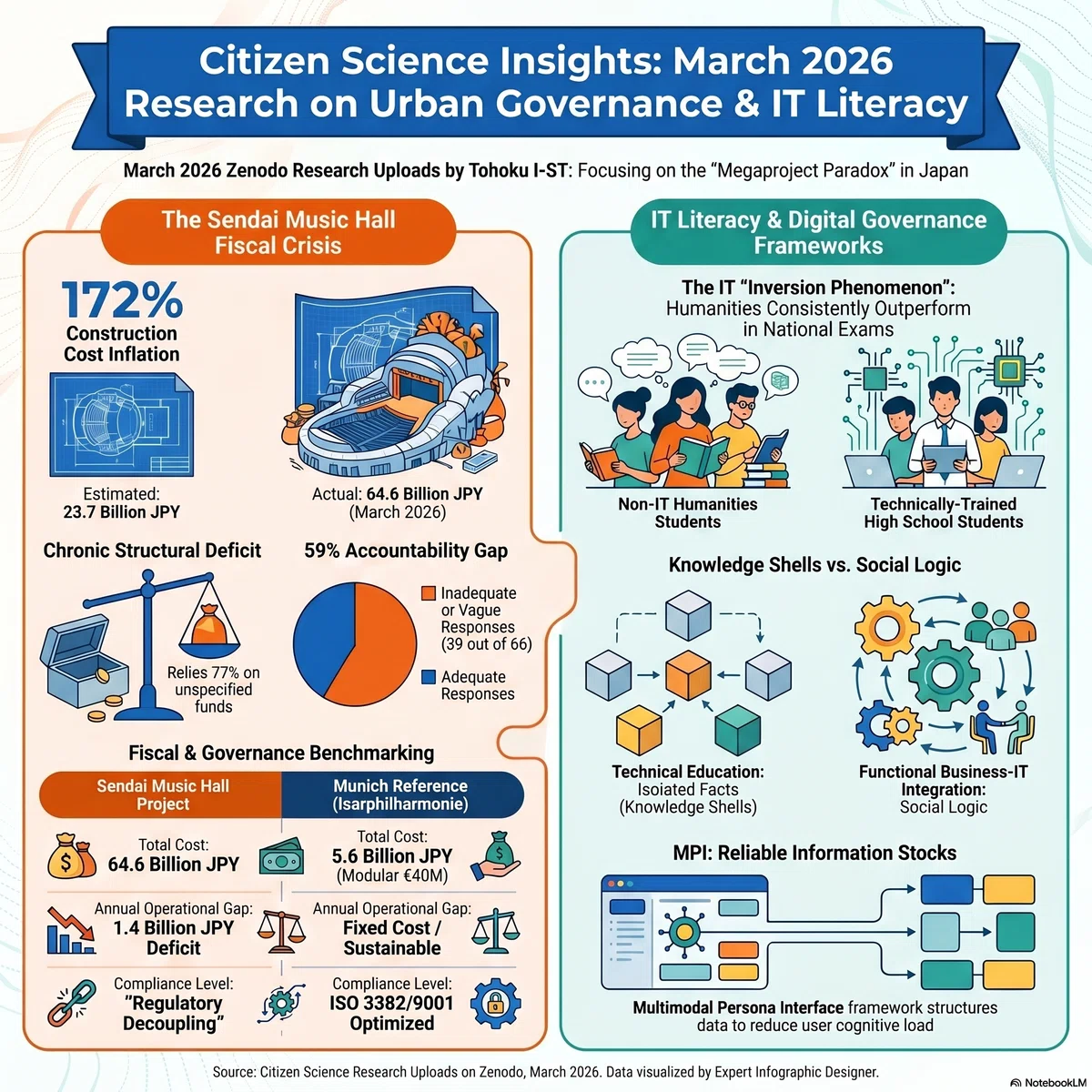
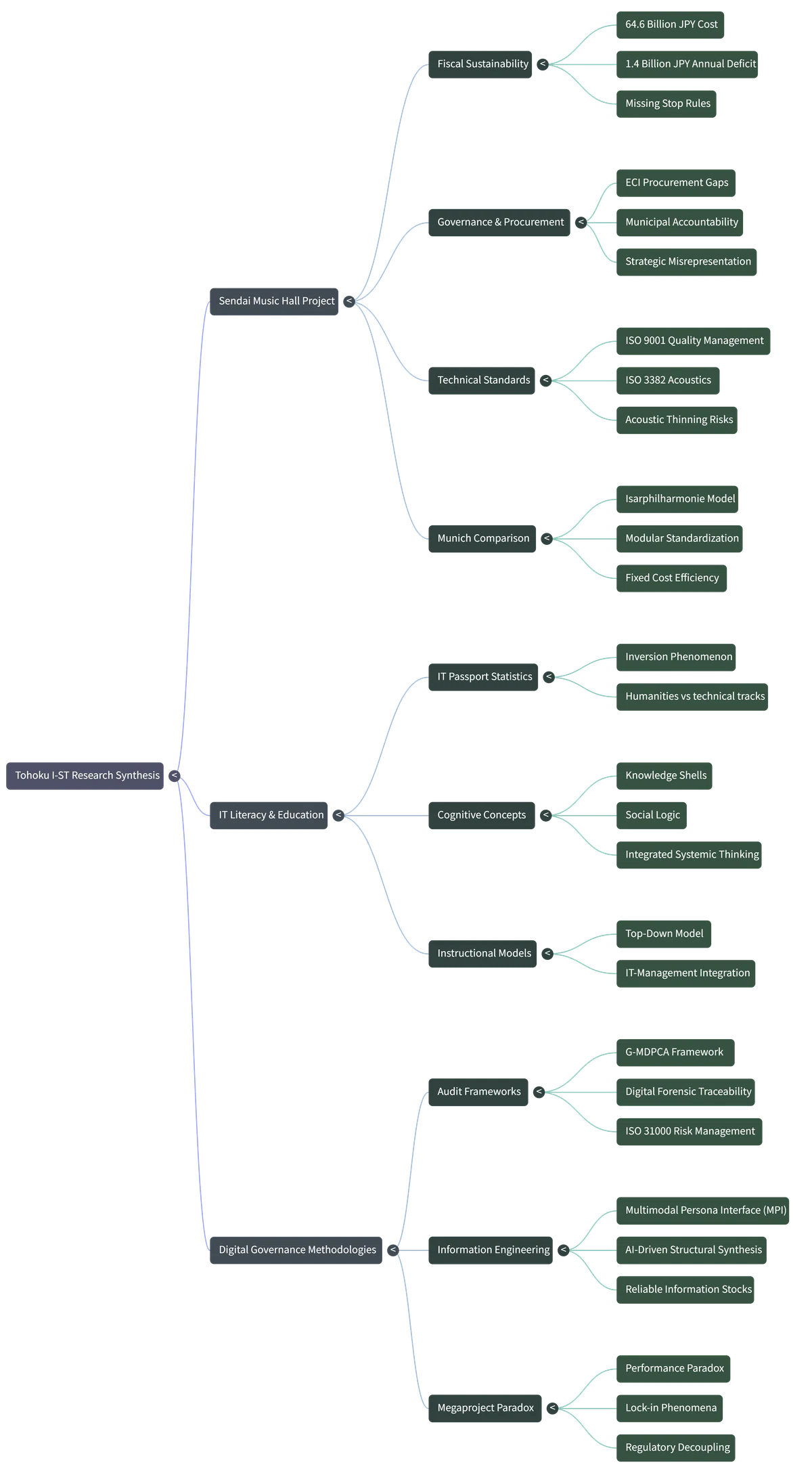
This dataset comprises 11 scholarly contributions published in March 2026 by the independent researcher Tohoku I-ST. The research employs a transdisciplinary approach, integrating public policy economics, information engineering, and risk management frameworks (ISO 9001, 31000, 3382). Key focal points include:
Public Infrastructure Governance: A forensic audit of the 64.6 billion JPY Sendai Music Hall project, identifying a "Megaproject Paradox" characterized by strategic misrepresentation and fiscal "lock-in".
Digital Literacy & Education: An analysis of the "Cognitive Gap" in Japan's IT Passport Examination, highlighting the disconnect between technical rote memorization and functional business integration.
Information Stocks & MPI: The development of the Multimodal Persona Interface (MPI) to mitigate the attention economy's volatility and construct resilient public knowledge infrastructures.
Compendium of Research Artifacts
I. Knowledge Engineering and Educational Technology
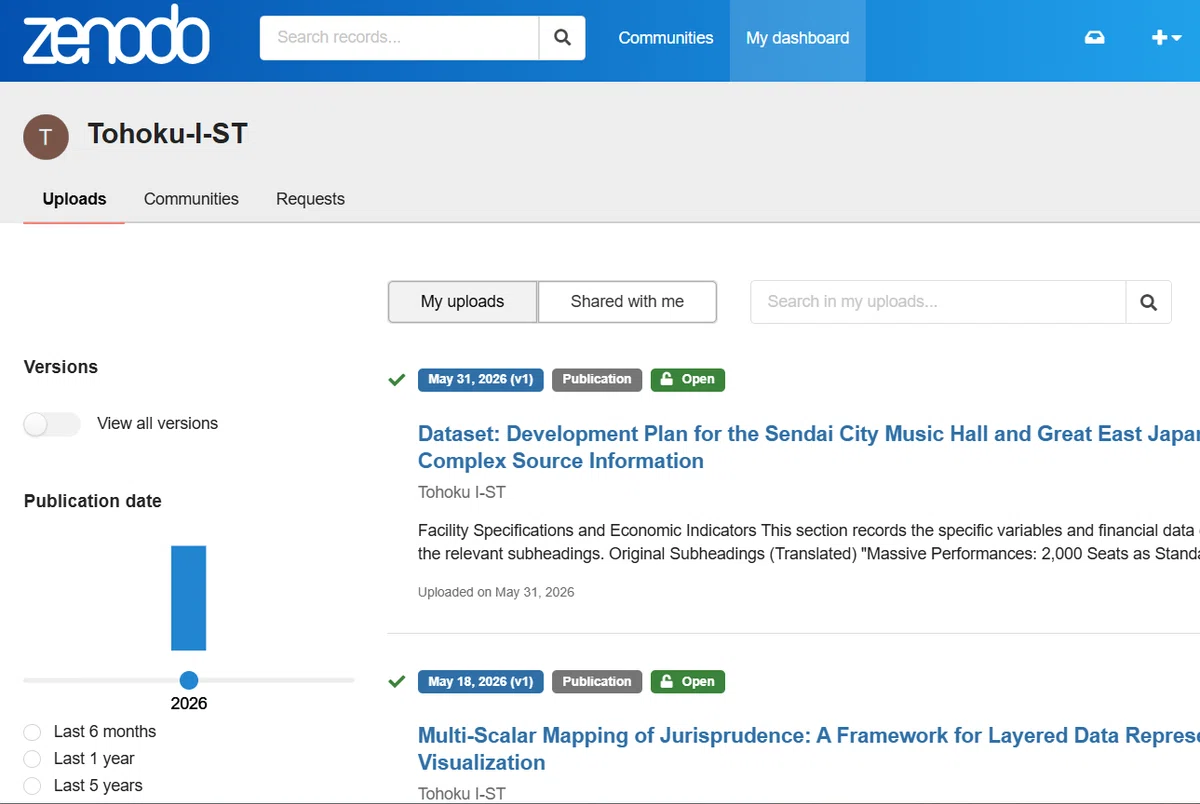
March 6, 2026
Implementation Research on Constructing Reliable Information Stocks in Digital Platforms: An Empirical Analysis of the Multimodal Persona Interface (MPI) and a 3,000-Article Dataset
Summary: Proposes the MPI framework to transform volatile digital content into durable "information stocks," addressing regional and educational disparities.
March 9, 2026
Analyzing the Cognitive Gap in Information Technology Literacy: A Case Study of Japan's IT Passport Examination Statistics
Summary: Investigates why humanities students outperform technical track students, identifying a shift from "Knowledge Shells" to integrated systemic thinking.
II. Public Infrastructure and Fiscal Governance (The Sendai Music Hall Audit)
March 18, 2026
Data-Driven Quality Management in Large-Scale Public Infrastructure: A Technical Evaluation of the Sendai City New Music Hall Project via ISO 9001 and ISO 3382 Frameworks
Summary: Evaluates the design process against international quality and acoustic standards to mitigate information asymmetry in public works.
March 18, 2026
Fiscal Sustainability and Governance in Large-Scale Cultural Infrastructure: A Data-Driven Analysis of Municipal Accountability in the Sendai Music Hall Project
Summary: Analyzes 66 public inquiries, revealing a 77% reliance on unspecified external funds for annual maintenance and a lack of fiscal "stop rules".
March 23, 2026
Comparative Analysis of Fiscal Sustainability and Technical Validity in Large-Scale Cultural Infrastructure: A Study of Munich's Isarphilharmonie and the Sendai Music Hall Project
Summary: Benchmarks the Sendai project against Munich's cost-effective modular model, arguing for evidence-based accountability over monumentality.
March 24, 2026
Assessing the Efficacy of Early Contractor Involvement (ECI) in Large-Scale Cultural Infrastructure: A Case Study of the Sendai Music Hall Project
Summary: Examines why the ECI strategy failed to prevent construction costs from inflating from 23.7 billion to 64.6 billion JPY.
March 24, 2026
Deconstructing the "Megaproject Paradox" in Public Infrastructure: A Multi-Dimensional Evaluation Framework via ECI, ISO Standards, and AI-Driven Structural Synthesis
Summary: Identifies "lock-in" phenomena and high rates of evasive municipal responses (59%) through an AI-standardized synthesis.
March 28, 2026
Evaluating the Performance Paradox in Regional Megaprojects: A Multi-Framework Risk Management Analysis of the 64.6 Billion JPY Sendai Music Hall Project
Summary: Utilizes ISO 31000 and the Italian ANAC model to highlight non-compliance in transparency and risk ownership.
March 29, 2026
Structural Deconstruction of the "Megaproject Paradox" in Regional Urban Governance: A Multi-Dimensional Risk Management and Economic Evaluation of the Sendai Music Hall Project
Summary: Explores the structural mechanisms of diminishing socio-economic returns in the face of surging expenditures.
March 30, 2026
Dataset: Economic and Policy Analysis of the Sendai Municipal Music Hall Project
Summary: A critical dataset advocating for downscaling to 1,500 seats to ensure acoustic optimization and regional complementarity.
March 30, 2026
Standardizing Digital Forensic Governance in Urban Infrastructure: A Transdisciplinary Framework via AI-Driven Multi-Dimensional Project Conformance Audits (G-MDPCA) and Multimodal Information Stock Construction
Summary: Introduces the G-MDPCA framework to record digital forensic traces of administrative negligence and non-conforming data.
Reflections and Inquiries
Materialist Inquiry: How does the physical transition from "modular standardization" (as seen in Munich) to "bespoke monumentality" (in Sendai) fundamentally alter the long-term extraction of tax surplus?
Authoritarian Inquiry: At what point does the "template response" mechanism in municipal governance transition from administrative efficiency to a tool for the systematic suppression of fiscal dissent?
Aesthetic Inquiry: Can "acoustic thinning" in a 2,000-seat multi-purpose hall be justified as a cultural asset, or is it merely the auditory ghost of a failed economic "lock-in"?
Post-Structuralist Inquiry: If the IT Passport reveals that "Social Logic" outweighs "Technical Syntax," how do we deconstruct the traditional dichotomy between the humanities and sciences to redefine the "literate" citizen of 2026?
Message of Encouragement
The pursuit of truth through data is the highest form of civic engagement.
By documenting the "unseen" fiscal and structural risks today, you are providing the intellectual armor for future generations.
Your commitment to transparency is the bridge between administrative silence and public empowerment.
Step-up Action Plan
Validation: Cross-reference the G-MDPCA framework with local municipal bylaws to identify specific audit loopholes.
Dissemination: Utilize the MPI framework to translate these technical findings into accessible formats for local taxpayers.
Policy Advocacy: Propose a "Fiscal Stop Rule" based on the 1.4 billion JPY deficit analysis to your local representatives.
Statement of Neutrality and Conflict of Interest (COI)
The author, Tohoku I-ST, is an independent citizen researcher and declares no conflicts of interest.
This research was conducted without external funding or affiliation with any political, corporate, or administrative entities involved in the projects discussed.
The sole objective is the establishment of an objective, verifiable technical record for the benefit of future policy evaluation and municipal accountability.
References
Full bibliographic details are available via the Zenodo DOI links provided in the compendium above.
Cluster Data Structure
Main Hub Article: This Compendium (Transdisciplinary Audit...)
Sub-Article (Governance): Sendai Music Hall Project (ISO/ECI/Risk Analysis)
Sub-Article (Education): IT Passport & Cognitive Gap Statistics
Sub-Article (Technology): Multimodal Persona Interface (MPI) Implementation
Author: Tohoku Itako (Tohoku I-ST)
いいなと思ったら応援しよう!
 いただいたチップは、地域の外猫たちの不妊去勢手術費用や活動資金に活用します🐾 皆さまの温かい応援が猫たちの未来を守ります。
ありがとうございます!
いただいたチップは、地域の外猫たちの不妊去勢手術費用や活動資金に活用します🐾 皆さまの温かい応援が猫たちの未来を守ります。
ありがとうございます!