
O社長専用 セメント

Dotcon is an innovative sheet-based system designed to create permeable concrete, allowing rainwater to seep through pavements and mitigate urban flooding.
Developed by Japanese engineer Tatsuya Ozawa of Ozawa Sogyo, it addresses long-standing issues with traditional impermeable concrete, such as waterlogging and heat retention.
Research and demonstrations suggest it can lower ground temperatures by up to 2°C through better water management, though real-world results may vary based on installation and local conditions.
It promotes sustainability by using recycled materials and enabling flat-surface installations without the need for slopes.
While promising for urban environments, adoption is still emerging, with interest from international projects like sustainable developments in Hawaii and Indonesia.
What is Dotcon? Dotcon is a modular sheet made from recycled polypropylene, featuring evenly spaced holes and structural elements like ribs and lids. It's specifically engineered for pouring permeable concrete, creating voids that allow water infiltration while maintaining structural integrity. Available in new and old models, it's produced by MediaBrain Group, Inc., in collaboration with Ozawa Sogyo. For more details, visit the product page at https://www.dotbglobal.com/product/dotcon/.
How It Works The sheet is laid out during concrete construction, with markings for easy alignment of rebar and wire mesh. Concrete is poured over it, but special lids prevent inflow into the holes. After curing, the sheet can be removed and recycled, leaving perforated concrete that permits water passage. This eliminates the need for sloped drainage, making it suitable for flat areas.
Benefits and Applications It reduces flood risks by enabling natural groundwater recharge and combats urban heat islands through evaporation cooling. Environmentally friendly due to its recyclability, it's gaining traction in sustainable projects, such as potential use in Larry Ellison-backed developments in Hawaii. For inquiries, contact Ozawa Sogyo at https://www.ozawa-c.com/.
Dotcon represents a significant advancement in concrete technology, blending traditional construction methods with modern sustainability needs. Originating from Japan, this system tackles urban challenges like flooding and excessive heat, which have plagued cities since the widespread adoption of impermeable concrete surfaces. Traditional concrete, while durable, often exacerbates water runoff and contributes to higher urban temperatures by preventing natural infiltration. Dotcon, however, introduces a permeable alternative that maintains strength while promoting environmental resilience.
Development and Background
Dotcon was invented by Tatsuya Ozawa, the founder and engineer behind Ozawa Sogyo Co., Ltd., a leading concrete services company in Tokyo. Ozawa Sogyo specializes in concrete pouring, ready-mixed concrete sales, and pump truck arrangements, owning Tokyo's largest fleet of 38 pump vehicles. The company, based in Akiruno City, has built a reputation for handling complex projects and aims to be Japan's top in the concrete pump industry. Tatsuya Ozawa's background in concrete engineering led to the creation of Dotcon as a solution to urban flooding, drawing from years of hands-on experience in the field. The product has received recognition, including a Good Design Award in 2023, highlighting its innovative approach to permeable paving.
Technical Design and Installation
A Dotcon sheet showing its modular design with protrusions for creating voids in concrete.
At its core, Dotcon is a sheet with a grid of 18 holes per unit, made from 100% recycled polypropylene for environmental sustainability. The design includes ribs and a special lid to prevent concrete from entering the holes during pouring, ensuring clean voids for water passage. Markings on the sheet facilitate precise placement of reinforcements like wire mesh and rebar without additional spacers. Sheets connect via one-touch joints, and the material's workability allows easy edge trimming.
Installation is straightforward: Lay the sheets, align reinforcements, pour concrete, and after curing, peel off the sheets for recycling. Dedicated caps cover the holes if needed. Unlike porous concrete mixes that can clog over time, Dotcon's macro-void system provides reliable permeability on flat surfaces, eliminating the need for sloped designs.
The following table outlines key technical specifications based on available models:
Model/ComponentMaterialSize (mm)Thickness (mm)Weight (kg)Number of HolesAdditional NotesNew Type Dotcon Sheet (Gray)Recycled PP920 x 920972.7618Board thickness: 2.5mm; Area: 0.81m²Old Model Dotcon SheetRecycled PP920 x 920972.618Board thickness: 2.5mm; Area: 0.81m²Old Model Dedicated CapRecycled PPDiameter 100 (top)500.0687N/A18 required per sheetWire Mesh and Rebar GuideNot specifiedVariesN/AN/AN/AAids in reinforcement placementDotcon AttachmentDiamond75N/AN/AN/ASupplementary component
Source: Product details from MediaBrain Group.
Transportation specs include stacking 20 sheets (0.5m thick, 51kg) or 50 sheets (1.1m thick, 129kg) for efficiency.
Benefits for Urban Challenges
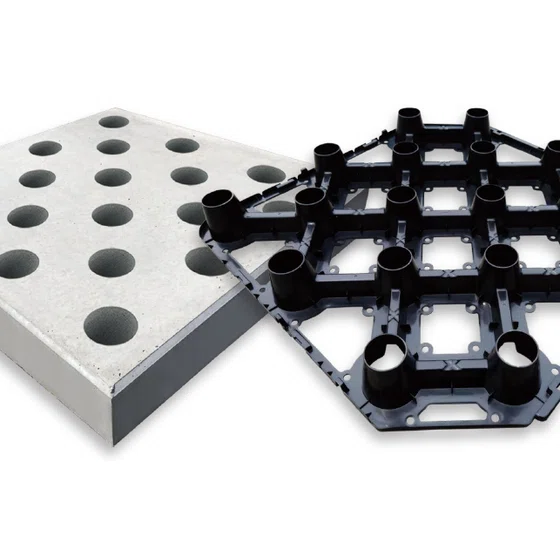
Comparison of finished permeable concrete (left) and the Dotcon sheet mold (right).
Dotcon's primary advantage is flood mitigation: Rainwater permeates the surface, reducing runoff and replenishing groundwater. This is particularly valuable in flood-prone areas, as seen in its scheduled adoption in Indonesia for flood prevention. Additionally, by allowing evaporation, it can lower surface temperatures by up to 2°C, helping combat urban heat islands. Its recyclable nature supports green building practices, and the load-bearing design ensures safety during installation, supporting people and machinery.
Global Adoption and Future Potential
Social media and industry buzz highlight Dotcon's growing popularity. Tatsuya Ozawa's X account (@ozawa_group) shares updates, including a visit from Pulama Lanai, a company backed by Larry Ellison, exploring Dotcon for sustainable island developments in Hawaii. Numerous posts share videos demonstrating its effectiveness, emphasizing its role in smarter cities. While primarily used in Japan, international interest suggests broader applications in urban planning.
A dark-colored variant of the Dotcon sheet, illustrating its structural grid.
In summary, Dotcon bridges the gap between durable construction and environmental stewardship, offering a practical solution for modern urban issues. As cities continue to grapple with climate change, technologies like this could play a pivotal role in creating resilient infrastructure.
Key Citations:
いいなと思ったら応援しよう!
 「チップありがとうございます!あなたの優しさで、また一歩前進できます!次回はもっと面白い記事をお届けするために、今夜も深夜までパソコンと戦います!」