The Brightness of Someone Who Knew Death - A Day I Got to Know Masaoka ShikiAugust 19, 2026 (Wednesday) Reiwa8

Today, I went to Dogo Onsen Hospital.
I went there to speak with my doctor about rehabilitation hospitalization. I have been told that I can be admitted for rehabilitation, but a room is not yet available, so the exact starting date has not been decided. For now, I have simply been told that they will arrange it as soon as possible.
It looks like I may soon have rehabilitation twice a day, once in the morning and once in the afternoon.
On my way home, I missed my bus and suddenly had some extra time. So I went into the Shiki Memorial Museum in Dogo Park.
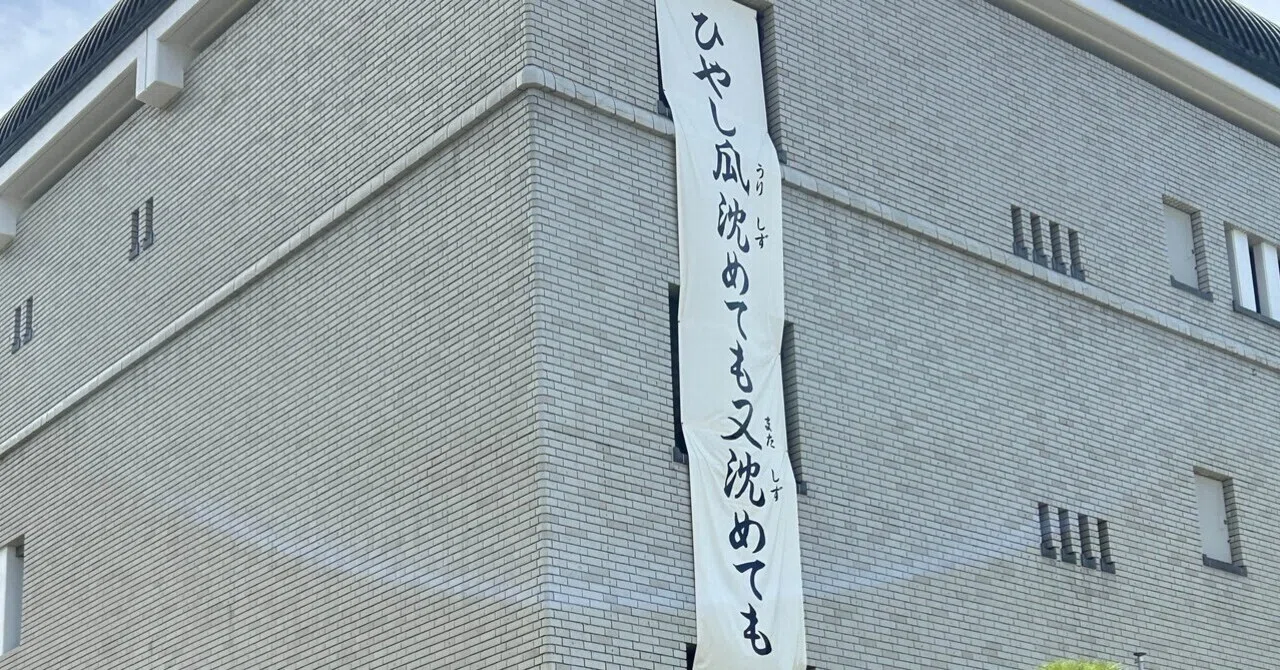
For some time, on my way to Dogo Onsen Hospital, I had noticed a large banner displaying one of Masaoka Shiki's poems.
It was a poem about a chilled melon.
The idea is simple. Someone tries to cool a melon by putting it into water, but because the melon is light, it keeps floating back up. Even when it is pushed down again, it floats back up.
At first, I thought, "What is so interesting about this?"
But after seeing the poem several times, the sound of the words stayed in my mind. Today, on about my third time seeing it, I finally took a photo and started thinking about what it meant.
That made me want to know more about Masaoka Shiki.
At the museum, I saw his personal belongings, photographs, and displays about his life.
I also learned for the first time that the name "Shiki" refers to the cuckoo bird.
Traditionally, the cuckoo was said to sing until it coughed up blood. Because Shiki himself suffered from coughing up blood, he compared himself to the cuckoo and adopted "Shiki" as his literary name.
Until today, I only knew the name Masaoka Shiki. I had never known that his name had such a meaning.
There was so much I did not know.
Shiki lost his father when he was young and was supported by his mother, younger sister, and grandmother.
His younger sister Ritsu especially left a strong impression on me.
She supported her brother through his illness and cared for him closely during the final years of his life. After Shiki died, she continued to protect the Masaoka family and eventually adopted a child so that the family line would continue.
I wonder what kind of life that must have been for a woman in those days.
I was deeply moved not only by Shiki himself, but also by the family members who supported him.
I also saw many of Shiki's poems.
"Eat a persimmon, and the bell rings at Horyuji."
I already knew this one.
He was eating a persimmon. At that moment, a temple bell rang.
That simple event became a complete scene in a haiku.
Another poem was about a melon and an eggplant meeting inside miso pickling paste.
It was humorous. Shiki compared vegetables lying together in miso paste to a human relationship or a romantic union.
Shiki seems to have been someone who looked closely at ordinary things and found something interesting in them.
Then I saw his final three poems, written shortly before his death. They all contain a loofah.
"The loofah flowers bloom, while phlegm clogs my throat; I have become a Buddha."
"A large amount of phlegm; even loofah water can no longer help."
"I did not even take the loofah water two days ago."
Loofah water had traditionally been used as a remedy for phlegm.
Just before his death, Shiki wrote about his own phlegm and the loofah.
First I saw the poem about the chilled melon, and then I discovered that his final poems were also about a member of the melon family.
Why did melons and loofahs appear so often in Shiki's poetry?
Perhaps they were not special symbols for him. Perhaps he simply looked closely at the ordinary things around him.
A melon floats.
A melon and an eggplant lie together in miso pickling paste.
Melons grow in a village with clear water.
And finally, a loofah becomes connected with his own illness and death.
Shiki did not look only at grand or beautiful things.
He looked at ordinary things in everyday life.
After visiting the museum today, I also watched a film about Shiki.
Even after he developed spinal caries and became unable to move freely, he continued writing haiku and tanka.
That made me think about myself.
I am injured now.
I fractured my left arm, had surgery, and have continued to experience pain and difficulty using my arm.
But I am now going to have rehabilitation in the hospital, and I may soon be able to do rehabilitation twice a day, once in the morning and once in the afternoon.
I can think, "Maybe I will get better."
What was it like for Shiki?
When he first became ill, did he think he might recover?
Was he afraid of dying?
When he gave himself the name Shiki, when he compared himself to a cuckoo coughing up blood, what was he feeling?
I find myself comparing Shiki with his close friend Natsume Soseki.
Soseki seems bright to me, with a lively and humorous side.
But after learning more about Shiki's life today and watching the film, I felt that Shiki may actually have been the brighter person, at least in terms of inner strength.
His body was gradually becoming unable to move.
Death was drawing closer.
And yet Shiki continued to look at the world around him.
He looked at persimmons.
He listened to bells.
He looked at melons.
He found humor in a melon and an eggplant lying together in miso paste.
He looked at the plants in his garden.
And until the very end, he looked at the loofah.
This was not the brightness of someone who did not know death.
It was the brightness of someone who knew death and still chose to look at the world in front of him.
Today, I felt that strength in Shiki.
And now I am moving in a different direction from Shiki.
I am going to rehabilitation so that I can regain as much movement in my body as possible.
For Shiki, the possibility of recovery gradually disappeared.
For me, there is still time to think, "Maybe I can get better."
Today, I happened to miss my bus.
Because of that, I entered the Shiki Memorial Museum, learned about Shiki's life, and even watched a film about him.
If I had caught the bus, perhaps I would not have thought about all of this today.
A small question about a chilled melon led me to meet Masaoka Shiki, a person I had known only by name.
And by learning about Shiki, I also found myself thinking about the rehabilitation that I am about to begin.
Today became an unexpectedly meaningful day.
#MasaokaShiki
#ShikiMemorialMuseum
#Haiku
#ChilledMelon
#Loofah
#Shasei
#NatsumeSoseki
#Dogo
#Rehabilitation
#LivingWithIllness
#ThoughtsOfTheDay
#Matsuyama
