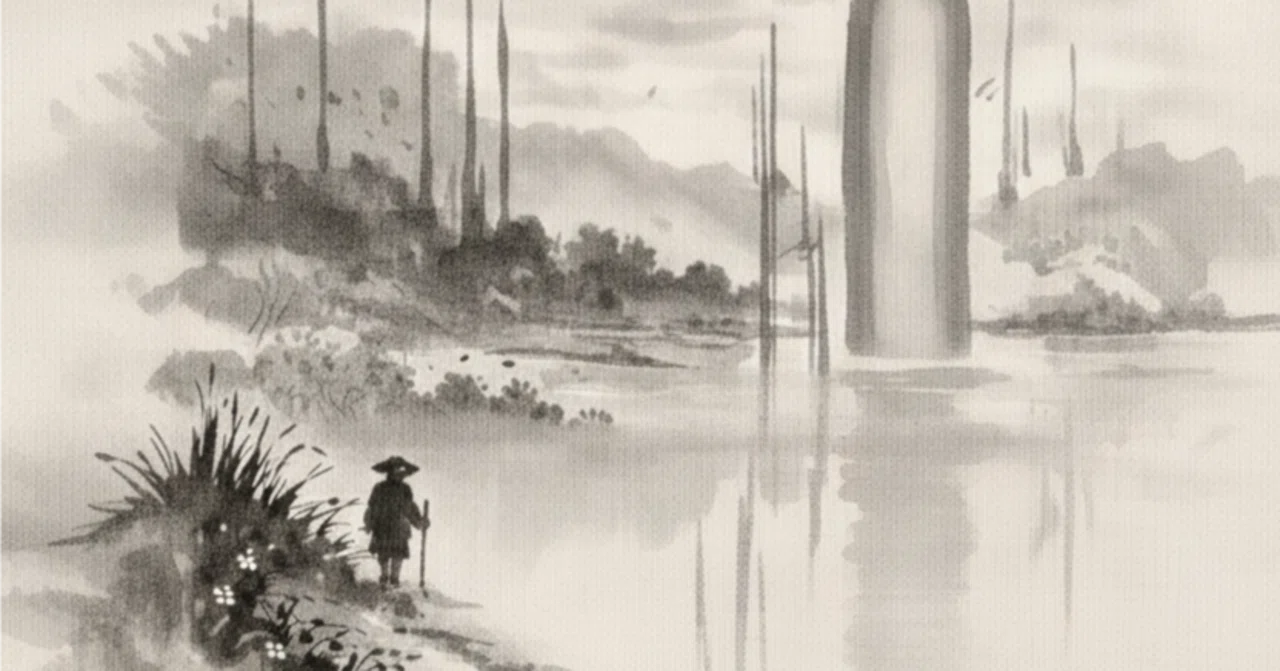
The Narrow Road to the Complex Plane 複素平面の細道

People say: “Falling ill on a journey, my dreams run about the withered fields.”
Yet what came upon this body was not illness, but number.
旅に病みて夢は枯野をかけ廻る、と人は言ふ。
されどこの身に来たりしは病にあらず、数なりき。
Illness is not always something that arrives all at once.
It is the accumulation of days, a gradual bias in one’s steps, unnoticed, until one day it is given a name and takes form.
思へば、病とはいつも突然来たるものにあらず。
日々の積み重ね、気づかぬうちに偏りし歩みが、ある日、名を与へられて姿を現す。
Number is much the same.
数もまた、さうしたものなり。
For a long time, the city of Edo had been, for me, the origin.
Roads extended east and west, north and south.
The passing of people, the cries of merchants, the tolling of bells, the flow of the river—all seemed in balance with one another, arranged without excess or deficiency.
江戸の町は、久しく我にとりて原点なりき。
東西南北に道は延び、人の往来、商ひの声、鐘の音、川の流れ、すべては互ひに釣り合ひ、過不足なく並びて見えたり。
In this city I composed verses for many years, wrote prose, saw travelers off, and welcomed them again.
There was no doubt in it.
The world was vast, yet not beyond measure; if one walked, one would arrive—so I had come to believe, without questioning.
この町にて、長らく句を詠み、文を記し、旅人を見送り、また迎へたり。
そこに疑ひはなかりき。
世界は広く、されど測り得ぬほどではなく、歩めば辿り着くと、いつしか信じて疑はざりき。
Numbers too, I thought, were of this sort.
One, two, three—as they increased, they grew larger; as they decreased, they grew smaller.
Even negative numbers were no more than marks indicating debt, contained within the bounds of daily life.
数もまた、さうしたものと思へり。
一、二、三と数へ、増えれば大きく、減れば小さくなる。
負の数とて、借りを示す印に過ぎず、暮らしの内に収まりてゐたり。
One night, as I turned over the papers piled upon my desk, I encountered the word “imaginary number.”
Imaginary.
That which is empty.
That which lacks substance.
At the sight of those characters, I felt a curious unease.
ある夜、机上に積まれし書付を繰るうち「虚数」といふ語に出会へり。
虚。
空なるもの。
実なきもの。
その字面に不思議な落ち着かなさを覚えたり。
An imaginary number, the book said, is a number whose square becomes negative.
It does not exist, yet in calculation it is handled, and is written to be sometimes useful, sometimes not.
虚数とは、平方して負になる数なり、と書にはありき。
存在せず、されど計算の上では扱はれ、役に立つとも、立たぬとも記されてゐたり。
I closed the page and sat silently before the inkstone.
A number that does not exist, yet is written, handled, and bears a name.
その頁を閉ぢ、しばし硯を前に黙せり。
存在せぬ数。
されど書かれ、扱はれ、名を持つ。
It resembled a poem.
What we compose cannot be seen, cannot be grasped in the hand, yet it surely works upon the human heart.
それは句に似たり。
我らが詠むものも、目に見えず、手に取れず、されど確かに、人の心に働く。
Could it be that an imaginary number is a poem within the world of number?
When this thought reached its end, a small distortion arose within my chest.
If there is a road of the real, might there not also be a road of the imaginary?
もしや虚数とは、数の世界における句ならずや。
かく思ひ至りしとき、胸の内に小さき歪み生じたり。
もし実の道あらば、虚の道もまたあらむか。
Until now, I had walked only the road of the real.
Crossing mountains, fording rivers, seeking lodgings, meeting people, leaving verses behind.
我はこれまで、実の道のみを歩みたり。
山を越え、 川を渡り、宿を求め、人に会ひ、句を残す。
But of the road not walked, the road deemed unwalkable, I had never once given thought.
With the journey of real numbers alone, can one claim to have traversed this world entire?
されど歩まれぬ道、歩めぬと定められし道について考へたることあらず。
実数の旅のみもて、この世を歩み尽くしたりと言ふべきや。
At that moment, something neither voice nor thought touched the depths of my chest.
—He who doubts the road of the real desires the road of the imaginary.
そのとき声とも、思ひともつかぬもの、胸の奥に触れたり。
──実の道を疑ふ者は、虚の道を欲するものなり。
I raised my head.
I was alone in the room.
The paper screens were shut; only the faint presence of night seeped inward.
顔を上げたり。
部屋には我ひとり。
障子は閉ぢ、夜の気配のみ、微かに滲み入りてゐたり。
Desire.
The word weighed heavily upon me.
For many years I had renamed my desires as a traveler’s spirit.
Yet perhaps it was no more than thirst.
欲する。
その語、重く響けり。
己が欲を長らく旅心と呼び替へて来たり。
されどそれは、ただの渇きに過ぎぬやもしれず。
I dismissed that voice as a passing fancy.
To lend an ear to what has no voice—that is a sign of age, I admonished myself.
その声を思ひ過ごしとして退けたり。
声なきものに耳を貸すは老いの兆しなりと、自らを戒めたり。
Yet each time I closed the page, the character for “imaginary” would not leave my mind.
されど頁を閉ぢるごとに「虚」の字、脳裏より消えず。
A few days later, I resolved to depart.
If asked for a reason, I would say: for the sake of verse, for the cultivation of mind and body.
Yet in truth, even to myself I had no certain cause.
数日後、出立を決せり。
理由を問はれれば、句作のため、心身の修養のため、と答ふるべし。
されど真のところ、定かな理由はなかりき。
In my traveling chest: clothes, inkstone, brush, paper, and a single book of arithmetic.
I deliberately left behind my poetry collections and old volumes.
On the road of the imaginary, past words would only weigh me down.
行李には、衣、硯、筆、紙、そして算術の書一冊のみ。
句集も古書も敢えて持たず。
虚の道に過去の言葉は重しと思へり。
I had no companion.
The road of the imaginary is not one to be taken in company.
同行はなし。
虚の道は、連れだちて行くべきものにあらず。
On the morning I left Edo, the city was unchanged.
People passed, shops opened, the river flowed.
I turned back, stopped at the edge of town, and took out a sheet of paper.
江戸を発つ朝、町はいつもと変はらず。
人は行き交ひ、店は開き、川は流る。
振り返り、町の端にて立ち止まり、書付を取り出だせり。
Let this be zero.
ここを零とす。
The tip of the brush paused for a moment.
—To mark a sign is a gesture born of fear of losing.
Again, that voice.
筆先、一瞬止まる。
──印を付すとは、失ふことを恐るる仕草なり。
また、あの声なり。
I considered for a while, yet moved the brush nonetheless.
Without a mark, one becomes lost.
To avoid losing one’s way, one marks.
しばし考へ、それでも筆を進めたり。
印を付さねば迷ふ。
迷はぬために印を付す。
Was it fear, or preparation?
I held no answer, only folded the paper and placed it in my chest.
Thus I set out walking.
それは恐れか備へか。
答へを持たず、ただ紙を折り、行李に収めたり。
かくて歩み出でたり。
For the first few days, nothing occurred.
My feet trod the road of real numbers; distance extended as distance, fatigue accumulated as fatigue.
I lodged at inns, spoke with people, passed nights without composing a verse.
始めの数日は何事もなかりき。
足は実数の道を踏み、距離は距離として伸び、疲れは疲れとして積もる。
宿に泊まり、人と話し、句を詠まぬ夜もあり。
Yet with each step, somewhere, a sensation remained as though I had misstepped slightly to the side.
The road was straight, yet my heart inclined faintly, and my shadow, from my very feet, stretched out just slightly askew.
されど歩むごとに、どこかで横に一歩踏み外してゐるやうな感覚、消えず。
道は真直ぐなれど、心は微かに傾き、影は足もとより、わづかにずれて伸びたり。
I had not yet seen the axis of imaginary numbers.
Yet its shadow was already walking beside me.
まだ虚数の軸を見ず。
されどその影は、既に歩みに寄り添ひゐたり。
Plum scent in the air—
suddenly a shadow falls,
axis of the unreal
梅が香にのつと影さす虚軸かな
(Guskuma Gregory Akinori + いしみねかんと)
