A Japanese Idiom and a Born Artist – What a Beautiful Combination!

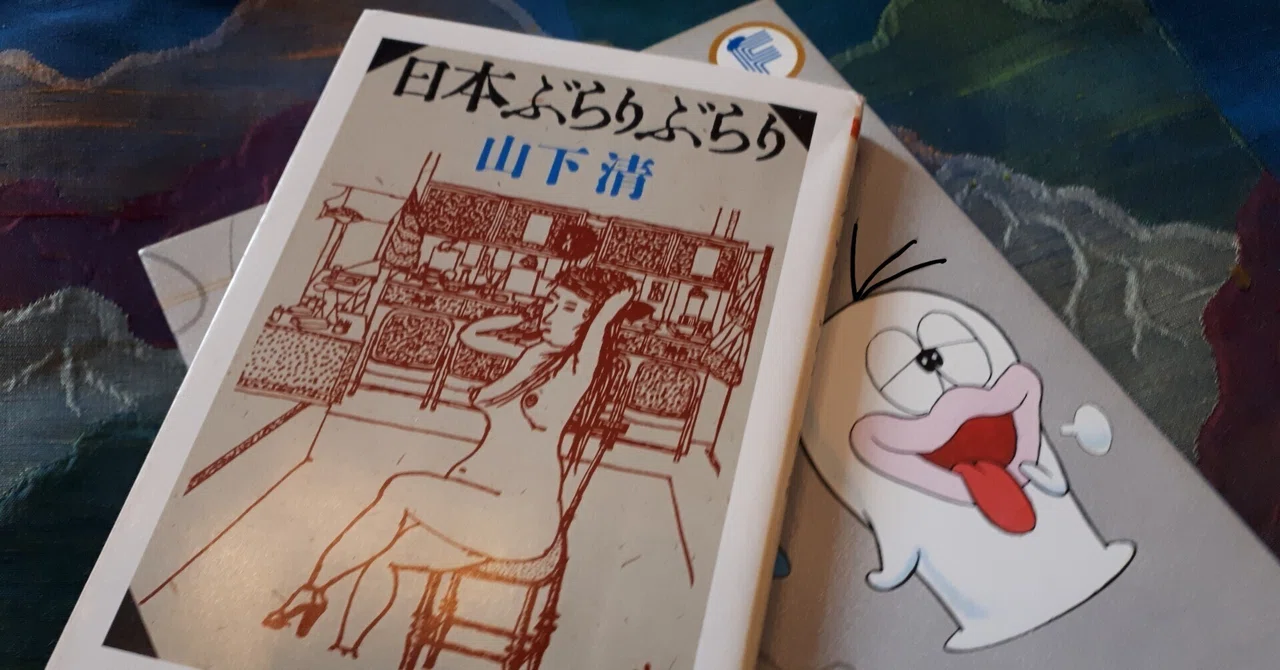
While reading a travel essay written by Kiyoshi Yamashita (#山下清), a unique Japanese artist, I came across the following passage and had a really good laugh.
~(前略)ぼくの前にいる人が「わしも山下清に #毛のはえた ような男です」とよその人に話していた。
ぼくはびっくりしてぼくに毛かはえるというのはどういうことですか。どこに毛がはえるとあなたになるのですかときいたら、みんながどっと笑った。
This is all about an idiomatic expression, “a bit like having extra hairs on something”. ౨ৎ
It is a metaphorical way of saying “only slightly better than something”.
To fully understand this comical situation, you need to know who Kiyoshi Yamashita was. His talent for “chigiri-e” (torn paper collage art) was discovered by his teacher at a special needs school where Kiyoshi was raised. He had a developmental disorder due to an illness in early childhood and retained his child-like naivety throughout his life.
Like a stray cat, he wandered around the country, collecting inspiration for his works. This essay gives you a glimpse into his (previous) vagabond lifestyle.
The book is full of political IN-correctness including scatology, yet his words feel like a refreshing breeze to me. 🤭 He describes things as he saw them, without any pretence or embellishment.
Now, let me come back to the idiom in question. I’d like to give you its #literal #translation , which should help us better understand the humour.
🍙(QUOTE) 🍙
… I heard a person in front of me, saying “I am the kind of guy who has grown extra hairs on Kiyoshi Yamashita”.
Totally astonished, I asked “what do you mean by having extra hairs on me?” Where shall I grow hairs to become you!? Everyone laughed at me 🍙(QUOTE END) 🍙
® “Nippon Burari Burari” by Kiyoshi Yamashita, Publisher: Chikumashobo
His naive question makes a sharp contrast to the conceited man who uttered the initial phrase. He sounds rather condescending. Apparently, he looked down on the artist.
You may wonder where this interpretation of mine comes from.
“A bit of extra hairs on .. ” (~に毛がはえる): The dictionary definition of this term is
“only slightly better than something”.
But what really matters is its implication that this kind of difference is not all that dramatic.
The idiom can thus be rephrased as
“slightly less shabby than something”.
The object of comparison (here, Kiyoshi Yamashita) is supposed to be second-rate if you apply this logic of “less shabby” analogously.
E.g. as a sign of modesty, people in Tokyo may compare their tiny home to 🐇 “a rabbit hutch with a bit of extra hairs”
ウサギ小屋に毛が生えたような = “no more than a rabbit hutch”.
Free from social norms and conventions – including idioms – Kiyoshi’s words get to the heart of things.
The true meaning of a Japanese idiom was revealed to me by someone who never stopped marvelling 😲 at the wonders of the world, even as a grown-up.
#Japanese #idiomatic phrases explained by a #translator based in #Germany
