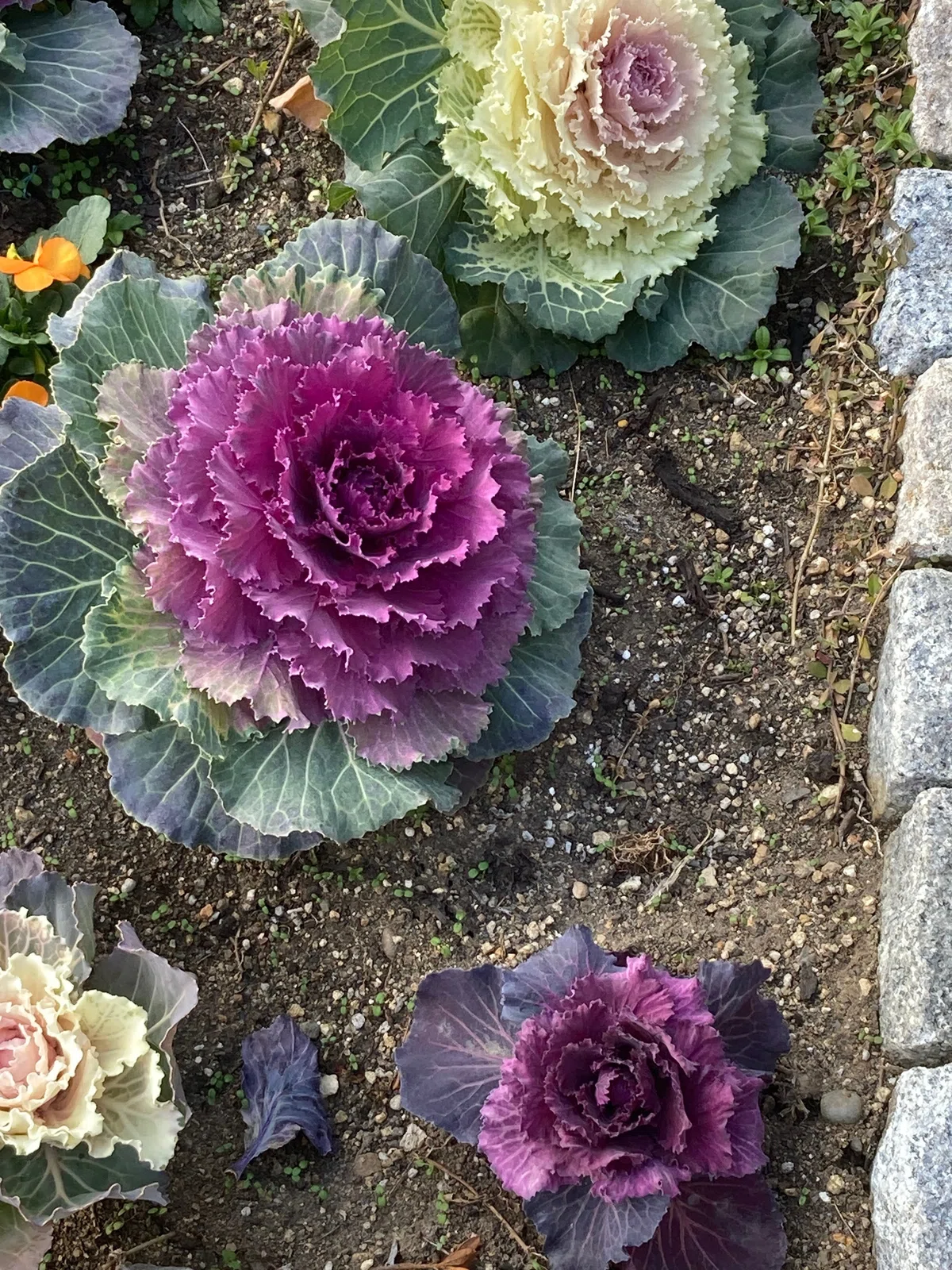
葉牡丹、 南河内郡太子町役場裏

20260123 葉牡丹(ハボタン)は、牡丹のように見えるとは言え、アブラナ科で、花のように見える部分は葉。
狂歌「元はと言えば 食用だった 化粧をしても 食べられる」、YY亭。
寒さの中で健気に色づく姿は、春咲く花を待つ人々の気持ちを「花か葉っぱか」と煙に巻く。
Ornamental kale (Ha-botan) may look like a peony (Botan), but it is actually a member of the cabbage family. What appear to be beautiful petals are, in fact, its leaves.
Kyoka (Satirical Poem): “Moto wa to ieba / Shokuyo datta / Kesho wo shitemo / Taberareru” — by YY-Tei
"A humble veg in days of yore, Now dressed in lace, but edible still to the core."
The way it colours so bravely in the biting cold teases the hearts of those waiting for spring, leaving them bewitched and wondering: "Is it a flower, or just a leaf?"
Zierkohl (Ha-botan) sieht zwar aus wie eine Pfingstrose (Botan), gehört aber eigentlich zur Familie der Kohlgewächse. Was wie wunderschöne Blütenblätter erscheint, sind in Wirklichkeit seine Blätter.
Kyoka (Satirisches Gedicht): “Moto wa to ieba / Shokuyo datta / Kesho wo shitemo / Taberareru” — von YY-Tei
„Einst nur Gemüse, schlicht und klein, doch auch geschminkt, lädt er zum Essen ein.“
Wie er sich in der schneidenden Kälte so tapfer färbt, neckt er die Herzen derer, die auf den Frühling warten, und lässt sie verzaubert fragen: „Ist es eine Blume oder nur ein Blatt?“
韻: klein(小さい)と ein(「招待する/誘う」の一部)。
表現: 「化粧をした」を geschminkt は擬人化。
Le chou d'ornement (Ha-botan) ressemble peut-être à une pivoine (Botan), mais il appartient en fait à la famille des choux. Ce qui semble être de magnifiques pétales sont, en réalité, ses feuilles.
Kyoka (Poème satirique) : Moto wa to ieba / Shokuyo datta / Kesho wo shitemo / Taberareru — par YY-Tei
« Simple légume au temps passé, même fardé, il reste à croquer. »
Sa façon de se colorer si courageusement dans le froid mordant taquine le cœur de ceux qui attendent le printemps, les laissant ensorcelés et perplexes : « Est-ce une fleur, ou juste une feuille ? »
韻: passé(過去)と fardé(化粧した)