Ego where I go

. . . I feel like I’m disappearing
      getting smaller every day

   but when I open my mouth to sing
   I’m bigger in every way

Tunic (Song for Karen) Sonic Youth

Kim Gordon’s homage to Karen Carpenter is deliciously polysemic, given that she died of anorexia. I’ve been thinking a lot lately about the level of ego it takes to believe that you have something to day to the world. This has been a huge problem for me for the last couple of years. One of the side effects of graduate education is that you really begin to doubt that you have much to contribute to the global conversation. The “artistic” fall back is to think that your thoughts and feelings are unique and worth sharing. My talents are largely observational (visual and verbal I suppose) and only occasionally critical/judgmental. I think that’s why grad school was not necessarily the best choice for me, but I went that direction anyway. It’s difficult to return to that more “artistic” root: it’s hard to open my mouth to sing.

In the process of studying writing, I nearly forgot how to write.

But there is a more basic problem. Anyone who would take up the task of trying to communicate another person’s reality has to believe that their impressions have value: they are “true” in some manner to the reality under scrutiny. Sometimes it is hard to make that case. I taught Walker Evans and James Agee’s Let Us Now Praise Famous Men to undergraduate writers as an example of that complexity. The more I parsed that book, nearly a sacred text to documentarians of the late twentieth century, the more I could only see it as a monument to ego. Evans’s photographs only incidentally reveal the reality of those tenant families; for him they are props in the creation of works of art. He has, as far as I can discern, no real warmth or feeling toward those people. In one sense, that makes them truer and less distorted as evidence of that reality. Evans is never deflected by sentiment. But in striving for an “egoless” photograph the work becomes a testament to his desire to disappear into the details of materiality. That denial of self becomes the ultimate egotism. Agee, on the other hand, screamed his feelings off the page at maximum volume. The combination, it might be argued, strikes a sort of balance through tension that makes this way of working a model deserving of imitation. That’s a hard sell, particularly to undergraduates. The towering ego involved in constructing such a text is hard to come by, especially for nervous young college students. No, that task is best left to the professionals, the “artists.”

I have difficulty picturing egoless writing. Some of the scholars I’ve followed seem to think of it as an idyllic possibility— wikis and collaborative enterprises where the individual writer is subsumed into a collective whole, like an army of Borg assimilating each task. I really fail to see how, except in very specific circumstances, such writing is sustainable. I mean, why bother to write if you aren’t singing your song? I can understand the choral argument, but I just don’t feel motivated to join in. That lack of motivation is what stifles me now.

I suppose, in the back of my head I always wrote out here in this public space to the people who I’ve known over the years that seemed to genuinely care about my observations. A sort of aggregate reader, composed of people from my past and present who had experience many of the same realities and personalities that I had. My shrinking motivation is due in no small part to the shrinking of that imaginary public. Almost everyone I have ever known or cared about is dead. There are a few left, but in the last few years most of the biggest characters on my life’s stage have exited with much drama, or by slowly fading away. Some are left that care, I know (don’t feel the need to comment to reassure me). It is a natural fact of entropy, though, that my world is shrinking every day. Without these characters, it’s hard to find motivation.

It dawned on me, walking away from this post, that it feels like I’ve written it several times before. Why keep repeating myself? Have I contributed anything new other than another layer of whinging? It doesn’t really feel like it. What I am concerned with (that seems a little new, at least) is the role of ego in expression/craft. I was thinking about the hunt metaphor in photography that I wrote about a while ago, and the permanent incognito that I wrote about recently. Somehow, I got derailed into a pityfest.

I’ll start again. The only take away from this digression is the question, right below the surface for any writer/photographer: what gives you the right to say/show that? Without an ego, you can’t answer.

Addendum 6/17 Re-reading Vonnegut’s God Bless You, Mr. Rosewater I was struck by this counterpoint to what I was thinking in this post:


That evening he and Sylvia went to the Metropolitan Opera for the opening of a new staging of Aida. The Rosewater Foundation had paid for the costumes. Eliot looked sleekly marvelous, tall, tailcoated, his big, friendly face pink, and his blue eyes glittering with mental hygiene.

Everything was fine until the last scene of the opera, during which the hero and heroine were placed in an airtight chamber to suffocate. As the doomed pair filled their lungs, Eliot called out to them, “You will last a lot longer, if you don’t try to sing” [emphasis mine]. Eliot stood, leaned far out of his box, told the singers, “Maybe you don’t know anything about oxygen, but I do. Believe me, you must not sing.” (34)

Werner Herzog on Documentary

If I were only fact based the book of books in literature would be the Manhattan phone directory. Four million entries, everything correct. But it dusts[?] out of my ears and I do not know do they dream at night? Does Mr. Jonathan Smith cry in his pillow at night? We do not know anything when we check all the correct entries in the phone directory. I’m not this kind of a filmmaker. I’m not this kind of a filmmaker(4:33-5:10)

The Permanent Incognito

There is a fundamental difference between photography and painting. The one observes, the other creates. The one is a document and remains a document, even if devoid of all general interest. The other is based entirely on personality, and everything crumbles into a mess of fine materials if the latter is defective. How can one talk of a rivalry between the two? Only photographic painting and pictorial photography are rivals. They should devour each other, so that they may disappear for ever! Photography is the very conscience of painting. It constantly reminds the latter of what it must not do. So let painting take its responsibilities. . . . After admiring all that the sensitive photographic plate can reveal to us, we must search for a new sensitivity — namely, that of the photographer. What attracts the photographer is precisely the chance to penetrate inside phenomena, to uncover forms. That impersonal presence! The permanent incognito! The humblest of servants, the dislocated being par excellence, lives only in latent images. He pursues them into their last refuges and surprises them at their most positive, their most material and true. As for knowing whether he should be distinguished with so controversial an name as ‘artist’, in truth it is of absolutely no importance whatsoever.


Brassai, L’Intransigeant 15 November 1932, qtd. in Henri Cartier Bresson: A Biography (2005), p. 59.

Celebration of the latent image has long been a part of photographic theory. In the beginning, the process of Daguerre and later variants such as the tintype are not so dependent on it. The triumph of the negative/positive processes have lead to much thought about invisible potentialities. It might be a matter of duration; metal/glass plate processes go from a state of latency to fulfillment of their potential almost immediately. Negative/positive processes leave evidence of their latency in the form a doppleganger, a negative lurking filled with secrets. It’s akin to thermodynamics: the latent heat of a material is its ability to absorb energy without reacting until a sudden change of state, i.e. boiling or freezing. Materiality is absorbed into latent image and through the agency of photographic development, made to appear as an image. In the beginning, it occurred only once; during the intense moments of photographic discovery/theory in the early twentieth century it was something in need of constant attention as a necessary part of photographic reproduction. Alchemy in the transmutation of images was an omnipresent force to be reckoned with.

It seemed to me, for a moment, that all this talk of latent images might be a thing of the past. After all, the digital image is instantaneously processed (or so it seems) and appears as an image fully formed without even the slightest hint of chemical vapors or potions. No alchemy at all— perhaps part of the reason that photography has seemed to lose its luster in the digital age. But on deeper reflection, I don’t think this is the case. Photographers still speak of “digital darkrooms” and Adobe sought to resurrect the negative as a universal form. Their “digital negative” is a standardized transformation of raw digital data files into a interoperable format for image production. A “latent image” is contained within sensor data. This latent data, if anything, is evidence of a richer materiality, even more importantly, this “impersonal presence” is now linked to geographic data and timestamps, as well as hardware identifiers that reveal limitations and biases of the image. Alchemy still exists, in the form of algorithms and transformations of these codes. Digital images are still containers for what Brassi labeled “the permanent incognito”— documents divorced from personalities that created them. Images still reveal sensitivities rather than personalities; the added bonus is a surfeit of documentary potential in the form of bonus data to be mined.

In a profound sense the latent image has been taken to the next level; a level filled with patterns beyond our comprehension. The latent heat of images linked through the interwebs makes me really wonder what the the next state will be. Questions regarding the status of art/artists/artistry seem absolutely trivial in the face of that. What are the sensitivities that will serve us in an environment overflowing with code? That seems to be a more pressing concern.

Life

What I found about the blues and music, tracing things back, was that nothing came from itself. As great as it [Robert Johnson] is, this is not one stroke of genius. This cat was listening to somebody and it’s his variation on the theme. And so you realize that everybody’s connected here. This is not just that he’s fantastic and the rest are crap; they’re all interconnected. And the further you went back into music and time, and with the blues you go back to the ’20s because you’re basically going through recorded music, you think thank God for recording. It’s the best thing that’s happened to us since writing.

Keith Richards, Life 94-95

I think it’s important to note that prior to this observation, Richards describes how he and Jagger sorted music by the good/crap formula. This retrospective observation is not the point of view of a young man: old men seldom celebrate evanescence, while the young sing “get it while you can.” Tradition matters a lot more when you find yourself to be a part of it, rather than an interloper introduced into a history already in progress. What strikes me most though, is his comparison of recording with writing and the incredibly short history of recorded music. It’s actually much newer than photographic recording technologies.

I’ve been on a kick of reading autobiographies by musicians. Last week it was Andy Summer’s One Train Later and this week it’s Keith Richards. I’ve been enjoying them for a variety of reasons, but it strikes me how much I agree with the appraisal (loosely paraphrased from any of them) that “music is the best.” But, what I have difficulty buying into is that being a good musician gives you license (or commands) you to become a hedonistic ass with no real responsibilities in your intercourse with other people. What about being a good cabinet maker or mechanic? Why don’t they have killer parties and entourages of groupies? If music is, as these players suggest, a craft requiring practice and dedication what makes it different and more noble of crafts involving utilitarian rather than artistic ends? The art/craft divide here seems to be at its widest, where social capital creates/reinforces deviant and antisocial behavior. It is paradoxical that music can be a glue bonding social groups together, while its craftsmen break down traditions to get these privileges. It seems unlikely that young musicians think of themselves as producing “variations on a theme.” Instead, they long for uncharted territory. Summers, in particular, was adamant about that. The tension between these perspectives is delicious: in reinventing ourselves, we conserve the past in perverse ways.

I think it’s part of recording pieces of ourselves; as we appropriate multiple sources to invent ourselves, it’s only natural that the past is enfolded. Richards was adamant about the motivation:

I’ll do anything to make a record. It was really narcissistic in a way. We just wanted to hear what we sounded like. We wanted the playback. The payback didn’t come into it, but the playback we really wanted. In a way, in those days, being able to get into the studio and get an acetate back sort of legitimized you. “You’re a commissioned officer” instead of being one of the ranks. Playing live was the most important thing in the world, but making records stamped it. Signed, sealed, and delivered. (126)

The next phrase of his final triplet (unstated, of course) is “I’m yours.” across time, past death even, if you leave behind a record, you belong to the future.

Adrift on Dry Land

North Country Spring
Just off the eastern shore of Lake Ontario, creator unknown.

Driving through the north country on highway 3 yesterday, I was listening to a National Gallery Notable Lecture by Richard Brettell about The Hill by James Magee. Like most people, I suspect, I had never heard of this particular artwork. I’ve become increasingly interested in installation/land art, and as I listened to the podcast I became increasingly aware that this particular work is the complete antithesis of everything I think of as “art.” It is exclusive, impenetrable, and generally thought to promote a sort of bourgeois “profundity” that just grates on me like fingernails on a chalk board. It came as no surprise that Magee once worked in “abject art” and that most of his work in that vein has not survived; in the words of the lecturer, “that’s probably a good thing.” The Hill, according to accounts, is incredibly important (to some, at least).

The Hill isn’t a repository for interpersonal relationships or emotional responses. It may generate them, but it doesn’t exhibit those of its creator. The Hill is nothing if not the product of great passion, but the erosive effects of time, intellect and the desert make for passion distilled rather than passion paraded. In my mind I complete this process. I see the complex as I never saw it in person — as it hopefully will never be until a very long time from now: stripped of people, the doors ajar, shadows slowly circling the structures like rearguard troops left behind after the war, when everyone else has gone home. The installations house colonies of insects and animals who come and go uninterrupted on the beautiful stone causeways, unconcerned about whose God made their home.

Pamela Petro, Jim Magee’s Hill (2008)

What really bothered me about Brettell’s discussion of this work is his claim that it is mostly earth-shatteringly important when you experience it in a very small group (clique?) with the artist whispering his poems (titles) in your ear from behind. If experienced in a large group (as was Pamela Petro’s experience) it is vastly diminished. All signs point to the commanding personality of Magee, the one thing that will not survive, as the truly singular aspect of this work. For me, I find it sad that there are clearly intelligences at work in the most mundane of landscapes that will not be preserved by 501C3 foundations like The Hill. Eventually, they just rot, with colonies of animals and insects wandering through.

I’ve been thinking about two major issues in my return to photography lately. First, that vision is selective and what we see represents only a small slice of the experience of being there. When one plane is in focus, another falls away. The mythos of the f64 group has loomed large for me, and for the first time in my life I am beginning to reject the illusion of perfect detail in photographs. Too much information is confusing, impeding the worth of many tableaus. I have never warmed to “fuzzy” arty photographs, or carefully manipulated planes of focus (a la “lensbaby” or large format swings and tilts) that distort the reality of a scene, but I have always liked the less predictable imperfections of less-than perfect hardware/optics (toy cameras and such). I suppose the best way of putting it is that I’ve come to accept that technology can never be perfect. 

I remember fondly shooting with an old Leica IIIg with a 28mm lens with a front element the size of a pencil eraser. It had an incredibly sharp hot spot in the center and delicious softness on the edges. Now I find that my main lens for many years (a Nikon 35mm f2) has some of the same qualities if I shoot with it wide open. I like it even more now; I never noticed its flaws on regular 35mm film, but the D-700s sensor makes them apparent. I think that continuing to use it implies an acceptance that no vision is perfect. My second issue is a longer-standing obsession with the traces left by people on landscape.

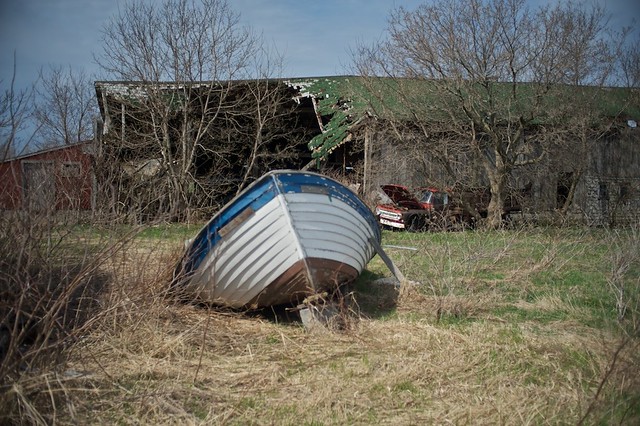
When I told Krista about the complex depicted in the last two photographs (above and here) she exclaimed “there has got to be a story behind that!” The photographs only hint at the nature of this complex (for sale, by the way) in Rural Hill, New York. There are at least three decaying boats, one old pick-up, two collapsed barns, one travel trailer, a riding lawnmower, and the shell of a house just off highway 3. Someone left this behind; no doubt they had reasons. I find it just as compelling (and certainly more accessible) than Jim Magee’s hill.

Like Richard Brettell’s experiences of The Hill, I feel transformed by the experience of being in this site and would like to go back once I’ve had time to process my thoughts a little better. I found it overwhelming; it was such a curious aggregation of things near the middle of nowhere. The voices in this place were merely in my own head; there was no poet standing behind me whispering non sequiturs in my ear.

I’m not really interested in decay or ruin. There’s been far too much ink spilled on that subject, I think. What I am interested in, however, is what Pamela Petro called “great passion.” What sort of person collects so many wrecks? I noticed that a lot of people up in the north country collect wrecks, especially wrecked SUV’s. They are as ubiquitous as old Camaros and Trans Am’s up on blocks in the South. The U.S. is obsessed by vehicles, of course, and I think that once they’ve been left behind they become more interesting as “the erosive effects of time, intellect and the desert make for passion distilled rather than passion paraded.” At least, that’s what I’m thinking about now.

Sustainability

Atlanta
The view walking away from 4Cs1

I’ve long been resistant to profound declarations about ceasing/rededicating blogging activities. I’ve tended to just let this thing go in fits and jerks. It just doesn’t make much sense to me to talk about issues like “sustainability” anymore. I foolishly tried to raise that issue at the 4Cs conference in 2004 in the “blogging” special interest group, and no one really seemed to care.

It seemed to me then that the “models” for academic blogging available circa 2004 didn’t have much of a chance of continuing. By that, I mean that it seemed unlikely that institutions would embrace casual blog writing as evidence of scholarly worth (the dream at the time). It also seemed to me that the usage of blogs as “social capital” or networking tools was doomed because who really wants to read a stream of constant advertisement and self-promotion? What I didn’t anticipate was the sponsorship of linking/blogging/networking activities by clearly commercial concerns (social media, publishers and journals such as The Chronicle of Higher Education). No matter. It seems that when you try to define social phenomena they are already “over.” It happened with blogging, and then podcasting, and soon it will probably happen with twittering as well. Most of the people I talked to in 2004 were already beginning to think along those lines, scanning the horizon for the next new thing.

The real take away for me in retrospect is that searching for “what’s new” is the cornerstone of unsustainable activity. Someone in the profession remarked that people in rhet/comp discuss the same “problems” for decades of conferences. Seems to me that we’ve been doing that for more than a hundred years, actually. Such pursuits are deliciously sustainable. Does that mean that such problems are unsolvable? I think it’s more likely that they are insoluble— they just don’t ever dissolve and go away. That’s why they are of recurrent interest as pressure points. Jumping tracks back to the problems of blogging, it seems to me that the long tradition of carefully reasoned blogging “sign-offs” is more interesting as a symptom of the difficulties of sustaining writing rather than evidence of the impoverishment of blogging as a social activity. Sustain neither desires nor requires novelty. But the question remains: why have so many of my electronic friends signed off?

Talking to one of the blogging “pioneers” at Cs (who wasn’t among the group from 2004 previously mentioned) he supposed that the main reason why he blogged less that he was investing most of his energy in other writing projects. That makes sense; most of my blogging friends are, after all, writers— and no writer wants to write in the same form forever. There are more productive ways to spend words than scribbling moderate-length missives. Most of the really active bloggers have rechanneled their electronic writing energy into short-form tweeting or facebooking. Most still blog, just not as much. It takes a lot of energy to write fiction or scholarship, and any longer form ideas are better worked out there. But in my case, I think it’s something more fundamental.

I started reading Pierre Assoluline’s introduction to his biography of Henri Cartier-Bresson today (picked up from the wonderful show of his work at the High Museum in Atlanta) and he talks about the problem of disclosure. Describing his first interview with HCB, Assouline says:

At the moment of our parting I was moved by something difficult to describe; I felt frustrated by his reticence when it came to discussing the war. At the risk of offending his modesty, I questioned him again about his years of captivity in Germany, the overcrowded conditions, the failed escapes. He seemed lost in thought for a while, his gaze focused somewhere distant, and then began to talk again. The further he went on the more convinced I became that intimate confidences are most easily addressed to complete strangers. He himself told me that one day in a Parisian taxi he had unveiled to the driver secrets that he had never confided in anyone before, so certain that he would never see this man again

When he recalled the names of the comrades who had been denounced, tortured and shot, his voice choked. And when he murmured their first names, he turned his head away unable to keep back the tears.

I suspect that what has passed in this type of writing is an age of innocence where you never felt the suspicion that you would meet those voices in the dark. After around a decade of doing it now, I have met more than a few of those voices. It becomes much harder to search deeper for those passionate things that once came so easy. And it was those things, revealed perhaps purely because of naivete, that made blogging (as a form of writing) most interesting. It’s hard to continue to write, and even harder to reveal secrets, when you have a clearer conception of just who is reading you.

Perhaps that’s the reason for the goodbye notes that shut the door on so many blogging friends: when you’ve been caught in an embarrassment, or a truth, one feels the need to apologize before walking away.

1 I did not attend the 4Cs conference this year, though I was there in Atlanta when it was going on. I have stepped outside the profession to catch my breath.

My Craft Universe

ho-craft1022_kre_0499301458.jpeg
James Krenov

Many of us want to know not only what is being done here and there, but also how it relates to certain aesthetics and sensitivity, what some regard as fixed points in our craft universe [emphasis mine]. There are, and should be, measures by which we can honestly get our bearings. Some of us who write about crafts are not pausing to include these points of orientation along with our reportage, human interest stories, and awed attention to the eccentric aspect of woodworking. We are not doing enough for those who would excel anonymously or merely within a small circle. We don’t seem to know where these people are and what they need in the way of help and encouragement. Ordinary professional and craft information is only part of what they need. The rest is as yet rather vague but it consists of aesthetics, the integrity of material weighed against various methods— judged not with hair-splitting exactness, but in relationship to skill, intuition, and reverence for the life that is in the wood.

There is too little constructive evaluation. After the artiness has been aired, the exposition of clearcut rights and wrongs terminated, we should still have a lot to talk about, and share. (11)


James Krenov, The Impractical Cabinetmaker (1979)

I’ve been making photographs for about 35 years now, and when I first encountered Aristotle’s classification of rhetoric as a technÃĐ (about ten years ago or so) I immediately started drawing parallels between the two. It’s hard not to overlay what you feel like you know over the top of what you would like to know. Rhetoric, in the Aristotelian sense of being able to “see” the available means of persuasion in any situation is more than metaphorically connected with “art” — it is “art” in a quite specific sense. Although technÃĐ is usually translated as “art”, it is closer to craft. Casting aside the tiresome question whether photography is an “art,” the craft of photography (chemical or digital) is undeniable.

Woodworking is certainly one of the ur-crafts (archÃĐ technai). It is a new world for me to consider. Therefore, I cannot stop overlaying Krenov’s pedagogical imperatives on both rhetorical and photographic education. Many writing teachers stress correctness above all else, marking with enthusiasm the most trivial of grammatical or syntactical errors. I always thought of myself as a rhetoric teacher, not a writing teacher: historically, grammar is a completely different subject and it annoys me that “writing” tends to conflate the two. Writing education that starves out rhetoric for the sake of cold correctness serves nothing but the inflation of the teachers’ ego. Similarly, in arts education there can be a sort of smug emphasis on learning to identify “art” and its characteristics as a product separate from its procedures: a rating game akin to dick-measuring. As Chuck Close says (loosely paraphrased), once you’ve seen some art it’s pretty easy to go about making something that looks like art. Similarly, students of rhetoric have a tendency to compose documents that look like rhetoric, filled with specious arguments and flourishes that cloud arguments like dandelion fluff.

Krenov’s suggestion that once basic correctness and “artiness” are addressed the “relationship to skill, intuition, and reverence for the life that is in the wood” leaves an ample realm for discussion that seems deceptively metaphysic. I prefer to look at it in a more literal, physical sense. There are resonances of craft of woodworking that can be easily overlaid to other technai. There are also shared problems. As Krenov suggests, beyond “professional and craft information” the territory is vague; it would be easy to argue that “human interest stories” have no relevance to woodworking, photography, or rhetoric when they are conceived as craft (as opposed to art).

In assigning rhetoric the craft of “seeing” the available means of persuasion in a given situation rather than the ability to persuade itself, Aristotle makes all alternatives in a given situation proper material for consideration. This might be misconstrued as constituting rhetoric from/about everything, so it seems fitting that the first book of Aristotle’s Rhetoric contains a long discussion regarding “speaking outside the subject.”1 The “matter” of rhetoric is situational. Photography, at least in the variant that I have myself practiced, is similarly dependent on what is given by the world in a specific place and time. Any “craft universe” is necessarily a subset of the actual universe, limited to experiences with some degree of presence to the practitioner and their subjective concerns. By definition, these are matters of human interest— not as warm and fuzzy subjectivities, but rather (following Krenov) as “fixed points” whereby the craftsman can locate themselves.

The first problem in mapping the subject (either photography, rhetoric, or woodworking) is finding acceptable definitions demarcating the universe they occupy/participate in. Proclamations that “photography is dead”, for example, only ring true if you class photography within a single technology circumscribed within a narrow historical moment. For example, despite its resurrections, the daguerreotype is for most purposes dead. Silver prints are clearly an endangered species as well. However, these (in my mind) are forms of photography, not photography itself. Patrick Maynard sidesteps this problem by labeling photography as a group of technologies for marking surfaces— rather than the end products or abilities engendered by those technologies.2 Aristotle’s definition of rhetoric takes a different path. Rhetoric is not a technology of persuasion, but rather an ability to see the means of persuasion.

Definitions are slippery, and careful choice of terms is imperative. To step back for a moment to the definition of technÃĐ as a general field, it is helpful to note some points of evolution. My easiest and most precise recourse regarding exposition of Aristotle’s conception of technÃĐ is simply to quote Joseph Dunne:

In E.N. 6, techne is defined as a hexis meta logou poiētikē, a “reasoned state of capacity to make.” It is thus quite straightforwardly linked to making (poiesis), i.e., the generation of things whose source (archē) is in the producer and not in the product.” (Such things [poiēta], then, are different from natural things [phusika], which have the source of their generation in themselves, and from necessary things—the objects of sophia—which are ungenerated.) This efficent causality of the maker is an element in a process in which other factors are causally at play: the material (hulē), which gives the maker something to work on and gives the product the solidarity and durability to exist as an artefact in the world; the form (eidos), which is realized in the material and gives the finished product its specific character; and the end (telos) of the making which may be looked on either as the realized form itself or, beyond that, as the use it serves in people’s lives.

When the maker is able to bring these causal forces together under his rational direction he may be said to possess the relevant techne.—e.g., to building in the relation to making houses or of cobbling in relation to the making of shoes. Techne is not itself a useful thing but rather a generative source (archē) of useful things, a habitual ability (dunamis) of the maker through which he can reliably produce and reproduce them. (248)


Back to the Rough Ground (1993)

Tiptoeing gingerly around the issues of formal cause (eidios), efficient cause (hothen) and final cause (telos), what strikes me most is Krenov’s insistence on “reverence for the life that is in the wood,” the material cause (hulÊ) of woodworking. “HulÊ” literally means timber or wood. In the most delicious convergence, Aristotle’s terminological choice for discussions of “material cause” is lifted straight from woodworking. Aristotelean material causality doesn’t refer to cause as in cause and effect but more fundamentally and arcanely: “what is it made of”?  What this provokes for me is a seemingly innocent question: What would the “wood” [matter] of rhetoric or photography be?

An elegant solution springs to mind in the case of photography: photography is “made of” light. Whether pixels on a screen or dye or silver on paper, light is the hulÊ (material cause) of photographic images. Light resides in its name, just as “wood” is the first particle in the compound “woodworking.” This makes for an interesting distinction between the two: the material of woodworking is (or arguably was) alive; light, obviously, is not.

I remember vividly a student wandering through the gallery at Bakersfield College where I was hanging an exhibition of my infrared bar photographs (Invisible Light) complaining “I just don’t hear the music.” I was puzzled; music is always alive but I never claimed that my photographs were alive. It seemed to me to be a category mistake: Alive? That’s impossible! I just don’t think it is productive to look for “life” in a photograph. Photographs may observed in life, but they are not of it. To speak of the “life in a photograph” is speaking outside of the subject. It’s been decades since that happened, and thinking through the material of photography clarifies the distinction considerably.

I do not mean to imply that photographs can not be evocative; far from it. It’s simply that what photographs can evoke are experiences of durable form residing in reproductions of space or texture. Form, and the spirit contained within it, are more complex. “Life” (as a proposition) is a missing element that must be supplied by the viewer; one cannot fault the photographer (or sculptor) for not animating the inanimate. Even if this were possible, the creation would be a soulless golem.

In rhetorical terms, photographs can be enthymatic, offering propositions of form and space illuminated by light. Only a viewer can supply any proposition of life. As Krenov asserts, wood is different. It grows and shrinks and warps and checks as the cells of its durable form surrender to entropy. Wood is alive, and does not require the intervention of an interpreter to supply life. Intuition, however, comes into play in determining the relationship between material and form and their suitability to purpose. In this, I think there is some parallel to photographic work— understanding the relationship of light to form is a hard won skill.

As this consideration should make clear, knowing the hulÊ (material cause) of something is necessary but not sufficient to defining the thing itself. Things with a durable physical presence are fairly easy to classify by hulÊ, but difficulty is encountered when the forms of a technai are compound or complex. In searching for the hulÊ of rhetoric, Alan Gross proposes that hulÊ can be classified as being composed of sensible matter, states of sensible matter, or intelligible matter.3 This excessively complicates determining the hulÊ of rhetoric— which Gross postulates without argument as a compound of intelligible matter, “thoughts and ideas” and sensible matter created by the vocalic apparatus and received by an aural apparatus (32). This conflates the efficient cause (hothen), which seems to me to be the thoughts and ideas of the speaker, with the formal cause (eidios) of their expression in speech to define their hulÊ.4

With much reflection in the past four days that I’ve been writing this, I believe that the most fitting hulÊ for rhetoric is breath. As such, it is indeed a manifestation of life. Without life, there is no persuasion or situation in need of it. As such, it seems natural to me to apply Krenov’s dictum and assert that it is desirable to discuss the life that comes from the breath of rhetoric.

These reflection on materials leads me deeper into these three crafts I love. The most exciting development in my thinking is discovering that both rhetoric and photography survive through ventriloquism because both are designed for reproduction. Reproduction is not a necessary state for woodworking, it is purely optional. While some forms of photography are not reproducible (monoprints and daguerreotypes), most are by design. For rhetoric, from rhapsodes to printing it has been by defined by its reproductions.

The light in which we view photographs as objects or on screens is not the same light which fell on the original scene, and the breath which reanimates a book from years or centuries past, or a recorded speech, is not the same breath that left the body of the speaker. But both can offer intimations of life, completed only in the reception of their products. 

In these examples though, only wood contains life.

1see Arthur E. Walzer, “Aristotle on Speaking ‘Outside the Subject’: The Special Topics and Rhetorical Forums” in Rereading Aristotle’s Rhetoric (2000)
Patrick Mayard, Thinking through Photography: The Engine of Visualization (1997)
3Alan Gross, “What Aristotle Meant by Rhetoric in Rereading Aristotle’s Rhetoric (2000)
4At some point, this all becomes mind-numbingly complex for a non-classical scholar like me. Gross defines the hothen (efficient cause) of rhetoric as a dunamis and hexis (an ability and habit); he also claims that dunamis and hexis are the psychological processes necessary to understanding a technÃĐ, making the definitions invoked essentially circular— it is defined by what it is? Uh, yeah. I fall back on my limited understanding of efficient cause as cause in the cause and effect sense. Having thoughts and ideas causes their expression in rhetoric, which generally takes the form of speech.
Riddles

Moral self-education requires of us above all that we erase mistaken representations, reject seemingly obvious postulates, and refuse the familiar recognitions that have become trite through repetition, thanks to our habits of perception. In order to see things, we must first of all look at them as if they had no meaning, as if they were a riddle. (7)


Carlo Ginzburg, Wooden Eyes: Nine Reflections on Distance (1998, trans. 2001)

Photographic education has, for me, always been synonymous with learning to see, taking notice of those things that other people don’t notice. In short, it’s learning how to view the world as a riddle waiting to be studied and unraveled. Photography’s reward is the pleasure of saying: oh, I see now!  I get it. Such revelations are of a quieter sort than solving a puzzle or riddle; and I don’t think that photography’s pleasure is equivocal with the assignation of “meaning” to the frame. Perhaps, the pleasure comes from the surrender of/ distance granted from/ fixed meaning. It is the acceptance of a “realm” of metaphoric/poetic thinking that delineates a range of possibilities that must begin apart from the commonplace, although it is always invoked at the risk of becoming the very thing it rejects: just another clichÃĐ, a canned mythic meaning with trite conclusions and predictable resolution. 

Ginzburg’s choice of terms in picking “moral self-education” as the goal of learning to see is spot on here, I think. Doing the right thing is something that we have to reinvent every day; it is not something that can be performed by rote according to a mysterious code that once mastered becomes second nature. The essay quoted above is the first of his nine reflections: “Making it Strange: The Prehistory of a Literary Device.” At issue from the outset is the problem of novelty; Ginzburg takes two primary, subtly nuanced, examples as his touchstones. First there is the novelty of Tolstoy (connected with Stoic philosophy through Marcus Aurelius) that proposes “to see things ‘as they really are’ meant to free oneself from false ideas and images” and accept mortality. Ginzburg’s second touchstone takes a different route via Proust.

The realm of Tolstoy is dominated by a sort of platonic view of the world as filled with falsehood and deception where there is an unfamiliar and novel “truth” underneath that might be located by finding the “true causal principles” as antidote (18). Proust, on the other hand suggests that the freshness and novelty of things is polluted by “the intrusion of ideas” (18). To find what is novel, it is better to present things “in the order of perception” and still uncontaminated by causal explanations” (18-19). I cannot recall the source at the moment, but one photographer advised that it was best to approach the world “as a sensitized plate” collecting impressions. Taking this advice, it is best to accept surfaces as they are rather than trying to elicit an impression of “true essence” (the driving force behind modernist photography). 

How might this be manifested? It seems to me that it is not novel in the Proustian sense to try to make a photograph of a iron pipe having the weight and strength of the original pipe (revealing an idealized concept of “iron” and its attributes) but it would be in its Stoic (via Tolstoy) sense. Or, alternatively, if it looked like ice cream, a totally unfamiliar presentation of a pipe, it would match up to the drive to defamiliarize present in the Stoics. What does it mean to be novel in the Proustian sense? Ginzburg quotes Proust:

Now Elstir’s quest to show things not has he knew they were, but in accordance to the optical illusions that determine how we first see them, had indeed led him to highlight certain of these laws of perspective, which were the more striking at the time because it was art that first revealed them. A river, because of a bend in its course, or a bay, because of the way the cliffs appeared to draw closer together, would seem to hollow out, in the midst of the plain or mountains, a lake completely closed off on all sides. (19)

Ginzburg connects this with ekphrasis, “elaborate attempts to produce verbal descriptions of nonexistent but plausible, pictures” (19). His definition of ekphrasis is the classical literary distortion of the rhetorical exercise (ekphrasis need not be fictional), but it suggests the “placing before the eyes” that is foundational to this rhetorical performance. Novelty, then, for Proust, is secured by viewpoint rather than essence.

The Proustian approach has more appeal to me (as an artist), but the close of Ginzburg’s essay claims that the historian should approach things from an opposite stance:

It seems to me that defamiliarization may be a useful antidote to the risk we all run of taking reality (ourselves included) for granted. The antipositivist implications of this remark are obvious. In stressing the cognitive effects of defamiliarization, however, I also want to take the firmest possible stand against those fashionable theories that blur the boundaries between fiction and history with the aim of making the two indistinguishable. Proust himself would have rejected this confusion. When he said that war might be narrated like a novel, he certainly had no intention of praising the historical novel; on the contrary, he wanted to suggest that historians, like novelists (or painters) come together in the pursuit of a cognitive goal. I agree entirely with this point of view. To characterize the historiographical project to which I see myself as contributing, I would use a phrase— slightly altered— that I have just quoted from Proust: “If we are to suppose that history is scientific, we would have to paint it as Elstir painted the sea in reverse. (22-23)

The stricture then, would not be “make it strange” but rather to make it familiar, which seems to coincide with the declared intent of much of the documentary photography of the 1930s. The irony of You Have Seen Their Faces with its exoticized southerners replete with goiters and Bibles is that it is nearly stoic in its emphasis on mortality and unfathomable strangeness. It is historicist only in the loosest possible senses. But in its earnestness, it contributed soundly to the standards of socially concerned documentary. The schism between documents and history, I think, can be productively traced here. The riddle, ultimately, is how to show the unfamiliar as familiar rather than the opposite.

Behind all this lies a core assumption: it is possible to make the familiar novel.

Oh, Snap!

Connie Nielsen and Robin Williams in One Hour Photo.jpeg
“According to the Oxford English Dictionary, the word “snapshot” was first used in 1808 by an English sportsman by the name of Sir Henry Hawker. He noted in his diary that almost every bird he shot that day was taken by snapshot, meaning a hurried shot, taken without deliberate aim. Snapshot, then, was originally a hunting term.”1

I had always meant to check this quote. It is basically accurate, except for some minor details. It was Peter Hawker, an English army officer (not sure about the “sir” either). The diary entry was dated 1808, but it wasn’t published until 1893, though their are similar usages noted from 1846 as well. Herschel applied “snap-shot” to photography as early as 1860. The comparatively recent deployment of the term makes it dubious to suggest any sort of originary hypotheses or hunting heritage based on Hawker alone. It’s easier if you trace down “snap” (sans shot). I love the OED.

Why does this matter? Because terminology always comes with a sort of baggage, a network of associations that persist even though the term is deployed in new contexts. I was reminded of that vividly by a chapter by Carolyn Miller on topos invoking the venatic (hunting) tradition in rhetoric. Photography, it seems to me, has even more direct ties to hunting and its rich tableau of associations. It is facile to simply associate hunting with predatory behavior as Sontag in On Photography, with critics in subsequent decades nodding along without challenge. The venatic tradition is, as Detienne and Vernant suggest, an alternate paradigm that simply does not fit in with the emergent classical world view2. Consequently, hunting doesn’t sit comfortably in modern consciousness either. There’s a lot more to say about that than I can possibly manage here.

What drove me to explore this again was an interview with Joan Fontcuberta on Eyecurious:

MF: With the proliferation of digital technology, more still photographs are being made than ever before, despite advances in other media like video. Do you think that people would still be as attached to photography if it were no longer perceived as a document of reality?

JF: Yes, certainly. Photography is dissolving into the magma of images. It is losing its historical specificity, but is beginning to fulfil other functions. I just published a book titled Through the Looking Glass about cell phone photos and their circulation through the Internet and online social networks. Teenagers are not interested in photographs as documents but as trophies. When Martians finally invade the Earth, green lizard-shaped aliens will emerge from their spacecrafts. They will fire at us with laser guns but we won’t hide nor protect ourselves. We’ll take our cell phones and we’ll photograph them to prove that we saw them, to prove that we were there when they arrived.

I have difficulty understanding why Fontcuberta thinks that “trophies” are a separate and novel category from documents; photographers have been taking “trophies” since the beginning of the medium. Roger Fenton’s Crimean War photographs, for example. They are documents, yes, but they are also trophies of a strange and far away place. The trophies returned to England from Egypt were not simply archeological plunder, but stereo views of places that prove the intrepidness of their publishers. Dissolving into the magma of images? Oh, snap! The onslaught of images began sometime in the middle ages, if not before. I began to wonder about the vocabulary involved: the venatic vocabulary.

Just what is the linguistic relationship between documents, monuments, and hunting?

Snap seems to enter the English lexicon as a verb around 1530 with reference to biting both by animals or humans; a bit later (1586) it is associated with the sound, the snapping of fingers. But by the early 1600s it moves to on a more criminal tack: a snap, also known as a cloyer, is a pickpocket or thief. But there’s foreshadowing in the phrasal use of snap up in 1550: “Whan we lyue in ydlenes in all luste and pleasure, the deuyll snappyth vs vp.” The nominal use is evidenced prior to this slightly; In 1495 snap designates a bite or bite mark. The predator/prey dynamic is clearly at the core of the term.

In the same time period c.1550, trophy designated both a type of monument erected at a battlefield, and also the spoils of war. Used figuratively, “Anything serving as a token or evidence of victory, valour, power, skill, etc.; a monument, memorial.” Interestingly, one of the earliest synonyms for “spoils” was prey, in usage c. 1385.3 The prey/monument connection is positively ancient. Famously, Foucault remarked that modernity was engaged in the practice of transforming documents into monuments. It seems that the first monuments were prey or the symbolic representation thereof. It seems impossible to neatly sever the relationship between hunting and memory/memorial. The predatory isn’t value added/observed; it’s the historical core of the practice. Far from “losing its historical specificity” photography ultimately returns to traditonal social practices.

Of course, this is contingent on granting a sort of “shape-shifter” definition of imaging: images are transformed by technology (i.e., wood-block to metal plate engraving, halftone dots to pixels on a screen) but have a relatively consistent core amid outwardly changing manifestations/deployments. Nonetheless, I am interested Fontcuberta’s latest work. I was not able to locate any evidence of the “book” he refers to, but I suspect it’s the catalog to this exhibition. The closest bit to the topic he suggests in my prior quotation here:


REFLECTOGRAMS

Mirrors and cameras is a work which describes the panoptic and scopic character of our society : everything is given to an absolute vision and all of us are guided by the pleasure of viewing.
With the proliferation of digital cameras and their incorporation into mobile phones a new extremely popular genre of images has turned up, as evidenced in blogs and forums on the net : numerous self-portraits taken by youngsters and teenagers in front of the mirror (in which to close the perceptive circle the camera itself appears as a recording device ). Mirrors in intimate spaces like baths, student rooms , hotels, club toilets and other leisure premises , fitting rooms of clothes shops, car rear-view mirrors , elevators…

In these photos the ludic and selfexploratory character prevails over memory. Self photography and the dissemination of these images through social networks is part of a seduction game and of the rituals of communication of new urban subcultures.

I suspect that Fontcuberta is aware of the fact that his name for the series is appropriated from the well established imaging practice of reflectography, an infrared technique used to locate drawings and other hidden images behind paintings (such images are also called reflectograms). The self portrait, again, is hardly new. But Fontcuberta’s emphasis of the “ludic and selfexploratory character” is admirable. Does this negate “memory” though? I suspect not. As people age, they are slow to update their self-image. It has long been a commonplace among participants in social media to use old snapshots (either of themselves, or sometimes of strangers) as icons— particularly baby pictures. Memory is simply redirected, playfully, and not negated. The high seriousness of fixed representation is replaced with a sort of polymorphic shape shifting. This, in the end, is what I find fascinating.

In their quest to uncover the logic/paradigm behind the venatic tradition, Detienne and Vernant focus on metis (cunning intelligence), tracking it through Greek literature like hunters themselves, “in areas which the philosopher usually passes over in silence or mentions only with irony or with hostility so that, by contrast, he can display to its fullest advantage the way of reasoning and understanding required in his own profession” (4). The divisions, promoted by philosophers in couplets: being and becoming, or the intelligible and the sensible, leave little or no room for the functioning of agency or the logic of the hunt.

Metis is characterized precisely by the way it operates by continuously oscillating between two opposite poles. It turns into contraries objects that are not yet defined as stable, circumscribed, mutually exclusive concepts but appear as Powers in a situation of confrontation and which, depending on the outcome of the combat in which they are engaged, find themselves now in one position, as victors, and now in the opposite one, as vanquished [emphasis mine]. These deities, who have the power of binding, have to be constantly on their guard in order not to be bound in their turn.

Thus, when the individual who is endowed with metis, be he god or man, is confronted with a multiple, changing reality whose limitless polymorphic powers render it almost impossible to sieze, he can only dominate it— that is to say enclose it within the limits of a single, unchangeable form within his control— if he proves himself to be more multiple, more polyvalent than his adversary. (5)

The struggle to bind a continually shifting world, to seize it, underwrites the struggle to document and monumentalize the world as evidence of our domination changes its shape but not its intent. In some ways we’re still out on the savannah chasing prey.

And like a cat, we often play with our food before consuming it.

1 I would have used the actual clip from the movie, but Fox blocked display of my upload of the 50 seconds I needed to illustrate my lead quote. Frickin’ copyright police.

2I cited Miller when I was working on my last RSA paper on Willis J. Abbot and his role in the invention/discovery of Panama in the popular consciousness. Shortly afterward, I dug through to find one of her primary sources on the venatic tradition and its influence on ancient thought,
Cunning Intellegence in Greek Culture and Society by Marcel Detienne & Jean-Pierre Vernant. Excellent stuff.

3Amazingly booty is late to the party only entering the lexicon c.1474; booty in its modern, sexualized sense is a very recent development c.1926 “bootylicious” enters the lexicon c.1992.

Aural detectives

Early humans first adapted to nature’s acoustic geography: open savannas and mountain ranges. Modern humans adapt, in a weaker way, to the acoustic architecture of urban centers and of enclosed dwellings and gathering places. Both natural and fabricated environments are relatively constant and difficult to change, but by changing their vocalization behavior, those who occupy them adapt, whether as individuals, groups, or species. Every acoustic arena is an application of the principle that social groups select or create an environment, which in turn, determines the resources of their acoustic arena. The vocal behavior of a social group creates an acoustic arena as a geographical region that supports an acoustic community. (27)

. . .

Reverberation gives rise to an interactive experience, with the space entering into an acoustic dialogue with its occupants. It is difficult to enter a reverberant space surreptitiously because the sound of your footsteps produces an acoustic reaction for all to hear. Metaphorically, the reverberated sound of footsteps is the reactive voice of the space; the spatial acoustics of a reverberant space announce the presence of active life by responding with an audible hello, as either a whisper or a shout. (62)

. . .

Although smaller spaces still produce reverberation, as a listening visitor, you experience it as changing the tonal color of the direct sound, not as enveloping you. The acoustic dialogue between you and the space changes, but it remains a dialogue nonetheless. The spatial acoustics of a shower stall may induce you to sing because a small space has numerous discrete resonances. When the pitch and overtones of your voice coincide with these resonances, the intensity of your voice decreases dramatically. Rather than remaining neutral, the space reacts to the presence of some frequencies and not others. Space may thus be said to have tonal preferences. A singer is an aural detective exploring an environment the way a child explores a toy. (63)

Spaces Speak, Are You Listening?, Barry Blesser and Linda-Ruth Salter.

As spaces become smaller, their defining characteristics are not set by their reverberation, but by their resonance. Resonance is a complicated matter; we are comfortable in certain spaces and uncomfortable in others. Comfort is certainly a cultural creation; it has to do with a sense of security and familiarity. Resonance is, by definition, reinforcement of a phenomena (sensually described in most cases). These descriptions nearly always make senses metaphorically overlap: e.g. tone color or anthropomorphized sound as quasi-conscious (the “dialog” example above).

McIntosh corporation has handy personifications typifying tone:

lost-07.jpeg

Harmonics are a flexible way of talking about the impure nature of most sounds, but it is much easier to simply dress them up in different clothes and imply a range of personalities (including our smug narrator in the kilt). Reverberation is involved, this time in a much more nuanced fashion because the harmonics of a sound grow/decay/reflect at the different rates.

Blesser and Salter make an interesting move by making space a partner in a dialogue with the beings that occupy it. It makes it easier to visualize even solitary spaces as social. The concept that space has a “preference” for certain types of tones and colors is relatively easy to grant (given the definitions of resonance, harmonics, etc.). But attributing personalities to space and objects within it is curious to say the least. Again, I defer to the little guy in the kilt:

lost-08.jpeg

Does music have a “message”? That doesn’t jibe well with the idea of the singer as an aural detective. Making sounds can simply be a way of exploring space. The McIntosh brochure is very much a product of its time (1952) with its modeling of aural space as an area where sound travels uninhibitedly without resonance. This is counter-intuitive to say the least. I find such notions of fidelity fascinating.

Listening to a 2008 interview with Roy Harper on the Stormcock podcast yesterday, Harper made some interesting assertions relevant to aural spaces. First, he described culture as a piece of architecture that we all live within, an “edifice” to be exact. Then, he went on to describe culture as “the history of interpretation.” This is a useful perspective in my (unrelated) discussion of aural space, because it is obvious that the McIntosh brochure provides a 50s interpretation/valuation of sound which emphasizes the purity of the signal as given. Taking things back a bit historically and culturally, Blesser and Salter seek to interpret/value sound within spaces, experienced as architecture culture: the edifice of culture as it were. Harper suggested, further, that meaning is created between the notes and between the words, of songs—the message isn’t something transmitted to a listener, but created by a listener. 

One interpretation of the “between the lines” concept is mystical and metaphysic (by definition, since metaphysic would be beyond the physically present message). But I would prefer to think that what Harper actually means here is that interpretation is the central and uncontrollable aspect of musical communication. We take songs and make meaning from them based on the psychological spaces we have available to them: messages are not pure and constant, but changeable over time. Messages, both musical and linguistic, find meaning through the resonances and harmonics they create within us.

Blesser and Salter provide a different view of the relationship of beings and sound by close comparison: sound/space/perception does not map the same as light/space/perception. We live in a world bathed in light that allows us to locate ourselves within it. Sound comes and goes based on motion and movement through life. The cues that we can use for location are transient, and interpretation of sounds are necessarily cultural and slippery. Not only that, they are profoundly accidental and unconscious. Reliance on “messages” makes understanding sounds quite mystical, particularly if the animated nature of sound is given preference.

Even though space reacts to all sonic events with its characteristic response, nobody from our modern cultures imagines that an enclosed space is actually alive. Using a similar concept, but without realizing that it still applies today, acoustic archeologists speculate that ancient shamans heard cave acoustics as the voice of the cave’s spirit. In ancient cultures, objects were animate, containing living spirits. Although, in modern terms, spatial acoustics have replaced animating spirits in describing the aural personality of a space, nevertheless, I prefer to believe that, however subliminally, some sense of spirits animating spaces resides within us even now. (ibid., 63-64)

Taken this way, the detective work of listening is analogous to spirit-catching. I like that idea quite a lot. The catch, however, is that such listening is as much a product of accidental transformation rather than conscious formation/transmission of messages. Spirit resides not in a “pure message” transmitted by an animate being, but rather in the dialog between messages (of animate origin or not) and spaces of/for interpretation.