Log inSign up
ACR_Journals
7,580 posts
user avatar
ACR_Journals
@ACR_Journals
Official journals of the ACR: Arthritis & Rheumatology, Arthritis Care & Research, and ACR Open Rheumatology. SoMe Editor: Karen Costenbader, MD, MPH
acrjournals.onlinelibrary.wiley.com
Joined March 2019
48
Following
14.7K
Followers
  • user avatar
    ACR_Journals
    @ACR_Journals
    May 7, 2025
    Now published simultaneously in AC&R + A&R, the 2024 ACR Guideline for the Screening, Treatment, and Management of Lupus Nephritis See ACR guideline page for resources - rheumatology.org/lupus-guideline DOI link - doi.org/10.1002/acr.25… Download the article - acr.tw/44sRwJM
    2024 ACR Guideline for the Screening, Treatment, and Management of Lupus Nephritis summary
    53K
  • user avatar
    ACR_Journals
    @ACR_Journals
    Aug 29, 2023
    2023 ACR/EULAR Antiphospholipid Syndrome Classification Criteria In Arthritis & Rheumatology loom.ly/3GI96GQ jointly supported by @acr_rheum and @eular_org
    15K
  • user avatar
    ACR_Journals
    @ACR_Journals
    Jan 6, 2023
    Dedicating today's tweets to the memory of @philipcrobinson by highlighting his work published in the @ACR_Journals. His kindness, mentorship and friendship will always be remembered by the rheumatology community.
    20K
  • user avatar
    ACR_Journals
    @ACR_Journals
    Aug 11, 2025
    American College of Rheumatology Guidance Statement for Diagnosis and Management of VEXAS - Developed by the International VEXAS Working Group Expert Panel Figure: A practical treatment algorithm for clinical management of VEXAS syndrome based on current available evidence
    A practical treatment algorithm for clinical management of VEXAS syndrome based on current available evidence. Treatment decisions should be customized to each individual patient.
    30K
  • user avatar
    ACR_Journals
    @ACR_Journals
    Jun 6, 2025
    Castleman disease can be a diagnostic challenge, and more than half of multicentric CD cases are idiopathic. Expert perspective in Arthritis & Rheumatology examines types of idiopathic multicentric CD, their mimics, and current treatments doi.org/10.1002/art.43…
    Expert Perspective: Diagnosis and Treatment of Castleman Disease. Graphical abstract created with BioRender
    19K
  • user avatar
    ACR_Journals
    @ACR_Journals
    Aug 29, 2024
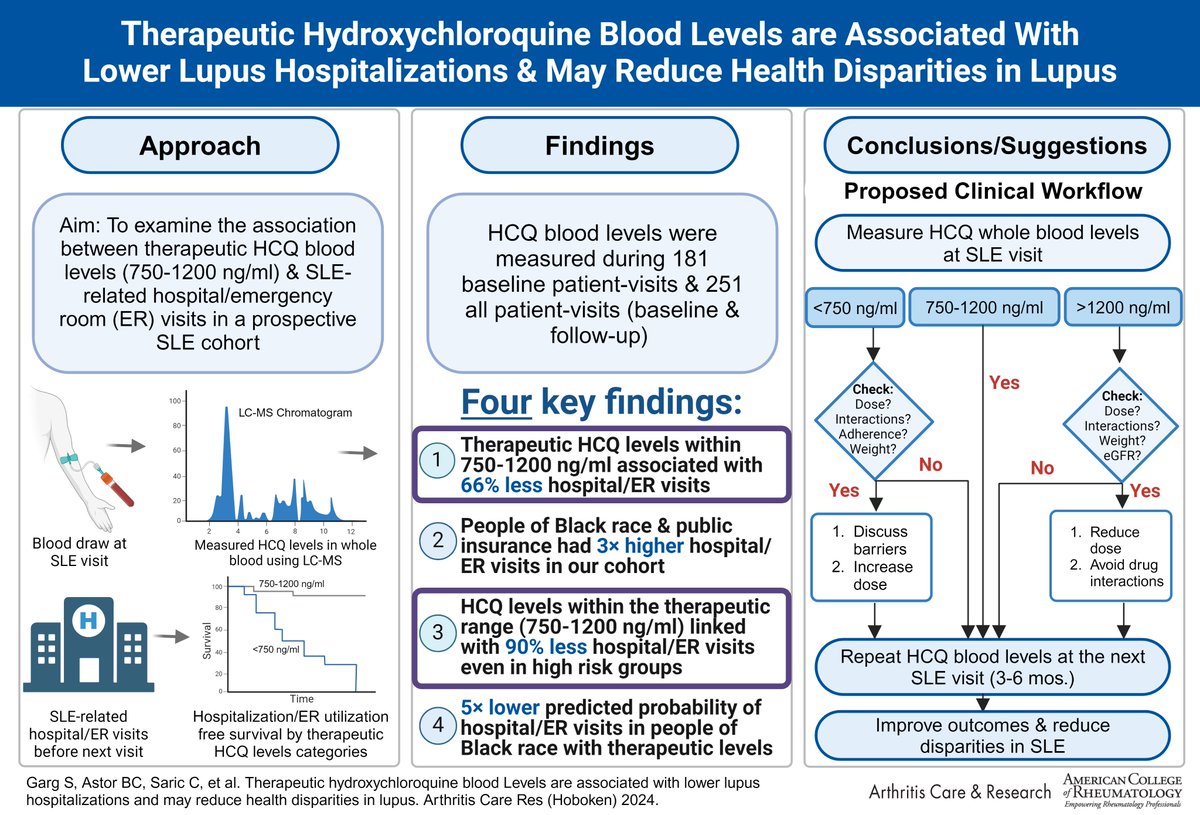
    HCQ blood levels within the therapeutic range (750-1200 ng/ml) were associated with 66% lower acute care utilization—and 90-95% fewer acute care visits, even in groups at higher acute care risk due to social barriers Supports the use of HCQ blood level monitoring in lupus and
    Therapeutic Hydroxychloroquine Blood Levels are Associated with Lower Lupus Hospitalizations and May Reduce Health Disparities in Lupus. Graphical abstract created with BioRender
    6.6K
  • user avatar
    ACR_Journals
    @ACR_Journals
    Feb 20, 2025
    Monogenic causes and clinical phenotypes of lupus and Behçet syndrome, and pathways involved
    Monogenic causes and clinical phenotypes of lupus and Behçet syndrome. ELF, E74-like ETS transcription factor; PFIT, periodic fever, immunodeficiency, and thrombocytopenia; RELA, v-rel reticuloendotheliosis viral oncogene homolog A; TLR, Toll-like receptor; TRIAD, trisomy 8–associated autoinflammatory disease
    Pathways involved in monogenic systemic lupus erythematosus. ACP, acid phosphatase; ADAR, adenosine deaminases that act on RNA; BAFFR, B cell–activating factor receptor; Bc, B cell; cGAS, cyclic guanosine monophosphate–AMP synthase; COPA, coatomer subunit alpha; Dc, dendritic cell; dsDNA, double-stranded DNA; ER, endoplasmic reticulum; IFN, interferon; IL-1R, interleukin-1 receptor; IRF, IFN regulatory factor; ISG, IFN-stimulated gene; MAVS, mitochondrial antiviral signaling protein; MDA, melanoma differentiation–associated protein; MyD, myeloid differentiation factor; NEMO, NF-κB essential modulator; NET, neutrophil extracellular trap; NIK, NF-κB–inducing kinase; NK, natural killer; PTPN, protein tyrosine phosphatase nonreceptor; RelB, v-rel avian reticuloendotheliosis viral oncogene homolog B; RIG, retinoic acid–inducible gene; SOCS, suppressor of cytokine signaling; STING, stimulator of IFN genes; Tc, T cell; TREX, three-prime repair exonuclease; USP, ubiquitin-specific protease.
    Pathways involved in Behçet syndrome. ACP, acid phosphatase; ADAR, adenosine deaminases that act on RNA; BAFFR, B cell–activating factor receptor; Bc, B cell; cGAS, cyclic guanosine monophosphate–AMP synthase; COPA, coatomer subunit alpha; Dc, dendritic cell; dsDNA, double-stranded DNA; ER, endoplasmic reticulum; IFN, interferon; IL-1R, interleukin-1 receptor; IRF, IFN regulatory factor; ISG, IFN-stimulated gene; MAVS, mitochondrial antiviral signaling protein; MDA, melanoma differentiation–associated protein; MyD, myeloid differentiation factor; NEMO, NF-κB essential modulator; NET, neutrophil extracellular trap; NIK, NF-κB–inducing kinase; NK, natural killer; PTPN, protein tyrosine phosphatase nonreceptor; RelB, v-rel avian reticuloendotheliosis viral oncogene homolog B; RIG, retinoic acid–inducible gene; SOCS, suppressor of cytokine signaling; STING, stimulator of IFN genes; Tc, T cell; TREX, three-prime repair exonuclease; USP, ubiquitin-specific protease.
    5.2K
  • user avatar
    ACR_Journals
    @ACR_Journals
    Jan 7, 2020
    Now available: 2019 American College of Rheumatology/Arthritis Foundation Guideline for the Management of Osteoarthritis of the Hand, Hip, and Knee onlinelibrary.wiley.com/doi/full/10.10…
  • user avatar
    ACR_Journals
    @ACR_Journals
    Sep 17, 2024
    IFN-driven cutaneous manifestations of dermatomyositis (A-D) and cutaneous lupus erythematosus (E-H) A. widespread erythematous to violaceous papules and plaques on extensor surfaces. B. heliotrope sign. C. poikilodermatous erythema on anterior neck in ‘V’ distribution. D.
    A. widespread erythematous to violaceous papules and plaques on extensor surfaces. B. heliotrope sign. C. poikilodermatous erythema on anterior neck in ‘V’ distribution. D. Gottron’s papules overlying joints. E. psoriasiform SCLE. F. malar erythema of acute LE. G. annular erythematous plaques of SCLE. H. dorsal hand erythema sparing joints of LE
    17K
  • user avatar
    ACR_Journals
    @ACR_Journals
    Oct 20, 2023
    2022 American College of Rheumatology Guideline for the Prevention and Treatment of Glucocorticoid-Induced Osteoporosis In A&R/AC&R loom.ly/H9dB2vc 📎A collated pdf document with flowcharts of the guideline can be downloaded at loom.ly/0arWJtk
    11K
  • user avatar
    ACR_Journals
    @ACR_Journals
    Mar 3, 2021
    Just accepted in Arthritis & Rheumatology: Tocilizumab Prevents Progression of Early Systemic Sclerosis Associated Interstitial Lung Disease onlinelibrary.wiley.com/doi/abs/10.100…
  • user avatar
    ACR_Journals
    @ACR_Journals
    Oct 16, 2024
    Neutrophil extracellular traps (NETs) are implicated in clinical manifestations of lupus Mechanisms by which NETs promote autoimmunity and organ damage in SLE
    Mechanisms by which NETs promote autoimmunity and organ damage in SLE.
A variety of stimuli (microbial and sterile inflammatory) can induce NET formation. NETs externalize several alarmins, native and oxidized nucleic acids and modified histones that can activate many immune and stromal cells to promote inflammation and tissue damage. If NET formation is enhanced or clearance mechanisms of these structures are impaired, the enhanced half-life of the NETs can exacerbate the deleterious role of these structures regarding immunogenicity and inflammatory potential.
    5.9K
  • user avatar
    ACR_Journals
    @ACR_Journals
    Nov 8, 2024
    The vicious cycle of macrophage activation syndrome, and therapeutic strategies for blocking the cycle
    The vicious cycle of macrophage activation syndrome. Antigen-presenting cells (macrophages and dendritic cells) and lymphocytes (primarily CD8+ T cells) form a cytokine-generating vicious cycle driven by multiple activation pathways (red arrows).  Under normal conditions, this positive feedback loop is stopped by inhibitory pathways (blue), including killing of activated antigen-presenting cells and lymphocytes, regulatory T cells, and elimination of triggers such as viruses (not shown). In MAS, factors leading to uncontrolled activation of this vicious cycle (gray boxes) include genetic and acquired defects in cell-cell killing, excess stimulation (Still’s disease activity, infection, malignancy), and “IL-2 theft” by highly activated CD8+ T cells expressing the high-affinity IL-2 receptor α chain CD25.
    Blocking the vicious cycle in MAS. Corticosteroids are broadly immunosuppressive and form the foundation of treatment. Anakinra, JAK inhibitors, and tocilizumab block cytokines derived from antigen-presenting cells that stimulate T cells, including IL-1β, type I interferons, and IL-6; JAK inhibitors also block IL-2, IL-12, and IL-15. Calcineurin inhibitors (tacrolimus and cyclosporine) reduce T cell activation and thereby production of IFN and IL-2, while etoposide depletes cycling lymphocytes, especially activated CD8+ T cells. Emapalumab blocks IFN, as do JAK inhibitors. Treatment of Still’s disease activity, infection, or malignancy reduces overall immunostimulation. Rituximab reduces antigen load in EBV-associated MAS. IVIG may control infectious triggers while blocking other immunostimulants or dampening inflammation via inhibitory Fc receptors, though is generally considered a weak agent against MAS.
    5.2K
  • user avatar
    ACR_Journals
    @ACR_Journals
    Apr 4, 2025
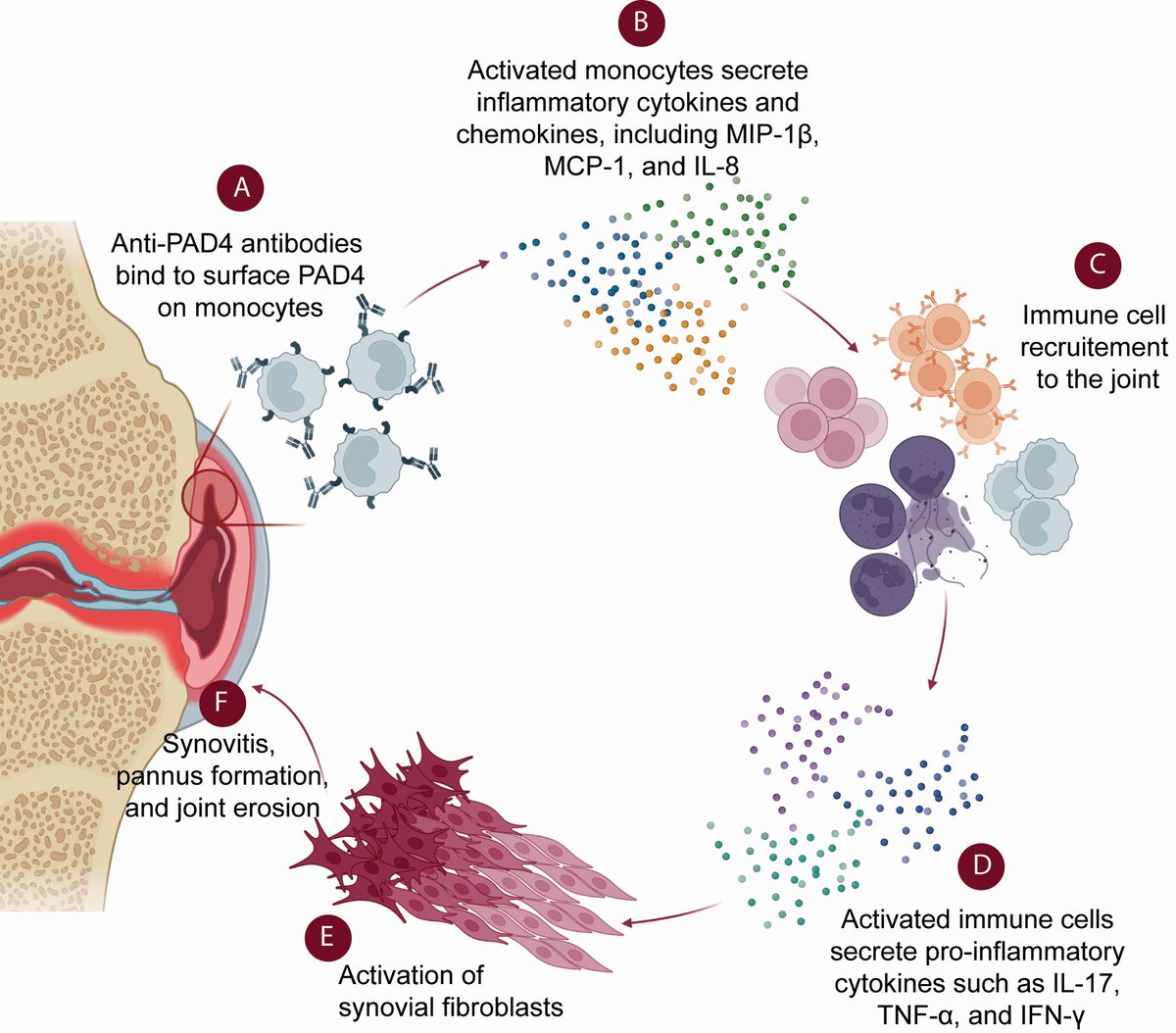
    Proposed mechanism of rheumatoid arthritis disease exacerbation by anti-PAD4 antibodies
    Proposed mechanism of disease exacerbation by anti-PAD4 antibodies. This model is based on our complementary in vitro and in vivo data showing that anti-PAD4 antibodies preferentially bind monocytes in mice and humans (A), stimulate the release of pro-inflammatory chemokines by human monocytes (B), result in increased immune cell infiltration into arthritic joint in CIA mice (C), including an increased proportion of T cells producing IL-17A, TNF-α, and IFN-γ (D), which can induce an activated and invasive synovial fibroblast phenotype (E-F).
    4.1K

New to X?

Sign up now to get your own personalized timeline!

Create account

By signing up, you agree to the Terms of Service and Privacy Policy, including Cookie Use.

Terms of Service|Privacy Policy|Cookie Policy|Accessibility|Ads info|© 2026 X Corp.
Don't miss what's happening
People on X are the first to know.
Log inSign up