Download the free Kindle app and start reading Kindle books instantly on your smartphone, tablet or computer – no Kindle device required.
Read instantly on your browser with Kindle for Web.
Using your mobile phone camera - scan the code below and download the Kindle app.
Follow the author
OK
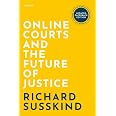
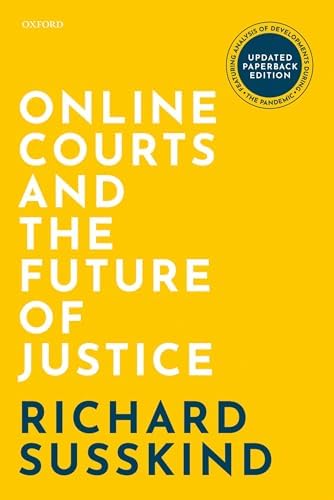
Online Courts and the Future of Justice
Purchase options and add-ons
With online courts now moving from idea to reality, we are looking at the most fundamental change to our justice system for centuries, but the public understanding of and debate about the revolution is only just beginning.
In Online Courts and the Future of Justice Richard Susskind, a pioneer of rethinking law for the digital age, confronts the challenges facing our legal system and the potential for technology to bring much needed change. Drawing on years of experience leading the discussion on conceiving and delivering online justice, Susskind here charts and develops the public debate.
Against a background of austerity politics and cuts to legal aid, the public case for online courts has too often been framed as a business case by both sides of the debate. Are online courts preserving the public bottom line by finding efficiencies? Or sacrificing the interests of the many to deliver cut price justice? Susskind broadens the debate by making the moral case (whether online courts are required by principles of justice) and the jurisprudential case (whether online courts are compatible with our understanding of judicial process and constitutional rights) for delivering justice online.
Includes a substantial new chapter updating the book with the developments in online courts since the onset of Covid-19.
- ISBN-100192849301
- ISBN-13978-0192849304
- EditionReprint
- PublisherOUP Oxford
- Publication date8 July 2021
- LanguageEnglish
- Dimensions22.35 x 3.05 x 15.24 cm
- Print length400 pages
Frequently bought together

Popular titles by this author
- The Future of Law: Reflections and PredictionsPaperbackUSD 13.98 deliveryGet it 26 Oct – 8 DecUsually dispatched within 1 to 3 months
- The End of Lawyers?: Rethinking the nature of legal servicesRichard Susskind OBEPaperbackUSD 12.82 delivery
Product description
Review
... remains the most necessary and pressing legal text for every court user given the current climate... is not just for those with the power to effect change, it is for every single user who works in our court system... We have been given a miraculous opportunity to make a hundred years-worth of progress in less than a generation. We all have the duty to make this opportunity count, not just to turn up to work, make our money, and go home. Online Courts must be the foundation for all conversations, immediate and long term, about the future of our justice system. ― Joseff Morgan, Counsel
About the Author
Product details
- Publisher : OUP Oxford
- Publication date : 8 July 2021
- Edition : Reprint
- Language : English
- Print length : 400 pages
- ISBN-10 : 0192849301
- ISBN-13 : 978-0192849304
- Item weight : 430 g
- Dimensions : 22.35 x 3.05 x 15.24 cm
- Best Sellers Rank: 295,734 in Books (See Top 100 in Books)
- Customer reviews:
About the author

Professor Richard Susskind CBE KC (Hon) is Special Envoy for Justice and AI to the Secretary-General of the Commonwealth. He is President of the Society for Computers and Law, and for 25 years, from 1998 to 2023, was Technology Adviser to the Lord Chief Justice of England and Wales. The author of 11 books, his work has been translated into 16 languages and he has been invited to speak in over 50 countries. He wrote his doctorate on AI and law at Balliol College Oxford in the mid-1980s. He is a Fellow of the British Computer Society and of the Royal Society of Edinburgh.
Customer reviews
Customer Reviews, including Product Star Ratings, help customers to learn more about the product and decide whether it is the right product for them.
To calculate the overall star rating and percentage breakdown by star, we don’t use a simple average. Instead, our system considers things like how recent a review is and if the reviewer bought the item on Amazon. It also analyses reviews to verify trustworthiness.
Learn more how customers reviews work on AmazonTop reviews from the United Kingdom
- 5 out of 5 stars
Delayed Justice is No Justice - this is a topical primer for options to improve
Reviewed in the United Kingdom on 11 June 2020Digital support to the justice system will be key to our future courts. And online approaches too. Covid-19 has dialled up the need for us to be thoughtful about how, what and when we make progress. This is a 'get you going' primer for anyone dealing with issues today or trying to safely implement change that makes justice more timely in delivery - but sustaining the necessary protections.
The Checklist of Critical Success Factors in the Appendix was a valuable addition.
Sending feedback...Sending feedback...HelpfulThank you for your feedback.Sorry, we failed to record your vote. Please try againThank you. We’ll investigate in the next few days.Sorry, We failed to report this review. Please try againWe’ll check if this review meets our community guidelinesOpens in a new tab. If it does not, we will remove it.
CancelReport - 5 out of 5 stars
A compelling case for online courts
Reviewed in the United Kingdom on 4 February 2020Richard Susskind has been arguing for years that the solution to the problems of citizens' access to justice lies in online courts. In 'Online Courts and the Future of Justice', he makes out a compelling case for such courts. He also provides convincing answers to the many objections that have been raised to them by doubters. Although Susskind is a passionate advocate of online courts, his argument is throughout balanced and scholarly. His writing is crystal clear and admirably free of complex, technical detail.
Sending feedback...Sending feedback...HelpfulThank you for your feedback.Sorry, we failed to record your vote. Please try againThank you. We’ll investigate in the next few days.Sorry, We failed to report this review. Please try againWe’ll check if this review meets our community guidelinesOpens in a new tab. If it does not, we will remove it.
CancelReport - 5 out of 5 stars
Great book--understandable and informative
Reviewed in the United Kingdom on 15 November 2019I am not a lawyer, however the law affects us all, and more and more of it is happening 'digitally'.
Sending feedback...Sending feedback...HelpfulThank you for your feedback.Sorry, we failed to record your vote. Please try againThank you. We’ll investigate in the next few days.Sorry, We failed to report this review. Please try againWe’ll check if this review meets our community guidelinesOpens in a new tab. If it does not, we will remove it.
CancelReport - 5 out of 5 stars
Stimulating
Reviewed in the United Kingdom on 9 February 2020A STIMULATING DEBATE WHICH IS FASHIONING CHANGE AS ONLINE COURTS EMERGE IN THE 2020s
An appreciation by Elizabeth Robson Taylor of Richmond Green Chambers and Phillip Taylor MBE, Head of Chambers, Reviews Editor, “The Barrister”, and Mediator
Professor Richard Susskind never fails to surprise us with his excellent new assessment on the future of legal services as we enter the 2020s. There is much of a personal approach to the thorny and controversial subject of what are called “online courts” which can different things to different professionals. One thing, however, is sure- change is on the way as the current systems we use to process justice have to face technological change whether we like it or not.
“Online Court and the Future of Justice” is another, in quite a long line, of books from Richard about what the future holds for his granddaughter (amongst others). Oxford University Press (OUP) are to be congratulated in publishing these texts at a time of change when we just do not know which possible direction, we will end up going in, locally and globally, with the new technologies as they come in.
“Our court system is struggling”, says the author. “It’s too costly to deliver justice for all but the few, too slow to satisfy those who can access it. Yet the values implicit in disputes being resolved in person, and in public, are fundamental to how we have imagined the fair resolution of disputes for centuries”.
Inevitably, the question is raised - could justice be delivered online? Yes… and no. Susskind remarks that this idea “has excited and appalled in equal measure, promising to bring justice to all, threatening to strike at the heart of what we mean by justice”. And those are just some of the politer views as lawyers do not like change!
With online courts moving “from idea to reality”, the government and public alike are facing one of the most fundamental changes to our justice system seen for centuries. However, the public’s understanding of it, and debate about this “process revolution” are only just beginning with Susskind’s new book.
For this new work, Susskind, who is described as “a pioneer of rethinking law for the digital age”, confronts head-on the challenges facing our legal system and the potential for technology to bring much needed change. His brings his expertise from years of experience leading discussions (often via OUP) on “conceiving and delivering online justice” and is rightly described here as charting and developing the public debate which will be of interest to a wide legal and lay audience alike.
Against a background of austerity politics and cuts to legal aid, the public case for online courts has too often been framed as a business case by both sides of the debate. Are online courts preserving the public bottom line by finding efficiencies? Or sacrificing the interests of the many to deliver cut price justice? Susskind broadens the debate by making the moral case (whether online courts are required by principles of justice) and the jurisprudential case (whether online courts are compatible with our understanding of judicial process and constitutional rights) for delivering justice online.
The book runs to just over 300 pages with an introduction, 28 chapters and a useful checklist on “critical success factors” set out in an appendix at the back. Footnotes are also included at the end together with a bibliography and short index.
The hardback edition of this book was published on 22nd October 2019.
One person found this helpfulSending feedback...Sending feedback...HelpfulThank you for your feedback.Sorry, we failed to record your vote. Please try againThank you. We’ll investigate in the next few days.Sorry, We failed to report this review. Please try againWe’ll check if this review meets our community guidelinesOpens in a new tab. If it does not, we will remove it.
CancelReport
Top reviews from other countries
Haben Girma5 out of 5 starsVisionary
Reviewed in the United States on 5 December 2019The author Richard Susskind has written a fascinating book on how we can harness the power of technology to increase access to justice for more people. He describes the shortcomings in our current system and tackles some of the thorny questions on the road to creating online courts — e.g., can computers serve as judges? The writing itself is accessible, sprinkled with humor throughout. I highly recommend this book for anyone interested in law and tech.
Sending feedback...Thank you. We’ll investigate in the next few days.Sorry, We failed to report this review. Please try againWe’ll check if this review meets our community guidelinesOpens in a new tab. If it does not, we will remove it.
CancelReport
Marcos Luz5 out of 5 starsOnline Court is the move forward
Reviewed in Brazil on 3 July 2021I am writing from Brazil and could say that online court is the only way to move forward. Here on state of Parana (South of Brazil) 100% of all cases have began online and this fact did not endangered anyone nor any right. Quite the contrary. An online court is more transparent, publicly accessible, and more near every place on earth ( in fact an online court is at one click away from you, 5 seconds from your everyday life tasks). Our state justice here in Parana already ruled more than 12 millions cases over an online environment and has a backlog of +_ 3 millions more yearly. The telepresence technology is also the only way to go. When needed Witnesses are heard over internet and this is another game changer: on the scheduled time they stop what they were doing and in 5 seconds are live on court and soon after their hearings are back to their lives again ( it’s huge). The most elegant and well-researched legal solution is of little value unless the rights it identifies can be translated into action—as some kind of remedy or other satisfactory outcome. The online court does exactly that for humankind.
Sending feedback...Thank you. We’ll investigate in the next few days.Sorry, We failed to report this review. Please try againWe’ll check if this review meets our community guidelinesOpens in a new tab. If it does not, we will remove it.
CancelReport
Nadine Tawdy5 out of 5 starsExcellent Book.
Reviewed in Canada on 23 February 2021For anyone interested in Tech and Law - this is a must.
Sending feedback...Thank you. We’ll investigate in the next few days.Sorry, We failed to report this review. Please try againWe’ll check if this review meets our community guidelinesOpens in a new tab. If it does not, we will remove it.
CancelReport
Amazon Kunde5 out of 5 starsdie Entwicklung der LegalTech
Reviewed in Germany on 23 April 2024Dieses Buch spiegelt die Asante Entwicklung von LegalTech wider. Es ist eine gute Grundlage nachzudenken.
Sending feedback...Thank you. We’ll investigate in the next few days.Sorry, We failed to report this review. Please try againWe’ll check if this review meets our community guidelinesOpens in a new tab. If it does not, we will remove it.
CancelReport
Joel Gomez5 out of 5 starsLlegó MUY rápido
Reviewed in Mexico on 8 September 2020Es el producto que he recibido más rápido en 20 años de compras a Amazon. El libro es mucho más grande de lo que Richard Susskind nos tiene acostumbrados. Es de pasta dura.
Sending feedback...Thank you. We’ll investigate in the next few days.Sorry, We failed to report this review. Please try againWe’ll check if this review meets our community guidelinesOpens in a new tab. If it does not, we will remove it.
CancelReport