Download the free Kindle app and start reading Kindle books instantly on your smartphone, tablet, or computer - no Kindle device required.
Read instantly on your browser with Kindle for Web.
Using your mobile phone camera - scan the code below and download the Kindle app.
-
-
-
Image Unavailable
Image not available for
Color:
Follow the author
OK
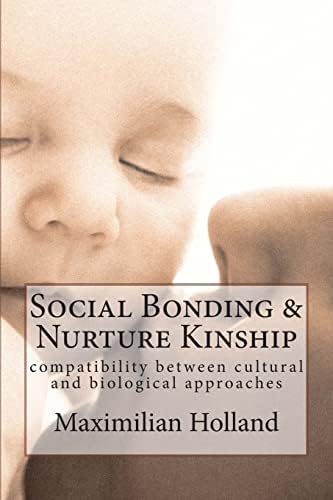
Social Bonding and Nurture Kinship: Compatibility between Cultural and Biological Approaches Paperback â October 26, 2012
Purchase options and add-ons
Praised by adherents of both perspectives, the work provides a thorough survey of the theoretical debates and empirical findings across a wide array of disciplines, providing students of social behaviour and kinship with a rich and comprehensive resource. This work is a powerful example of how social and physical sciences can unite on equal terms, without the danger of one being subsumed by the other. Both approaches emerge stronger as a result.
Scholarly Reviews
âĒ A landmark in the field of evolutionary biology, which places genetic determinism in the correct perspective.
- Folia Primatologica Journal
âĒ I will be strongly recommending this book to all of my advanced undergraduates, masters and PhD students, as well as to my colleagues. Not only does it help to resolve debates that have run for many years, but it is also an outstanding example of what can be achieved by immersing oneself in literature from different fields, while retaining an intellectual openness and exercising incisive analysis... a shining example of what can be achieved when excellent scholars engage fully across disciplinary boundaries.
- Acta Ethologica Journal
âĒ Maximilian Holland gets to the heart of the matter... If he had been in the debate in the 1980s then a lot of subsequent confusion could have been avoided.
- Robin Fox, Emeritus Professor of Anthropology, Rutgers. NAS Member
âĒ Max Holland has demonstrated extraordinarily thorough scholarship in his exhaustive review of the often contentious discussions of kinship. He has produced a balanced synthesis melding the two approaches exemplified in the biological and sociocultural behavioral positions... This should be the definitive word on the subject.
- Irwin Bernstein, Distinguished Research Professor of Primatology, Georgia
âĒ A brilliant discussion of the relationship between kinship and social bonding as understood in evolutionary biology and in sociocultural anthropology.
- Kirk Endicott, Emeritus Professor of Anthropology, Dartmouth
âĒ His synthesis is lucid and effectiveâĶ Holland has produced a significant work of scholarship that will be of interest to a wide swath of the anthropological community."
- Critique of Anthropology Journal
âĒ A tremendously useful resource for students of kinship in anthropology, psychology and biology who are interested in looking beyond the confines of their own disciplineâĶ highly relevant for anyone interested in this exciting field.
- Social Anthropology Journal
âĒ Max Holland has provided a wide-ranging and deeply-probing analysis of the influence of genetic relatedness and social context on human kinship. He argues that while genetic relatedness may play a role in the evolution of social behavior, it does not determine the forms of such behavior. His discussion is exemplary for its thoroughness, and should inspire more nuanced ventures in applying Darwinian approaches to sociocultural anthropology.
- Philip Kitcher, John Dewey Professor of Philosophy, Colombia. Fellow of the American Academy of Arts and Sciences
âĒ Unlike many commentators who have tackled kinship in the context of biology, Holland takes culture seriously and deals fairly with Schneiderâs arguments... This book helps to untangle a long-standing disciplinary muddle.
- Richard Feinberg, Professor of Anthropology, Kent State
- Print length352 pages
- LanguageEnglish
- Publication dateOctober 26, 2012
- Dimensions6 x 0.8 x 9 inches
- ISBN-101480182001
- ISBN-13978-1480182004
Book recommendations, author interviews, editors' picks, and more. Read it now.
Editorial Reviews
Review
- Irwin Bernstein, Distinguished Research Professor of Primatology, Georgia
"A brilliant discussion of the relationship between kinship and social bonding as understood in evolutionary biology and in sociocultural anthropology."
- Kirk Endicott, Emeritus Professor of Anthropology, Dartmouth
"Unlike many commentators who have tackled kinship in the context of biology, Holland takes culture seriously and deals fairly with Schneider's arguments. He acknowledges, correctly in my opinion, that culture and biology are both important but are largely relevant to separate questions. This book helps to untangle a long-standing disciplinary muddle."
- Richard Feinberg, Professor of Anthropology, Kent State

This genuinely original thesis... will (with any luck) put paid to prevailing misapplications of inclusive fitness theory in Evolutionary Psychology and Darwinian Anthropology. The scholarship is excellent... his ability to convey his argument clearly and without intellectual posturing makes it a pleasure to read - Christina Toren, Anthropologist
From the Author
From the Back Cover
Resolving this decades long divide, Social Bonding & Nurture Kinship unites cultural and biological approaches to social life and kinship. The synthesis is non-reductive, respecting the core tenets of both paradigms, and also incorporates psychological attachment theory into the account. Praised by adherents of both perspectives, the work provides an exhaustive survey of the theoretical debates and empirical findings across a wide array of disciplines, providing students of social behaviour and kinship with a rich and comprehensive resource. This work is a powerful example of how social and physical sciences can unite on equal terms, without the danger of one being subsumed by the other. Both approaches emerge stronger as a result.- Max Holland gets to the heart of the matter concerning the contentious relationship between kinship categories, genetic relatedness and the prediction of behavior. If he had been in the debate in the 1980s then a lot of subsequent confusion could have been avoided - Robin Fox, Anthropologist and Member of the National Academy of Sciences
Extremely interesting... gives a sympathetic and accurate - hearing to a large number of anthropologists, biologists and other scholars - Charles Stafford, Anthropologist An extremely worthwhile project... opening up some much-needed conversations... constructing a new continent for us to live on - Mary Weismantel, Anthropologist
Product details
- Publisher : CreateSpace Independent Publishing Platform
- Publication date : October 26, 2012
- Language : English
- Print length : 352 pages
- ISBN-10 : 1480182001
- ISBN-13 : 978-1480182004
- Item Weight : 1.04 pounds
- Dimensions : 6 x 0.8 x 9 inches
- Best Sellers Rank: #2,317,396 in Books (See Top 100 in Books)
- #2,875 in General Anthropology
- #4,996 in Evolution (Books)
- #6,418 in History & Philosophy of Science (Books)
- Customer Reviews:
About the author

Discover more of the authorâs books, see similar authors, read book recommendations and more.
Customer reviews
- 5 star4 star3 star2 star1 star5 star33%26%41%0%0%33%
- 5 star4 star3 star2 star1 star4 star33%26%41%0%0%26%
- 5 star4 star3 star2 star1 star3 star33%26%41%0%0%41%
- 5 star4 star3 star2 star1 star2 star33%26%41%0%0%0%
- 5 star4 star3 star2 star1 star1 star33%26%41%0%0%0%
Customer Reviews, including Product Star Ratings help customers to learn more about the product and decide whether it is the right product for them.
To calculate the overall star rating and percentage breakdown by star, we donât use a simple average. Instead, our system considers things like how recent a review is and if the reviewer bought the item on Amazon. It also analyzed reviews to verify trustworthiness.
Learn more how customers reviews work on AmazonTop review from the United States
There was a problem filtering reviews. Please reload the page.
- Reviewed in the United States on January 17, 2013Intriguing research in social bonding and kinship. Taking in account diverse perspectives, but also correlating scientific views of sociology, anthropology, biology and psychology. A very good way to understand how relationships are built up in our societies.