
28% off Kindle Scribe Colorsoft bundle
Enjoy fast, free delivery, exclusive deals, and award-winning movies & TV shows.
Buy New
-15% $20.32
FREE delivery Tuesday, June 23 on orders shipped by Amazon over $35
Ships from: Amazon.com
Sold by: Amazon.com
$20.32 with 15 percent savings
List Price: $24.00
Get Fast, Free Shipping with Amazon Prime
FREE delivery Tuesday, June 23 on orders shipped by Amazon over $35
Or Prime members get FREE delivery Sunday, June 21. Join Prime
Arrives after Father's Day. Need a gift sooner? Send an Amazon Gift Card today by email or text message.
In Stock
$$20.32 () Includes selected options. Includes initial monthly payment and selected options. Details
Price
Subtotal
$$20.32
Subtotal
Initial payment breakdown
Shipping cost, delivery date, and order total (including tax) shown at checkout.
Shipper / Seller
Amazon.com
Amazon.com
Shipper / Seller
Amazon.com
Returns
FREE 30-day refund/replacement
Quick refund
Usually issued within 24 hours. See exceptions
FREE return
At least one free return option available.
Convenient dropoff
At any of our 50,000 US locations.
See return policy
Gift options
Available at checkout
Available at checkout This item is a gift. Change
At checkout, you can add a custom message, a gift receipt for easy returns and have the item gift-wrapped
Payment
Secure transaction
Your transaction is secure
We work hard to protect your security and privacy. Our payment security system encrypts your information during transmission. We don’t share your credit card details with third-party sellers, and we don’t sell your information to others. Learn more
$6.56
FREE delivery Tuesday, June 30. Details
Arrives after Father's Day. Need a gift sooner? Send an Amazon Gift Card today by email or text message.
Only 1 left in stock - order soon.
$$20.32 () Includes selected options. Includes initial monthly payment and selected options. Details
Price
Subtotal
$$20.32
Subtotal
Initial payment breakdown
Shipping cost, delivery date, and order total (including tax) shown at checkout.
Access codes and supplements are not guaranteed with used items.
Ships from and sold by Bay State Book Company.
Added to

Sorry, there was a problem.

There was an error retrieving your Wish Lists. Please try again.

Sorry, there was a problem.

List unavailable.
Kindle app logo image

Download the free Kindle app and start reading Kindle books instantly on your smartphone, tablet, or computer - no Kindle device required.

Read instantly on your browser with Kindle for Web.

Using your mobile phone camera - scan the code below and download the Kindle app.

QR code to download the Kindle App

  • The Dependent Gene: The Fallacy of "Nature vs. Nurture"

Follow the author

Get new release updates & improved recommendations
Something went wrong. Please try your request again later.

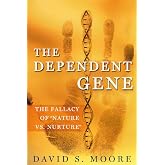
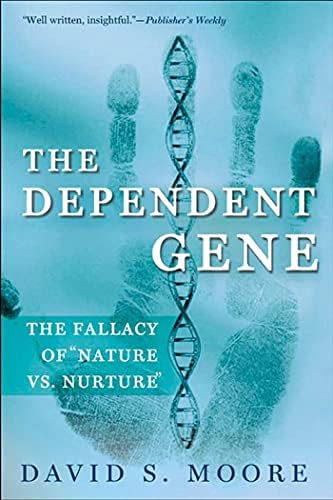
The Dependent Gene: The Fallacy of "Nature vs. Nurture"

4.1 out of 5 stars (25)

{"desktop_buybox_group_1":[{"displayPrice":"$20.32","priceAmount":20.32,"currencySymbol":"$","integerValue":"20","decimalSeparator":".","fractionalValue":"32","symbolPosition":"left","hasSpace":false,"showFractionalPartIfEmpty":true,"offerListingId":"cPd9DmNFm%2BZplVDbvL58k62R1ORMBmw%2BOJ5M1vRO%2B0MxUOc2FnQ1sMw9APamHTupxBZs%2FyDB4KVDADoEo7pJgwA%2FC7WgiRJBpE7DT6shGbJ4mDVxGhLrpS5GF886pKlcePK9d7kgRgI%3D","locale":"en-US","buyingOptionType":"NEW","aapiBuyingOptionIndex":0}, {"displayPrice":"$6.56","priceAmount":6.56,"currencySymbol":"$","integerValue":"6","decimalSeparator":".","fractionalValue":"56","symbolPosition":"left","hasSpace":false,"showFractionalPartIfEmpty":true,"offerListingId":"cPd9DmNFm%2BZplVDbvL58k62R1ORMBmw%2BgMXEaRVwqiw%2BG%2BrkKWD6VVBsdd0BjzgEMRXnZ0amoqshDSGRIAYR6sM27EjqNHZc2yq5QkXbQC5Nt8FIyqUzYB0TsPsNzjS7LRxI%2BeJy0kj6UjvglRlstaoSh%2B18maNsh0WSSzBxcYOFG2U9m71bW7rkHEK7hupt","locale":"en-US","buyingOptionType":"USED","aapiBuyingOptionIndex":1}]}

Purchase options and add-ons

A masterful guide to human development that redefines the nature versus nurture debate

A much-needed antidote to genetic determinism,
The Dependent Gene reveals how all traits-even characteristics like eye and hair color-are caused by complex interactions between genes and the environment at every stage of biological and psychological development, from the single fertilized egg to full-grown adulthood.

How we understand the nature versus nurture debate directly affects our thoughts about such basic issues as sex and reproduction, parenting, education, and crime, and has an enormous impact on social policy. With life-and-death questions in the balance surrounding stem-cell research, cloning, and DNA fingerprinting, we can no longer afford to be ignorant of human development. An enlightening guide to this brave new world,
The Dependent Gene empowers us to take control of our own destiny.

The%20Amazon%20Book%20Review
The Amazon Book Review
Book recommendations, author interviews, editors' picks, and more. Read it now

Editorial Reviews

Review

“A provocative and gracefully written book that will surely generate discussion and debate.” ―Jerome Kagan, Ph.D., author of Three Seductive Ideas

The Dependent Gene is a masterful analysis. A useful and engaging guide for the lay reader, the practicing scientist, and all who seek a more integrative approach to the endlessly fascinating process of development.” ―Robert Lickliter, Virginia Polytechnic Institute and State University

About the Author

David S. Moore is a professor of psychology at Pitzer College. He received his Ph.D. in developmental and biological psychology from Harvard University. A developmental cognitive neuroscientist with expertise in infant cognition, his theoretical writings have explored the contributions of genetic, environmental, and epigenetic factors to human development. His book The Dependent Gene has been widely adopted for use in undergraduate education and was nominated for the Cognitive Development Society’s Best Authored Volume award. His book The Developing Genome won both the William James Book Award and the Eleanor Maccoby Book Award from the American Psychological Association, recognizing a book expected to have a profound effect on developmental psychology. Dr. Moore has served on the consulting editorial board for Child Development Perspectives and has been the editor of special issues of New Ideas in Psychology, Developmental Psychobiology, and Infant Behavior and Development. From 2016 - 2018, Dr. Moore served as the Director of the U.S. National Science Foundation’s Developmental Sciences Program in Washington, D.C. He was elected a Fellow of the American Psychological Association in 2021.

Product details

  • Publisher ‏ : ‎ Holt Paperbacks
  • Publication date ‏ : ‎ February 5, 2003
  • Edition ‏ : ‎ Reprint
  • Language ‏ : ‎ English
  • Print length ‏ : ‎ 320 pages
  • ISBN-10 ‏ : ‎ 0805072802
  • ISBN-13 ‏ : ‎ 978-0805072808
  • Item Weight ‏ : ‎ 12.8 ounces
  • Dimensions ‏ : ‎ 6 x 0.71 x 9 inches
  • Best Sellers Rank: #1,145,016 in Books (See Top 100 in Books)
  • Customer Reviews:
    4.1 out of 5 stars (25)

About the author

Follow authors to get new release updates, plus improved recommendations.
David S. Moore
Brief content visible, double tap to read full content.
Full content visible, double tap to read brief content.

David S. Moore is a Professor Emeritus of Psychology in Claremont, California. He received his Ph.D. in developmental and biological psychology from Harvard University. Moore is a developmental cognitive neuroscientist with expertise in perceptual and cognitive development in infancy. His books have explored how genetic, environmental, and epigenetic factors contribute to human development. His first book, The Dependent Gene, was widely adopted for use in undergraduate education, was translated into Japanese, and was nominated for the Cognitive Development Society's Best Authored Volume award. His second book, The Developing Genome, explored behavioral epigenetics and won the William James Book Award and the Eleanor Maccoby Book Award from the American Psychological Association; it was recently translated into Korean. He was a Fellow at The Center for Advanced Study in the Behavioral Sciences at Stanford in 2023-2024, and will be a Fulbright U.S. Scholar in The Netherlands in 2025.

Customer reviews

4.1 out of 5 stars
25 global ratings

Top reviews from the United States

  • 5 out of 5 stars
    Highly recommend
    Reviewed in the United States on December 9, 2018
    Brief content visible, double tap to read full content.
    Full content visible, double tap to read brief content.

    Such an interesting book! I had to get it for a class, but my goodness, I'm glad I did! I would've wanted to read it anyways! Recommended it to my family to read. Lays out complicated topics in fascinating, comprehensible ways!

    2 people found this helpful
    Sending feedback...
    Thank you for your feedback.
    Sending feedback...
    Thanks, we'll investigate in the next few days.
  • 5 out of 5 stars
    If more of my teachers had introduced biology the way ...
    Reviewed in the United States on February 2, 2017
    Brief content visible, double tap to read full content.
    Full content visible, double tap to read brief content.

    If more of my teachers had introduced biology the way Moore does, I might have ended up researching biology instead of family processes.

    One person found this helpful
    Sending feedback...
    Thank you for your feedback.
    Sending feedback...
    Thanks, we'll investigate in the next few days.
  • 5 out of 5 stars
    Five Stars
    Reviewed in the United States on November 15, 2016
    Brief content visible, double tap to read full content.
    Full content visible, double tap to read brief content.

    Eye-opening, very readable, seems well-researched.

    One person found this helpful
    Sending feedback...
    Thank you for your feedback.
    Sending feedback...
    Thanks, we'll investigate in the next few days.
  • 5 out of 5 stars
    Easy to understand book with info we much need to understand
    Reviewed in the United States on July 17, 2012
    Brief content visible, double tap to read full content.
    Full content visible, double tap to read brief content.

    We are not determined by our genes. Our traits are caused by complex interactions between genes and the environment. The message is simple but it's so difficult for us to fully appreciate. The author himself admits that, at first, he failed to fully understand and appreciate this basic fact.

    Well, thank goodness he did. We, the general public, need an easy-to-understand book that helps us to begin to understand this complexity and let go of the simplistic and destructive notions of genetic determinism. The value of such a book as this cannot be overstated.

    I've read many books lately - and I've taken a couple of courses - trying to better understand the issues of evolution and of development because I've noticed just how important it is in our daily lives and in society, to do so.

    This book is one of the easiest to understand (I wish I had it when I first started out and didn't know a ribosome from a cartoon hand of Mickey Mouse) and it has plenty of information that I had not heard about before. It has helped me to more clearly understand the subject despite the fact that it's, at least, the 20th book I've read on the broad subject.

    -- Are traits such as height, eye and hair color, determined by genes? What about the number of fingers on each hand and how the cortex of our brain is structured?

    -- Can diet play such a major role in the health of someone with a "genetic" disorder characterized by severe mental retardation, so that a person can, instead, have normal intelligence?

    -- Do some "identical" twins have a significantly different environment in the womb from each other while other sets of twins have a much more similar environment? And can this influence the degree of similarity between the set of twins?

    -- Can we say with certainty that human genes coding for wings, (or any other body part that we do not possess but was possessed by animals that we descended from), do not exist? Do we know for certain that genes coding for mammalian-type teeth exist dormant in toothless, beaked chicks?

    The answers to these, and many other, questions - mostly about biological traits - may surprise you and may help to free you from the simplistic, misleading, popular beliefs, so common in our culture - regarding both biology and psychology - that have caused, and are still causing, so much harm.

    4 people found this helpful
    Sending feedback...
    Thank you for your feedback.
    Sending feedback...
    Thanks, we'll investigate in the next few days.
  • 2 out of 5 stars
    Selective memory
    Reviewed in the United States on June 30, 2011
    Brief content visible, double tap to read full content.
    Full content visible, double tap to read brief content.

    If this guy has ever actually read a book on behavior genetics or population biology, it doesn't show. The "words" he puts into the mouths of behavior geneticists are things that behavior geneticists (such as Plomin and Bouchard) don't in fact say. His interpretation of the heritability coefficient, for example, is simply wrong. His misunderstanding of that statistic is typical for a psychologist (I am one myself), and even more typical of the lay public, and therefore it is something that needs to be corrected. But blaming behavior geneticists for getting it wrong is just misinformed. What Moore says is, for the MOST PART correct. He just attributes the mistakes he is trying to correct to the wrong people.

    I found the general tone of the book arrogant, and for that reason I found it hard to read, which is a shame because the book contains a valuable message that many psychologists still need to learn (even though that lesson has been out there and available to them for over 50 years). The way to get that message out, however, is not by setting up and then knocking down a straw man, which is what Moore does.

    I think the book finds its voice in chapter 4 and subsequent chapters. It's too bad the author didn't start the book there. Even so, he presents his material in a tone that suggests he believes (or wants us to believe) that it is "new stuff" that "genetic determinists" (whoever they are) are unaware of. In fact, I remember studying a lot of this stuff in undergraduate biology classes several decades ago. His discussion of brain development is also outdated and was so even 10 years ago when this book was being written, although that's not really a serious detriment to the point he is trying to get across.

    I had high hopes for this book (it came highly recommended). I was disappointed. Too bad because a lot of people, mostly psychologists, need to understand this stuff. And they don't!

    13 people found this helpful
    Sending feedback...
    Thank you for your feedback.
    Sending feedback...
    Thanks, we'll investigate in the next few days.
  • 3 out of 5 stars
    To agree or not to agree
    Reviewed in the United States on July 13, 2006
    Brief content visible, double tap to read full content.
    Full content visible, double tap to read brief content.

    While Mr. Moore presents his view with reasonable facts of science, it leaves one with the impression "what do we do now?" I never got a clear picture of his definition of the Nature vs. Nurture debate.

    3 people found this helpful
    Sending feedback...
    Thank you for your feedback.
    Sending feedback...
    Thanks, we'll investigate in the next few days.
  • 1 out of 5 stars
    A straw man attack on behavioral genetics and sociobiology
    Reviewed in the United States on July 20, 2013
    Brief content visible, double tap to read full content.
    Full content visible, double tap to read brief content.

    The author of this book misrepresents the nature of the conclusions drawn from behavior genetics and oversimplifies how they do things. He writes as if they have not made any progress since Francis Galton founded the field and he repeatedly equates it with eugenics.

    For one, sociobiologists and behavioral geneticists are well aware that everything occurs via gene-environment interactions.

    Secondly, he completely fails to substantiate the claim that it is absurd in theory to separate gene and environment in concept. Of course you can separate them in concept. I have stands of DNA in me. There is an environment outside of me. Those are completely different things. Of course what he means is a bit more specific. He means that when discussing a phenotype it is impossible to separate the contributions made by genes and those by environment. Except that it is. Even when the environment completely changes the phenotype via epigenetic modifcations, we know exactly how this is done. There's nothing mysterious or inseparable or irreducible about it.

    Here's some examples of the inaccuracies and straw man attacks in the book.

    On page 41 he writes that heritiability estimates tell us about what causes *variability* in traits, but not what causes traits themselves. Fair enough, but he uses this to argue that NOTHING is genetically determined. What then about diseases like cystic fibrosis where the specific alleles and conditions for their expression are known? It follows a perfectly predictable autosomal recessive pattern of inheritance. So, how exactly is Moore's dynamic developmental perspective supposed to undermine the fact that C.F. is genetically determined?

    "What is the value, then, of knowing what accounts for differences among people in a unique situation, if it is within our power to easily change situations?" For one, that's assuming we DO have the power to change how a gene is expressed just by changing a situation. Certainly for certain behavioral traits this is possible, but otherwise, he's basically just saying "Lalalalala I can't hear you geneticists I can't hear you lalalala" He COMPLETELY misses the point here of scientific understanding. Sometimes the goal is not just to understand what accounts for differences, but to understand for what accounts for SIMILARITIES across different situations over time.

    He goes on to say that "for behavior geneticists, the goal is to predict the appearance of traits by looking at genes -- only genes! .... knowing what affects non-genetic factors have on a trait's appearance is simply not of interest to behavior geneticists, who consequently just ignore these factors." (pg. 46) That's completely and utter nonsense. There is TONS of research investigating the role environmental factors have on gene expression. Being that I have a stack of research papers right next to me, allow me to list just a few.

    - Genetic and Environmental Influences on Human Psychological Differences, Bouchard & McGue, 2003

    - Reconsolidation involves histone acetylation depending on the strength of memory, Federman, Fustinana, & Romano, 2012

    - Epigenetics, brain evolution, and behaviour, Kervene & Curley, 2008

    - Epigeneitc regulation of nervous system development by DNA methylation and histone deacetylation, MacDonald & Roskams

    - Epigenetic Gene Regulation in the Adult Mammalian Brain: Multiple Roles in Memory Formation, Lubin, 2011

    - Epigenetics: Behavioral Influences on Gene Function, Part 1. Maternal Behavior Permanently Affects Adult Behavior in Offspring, Orgen & Lombroso, 2008

    I have more, but you get the picture. All of those studies involve understanding the roles genes play in biological function and take into account environmental factors, not just as measurement error or what can't be accounted for by genes, but HOW the environment works with genes. So his claim that behavior geneticists have no interest in these things is a lie and a low brow attack on the field.

    Of course, there's also the famous prairie vole study. I'll leave it to you to look it up, but it can be found in Braintrust: What Neuroscience Tells Us about Morality and Animal Behavior: An Evolutionary Approach, 8th Edition

    The point is that no one thinks everything is determined by genetics. I recommend taking a look at the book The Triumph of Sociobiology. In it there is a chapter called Sociobiology and Genes and there is a section within called "The Myth of The Genetic Determinist". The author discusses a lot of the same things that David Moore does, except he doesn't draw scientifically irresponsible conclusions. Sadly, this book is the same sort of crap we used to see from S.J. Gould, Richard Lewontin, and Leo Kamin -- all otherwise great scientists who were scared to death of the implications their fields might have on their socio-political views, so they did everything they could to twist scientific fact to fit their social concerns.

    8 people found this helpful
    Sending feedback...
    Thank you for your feedback.
    Sending feedback...
    Thanks, we'll investigate in the next few days.
  • 5 out of 5 stars
    primarily because it is a well-researched text and written at a level that my students can understand and easily digest. My stud
    Reviewed in the United States on November 18, 2016
    Brief content visible, double tap to read full content.
    Full content visible, double tap to read brief content.

    Moore provides an illuminating antidote to full-blown genetic determinism and all the inherent problems of adopting this perspective. I have used this book to introduce students to the developmental systems perspective in my undergraduate seminar on developmental psychobiology, primarily because it is a well-researched text and written at a level that my students can understand and easily digest. My students come away from Moore's book with a new perspective regarding the complexity of mechanisms that undergird the acquisition of human traits and a much greater appreciation for the need to examine our human experience through a developmental lens rather than relying on dated, monolithic modes of explanation. Most say they have never heard this perspective before and feel it is an important counterweight to much of the misguided dichotomous thinking that is still taught in our introductory developmental psychology courses.

    One person found this helpful
    Sending feedback...
    Thank you for your feedback.
    Sending feedback...
    Thanks, we'll investigate in the next few days.

Top reviews from other countries

    Translated by Amazon
    See original
  • 5 out of 5 stars
    Ok
    Reviewed in Italy on September 24, 2025
    Brief content visible, double tap to read full content.
    Full content visible, double tap to read brief content.
    Sending feedback...
    Thanks, we'll investigate in the next few days.
  • 5 out of 5 stars
    Exacto lo que requería. Gracias
    Reviewed in Mexico on January 17, 2022
    Brief content visible, double tap to read full content.
    Full content visible, double tap to read brief content.

    Muy interesante y con muchísimas información valiosa, además de fácil de leer

    Sending feedback...
    Thanks, we'll investigate in the next few days.
    Translated from Spanish by Amazon
    See original