1. Overview
In this tutorial, we’ll look at different methods to get a List from a Stream. We’ll also discuss the differences among them, and when to use each method.
2. Collecting Stream Elements Into a List
Getting a List from a Stream is the most used terminal operation of the Stream pipeline. Before Java 16, we used to invoke the Stream.collect() method and pass it to a Collector as an argument to gather the elements into. The Collector itself was created by calling the Collectors.toList() method.
However, there have been change requests for a method to get a List directly from a Stream instance. With the Java 16 release, we can now invoke toList(), a new method directly on the Stream, to get the List. Libraries, like StreamEx, also provide a convenient way to get a List directly from a Stream.
We can accumulate Stream elements into a List by using:
We’ll work with these methods in the chronological order of their release.
3. Analyzing the Lists
We’ll first create the lists from the methods described in the previous section. Then we’ll analyze their properties.
We’ll use the following Stream of country codes for all the examples:
Stream.of(Locale.getISOCountries());
3.1. Creating Lists
Now we’ll create a List from the given Stream of country codes using the different methods.
First, we’ll create a List using Collectors:toList():
List<String> result = Stream.of(Locale.getISOCountries()).collect(Collectors.toList());
Then we’ll collect it using Collectors.toUnmodifiableList():
List<String> result = Stream.of(Locale.getISOCountries()).collect(Collectors.toUnmodifiableList());
Here, in these methods, we accumulate the Stream into a List through the Collector interface. This results in extra allocation and copying, as we don’t work directly with the Stream.
Next, we’ll repeat the collection with Stream.toList():
List<String> result = Stream.of(Locale.getISOCountries()).toList();
Here, we get the List directly from the Stream, thus preventing extra allocation and copying.
Consequently, using toList() directly on the Stream is more concise, neat, convenient, and optimal when compared to the other two invocations.
3.2. Examining the Accumulated Lists
Let’s begin by examining the type of List we created.
Collectors.toList() collects the Stream elements into an ArrayList:
java.util.ArrayList
Collectors.toUnmodifiableList() collects the Stream elements into an unmodifiable List:
java.util.ImmutableCollections.ListN
Stream.toList() collects the elements into an unmodifiable List:
java.util.ImmutableCollections.ListN
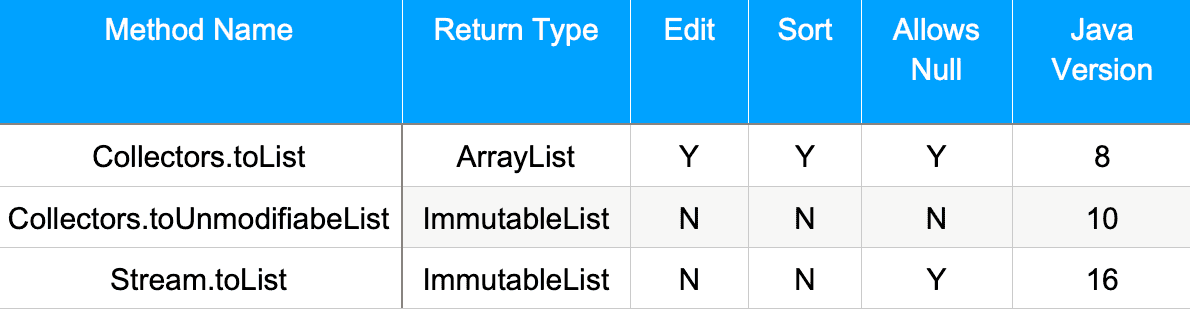
Though the current implementation of the Collectors.toList() creates a mutable List, the method’s specification itself makes no guarantee on the type, mutability, serializability, or thread-safety of the List.
On the other hand, both Collectors.toUnmodifiableList() and Stream.toList() produce unmodifiable lists.
This implies that we can do operations like add and sort on the elements of Collectors.toList(), but not on the elements of Collectors.toUnmodifiableList() and Stream.toList().
3.3. Allowing Null Elements in the Lists
Although Stream.toList() produces an unmodifiable List, it’s still not the same as Collectors.toUnmodifiableList(). This is because Stream.toList() allows the null elements, and Collectors.toUnmodifiableList() doesn’t allow the null elements. However, Collectors.toList() allows the null elements.
Collectors.toList() doesn’t throw an Exception when a Stream containing null elements is collected:
Assertions.assertDoesNotThrow(() -> {
    Stream.of(null,null).collect(Collectors.toList());
});
Collectors.toUnmodifiableList() throws a NulPointerException when we collect a Stream containing null elements:
Assertions.assertThrows(NullPointerException.class, () -> {
    Stream.of(null,null).collect(Collectors.toUnmodifiableList());
});
Stream.toList() doesn’t throw a NulPointerException when we try to collect a Stream containing null elements:
Assertions.assertDoesNotThrow(() -> {
    Stream.of(null,null).toList();
});
Therefore, this is something to watch out for when migrating our code from Java 8 to Java 10 or Java 16. We can’t blindly use Stream.toList() in place of Collectors.toList() or Collectors.toUnmodifiableList().
3.4. Summary of Analysis
The following table summarizes the differences and similarities of the lists from our analysis:
4. When to Use Different toList() Methods
The main objective of adding Stream.toList() is to reduce the verbosity of the Collector API.
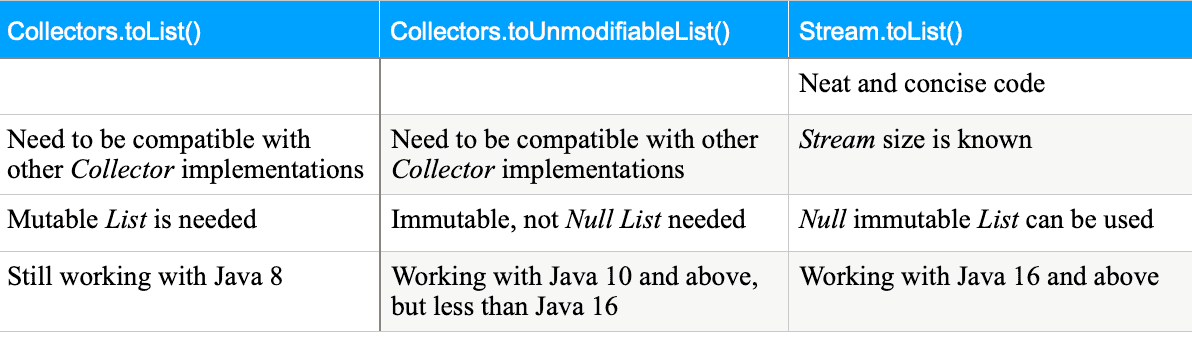
As shown previously, using the Collectors methods for getting Lists is very verbose. On the other hand, using the Stream.toList() method makes code neat and concise.
Nevertheless, as seen in earlier sections, Stream.toList() can’t be used as a shortcut to Collectors.toList() or Collectors.toUnmodifiableList().
Secondly, the Stream.toList() uses less memory because its implementation is independent of the Collector interface. It accumulates the Stream elements directly into the List. So if we know the size of the stream in advance, it’ll be optimal to use Stream.toList().
We also know that the Stream API provides the implementation only for the toList() method. It doesn’t contain similar methods for getting a map or a set. So if we want a uniform approach to get any converters, like list, map, or set, we’ll continue to use the Collector API. This will also maintain consistency and avoid confusion.
Finally, if we’re using versions lower than Java 16, we have to continue to use Collectors methods.
The following table summarizes the optimum use of the given methods:
5. Conclusion
In this article, we analyzed the three most popular ways of getting a List from a Stream. Then we looked at the main differences and similarities. We also discussed how and when to use these methods.
The code backing this article is available on GitHub. Once you're
logged in as a Baeldung Pro Member, start learning and coding on the project.


