

Grok 4.5 API pricing: the real per-token rates
xAI's own developer pricing page and the Grok 4.5 model page both list the same numbers, so this table is about as primary-source as pricing gets:
| Model | Context | Input / 1M | Cached input / 1M | Output / 1M |
|---|---|---|---|---|
| Grok 4.5 (flagship) | 500K | $2.00 | $0.50 | $6.00 |
| Grok 4.3 (prior flagship) | 1M | $1.25 | $0.20 | $2.50 |
| Grok 4.20 family | 1M | $1.25 | $0.20 | $2.50 |
Worth sitting with for a second: grok-4.5 is more expensive per token than the model it replaces. Input jumped from $1.25 to $2.00, and output more than doubled from $2.50 to $6.00. That's an unusual move for a "new flagship" announcement, and xAI's launch post on X states the rate plainly: "$2/M input tokens, $0.50/M cached input tokens, $6/M output tokens, 500K context window." The community noticed the number immediately too:
"The benchmarks look similar to Grok 4.5 also released today and priced at $2/M input tokens and $6/M output tokens."

A few other things the rate card doesn't advertise up front: xAI caps request rates at 150 requests/second and 50M tokens/minute in us-east-1/us-west-2 (higher limits available via request form), and requests above the 200K-token mark inside that 500K context window bill at a different rate that xAI mentions but doesn't publish a number for, so budget conservatively if you're routinely filling the full window.
How Grok 4.5 stacks up against GPT-5.5, Claude Opus 4.8, and Claude Fable 5
Per-token rates are hard to reason about in the abstract, so here's what they turn into on a real bill. Say you're running a workload that uses 50M input tokens and 10M output tokens in a month, a reasonable shape for an agent reading a lot of context and writing shorter replies:
- Grok 4.3: (50 × $1.25) + (10 × $2.50) = $87.50/month
- Grok 4.5: (50 × $2.00) + (10 × $6.00) = $160/month
- Claude Opus 4.8: (50 × $5) + (10 × $25) = $500/month
- GPT-5.5-class pricing: (50 × $5) + (10 × $30) = $550/month
- Claude Fable 5: (50 × $10) + (10 × $50) = $1,000/month
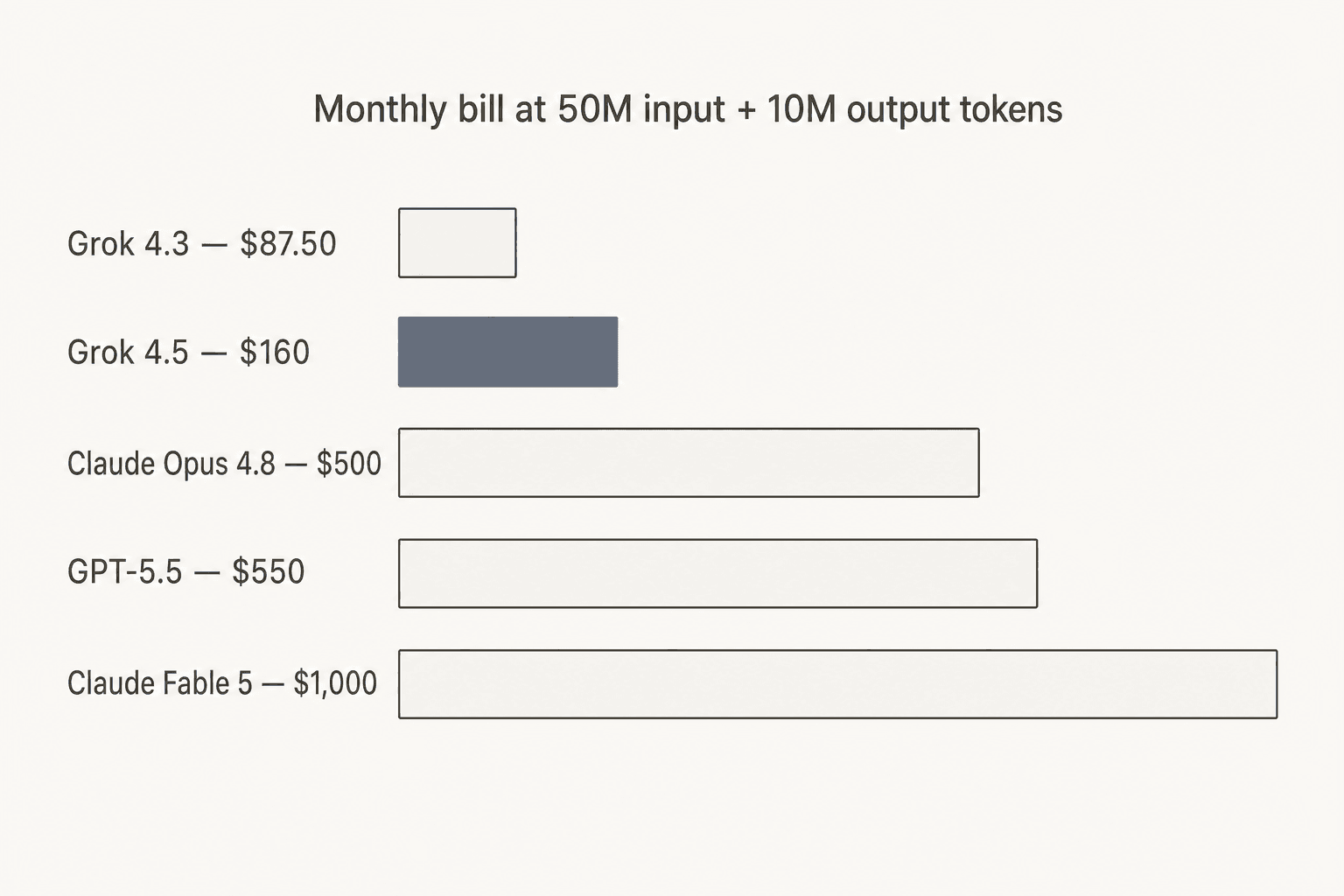
At that volume, Grok 4.5 comes in at less than a third of Claude Opus 4.8 and just over an eighth of Claude Fable 5. It's one of the cheapest ways to get near-frontier output right now. On the independent Artificial Analysis Intelligence Index, Grok 4.5 scores 54, just a few points off Claude Opus 4.8's 56 and GPT-5.5's 55, and it hit #4 on GDPval-AA v2, per Artificial Analysis, at "a cost of $0.49 per GDPval task to sit clearly on the Pareto frontier." The Hacker News crowd landed in the same place:
"Pretty decent, comparable with some older opus models, and fairly cheap per token."
Two caveats worth keeping in your back pocket. First, the older grok-4.3 is still cheaper than the new flagship at this volume ($87.50 vs $160), so if your workload doesn't need grok-4.5's extra capability, downgrading is a real lever. Second, OpenAI's cheapest new tier, GPT-5.6 Luna, prices at $1/$6 per 1M, which works out to about $110/month at this same volume, undercutting Grok 4.5 on pure token price. Luna trades away capability to get there, while grok-4.5 is xAI's actual flagship, so it's not a clean swap, but it's a reminder that "cheapest frontier model" and "cheapest model, period" are two different claims.
The costs the sticker price leaves out
Token price is only part of what a Grok 4.5 workload bills for. xAI's pricing page lists server-side tool calls and storage as separate line items, billed on top of whatever tokens the request used:
| Cost item | Rate |
|---|---|
Web search (web_search) | $5 / 1,000 calls |
X search (x_search) | $5 / 1,000 calls |
Code execution (code_execution) | $5 / 1,000 calls |
File attachments (attachment_search) | $10 / 1,000 calls |
Collections search / RAG (collections_search) | $2.50 / 1,000 calls |
| File storage | $0.025 / GiB / day |
| Collection storage | $0.10 / GiB / day |
| File / collection downloads | $0.20 / GiB |
If your use case leans on Grok 4.5's built-in tool calling, which xAI markets as a headline feature, those calls add up fast on a busy agent that's checking the web or searching a knowledge base on nearly every turn. There's also a discount that quietly doesn't apply here: xAI's batch API gives grok-4.3 and the grok-4.20 family a 20% discount on asynchronous requests completed within roughly 24 hours. Grok 4.5 isn't on that discount list at launch, so if you were planning to route bulk, latency-tolerant work through batch to save money, the newest model doesn't currently qualify.
SuperGrok, SuperGrok Heavy, and X Premium+: what Grok costs outside the API
If you're a consumer rather than a developer, the pricing lives on grok.com/supergrok instead of the docs site:
| Tier | Monthly price | What it includes |
|---|---|---|
| Grok (Free) | $0 | Chat, real-time web + X search, limited daily usage, no multi-agent mode |
| SuperGrok | $30.00 | Higher limits, priority access, multi-agent mode, Grok Build access |
| SuperGrok Heavy | $300.00 (often ~$99 on promo) | Full flagship access plus the multi-agent "Heavy" model |
| X Premium+ | $40.00 | Grok access bundled into the X social subscription |
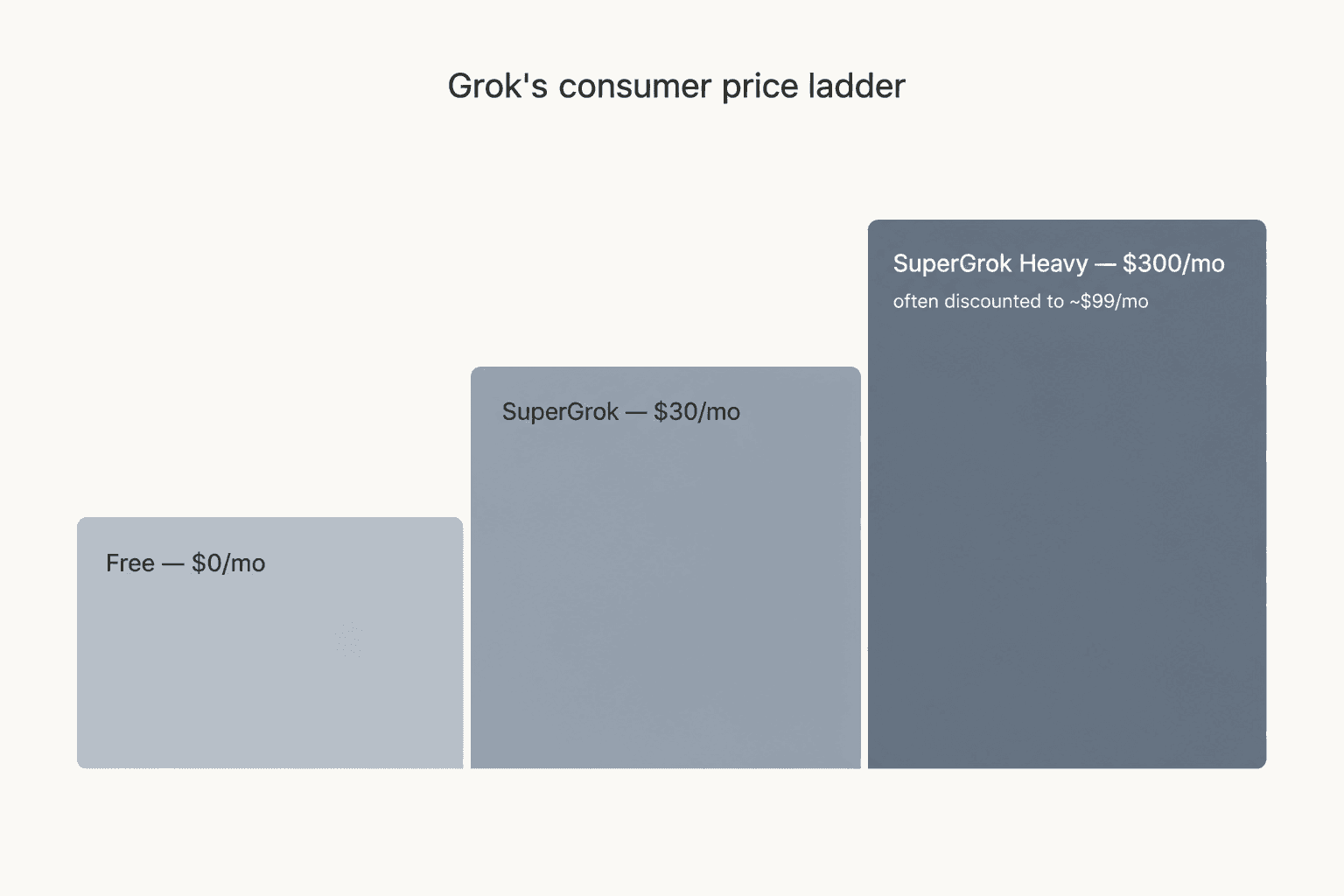
The $300 SuperGrok Heavy price is confirmed straight from xAI's own X account: "SuperGrok Heavy subscription: $300/month." But that's the list price, not always what people actually pay. xAI runs recurring promotional pricing, and multiple posts, including Sawyer Merritt's breakdown of the tier structure, point to a roughly 67%-off rate that lands closer to $99/month for new subscribers during active promo windows. If you're comparing Grok's consumer cost to a competitor's list price, check whether you're looking at the sticker or the promo, because the gap between $300 and $99 changes the comparison a lot.
Why the cheapest tokens don't always mean the cheapest support bot
Here's the part every one of these per-1M comparisons quietly skips: token pricing assumes you know your volume up front, and a customer support conversation doesn't hand you that number in advance. A three-turn ticket and a twelve-turn ticket look identical on a pricing page, but they don't cost the same, because most implementations re-send the growing conversation history, the system prompt, and any retrieved knowledge-base context on every single turn. Add a tool call or two per turn, at $5 per 1,000 calls, and the bill for one "difficult" ticket can end up several times the bill for an easy one.
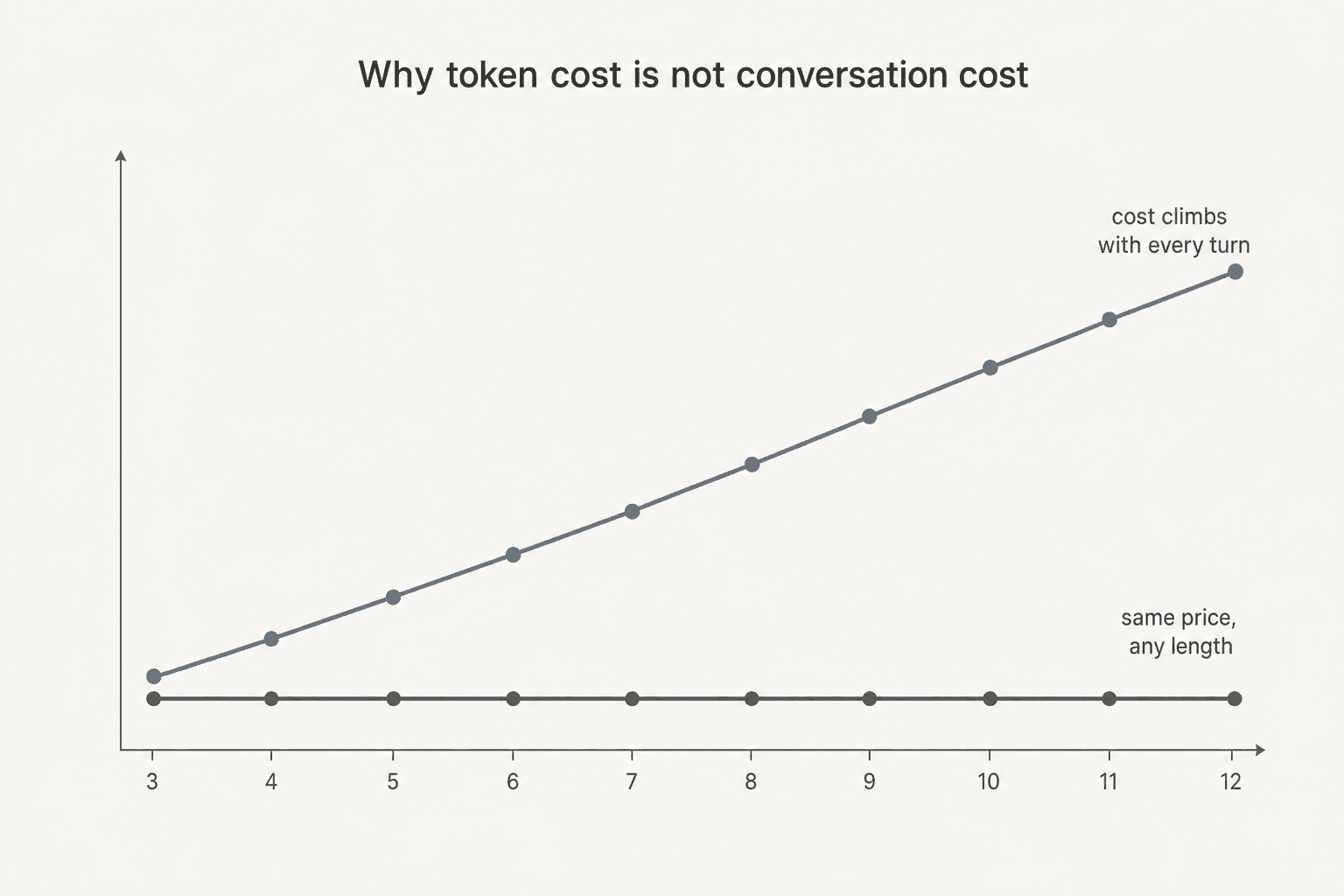
That's the exact gap eesel's pricing is built to close: $0.40 per resolved ticket or chat session, no matter how many messages it takes to close it. Run 1,000 tickets through eesel and the bill is a predictable $400, whether every one of those tickets took two replies or twenty. Run the same 1,000 tickets on raw model tokens and the bill depends entirely on how chatty your customers are that month, plus every tool call, retry, and re-sent history token along the way, which is exactly the variability I'd want to avoid when I'm the one signing off on the budget.
Try eesel
Whatever frontier model wins the price-per-token race this month, Grok 4.5 today, something cheaper next quarter, the hard part of AI support was never picking the smartest or cheapest LLM. It's making sure the model only answers what it actually knows, hands off cleanly when it doesn't, and doesn't turn a long ticket into a budget surprise. eesel sits on top of your existing helpdesk, whether that's Zendesk, Freshdesk, Gorgias, HubSpot, or Front, learns from your real ticket history on day one, and runs a full simulation against your past tickets so you can see exact coverage before it ever touches a live conversation.

Pricing is usage-based at $0.40 per resolved ticket, no seat fees, no platform minimum, and no separate line items for tool calls or storage to track down later. You're not paying for a model's benchmark score, you're paying for tickets it actually closed: Gridwise resolved 73% of tier-1 requests in their first month running it.
Frequently Asked Questions
How much does Grok 4.5 cost?
Grok 4.5's API is priced at $2.00 per 1M input tokens and $6.00 per 1M output tokens, with cached input at $0.50 per 1M, confirmed on xAI's pricing page. On the consumer side, Grok's free tier costs nothing, SuperGrok is $30/month, and SuperGrok Heavy is $300/month. For the model itself rather than the price tag, see our Grok 4.5 overview.
Is Grok 4.5 cheaper than GPT-5.5 or Claude?
Yes, by a wide margin on raw token price. At the same 50M input / 10M output token volume, Grok 4.5 costs around $160/month versus roughly $500 for Claude Opus 4.8, $550 for GPT-5.5-class pricing, and $1,000 for Claude Fable 5. Our full xAI pricing guide covers the wider model lineup.
Does Grok 4.5 have a free tier?
Yes, on the consumer side. Grok's free tier includes chat, real-time web and X search, and limited daily usage, with no multi-agent mode. The API has no free tier at all; every token is billed from the first call, unlike some AI chatbot tools that offer a free API sandbox.
What's the difference between SuperGrok and SuperGrok Heavy?
SuperGrok ($30/month) unlocks higher limits, priority access, and multi-agent mode. SuperGrok Heavy ($300/month list price) adds the full "Heavy" multi-agent model aimed at professional and power users, though xAI frequently discounts it to around $99/month for new subscribers during recurring promos.
Can I use Grok 4.5's token pricing to budget an AI support agent?
Only loosely. Token cost per conversation swings with how long the thread runs, how much history the model re-reads each turn, and how many tool calls it makes, so a per-ticket estimate built from token math alone tends to run optimistic. Outcome-priced tools like eesel charge a flat rate per resolved ticket instead, so the bill doesn't move when a conversation runs long.
Is Grok 4.5 worth it for customer support?
On price per token, it's one of the cheapest near-frontier models on the market, and it posts the best agentic tool-use score in its class. But model cost was never really the bottleneck in automated ticket resolution, hallucination control and clean escalation are, which is why we'd pair any frontier model with guardrails rather than call the raw API directly. See how to prevent AI hallucinations in support for what that setup looks like.


Article by
Kurnia Kharisma Agung Samiadjie
Kurnia is a software engineer and writer at eesel AI with two years of SEO experience, writing about AI tools, helpdesk software, and customer support. He pairs a developer's understanding of how these products are built with search-driven research into what actually ranks and resonates with the people searching for them.