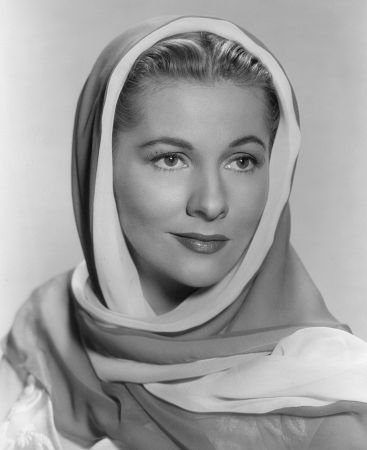
Actress. A respected performer over a long career, she was honored as Best Actress for Sir Alfred Hitchcock's 1941 film, Suspicion. Born Joan de Beauvoir de Havilland to a British family of wealth and position, she was raised in Northern California following her parents' 1919 break-up and attended Los Gatos High School before moving back to Japan at 16 to live with her father. Returning to America following her graduation from The American School in Japan, she made her 1935 professional stage bow in Call It a Day and that same year first appeared on the silver screen in No More Ladies. Over the next few years, Joan, who took her stepfather's name professionally while her older sister Olivia kept her own, was in about a dozen RKO features including A Million to One and A Damsel in Distress (both 1937) and 1939's The Women. In 1940, Joan got her break when she co-starred with Sir Laurence Olivier in Rebecca, a film directed by the then little-known Hitchcock, who had a fondness for pretty blondes. Nominated for an Academy Award (Oscar), Joan did not win but took the prize the next year for Suspicion, another Hitchcock piece in which she shared the screen with Cary Grant. Joan earned her third Oscar nomination for the 1943 film, The Constant Nymph and thru the 1940s, she was seen in a number of well received dramas including Jane Eyre (1943), Letter from an Unknown Woman and Ivy (both 1947), and was frequently heard on the Lux Radio Theater. In 1950, she starred as 'Christabel' in Born to Be Bad with Zachary Scott. As her film appearances slowed, she became a regular in such small screen fare of the day as GE True Theater, the Ford Television Theater, and the Westinghouse Desilu Playhouse and in 1954 earned good reviews on Broadway for Tea and Sympathy in which she starred with Anthony Perkins. Last seen on the big screen in 1966's The Witches, she continued her television work in The Alfred Hitchcock Hour, Cannon, The Love Boat, and Ryan's Hope, for which she received a 1980 Emmy Award nomination. Married four times, she bore one child, to producer William Dozier; Joan and Olivia de Havilland are the only sisters to win Oscars, and while stories have circulated within the entertainment community that the two were rivals or even enemies, both ladies have discounted those tales as press fiction. Joan earned her final credit in the 1994 television movie Good King Wenceslas, lived out her days at Villa Fontana, her home in Carmel Highlands near Carmel-by-the-Sea, and died of the effects of advanced age. For her contributions to motion pictures, she has a star on the Hollywood Walk of Fame, located at 1645 Vine St., and her performance is the only Hitchcock-directed performance to win an Oscar. Many of her films are preserved on DVD and at her death questions remained as to how much truth there was to the Joan-Olivia rivalry stories.
Actress. A respected performer over a long career, she was honored as Best Actress for Sir Alfred Hitchcock's 1941 film, Suspicion. Born Joan de Beauvoir de Havilland to a British family of wealth and position, she was raised in Northern California following her parents' 1919 break-up and attended Los Gatos High School before moving back to Japan at 16 to live with her father. Returning to America following her graduation from The American School in Japan, she made her 1935 professional stage bow in Call It a Day and that same year first appeared on the silver screen in No More Ladies. Over the next few years, Joan, who took her stepfather's name professionally while her older sister Olivia kept her own, was in about a dozen RKO features including A Million to One and A Damsel in Distress (both 1937) and 1939's The Women. In 1940, Joan got her break when she co-starred with Sir Laurence Olivier in Rebecca, a film directed by the then little-known Hitchcock, who had a fondness for pretty blondes. Nominated for an Academy Award (Oscar), Joan did not win but took the prize the next year for Suspicion, another Hitchcock piece in which she shared the screen with Cary Grant. Joan earned her third Oscar nomination for the 1943 film, The Constant Nymph and thru the 1940s, she was seen in a number of well received dramas including Jane Eyre (1943), Letter from an Unknown Woman and Ivy (both 1947), and was frequently heard on the Lux Radio Theater. In 1950, she starred as 'Christabel' in Born to Be Bad with Zachary Scott. As her film appearances slowed, she became a regular in such small screen fare of the day as GE True Theater, the Ford Television Theater, and the Westinghouse Desilu Playhouse and in 1954 earned good reviews on Broadway for Tea and Sympathy in which she starred with Anthony Perkins. Last seen on the big screen in 1966's The Witches, she continued her television work in The Alfred Hitchcock Hour, Cannon, The Love Boat, and Ryan's Hope, for which she received a 1980 Emmy Award nomination. Married four times, she bore one child, to producer William Dozier; Joan and Olivia de Havilland are the only sisters to win Oscars, and while stories have circulated within the entertainment community that the two were rivals or even enemies, both ladies have discounted those tales as press fiction. Joan earned her final credit in the 1994 television movie Good King Wenceslas, lived out her days at Villa Fontana, her home in Carmel Highlands near Carmel-by-the-Sea, and died of the effects of advanced age. For her contributions to motion pictures, she has a star on the Hollywood Walk of Fame, located at 1645 Vine St., and her performance is the only Hitchcock-directed performance to win an Oscar. Many of her films are preserved on DVD and at her death questions remained as to how much truth there was to the Joan-Olivia rivalry stories.
Bio by: Bob Hufford