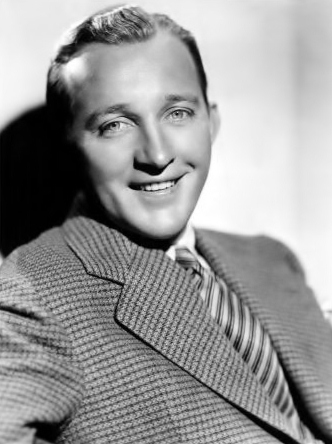
Actor, Singer. He is best remembered for his many Road movies with co-star Bob Hope, for such classic movies as Going My Way (1944), White Christmas (1954), and for such songs as "Pennies from Heaven" (1936) and "White Christmas" (1942). Born in Tacoma, Washington and raised in Spokane, Washington, while studying law at Gonzaga University in Spokane, he became interested in playing drums and singing with a local band. Teaming with the band's piano player, he went to Los Angeles, California in 1925, where they made a small living playing theaters and nightclubs, and making his film debut with The King of Jazz (1930). When one of his songs became successful on the radio in 1931, it brought him to the attention of Hollywood. Paramount Pictures included him in the movie, The Big Broadcast of 1932 (1932), and his relaxed, low key style found success with audiences, making him a star. More films followed with varying acclaim, but in 1940, he was teamed with his friend, Bob Hope, in Road to Singapore and the combination of jokes, songs, romance, burlesque, and exotic locations (it was actually filmed in Hollywood), made the pair a hit, and additional Road movies followed, include Road to Zanzibar (1941), Road to Morocco (1942), Road to Utopia (1945), Road to Rio (1947), Road to Bali (1952), and Road to Hong Kong (1962). In the film Holiday Inn (1942), he sang Irving Berlin's "White Christmas" and it went on to become one of the biggest selling records for the next 50 years. In 1944, he played 'Father Chuck O'Malley' in the sentimental comedy-drama Going My Way (1944) and won the Academy Award (Oscar) for Best Actor. He got a second nomination for Best Actor Academy Award for the sequel, The Bells of St. Mary's (1945), when he reprised the role of Father O'Malley. Later films suffered highs and lows, but two films found much success: The Country Girl (1954) in which he played an alcoholic singer, earning him another Oscar nomination, and White Christmas (1954), which was a box-office sellout. In this period, he also moved on to television, with numerous appearances on Hollywood Palace (1964 to 1970) and his own sitcom The Bing Crosby Show (1964 to 1965). He also became a producer, and his Bing Crosby Productions became a leader in the film and television industry. His autobiography, Call Me Lucky was published in 1953. He died of a heart attack on a golf course in Alcobendas, Madrid, Spain, after completing a tour of England that had included a sold-out engagement at the London Palladium. His last words were reportedly, "That was a great game of golf, fellers."
Actor, Singer. He is best remembered for his many Road movies with co-star Bob Hope, for such classic movies as Going My Way (1944), White Christmas (1954), and for such songs as "Pennies from Heaven" (1936) and "White Christmas" (1942). Born in Tacoma, Washington and raised in Spokane, Washington, while studying law at Gonzaga University in Spokane, he became interested in playing drums and singing with a local band. Teaming with the band's piano player, he went to Los Angeles, California in 1925, where they made a small living playing theaters and nightclubs, and making his film debut with The King of Jazz (1930). When one of his songs became successful on the radio in 1931, it brought him to the attention of Hollywood. Paramount Pictures included him in the movie, The Big Broadcast of 1932 (1932), and his relaxed, low key style found success with audiences, making him a star. More films followed with varying acclaim, but in 1940, he was teamed with his friend, Bob Hope, in Road to Singapore and the combination of jokes, songs, romance, burlesque, and exotic locations (it was actually filmed in Hollywood), made the pair a hit, and additional Road movies followed, include Road to Zanzibar (1941), Road to Morocco (1942), Road to Utopia (1945), Road to Rio (1947), Road to Bali (1952), and Road to Hong Kong (1962). In the film Holiday Inn (1942), he sang Irving Berlin's "White Christmas" and it went on to become one of the biggest selling records for the next 50 years. In 1944, he played 'Father Chuck O'Malley' in the sentimental comedy-drama Going My Way (1944) and won the Academy Award (Oscar) for Best Actor. He got a second nomination for Best Actor Academy Award for the sequel, The Bells of St. Mary's (1945), when he reprised the role of Father O'Malley. Later films suffered highs and lows, but two films found much success: The Country Girl (1954) in which he played an alcoholic singer, earning him another Oscar nomination, and White Christmas (1954), which was a box-office sellout. In this period, he also moved on to television, with numerous appearances on Hollywood Palace (1964 to 1970) and his own sitcom The Bing Crosby Show (1964 to 1965). He also became a producer, and his Bing Crosby Productions became a leader in the film and television industry. His autobiography, Call Me Lucky was published in 1953. He died of a heart attack on a golf course in Alcobendas, Madrid, Spain, after completing a tour of England that had included a sold-out engagement at the London Palladium. His last words were reportedly, "That was a great game of golf, fellers."
Bio by: Kit and Morgan Benson
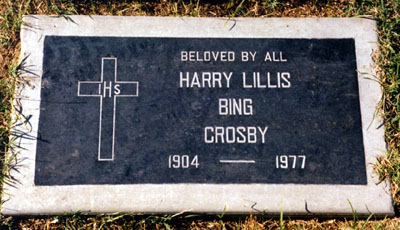
Inscription
Beloved By All
Gravesite Details
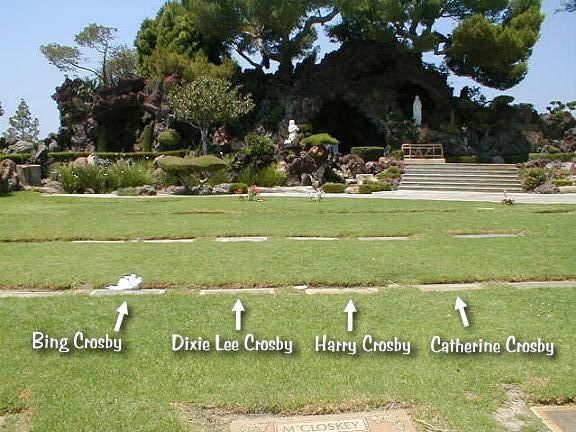
Gravesite has an error for the year of his birth, buried next to his first wife Dixie Lee.