
Rotation is a geometric transformation that turns every point of a figure about a fixed point (called the center of rotation) through a given angle and direction (clockwise or counterclockwise), without changing the shape's size or internal angles. In mathematical terms, rotation is an isometry: a transformation that preserves distances and shape properties.
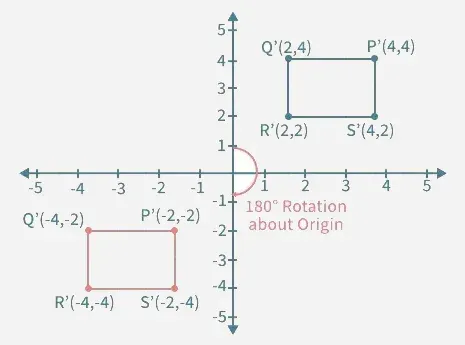
Mathematical Representation
1) Rotation about Origin
P'(x', y') = (x cosθ - y sinθ, x sinθ + y cosθ)
2) Quick Rules (Standard Angles)
Angle | Counterclockwise | Example: (3,1) | Clockwise | Example: (3,1) |
|---|---|---|---|---|
90° | (-y, x) | (-1, 3) | (y, -x) | (1, -3) |
180° | (-x, -y) | (-3, -1) | (-x, -y) | (-3, -1) |
270° | (y, -x) | (1, -3) | (-y, x) | (-1, 3) |
360° | (x, y) | (3, 1) | (x, y) | (3, 1) |
Types of Rotation
1. Based on Direction
• Counterclockwise (Positive angle θ): Standard mathematical convention
• Clockwise (Negative angle {-θ}): Opposite to standard direction
2. Based on Center
• Origin Rotation: Center at (0,0)
• Arbitrary Point Rotation: Center at C(cx,cy)
3. Based on Dimension
• 2D Rotation: Plane rotation (x,y coordinates)
• 3D Rotation: Space rotation (x,y,z coordinates)
Clockwise & Counterclockwise Rotation
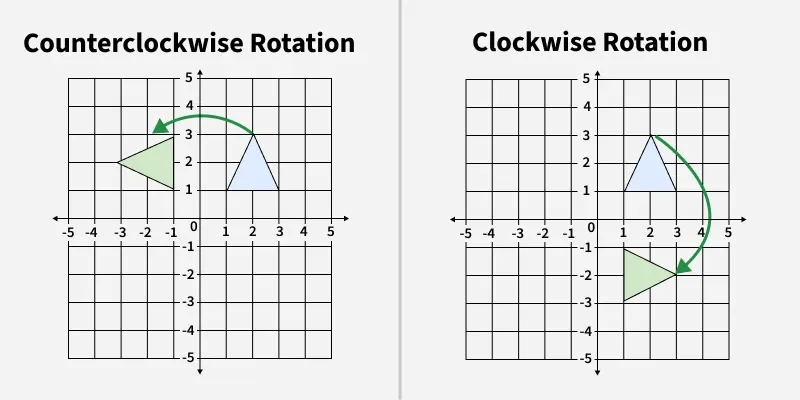
Counterclockwise Rotation :
Rotation in the positive angle direction (standard mathematical convention) where points move leftward from the positive x-axis around the center. Every point traces a counterclockwise circular arc, preserving distance from rotation center.
Clockwise Rotation :
Rotation in the negative angle direction (opposite to standard convention) where points move rightward from the positive x-axis around the center. Equivalent to counterclockwise rotation by -θ.
Origin Rotation & Arbitrary Point Rotation
Origin Rotation : Rotation about the fixed point (0,0) using simple coordinate transformation rules. Every point rotates around the origin maintaining constant distance from (0,0).
Arbitrary Point Rotation : Rotation about any point C(cx,cy) (not origin) requires 3-step process:
(1) Translate so C becomes origin
(2) Rotate about new origin
(3) Translate back to original position.
All points maintain same distance from C after rotation.
Step 1: Translate: P(x,y) → P1 (x-cx, y-cy)
Step 2: Rotate: P1 → P2 (x1cosθ - y1sinθ, x1sinθ + y1cosθ)
Step 3: Translate back: P2 → P' (x2 + cx, y2 + cy)
Example: Rectangle Rotation 90° Counterclockwise about C(2, 2)
Original Rectangle ABCD: A(1, 1), B(4, 1), C(2, 2), D(2, 4) rotated 90° Counterclockwise about center C(2, 2)
Solution :-
Step 1: Translate C(2,2) → Origin
A(1,1) → A₁(1-2,1-2) = (-1,-1)
B(4,1) → B₁(4-2,1-2) = (2,-1)
D(2,4) → D₁(2-2,4-2) = (0,2)
Step 2: 90° CCW Rotation [(-y,x) Rule]
A₁(-1,-1) → A₂(1,-1)
B₁(2,-1) → B₂(1,2)
D₁(0,2) → D₂(-2,0)
Step 3: Translate Back C(2,2)
A₂(1,-1) → A'(1+2,-1+2) = (3,1)
B₂(1,2) → B'(1+2,2+2) = (3,4)
D₂(-2,0) → D'(-2+2,0+2) = (0,2)
Final Answer: A'(3,1), B'(3,4), D'(0,2)
2D & 3D Rotation
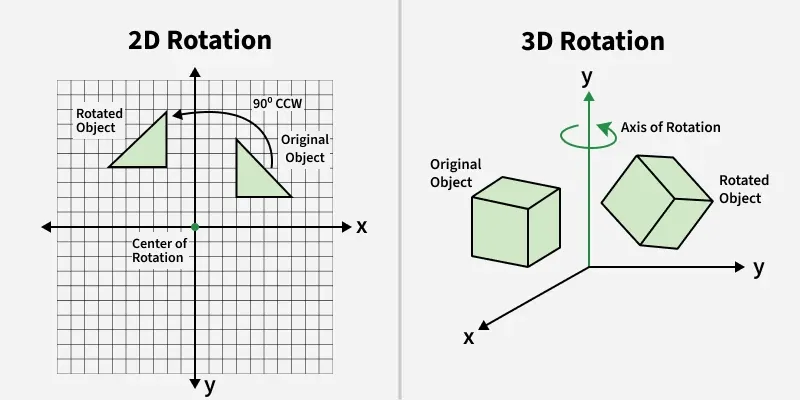
2D Rotation : It transforms points in a plane (x,y coordinates) around a fixed center by angle θ. Points move along circular arcs maintaining constant distance from rotation center.
2D Rotation Matrix about Origin:
\begin{bmatrix} x' \\ y' \end{bmatrix} = \begin{bmatrix} \cos \theta & -\sin \theta \\ \sin \theta & \cos \theta \end{bmatrix} \begin{bmatrix} x \\ y \end{bmatrix}
3D Rotation : It transforms points in space (x,y,z coordinates) around a fixed axis (X, Y, or Z) by angle θ.
Homogeneous Coordinates (3×3 for composition):
\begin{bmatrix} x' \\ y' \\ 1 \end{bmatrix} = \begin{bmatrix} \cos \theta & -\sin \theta & 0 \\ \sin \theta & \cos \theta & 0 \\ 0 & 0 & 1 \end{bmatrix} \begin{bmatrix} x \\ y \\ 1 \end{bmatrix}
Rotation of Shape - Solved Question and Answers
Question 1 : Point P(3,−2) is rotated 90° counterclockwise about the origin. Find the coordinates of P′ .
Solution :
For 90° CounterClockWise about origin, use rule: (x , y) → (−y , x)
P(3 , −2) → P′ (−(−2) , 3) = (2,3)
Question 2: Point A(5,7) is rotated 180° about the origin. Find the coordinates of A′ .
Solution :
For 180° (same for Clockwise/Counterclockwise): (x,y) → (−x,−y).
A(5 , 7) → A′(−5 , −7)
Answer: A′(−5 , −7)
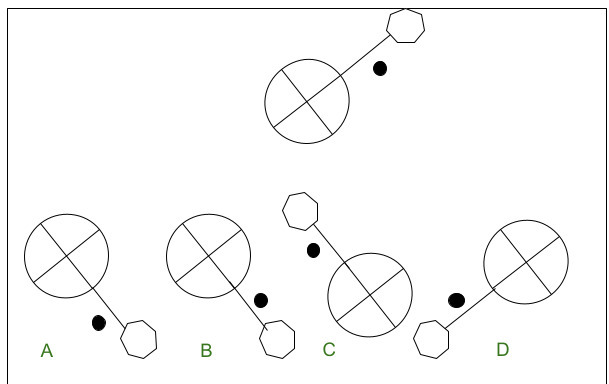
Question 3: The given figure is rotated 90° counterclockwise about the black dot (which acts as the center of rotation). Which of the following options correctly represents the rotated figure?
Solution:
- During a 90° counterclockwise rotation, the black dot remains fixed as the center of rotation.
- All parts of the figure move along circular paths, maintaining their distances and orientation.
- Only Option (C) shows the correct position and orientation after this rotation.
Realated Articles
Practice Problems on Rotation of Shapes
Question 1 : A triangle ABC with vertices A(1, 0), B(2, 0), and C(1, 1) is rotated 180° counterclockwise about the origin. What are the coordinates of the rotated triangle A'B'C'?
Question 2 : Point P(6,3) is rotated 90° counterclockwise about point C(2,2) . Find P′.
Question 3 : Point P(2,−3) is rotated:
- 90° counterclockwise about origin
- 270° counterclockwise about origin . Find the coordinates after each rotation.
Question 4 : Triangle T1 (1,1),(4,1),(2,3) becomes T2 (-1,-1),(-4,-1),(-2,-3). Is T2 a rotation of T1 ? If yes, what angle and center?
