
Hierarchical State Space Search (HSSS) is a way for AI to break down big, complicated problems into smaller, more manageable pieces. Instead of trying to solve a problem all at once, HSSS creates several layers with each layer focusing on a different level of detail. This step-by-step method allows computers and robots to find solutions faster and more efficiently especially when facing enormous or tricky challenges.
Working of Hierarchical State Space Search
- Step 1: Abstraction: Start with a simple, high-level version of the problem. This gives a “big-picture” overview where each part stands for lots of smaller details.
- Step 2: Top-Level Search: The AI first looks for a rough solution at the top layer, working with broad details rather than fine points.
- Step 3: Refinement: Once a promising path is found, the AI zooms in, moving to the next layer and adding more details. It keeps doing this as it goes deeper into the hierarchy.
- Step 4: Solution: The process continues until the AI reaches the most detailed level and finds a complete, practical answer, which can then be traced back up the hierarchy to summarize the whole solution.
Now lets see its implementation in Python.
Implementing Hierarchical State Space Search
We will use a simple robot vacuum cleaner example.
Step 1: Set Up Hierarchy
- We have a list of rooms.
- In each room, there are 3 main areas.
- Each area has 3 tiles to be cleaned.
rooms = ['kitchen', 'living room', 'bedroom']
areas_per_room = ['left', 'center', 'right']
tiles_per_area = 3
Step 2: High-Level Planning
The robot focuses first on big decisions (going from room to room).
for room in rooms:
    print(f"Moving to {room}...")
Step 3: Mid-Level Planning
Now, the robot breaks down the room into smaller targets (areas).
for area in areas_per_room:
    print(f"  Cleaning {area} of {room}...")
Step 4: Low-Level Planning
At this layer, the robot acts on the smallest tasks, cleaning one tile at a time.
for tile in range(1, tiles_per_area + 1):
    print(f"    Vacuuming tile {tile} in {area} of {room}")
Output:
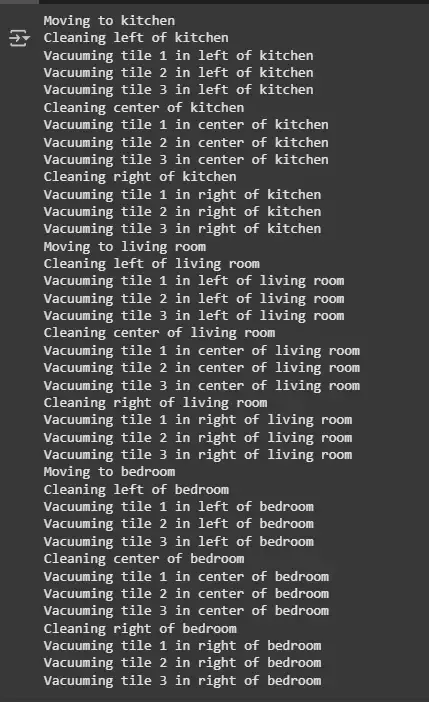
The complete code can be downloaded from here.
Applications of Hierarchical State Space Search in AI
- Robotics: It is widely used in robotics for tasks such as navigation, manipulation and multi-tasking. By decomposing complex robotic tasks into hierarchical levels, it allows robots to plan and execute actions more efficiently.
- Automated Planning and Scheduling: In automated planning and scheduling, it helps to manage and optimize complex workflows and processes. By organizing tasks into a hierarchy, it enables efficient scheduling and resource allocation, improving overall performance and coordination.
- Game AI: It is applied in game AI to create complex behaviors and strategies for non-player characters (NPCs). By structuring the state space hierarchically, game AI systems can manage intricate decision-making processes and enhance the realism of NPC actions.
Advantages
- Efficiency: By focusing the search on specific areas of the state space, HSS reduces the overall computational cost making it feasible to solve problems with large state spaces.
- Scalability: HSS is well-suited for complex problems that would otherwise be too large to handle using traditional search methods.
- Modularity: The hierarchical approach allows for modular problem-solving where different levels of the hierarchy can be designed and optimized independently.
Limitations
- Managing Complexity: Large hierarchies can themselves be tough to manage.
- Good Knowledge Needed: The AI needs accurate “maps” at each layer to work well.
- Needs Flexibility: If things change quickly, the hierarchy must be ready to adapt.
