
Knowledge conflict in Retrieval‑Augmented Generation (RAG) occurs when the retrieved information contains contradictory or inconsistent facts, which can lead to inaccurate or confusing model outputs. Since RAG systems rely on external data sources, differences in data quality or context can create conflicts during response generation.
For Example:
- Document 1: “Python was released in 1991”
- Document 2: “Python was released in 1989”
So, now the model gets confused about "Which one is correct?" or "What should it answer?" which can lead to incorrect or mixed responses.
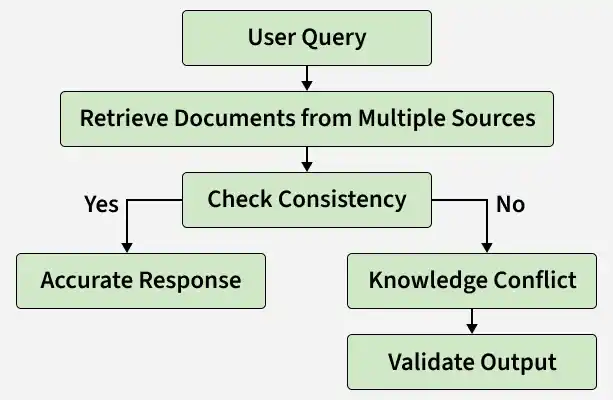
Approaches to Control Knowledge Conflict
To effectively manage knowledge conflict, several techniques can be applied in RAG systems:
1. Source Ranking
It is a method where retrieved documents are ordered based on their reliability and relevance. The system gives more importance to higher-quality and accurate sources to reduce the impact of conflicting information.
- Prioritize trusted and verified sources to ensure reliability
- Prefer recent information to maintain up-to-date responses
- Select closely related documents to the query
- Improve overall answer quality using credible and relevant data
2. Metadata Filtering
It uses structured attributes such as date, author and source type (category of information source) to remove low-quality or outdated documents before generation. This helps ensure that only relevant and reliable information is used.
- Filter documents by date to remove outdated or old information
- Prefer content from credible authors or trusted organizations
- Select data from reliable domains such as academic or official sources
- Exclude low-quality, irrelevant or unreliable content
3. Handling Uncertainty
Handling uncertainty enables the system to recognize conflicting information and avoid forcing a single definite answer. This helps in generating more transparent and reliable responses.
- Detect conflicting sources by identifying differences across documents
- Indicate uncertainty when the information is not fully consistent
- Avoid overconfident responses when data is uncertain
- Improve user trust through transparent and honest outputs
4. Improved Retrieval Techniques
This approach focuses on enhancing the retrieval process to ensure that only highly relevant and contextually accurate documents are selected, reducing noise and potential conflicts.
- Use semantic search to retrieve information based on meaning rather than keywords
- Improve query understanding to better interpret user intent
- Reduce noisy retrieval by avoiding irrelevant data
- Ensure relevant inputs by providing accurate and context-aware information
5. Cross-Verification
It compares information across multiple sources to identify consistent and reliable facts before generating a response. It helps filter out conflicting or unsupported data.
- Analyze information from different documents
- Identify common facts by selecting information that is consistent across sources
- Ignore outliers by removing data that contradicts most sources
- Improve answer accuracy by relying on verified information
6. Confidence Scoring
It assigns a reliability score to each retrieved piece of information based on factors like relevance and source quality.
- Score information based on its relevance to the query
- Consider source quality by giving higher weight to reliable sources
- Rank information based on confidence scores
- Select high confidence data for generating accurate responses
Advantages
- Highlights inconsistencies across sources, improving critical evaluation
- Encourages use of reliable and verified information
- Identifies gaps or limitations in available data
- Supports development of more transparent AI systems
Disadvantages
- Can lead to incorrect or inconsistent responses
- Reduces overall accuracy of the system
- Creates confusion for users
- Decreases trust in AI-generated outputs
