
Pre-training is the initial phase in building machine learning models, especially large language models, where the system learns from large amounts of unlabeled data to capture general patterns and knowledge.
- Learns language structure, patterns and contextual relationships
- Builds a strong foundational understanding of data
- Enables the model to perform well across multiple tasks
- Can be fine-tuned later on specific datasets for targeted applications
Pre-Training
- The model is trained from scratch or initialized with weights
- Learns general features using objectives like masked token prediction or next-token prediction
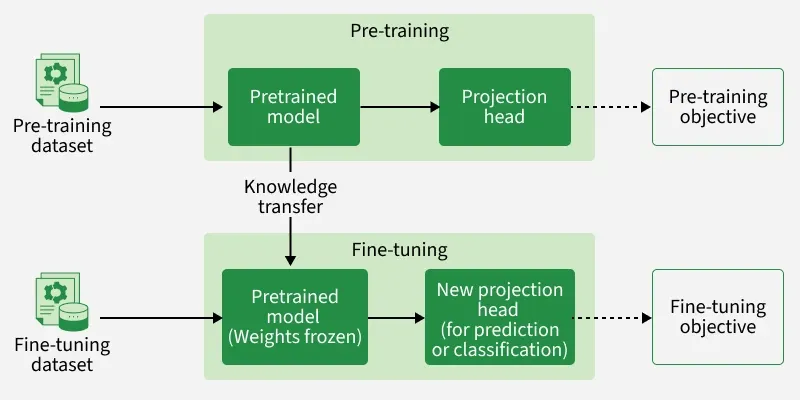
- A projection head maps learned features to the training objective
- Knowledge gained during pre-training is transferred to the fine-tuning phase
- During fine-tuning, task-specific layers may be added
Objectives
- Masked Language Modeling (MLM): The model learns to predict missing or masked words in a sentence using surrounding context.
- Next-Token Prediction: The model predicts the next word in a sequence based on previous words.
- Context Learning: The model learns relationships between words and understands context within text.
- Representation Learning: The model generates meaningful vector representations that can be used for various downstream tasks.
Applications
- Used in NLP tasks like chatbots, sentiment analysis, translation and summarization
- Applied in computer vision for image classification, object detection and medical analysis
- Supports speech processing tasks like speech-to-text, voice assistants and audio classification
- Powers code generation systems that assist in writing and debugging programs
Advantages
- Reduces time and computational effort required for fine-tuning
- Improves accuracy and generalization across different tasks
- Requires less labeled data, reducing cost and effort
- Enables the same model to be adapted to multiple tasks without retraining from scratch
