
Agentic AI development focuses on building systems that can think, plan and adapt, unlike traditional software that follows fixed instructions. These systems act like intelligent assistants that understand goals and take actions to achieve them.
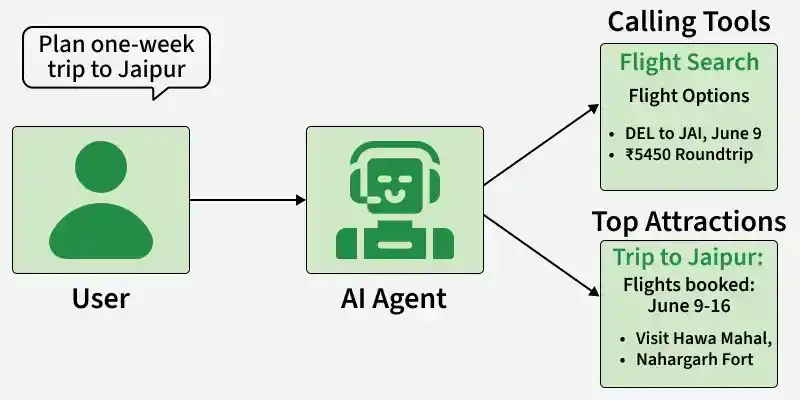
- Autonomous Decision Making: Can analyze situations and choose actions without constant human input
- Goal Oriented Behavior: Breaks complex tasks into smaller steps and works toward completion
- Learning and Adaptation: Improves over time using feedback and past experiences
- System Integration: Connects with APIs, databases and external tools to perform real tasks
Responsibilities
Agentic AI developers design and maintain systems that operate in real-world environments and handle dynamic situations.
- System Design: Build multiple AI agents that collaborate to solve problems
- Thinking Frameworks: Design step by step reasoning and decision making logic
- System Integration: Connect AI agents with external tools and business systems
- Monitoring and Improvement: Analyze performance and improve based on failures
- Safety and Reliability: Ensure systems behave correctly and handle edge cases safely
Skills Required
To succeed as an agentic AI developer, both technical and nontechnical skills are required.
Technical Skills
1. Programming Skills
Programming forms the foundation of agentic AI development. Python is the primary language used for building agents, workflows and integrations.
- Python Introduction
- Python Variables
- Python Data Types
- Conditional Statements in Python
- Loops in Python
- Python Functions
- Object-Oriented Programming (OOP)
- Exception Handling
- NumPy for Numerical Computing
- Pandas for Data Manipulation
- Working with APIs (requests, JSON)
- Frameworks: LangChain,LangGraph,CrewAI and similar agent frameworks
- Basic JavaScript (for UI and integrations)
2. Machine Learning & LLM Understanding
Understanding how AI models work is essential for building intelligent agents. This helps in designing better prompts, workflows and decision systems.
- Basics of Machine Learning
- Supervised vs Unsupervised Learning
- Introduction to Neural Networks
- Understanding Large Language Models (LLMs)
- Prompt Engineering Fundamentals
- Fine-tuning Concepts
- Embeddings and Vector Representations
- Tokenization and Context Windows
- Model Parameters (temperature, top-k, etc.)
- Evaluation of LLM Outputs
3. System Integration
Agentic systems need to interact with real world tools and services. Integration skills ensure agents can perform meaningful tasks beyond text generation.
- Working with REST APIs
- Database Basics (SQL and NoSQL)
- Cloud Platforms (AWS, GCP, Azure basics)
- Handling JSON and structured data
4. Planning and Reasoning Systems
Agentic AI systems rely on structured thinking to solve multi step problems and take actions effectively.
- Task Decomposition
- Chain of Thought (CoT) reasoning
- Tool Calling and Tool Selection
- Memory systems (short-term and long-term)
Soft Skills
Agentic AI developers need soft skills to align technical systems with real world impact and usability.
- Business Understanding: Connect AI solutions with real world use cases and outcomes
- User Experience (UX): Design systems that are intuitive, reliable and easy to use
- Ethical Thinking: Ensure responsible AI use with proper safeguards
- Communication Skills: Explain AI behavior clearly to non technical users
Applications
- AI systems handle customer queries end to end by understanding issues and providing solutions with context.
- Fraud detection systems monitor transactions and make real time decisions with minimal human input.
- AI helps analyze patient data and suggest tests and treatments with human oversight.
- Intelligent systems manage supply chains by predicting issues and optimizing inventory and logistics.
Challenges
- Integrating AI with diverse systems requires custom work, secure data handling and smooth interoperability.
- Building trust is difficult when AI decisions lack clear explanations and require human oversight.
- Ensuring speed, reliability and cost efficiency while handling large-scale requests is challenging.
- Designing memory systems that retain useful context without compromising privacy is complex.
- Adapting workflows and roles while introducing AI requires careful change management.
- Developing human skills for collaboration, oversight and problem-solving becomes essential.
- Establishing clear rules for AI autonomy and accountability is necessary to avoid risks.
Career Opportunities
- Career paths span core AI development, system integration, deployment and user experience or safety focused roles.
- Opportunities exist for both deep technical specialization and broader system design and architecture roles.
- Demand is growing rapidly as companies move from experimentation to real world deployment of agentic systems.
- Roles involve designing, building and maintaining scalable AI agents across industries.
- Specialization in areas like language processing, robotics and real time systems can enhance career growth.
