
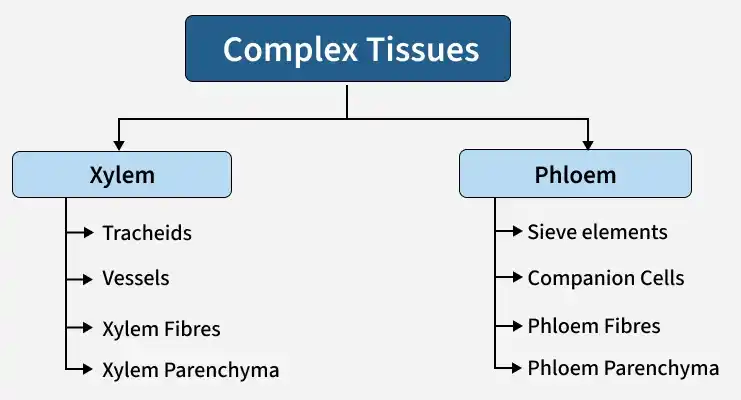
Complex Permanent tissues consist of more than one type of cell that have a common origin and which are working together for a common goal as a unit. The main purpose of these complex permanent tissues is the transportation of water and minerals; these tissues are also known as conducting and vascular tissues.
Xylem
The term xylem was given by Carl Nageli in 1858. It is derived from the Greek word “xylon”, which means “wood”. All vascular plants have xylem. It provides support and storage to plants. It helps in the transport of nutrients and minerals. The xylem conducts water through transpiration pull and capillary action. It helps in overall plant growth. The evaporation from leaves helps to build root pressure and transpiration.
Characteristics of Xylem
The characteristics of xylem are stated below:
- Xylem is a conductive tissue of the plant, which helps to move nutrients and water and nutrients from roots to stems and leaves.
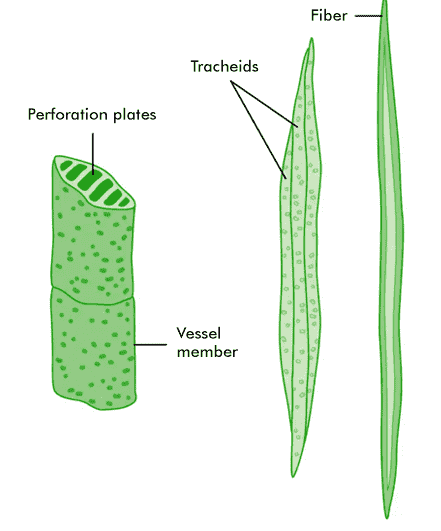
- Xylem has special cells called tracheids and vessels that are used for water transport.
- Several plant species use tracheids in water transport, such as gymnosperms and certain seedless plants.
- Tracheids are the first component of xylem vessel members, which are the second type of tracheary component in xylem and are highly specialised cells, especially compared to tracheids.
- Vessel elements carry water in angiosperms.
- Gymnosperms do not contain elements of vessels.
- The parenchyma tissue and fibre cells are also present in xylem.
- The parenchyma is a type of storage cell composed of the simplest and thinnest-walled cells.
- Xylem provides structural support to plants through the tough, lignifying fibres.
Types of Xylem
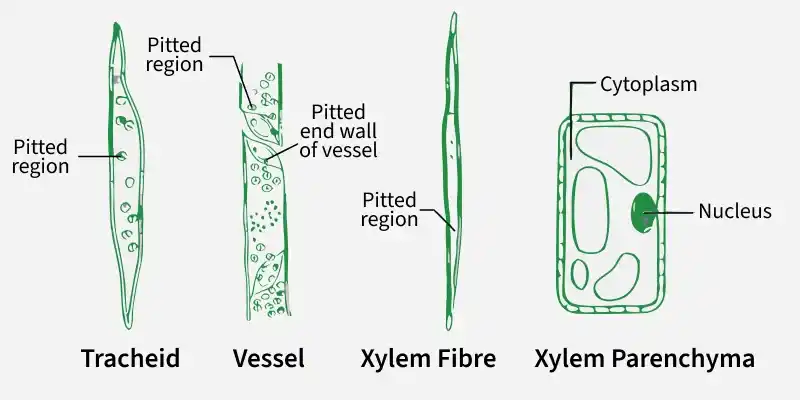
The xylem is composed of four types of cells, namely tracheids, xylem vessels, xylem fibres, and xylem parenchyma, which provide strength to the plants and help in storage and transportation functions.
1. Tracheids
- Tracheids are the xylem cells observed in vascular plants.
- It is said to be the plant's conductive element.
- It appears to be thin and long and has tapered ends.
- The cell walls of tracheids are lignified and contain pits.
- The tracheids are involved in the transportation of inorganic salts and water.
- It also offers structural support to the plants.
- The presence of pits in their cell walls allows the flow of water between cells.
2. Xylem Vessels
- Xylem vessels are another type of conductive element seen only in angiosperms and are absent in gymnosperms.
- It helps to distinguish between hardwood and softwood in plants.
- It is essential for the transport of minerals and water to the leaves from the roots.
- The cell walls are lignified and have pits on the side.
- Vessels have openings at both ends to form a continuous and tubular vessel.
3. Xylem fibres
- Xylem fibres are made up of thick, lignified, dead sclerenchyma cells.
- It is observed between vessels and tracheids of the plant.
- They are called wood fibres because of the hardness of their tissue.
- Xylem fibres are elastic and are known to provide strength to plants.
4. Xylem parenchyma
- Xylem parenchyma cells are colourless and have a distinct nucleus, protoplast, and large vacuoles mainly involved in the storage functions of the plants.
- It helps to store fats and carbohydrates.
- The plants need to carry out photosynthesis, secretion, respiration and assimilation.
- It gives rise to contact cells, which are also called “tyloses”.
- Live parenchyma cells are seen in both primary and secondary xylems.
Phloem
Phloem is a plant vascular tissue that transports food made in the leaves to all other parts of the plant. The word phloem is derived from the Greek word 'phloios', meaning 'bark'. It is of two types, primary and secondary phloem.
Characteristics of Phloem
- Primary phloem is derived from procambium and is formed during the primary growth of a vascular plant.
- Secondary phloem is derived from the vascular cambium during the secondary growth of the plant.
- In the roots and stems, secondary phloem develops inside the primary phloem.
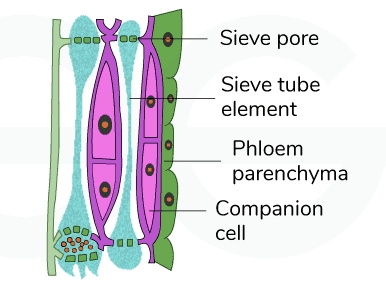
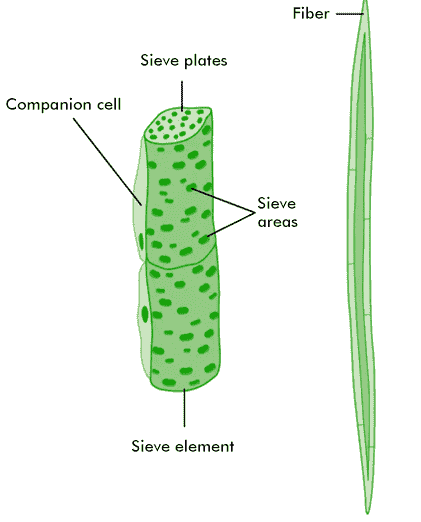
- Phloem is composed of four main types of cells, namely, sieve tube elements, phloem parenchyma cells, companion cell and phloem fibres.
- The sieve element is the primary part of the phloem that does the task of transporting organic matter throughout the plant. This happens with the help of sieve tubes, which are nothing but sieve elements themselves, connected end to end.
- It is typically located closer to the outer regions of the stem or root.
Types of Phloem
A phloem is composed of four types of cells. These components are made up of three types of cells: conducting cells, supporting cells, and parenchyma cells. The components of phloem are discussed below.
1. Sieve Tube Elements
- Sieve elements comprise two types of cells: sieve tube elements in angiosperms and sieve cells in gymnosperms.
- Sieve elements are the principal conducting cells.
- They are elongated cells with thin walls and lack a nucleus at maturity.
- Sieve elements are connected end-to-end via sieve plates, which contain pores that allow for the movement of sap between adjacent cells.
- Connected sieve elements form the sieve tube with a central pore through which nutrients pass.
- Sieve tubes are found only in angiosperms. In gymnosperms, sieve cells that do not have sieve plates are the primary conducting tissue.
2. Phloem Parenchyma Cells
- Living cells with thin cell walls and contain cytoplasm and nucleus
- Usually elongated in shape and have large vacuoles for storage
- Storage of food mainly starch, sugars, and other substances.
- Help in lateral transport of food within the plant and assist sieve tubes in the translocation of nutrients.
3. Companion cells
- These are connected to sieve elements by plasmodesmata and play a vital role in supporting their metabolic functions.
- They are typically smaller but have dense cytoplasm and numerous organelles, including mitochondria, ribosomes, and endoplasmic reticulum. and Albuminous cells have similar functions to companion cells but are associated with sieve cells and are found only in gymnosperms.
4. Phloem Fibres
- Elongated, lignified cells that provide mechanical support to the phloem tissue.
- These are the supporting tissues in the phloem responsible for structure and rigidity.
