
A nerve impulse is a rapid and temporary change in the electrical potential across the membrane of a neuron, caused by a stimulus of adequate strength. This impulse travels along the neuron and enables communication between different parts of the body. The transmission of this impulse along the axon, across synapses, and to muscles or glands is known as nerve impulse conduction.

Structure of a Neuron
Neurons are the basic units of the nervous system. The following are its main parts:
- Dendrites: They receive impulses from other neurons.
- Cyton (cell body): It contains the nucleus, integrating impulses received.
- Axon: Transmits impulses away from the cell body.
Types of Nerve Fibres
There are two types of nerve fibres depending on whether there is a myelin sheath:
Myelinated Nerve Fibres | Non-Myelinated Nerve Fibres |
|---|---|
They have a myelin sheath | They do not have a myelin sheath. |
The myelin sheath has gaps known as the nodes of Ranvier. They conduct impulses quickly. | They conduct impulses slowly. |
They are found in the white matter of the brain and spinal cord. | They are mainly found in the autonomic nervous system. |
Steps for Conduction of Impulse
Nerve impulse transmission occurs through the following steps:
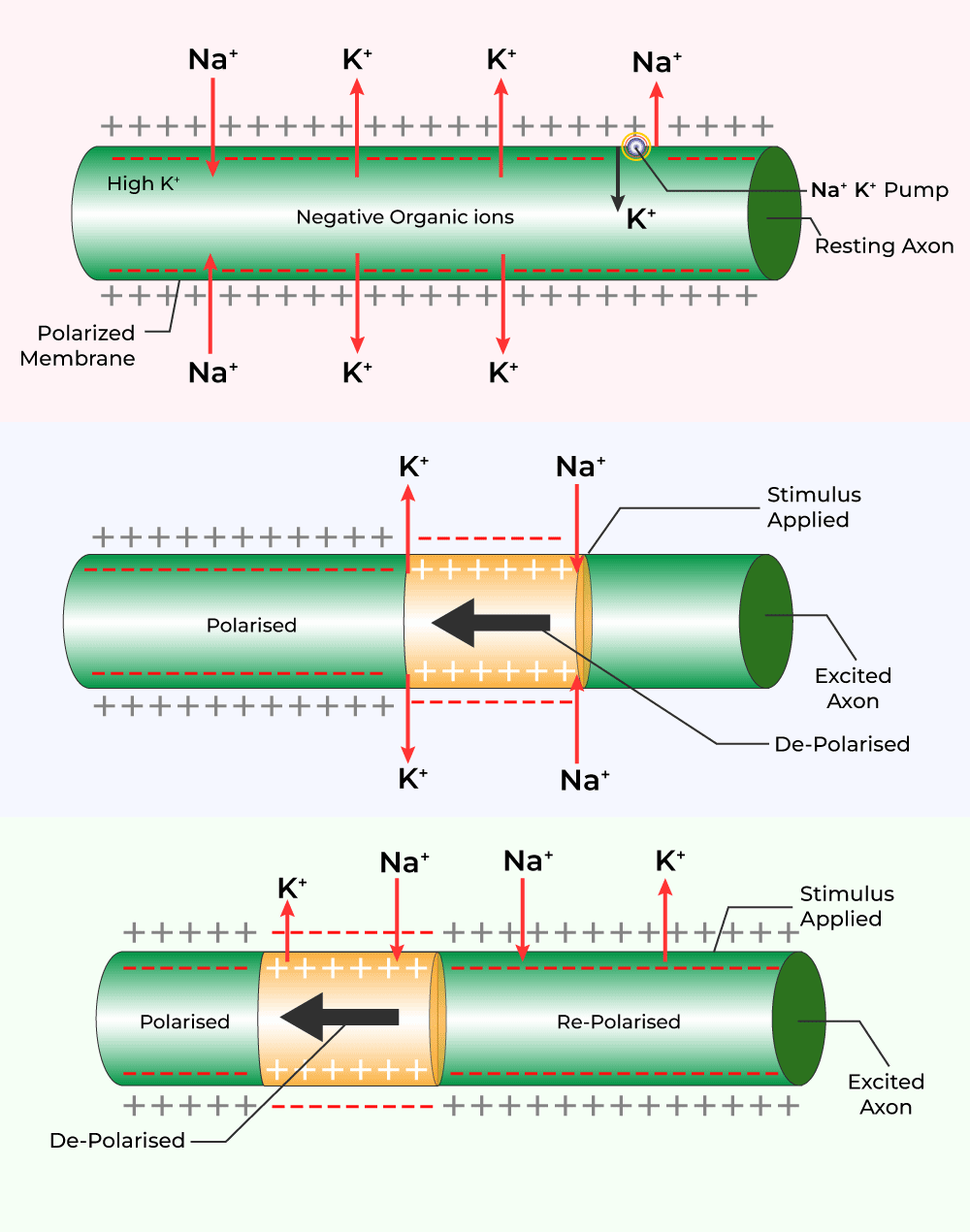
1. Polarisation (Resting Potential)
- If no impulse is being transmitted by the neuron, it is termed to be in the resting condition or polarisation.
- Inside the axon (axoplasm): Higher concentration of K⁺ (Potassium ions) and lower concentration of Na⁺ (Sodium ions)
- Outside the axon: Lower concentration of K⁺ ions and higher concentration of Na⁺ ions
- Such differences in ion concentrations are sustained by the sodium-potassium pump that acts to move:
- 3 Na⁺ ions outwards
- 2 K⁺ ions inwards
- Hence, this leads to move positive charge outside and negative charge inside. Such differences are termed the resting potential.
2. Depolarisation (Action Potential)
- If there is a threshold stimulus: Sodium gates are opened and a rush of Na⁺ ions into the axon
- This results in moving positive charge inside and negative charge outside.
- This is referred to as depolarization and such electrical changes are termed action potentials.
3. Repolarisation
- Closing of sodium gates, Opening of potassium gates, and Outward movement of K⁺ ions are happening in this step.
- This restores negative charge inside and positive charge outside. This process is called repolarisation.
