
Salesforce is the leading customer relationship management (CRM) platform, serving more than 150,000 businesses, and is expected to create 9.3 million new jobs in its ecosystem by 2026. Within this ecosystem, two prominent roles are the Salesforce Administrator (Admin) and the Salesforce Consultant. But what do they actually do, and how do you choose between them?
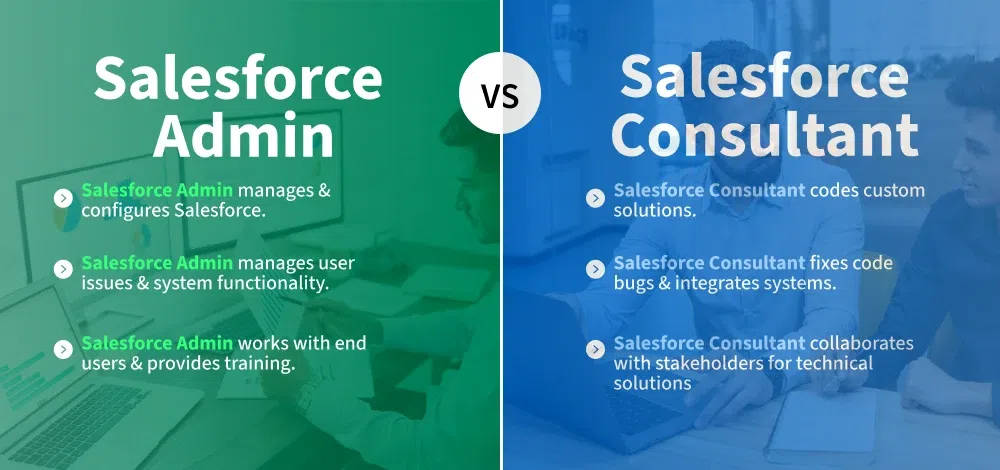
Think of it like this: a Salesforce Admin is like the wizard behind the curtain, ensuring the Salesforce kingdom runs smoothly for everyone. On the other hand, a Salesforce Consultant is the strategic hero, swooping in to design solutions that save the day (and businesses). Let’s break down these roles in a simple, relatable way so you can decide which path suits you best!
Table of Content
Who is a Salesforce Admin?
Salesforce Administrators are the backbone of an organization that uses Salesforce. They are the go-to problem solvers for managing a company's Salesforce system so that it can be tailored to the unique needs and tasks of the company. They handle everything from setting up user accounts to creating reports and automating tasks. Salesforce Admins or you may call them the "Custodian" of Salesforce, handles system's day to day operations making sure it runs well. It’s a role that combines technical knowledge with a deep understanding of business processes. Think of them as the friendly neighborhood superhero of your organization, ensuring the Salesforce platform works seamlessly for everyone.
Sometimes, you may hear about "Accidental" Administrators. These are people who often end up in the role unexpectedly. Typically, they have a solid background in IT and might be looking for a career change or a way to expand their knowledge of Salesforce. However, it’s important to ensure that these individuals are adequately trained and fully understand their work. Without the necessary expertise, accidental administrators can unintentionally disrupt business processes rather than improve them.
If you're looking to launch or elevate your career in the Salesforce domain, the Salesforce Certified Administrator Online Course by GeeksforGeeks is an excellent starting point. This course offers in-depth training on the core skills required for a Salesforce Admin role, ensuring you're equipped to handle real-world challenges. Whether you're a beginner or transitioning roles, this certification can set you apart in a competitive market.
Responsibilities of a Salesforce Admin
- User Management: Creating, managing, and training Salesforce users.
- System Configuration: Implementing workflows, validation rules, and automation.
- Data Management: Ensuring data integrity through duplication and imports.
- Reports and Dashboards: Providing insights for better decision-making.
- Troubleshooting: Addressing technical issues and ensuring smooth operations.
Skills Required
- Strong knowledge of Salesforce platform features.
- Analytical and problem-solving skills.
- Basic understanding of automation tools.
- Communication skills to train users and collaborate with teams.
- Good project management skills.
Pros and Cons of Salesforce Admin
Pros:
- Hands-on role with direct impact on daily operations.
- Predictable work environment with minimal client-facing pressure.
- Great entry point into the Salesforce ecosystem.
Cons:
- Limited exposure to strategy projects.
- Growth may plateau without pursuing advanced certifications.
You can Also Visit : How to Become a Salesforce Developer?
Who is a Salesforce Consultant?
A Salesforce Consultant focuses on implementing and optimizing the Salesforce platform in a organization. They are responsible for the entire lifecycle of Salesforce implementation—From the point of having analyzed the business requirements, it may cover understanding lifecycle events such as implementation, adoption, and any recurring maintenance or change management processes for the platform. These consultants can act as bridges between teams and stakeholders by managing the gap between non-technical stakeholders and developers. It often involves going out to meet clients, analyzing requirements, proposing solutions, and implementing customized features.
A Salesforce Consultant must have a deep understanding of the CRM’s capabilities, strong business acumen, and the ability to align technical solutions with business strategies. Salesforce Consultants often work with clients for setting measureable goals, for example, improving sales efficiency or finding needs relative to customer satisfaction that maximizes value the platform delivers through Salesforce.
Responsibilities of a Salesforce Consultant
- Solution Design: Customizing Salesforce features to align with business requirements.
- Client Engagement: Understanding business processes and pain points.
- Implementation: Configuring Salesforce or managing development teams.
- Training: Guiding clients to use Salesforce effectively.
- Project Management: Delivering projects within scope, budget, and timelines.
Skills Required
- Knowledge and expertise in design and implementation of Salesforce solution.
- Mastery of Salesforce as a CRM.
- Strong computer skills going beyond traditional IT functions.
- Strong business acumen and process mapping skills.
- Excellent communication and presentation skills.
- Ability to work with cross-functional teams.
Pros and Cons of a Salesforce Consultant
Pros:
- Varied challenging projects with high impact.
- Opportunity to work with diverse industries and clients.
- Higher earning potential compared to Admins.
Cons:
- High pressure environment with tight deadlines.
- Frequent travel (depending on the consulting firm).
- Requires managing multiple client demands simultaneously.
Salesforce Admin Vs Salesforce Consultant
Aspects | Salesforce Admin | Salesforce Consultant |
|---|---|---|
Skills | Strong knowledge of Salesforce configuration, automation tools and user management. | Expertise in Salesforce solutions, business processes and client management. Strong communication skills. |
Salary | The average salary of a Salesforce Admin is 6L/yr. | The average salary of a Salesforce Consultant is 10L/yr. |
Learning Curve | Easier to start with admin-level certifications. Learning involves mastering core platform features. | Steeper learning curve, requiring not only Salesforce knowledge but also understanding of business strategies. |
Adaptability | Easily adapts on ongoing organizational needs and changes in the system. | Follows a structured plan and requires more preparation for mid-project shifts. |
Experience | Entry level roles are common. Experience grows through consistent system management and problem-solving. | Requires a mix of Salesforce expertise and professional knowledge, often starting with smaller projects. |
Pros | Long-term stability within an organization along with clear career growth through certifications. | Diverse projects with varies industries; High earning potential. |
Cons | Limited exposure to broader business strategies. | High-pressure environment; Requires balancing multiple clients. |
Similarities
Salesforce Administrators and Salesforce Consultants perform entirely different roles, yet both are critical in the functioning of any Salesforce ecosystem. Here are a few key points where their responsibilities and skillsets are similar:
- Salesforce Expertise: Admin and consultant have to understand the Salesforce functional capabilities, including all its automation tools, workflows, external integrations, and other.
- Focus on Business Optimization: Both Admin and Consultant either configure the system or define very large implementations that make business processes as simple and efficient as possible.
- Problem Solving: Both roles require analytical thinking and problem-solving skills. An Admin would configure into the technical aspect, referring to the day-to-day operations that require troubleshooting, while a Consultant would speak to the business aspect and solutions of higher-tiered problems.
- Collaboration: Admins and Consultants often work together to achieve the best results for an organization. Admins do provide daily operations insight while the Consultant has the outside perspective and strategic thoughts for the bigger projects.
- Continuous Learning: Salesforce is constantly evolving with new features and updates. Both Admins and Consultants need to stay up-to-date to remain relevant and effective in their roles.
- Customization Skills: Both roles involve a level of customization to fit Salesforce to specific organizational needs. While Admins may focus more on maintaining these customization, Consultants often work on creating them from scratch.
How to Choose the right role?
Choosing between becoming a Salesforce Admin or a Salesforce Consultant largely depends on your career goals, skills, and interests. Here are some points to help you make the right decision:
- Consider Your Interests: If you would prefer close working with a particular organization, handling the daily functioning and going deep into its specific Salesforce environment-the Admin might be a good role for you. However, if you are more comfortable with working on an assortment of projects, with an ability to solve high-level issues in commercial problems as they relate to multiple clients, then consulting would probably be a better fit for you.
- Evaluate Your Skills: A Salesforce Admin requires technical capabilities, ability to pay attention to detail, and effective management of user needs. However, a Salesforce Consultant requires having the technical expertise to analyze the particular scope of the project, a strategic character, and highly proficient communication skills for defining business objectives and the technical implementation of the potential new solution.
- Think About Work Style: Admins usually prefer to work in a more stable, continuous environment with an unchanging framework of responsibility in their work. On the other hand, consultants should be people who can take dynamic, fast-paced work, sometimes going between clients or pretty often traveling.
- Certification Paths: The Admin certification focuses on how one administers systems and manages them. The certification for consultants revolves around understanding business needs and providing customized solutions.
Future Growth Opportunities
Both Salesforce Admins and Consultants have excellent career growth potential due to the increasing use of Salesforce across industries. Organizations are constantly looking for professionals who can help them get the most out of their Salesforce investments.
Salesforce Admins or Administrators have a clear path to progress by gaining advanced certifications like Advanced Administrator or Platform App Builder. These certifications allow admins to take on more challenging tasks, such as creating complex automation or managing larger systems. With time and experience, admins can grow into roles like Business Analyst, Salesforce Developer, or even CRM Manager.
For Salesforce Consultants, career growth often comes with specialization. By focusing on specific areas like Marketing Cloud or Service Cloud, consultants can develop expertise that’s highly valued. They also have the opportunity to work on large-scale projects across different industries, gaining diverse experience. Over time, consultants can transition into roles such as Project Manager, Technical Architect, or Salesforce Practice Lead.
Must Read:
Conclusion
Deciding between a Salesforce Admin and Consultant career is all about understanding what excites you and where your strengths lie. If you enjoy stability, solving technical problems, and working closely with one organization, the Admin role might be your perfect match. But if you love challenges, diverse projects, and strategizing for businesses, the Consultant path could be your calling.
No matter which path you choose, there will always be opportunities to grow, learn, and really make an impact. "It is not about where you start; it is about where you are going!" So, just get started exploring, keep enhancing your skills, and let your Salesforce journey take you to great heights.
