
The Product Market Matrix, commonly known as the Igor Ansoff Matrix, is a strategic planning tool used by organizations to identify and evaluate growth opportunities. It helps businesses determine how to expand by analyzing the relationship between products and markets.
The framework highlights four key growth strategies:
- Selling existing products in existing markets
- Creating new products for current markets
- Expanding existing products into new markets
- Launching new products in new markets
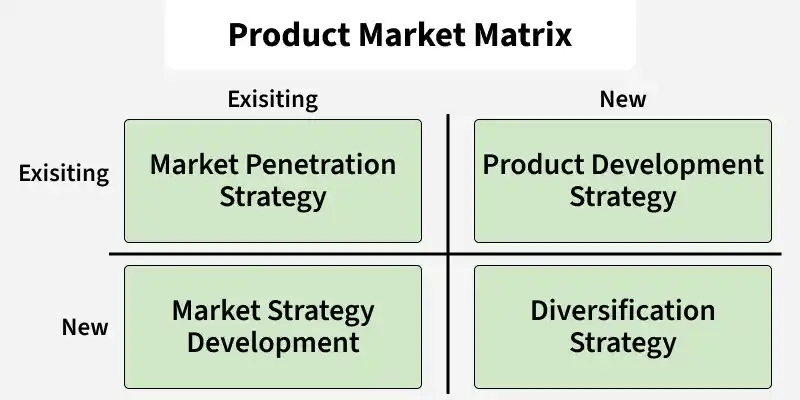
Ansoff Product Matrix
The Ansoff Matrix was introduced in 1957 by Igor Ansoff in his Strategies for Diversification article. The model provides a structured way for companies to evaluate growth strategies by considering products (existing or new) and markets (existing or new).
The framework identifies four strategic growth options:
1. Market Penetration
Market penetration focuses on increasing sales of existing products in current markets. Organizations attempt to gain a larger market share without changing their product offerings.
Common approaches include:
- Increased advertising and marketing campaigns
- Price reductions, discounts, and promotions
- Improving distribution channels
- Enhancing customer service and retention strategies
This strategy is considered the least risky, as both the product and market are already familiar.
2. Product Development
Product development involves creating new or improved products for existing markets. The goal is to retain current customers and increase engagement by introducing innovative or enhanced offerings.
Typical strategies include:
- Launching upgraded product versions
- Adding new features or functionalities
- Introducing complementary products
- Expanding product variations
This approach requires innovation and R&D investment, but leverages an already established customer base.
3. Market Development
Market development focuses on selling existing products in new markets. Companies expand their reach by targeting new customer segments or geographic regions.
Examples include:
- Entering new countries or regions
- Targeting different demographics
- Exploring new distribution channels
- Expanding through partnerships or franchising
This strategy allows businesses to grow using proven products while exploring untapped markets.
4. Diversification
Diversification involves introducing new products into new markets. This is considered the highest-risk strategy because both the product and the market are unfamiliar. However, diversification can also offer significant growth potential.
Types of diversification include:
- Related diversification: New products related to existing expertise
- Unrelated diversification: Entering completely different industries
Successful diversification can open entirely new revenue streams and business opportunities.
The BCG Product Market Growth Matrix
Another strategic framework often used alongside the Ansoff Matrix is the Boston Consulting Group Matrix, also known as the BCG Matrix. This matrix evaluates a company’s product portfolio based on:
- Market growth rate
- Relative market share
It classifies products into four categories.
1. Stars
Stars represent products with high market share in high-growth markets.
- Generate strong revenue and market leadership
- Require continuous investment to maintain growth
- Have the potential to become future Cash Cows
2. Cash Cows
Cash Cows are products with high market share in low-growth markets.
- Generate consistent and stable cash flow
- Require minimal additional investment
- Often fund other strategic initiatives within the company
3. Question Marks
Question Marks (also called Problem Children) operate in high-growth markets but have low market share.
- Require significant investment to compete
- Possess growth potential but uncertain outcomes
- Businesses must decide whether to invest heavily or exit
4. Dogs
Dogs represent products with low market share in low-growth markets.
- Limited growth potential
- Often generate minimal profit
- Companies may consider divesting, discontinuing, or repositioning these products
Ansoff Product Market Growth Strategies
The Ansoff Matrix helps businesses structure their growth decisions by offering four clear strategic paths:
| Strategy | Products | Markets | Risk Level |
|---|---|---|---|
| Market Penetration | Existing | Existing | Low |
| Product Development | New | Existing | Medium |
| Market Development | Existing | New | Medium |
| Diversification | New | New | High |
Each strategy provides a different pathway to business expansion, allowing organizations to balance risk, innovation, and growth potential.
Product Market Matrix Example
Let's consider a company, XYZ Electronics, to illustrate the Ansoff Matrix:
- Market Penetration: XYZ Electronics increases advertising and promotional campaigns for its existing smartphones to attract more customers within its current market.
- Product Development: The company introduces smart home devices designed for its existing customer base, expanding its product ecosystem.
- Market Development: XYZ Electronics expands into European markets, selling its current smartphone models to new regional customers.
- Diversification: The company launches health and fitness wearables, entering an entirely new market with a new product category.
Benefits of the Product Market Matrix
The Ansoff Matrix provides several advantages for strategic planning:
- Structured growth planning: Helps organizations identify clear expansion paths
- Risk assessment: Allows comparison of strategies based on risk levels
- Strategic alignment: Supports decision-making aligned with business goals
- Market opportunity identification: Highlights potential areas for expansion
Related Article:
