
Halogenation of alkanes is a chemical reaction in which one or more hydrogen atoms of an alkane are replaced by halogen atoms such as chlorine (Cl) or bromine (Br). This reaction takes place in the presence of ultraviolet (UV) light or heat, which provides the energy required to break the halogen molecule into free radicals. Therefore, halogenation of alkanes proceeds through a free radical substitution mechanism.
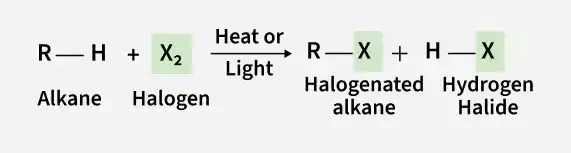
Reagents and Conditions
The halogenation of alkanes is carried out using halogens such as chlorine (Cl2) or bromine (Br2) as the main reagents. These halogens act as substituting agents that replace hydrogen atoms of the alkane.
- Fluorine (F2) is highly reactive and leads to explosive reactions, so it is generally not used.
- Iodine (I2) is less reactive and does not undergo the reaction easily.
- The reaction usually takes place in the vapour phase and follows a free radical mechanism.
General Reaction of Alkanes
In the halogenation of alkanes, an alkane reacts with a halogen such as chlorine (Cl2) or bromine (Br2) in the presence of ultraviolet light or heat. In this reaction, one hydrogen atom of the alkane is replaced by a halogen atom, so it is a substitution reaction.
The general reaction can be written as:
Example: Chlorination of methane
CH_4 + Cl_2 \xrightarrow{hv} CH_3Cl + HCl
Mechanism of Halogenation of Alkanes
The halogenation of alkanes occurs through a free radical substitution mechanism. It involves three main steps:
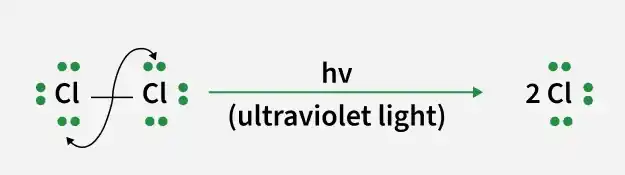
1. Initiation Step: In this step, the halogen molecule breaks in the presence of UV light or heat to form free radicals. This step produces highly reactive chlorine free radicals.
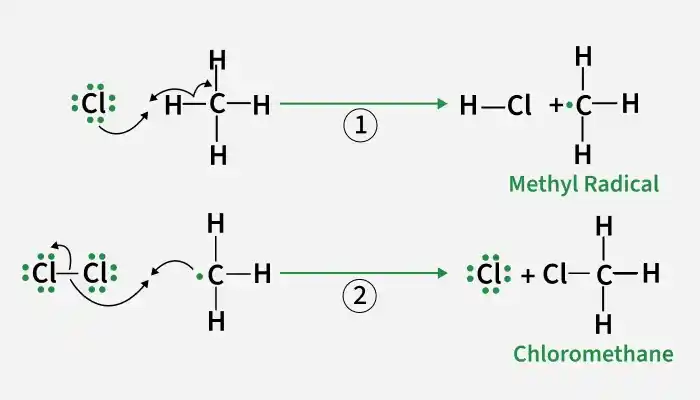
2. Propagation Step: This step consists of two reactions and continues the chain process.
Step 1: Formation of alkyl radical
Chlorine radical removes a hydrogen atom from the alkane, forming an alkyl radical.
Step 2: Formation of haloalkane
Alkyl radical reacts with another chlorine molecule to form haloalkane and regenerate a chlorine radical. This regenerated radical continues the reaction chain.
3. Termination Step:
In this step, free radicals combine with each other to stop the reaction.
Combination of two chlorine radicals: Two chlorine radicals combine to form a stable chlorine molecule.
Combination of alkyl radical and chlorine radical: An alkyl radical reacts with a chlorine radical to form a haloalkane.
Combination of two alkyl radicals: Two alkyl radicals combine to form a higher alkane.
Chlorination of Methane by Substitution
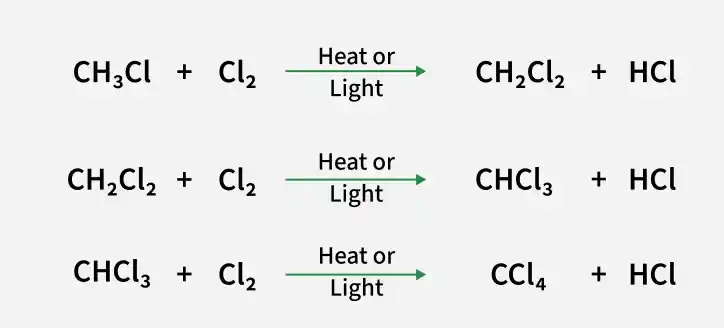
Chlorination of methane is an example of halogenation of alkanes in which methane reacts with chlorine. In this reaction, hydrogen atoms of methane are replaced one by one by chlorine atoms. Therefore, it is a substitution reaction.
1. Initiation Step: In the presence of UV light, chlorine molecule breaks to form free radicals, Formation of highly reactive chlorine radicals.
2. Propagation Step:
Step 1: Formation of methyl radical
Chlorine radical abstracts hydrogen from methane.
Step 2: Formation of chloromethane
Methyl radical reacts with chlorine to form chloromethane and regenerate chlorine radical. This regenerated radical continues the chain reaction.
3. Termination Step: Free radicals combine to form stable products and stop the reaction:
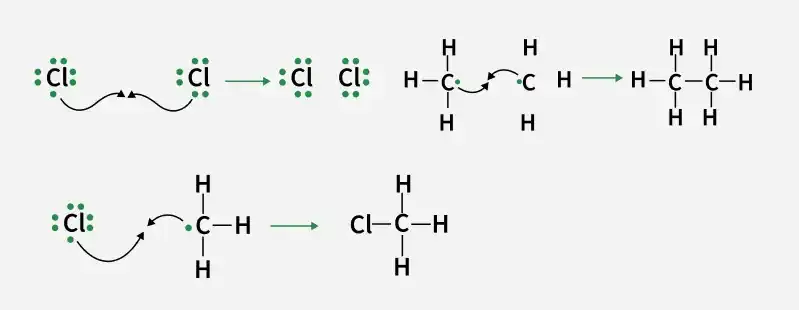
Combination of chlorine radicals:
Combination of methyl and chlorine radical:
Combination of two methyl radicals:
