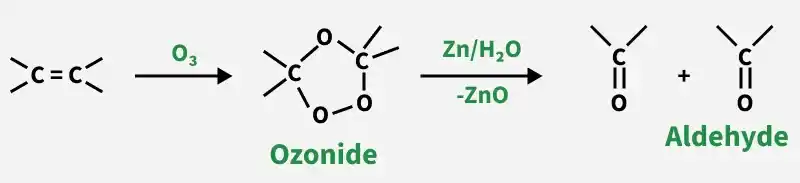
Ozonolysis is an important reaction of unsaturated hydrocarbons (alkenes) in which they react with ozone (O3) leading to the cleavage of the carbon–carbon double bond. In this process, the double bond breaks completely and forms carbonyl compounds such as aldehydes or ketones.
Reagents and Conditions
The ozonolysis of alkenes is carried out using ozone (O3) as the main reagent. Ozone acts as an oxidizing agent and reacts with the carbon–carbon double bond of the alkene.
- After the reaction with ozone, the intermediate formed is treated with zinc and water (Zn/H2O), which is known as reductive workup.
- This step is important because it reduce further oxidation of the products.
- The reaction is usually carried out at low temperature.
General Reaction of Ozonolysis
In this reaction, an alkene reacts with ozone followed by Zn/H2O, resulting in the cleavage of the carbon–carbon double bond to form carbonyl compounds such as aldehydes or ketones. Ethene on ozonolysis gives two molecules of methanal (formaldehyde).
The general reaction can be written as:
Example:
CH_2 = CH_2 \xrightarrow{O_3 / Zn, H_2O} 2HCHO
General Mechanism of Ozonolysis
Ozonolysis results in cleavage of multiple bonds forming carbonyl compounds or acids depending on the reaction conditions
Step 1: Addition of Ozone
Ozone (O3) adds across a multiple bond (C=C or C≡C) of the organic compound.
R_1C=CR_2 + O_3 \rightarrow \text{Molozonide}
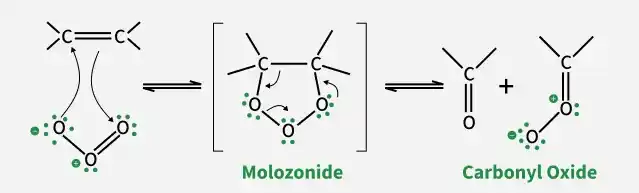
- The π-bond electrons attack ozone, forming a cyclic molozonide (primary ozonide).
- A cyclic molozonide (primary ozonide) is formed.
- This intermediate is unstable.
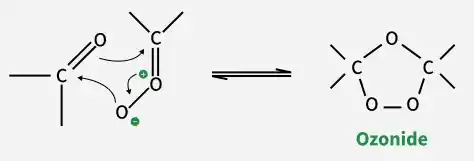
Step 2: Rearrangement
The unstable molozonide rearranges to form a more stable ozonide.
Step 3: Cleavage of Ozonide
The ozonide undergoes cleavage depending on conditions:
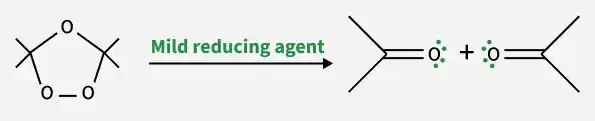
(a) Reductive workup
- Reagents used Zn/H2O or (CH3)2S.
- Products: Aldehydes / Ketones.
\text{Ozonide} \xrightarrow{Zn/H_2O} R_1CHO + R_2CHO
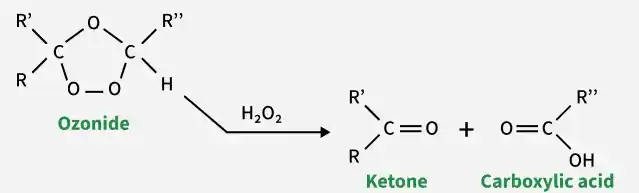
(b) Oxidative workup
- Reagent: H2O2.
- Products: Carboxylic acids / Ketones.
\text{Ozonide} \xrightarrow{H_2O_2} R_1COOH + R_2COOH