
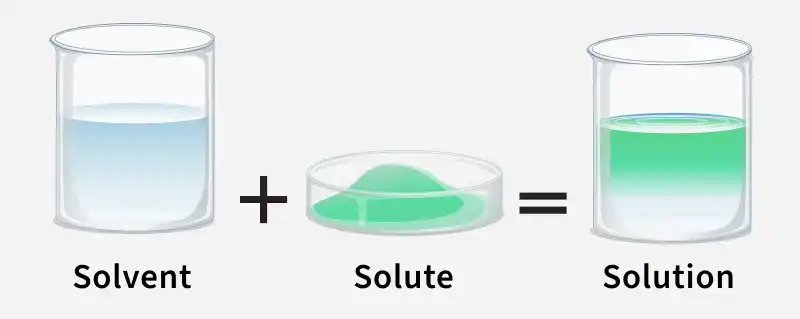
Solubility is defined as the amount of solute required to form a saturated solution in a given amount of solvent at a specific temperature. When a solute is added to a solvent it dissolves up to a certain limit after that, no more solute dissolves this point is called saturation.
The solubility product (Ksp) is a constant value that represents this equilibrium. The product of the concentrations of the ions present in a saturated solution, each raised to the power of their coefficients.
Example:
AgCl (s) ⇌ Ag⁺ (aq) + Cl⁻ (aq)
Ksp = [Ag⁺] [Cl⁻]
At equilibrium:
- Solid AgCl is present
- Ions (Ag⁺ and Cl⁻) are present in solution
Formula for Solubility Product
The solubility product (Ksp) is written using the balanced chemical equation of the dissociation of a sparingly soluble salt. Ksp is product of concentrations of ions, each raised to the power of its coefficient.
For a salt:
AxBy (s) ⇌ xA y+ (aq) + yB x- (aq)
The Ksp expression is:
Ksp = [Ay+] x [Bx-] y
Significance of Solubility Product
The solubility product (Ksp) is very useful in understanding the behavior of sparingly soluble salts in solutions. It has several important applications in chemistry.
- Predicting Solubility: It helps us know whether a salt is highly soluble or sparingly soluble. Low Ksp refers to low solubility and High Ksp means higher solubility.
- Predicting Precipitation: By comparing ionic product (Q) with Ksp: Q < Ksp → no precipitation (unsaturated), Q = Ksp → saturated solution , Q > Ksp → precipitation occurs.
- Calculation of Solubility: It is used to calculate the solubility of sparingly soluble salts.
- Common Ion Effect: This shows how the presence of a common ion reduces solubility.
- Selective Precipitation: It helps to separate ions from a mixture. Different salts have different Ksp values, so they precipitate at different conditions.
Solubility Product Constant
Ksp is defined as the product of the molar concentrations of the ions in a saturated solution, each raised to the power of their stoichiometric coefficients, at a given temperature.
- At a fixed temperature, the value of Ksp remains constant
- It does not depend on the amount of solid present
- It changes only when temperature changes
Example:
AgCl (s) ⇌ Ag⁺ (aq) + Cl⁻ (aq)
Ksp = [Ag⁺] [Cl⁻]
Steps to Calculate Solubility Product Constant
To calculate Ksp, follow these steps:
Step 1: Write the Dissociation Equation
Write the balanced chemical equation of the salt dissolving in water.
Example:
CaF2 (s) ⇌ Ca2+ (aq) + 2F-(aq)
Step 2: Assume Solubility (s)
Let the solubility of the salt = s mol/L. It means Amount of salt dissolved = s
Step 3: Write Ion Concentrations
Use the equation to express ion concentrations in terms of s.
Example:
For CaF₂:
- [Ca 2+] = s
- [F -] = 2s
Step 4: Write Ksp Expression
Ksp = product of ion concentrations (with powers)
For CaF2:
Ksp = [Ca2+] [F -] 2
Step 5: Substitute Values
Put the values in terms of s:
Ksp = s × (2s) 2
Ksp = 4s 3
Step 6: Calculate Ksp
- If s is given, substitute and calculate Ksp
- If Ksp is given, solve to find solubility (s)
Relation between Solubility and Solubility Product
The solubility (s) of a salt is directly related to its solubility product (Ksp). This relation depends on how the salt dissociates. The relation depends on the number of ions formed. Higher powers of s appear when more ions are produced
Using this relation, we can:
- Find solubility from Ksp
- Find Ksp from solubility
Examples:
For 1 : 1 Electrolyte
AgCl ⇌ Ag⁺ + Cl⁻
Ksp = s2
Relation:
s = √Ksp
Solved Examples
Example 1: Calculate the solubility product constant for silver chloride (AgCl) given that the concentration of Ag+ ions is 1.5×10 −5M and Cl− ions is 2.0×10⁻⁵M.
Solution:
Ksp = [Ag+]×[Cl-]
Ksp = (1.5×10−5)×(2.0×10−5)
Ksp = 3.0×10 −10
Example 2: Calculate the Molar Solubility for calcium hydroxide (Ca(OH)2) given that the solubility product constant for calcium hydroxide is 6.7 X 10⁻⁶
Solution:
Ca(OH)2 = Ca 2+ + 2OH -
Ksp = [Ca 2+] +[OH -] 2
Let x be molar solubility and Ca2+ = x and OH -= 2x
6.7 × 10 -6= 4x 3
Now substitute x
x3= 6.7 × 10 -6 /4
x = 0.012 M (approx)
Example 3: Calculate the solubility product constant for silver chloride (AgCl) given that the concentration of Ag+ ions is 0.5×10 −6M and Cl− ions is 3.0×10⁻⁹M.
Solution:
Ksp =[Ag+]×[Cl-]
Ksp =( 0.5×10 −6M)×(3.0×10⁻⁹M)
Ksp = 1.5 x 10 -15
Example 4:How to Calculate Solubility Product Constant? Demystify the calculation of Ksp with an example. Consider silver chloride (AgCl) with [Ag+]=2.4×10⁻⁵M and [Cl-]=1.0×10⁻⁵M.
Solution:
Ksp = Ag + × Cl -
Ksp = (2.4×10−5)×(1.0×10−5)
Ksp = 2.4×10⁻¹⁰
