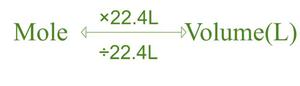
Standard temperature is defined as the freezing point of pure water at sea level, 0˚C (zero degrees Celsius), or 32˚F (32 degrees Fahrenheit) or 273˚K (273.15 degrees kelvin). Standard pressure is defined as a unit of pressure that will support a column of mercury 760 mm high at sea level and 0 degrees centigrade. The STP is defined as 0˚C and 1 atm. The volume of a gas depends on several factors. The gas's temperature, the gas's pressure, and the amount of gas (number of moles).
STP Formula
The ideal gas law states that the volume occupied by a gas depends on the amount of substance (gas), temperature, and pressure. Standard temperature and pressure are 0 degrees Celsius and 1 atmosphere of pressure. Parameters of gases are significant for calculations in chemistry and physics and are usually calculated at STP.
By using the law of Ideal gas,
P × V = n × R × T
Where as, P = Pressure
V = Volume
n = no. of moles
R = molar gas constant
T = Temperature
At STP
T = Tstp = 273.15 K
P = Pstp = 1 atm and
n = 1 mol gas
R = 0.08206 L-atm/mol-K
V = Vstp = (n × R × Tstp)/Pstp
= ((1 mol) × (0.08206 L-atm/mol-K))/(1 atm)
= 22.414 L / mol
Sample Questions
Question 1: What is the volume of oxygen that, as 2.50 mol, exerts a pressure of 1500 mm mercury at 20 degrees C?
Solution:
We know that from the definition, 1∙atm will support a column of mercury that is 760∙mm high. We use Kosher units,
i.e., P = (1500 mm. Hg)/(760 mm. atm-1)
= 1.97 atm.
Then, we solve for volume in the Ideal Gas Equation,