
A Network Security Model explains how secure communication is achieved over an insecure network using security services, mechanisms, and protocols.
- Defines the framework for secure data transmission over networks
- Combines security mechanisms, algorithms, and protocols
- Protects data against unauthorized access and attacks
- Ensures confidentiality, integrity, and authentication
- Identifies roles of sender, receiver, attacker, and trusted third party
Elements of Network Security Model
Let's understand all the elements involved in this model:
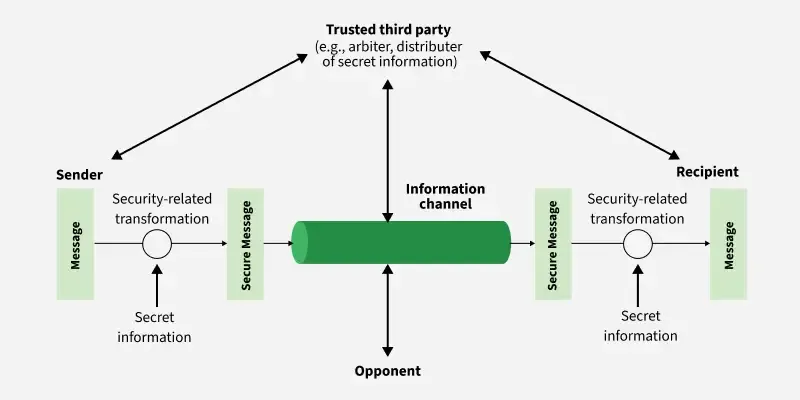
1. Sender
- The sender is the source of the original message.
- It wants to transmit data securely to the intended recipient.
2. Message
- This is the original plain data generated by the sender.
- Before transmission, it is vulnerable to attacks if sent directly.
3. Security-Related Transformation (Sender Side)
- The sender applies a security operation such as encryption or digital signature.
- This transformation protects the message from unauthorized access or modification.
4. Secret Information
- Secret information refers to cryptographic keys or credentials.
- These keys are used in the security transformation and must remain confidential.
5. Secure Message
- After applying the security transformation, the message becomes a secure message.
- This encrypted or signed data is safe to transmit over an insecure network.
6. Information Channel
- The information channel represents the communication medium (e.g., Internet).
- It is assumed to be insecure and open to interception.
7. Opponent (Attacker)
- The opponent is an unauthorized entity attempting to intercept, read, modify, or disrupt the message.
- The security model is designed to protect against such attackers.
8. Trusted Third Party (TTP)
- A trusted third party (e.g., Certificate Authority) assists in key distribution, authentication, or verification.
- It ensures trust between sender and receiver.
9. Security-Related Transformation (Receiver Side)
- The receiver applies a reverse security process such as decryption or signature verification.
- This process uses the corresponding secret information.
10. Recipient
- The recipient is the intended destination of the message.
- After successful transformation, the original message is recovered securely.
11. Final Message at Receiver
- The receiver obtains the original message in its usable form.
- Confidentiality, integrity, and authenticity are preserved.
Real-World Applications of Network Security Model
The Network Security Model is widely used in real-world systems to ensure safe and reliable communication over insecure networks. Its applications include:
1. Secure Web Communication (HTTPS)
- Used in online banking, e-commerce, and social media.
- Encryption and authentication protect data exchanged between users and websites.
2. Online Banking and Financial Transactions
- Ensures confidentiality and integrity of account details and transactions.
- Uses encryption, authentication, and trusted third parties like banks and payment gateways.
3. Email Security
- Protects emails from interception and tampering.
- Uses encryption and digital signatures to ensure privacy and sender authenticity.
4. E-Commerce Platforms
- Secures customer data such as credit card details and personal information.
- Prevents fraud, data theft, and unauthorized access.
5. Cloud Computing Services
- Protects data stored and transmitted between users and cloud servers.
- Uses access control, encryption, and authentication mechanisms.
6. Corporate Networks
- Secures internal communication between employees and departments.
- Prevents data leaks and unauthorized access to confidential company resources.
