
In Address Resolution Protocol (ARP), the Receiver's MAC address is fetched. Through ARP, a 32-bit IP address is mapped into a 48-bit MAC address. Whereas, in Reverse Address Resolution Protocol (RARP), the IP address is fetched through a server. Through RARP, a 48-bit MAC address of 48 bits mapped into a 32-bit IP address.

ARP
Address Resolution Protocol is a protocol used to map a 32-bit IP address to a 48-bit MAC address. The MAC address is known as the hardware ID number. This is important in local area networks where devices need to know each other's MAC addresses to communicate easily at the data link layer.
How Does ARP Work?
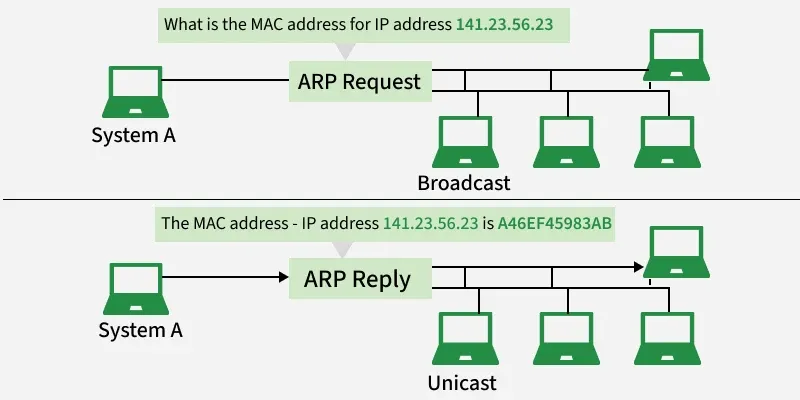
- When a device wants to communicate with another device on the local network but only knows its IP address, it sends out an ARP request. This request is broadcast to all devices on the local network.
- The ARP request packet includes the sender's IP address, the sender's MAC address, and the IP address of the device whose MAC address is being queried.
- The sender receives the ARP reply and updates its ARP table with the IP-to-MAC address mapping, allowing it to send packets directly to the destination device.
RARP
Reverse Address Resolution Protocol is used to map a MAC address 48-bit to an IP address 32-bit. This protocol is typically used by devices that know their Media Access Control address but need their IP address.
How Does RARP Work?
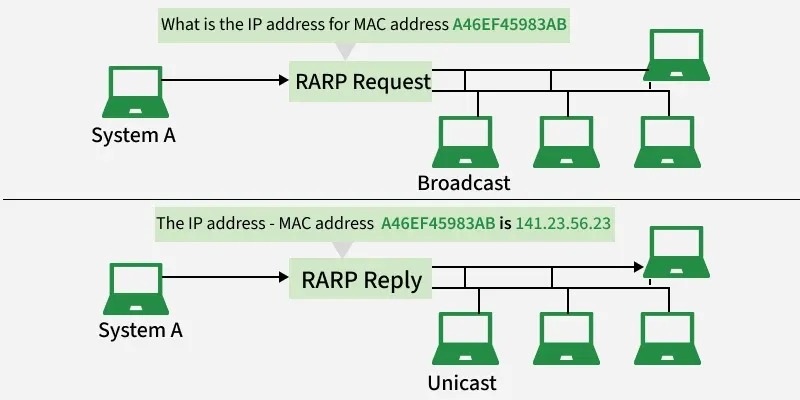
- When a device with only its MAC address but not its IP address needs to find its IP address, it sends out a RARP request. This request is broadcasted to all devices on the local network.
- The RARP request packet includes the devices MAC address and requests an IP address in return.
- The device receives the RARP reply and configures itself with the IP address provided by the RARP server.
ARP vs RARP
Let us see that the difference between ARP and RARP that are as follows:
| ARP | RARP |
|---|---|
| A protocol used to map an IP address to a physical address | A protocol used to map a physical address to an IP address |
| To obtain the MAC address of a network device when only its IP address is known | To obtain the IP address of a network device when only its MAC address is known |
| IP addresses | MAC addresses |
| ARP stands for Address Resolution Protocol. | Whereas RARP stands for Reverse Address Resolution Protocol. |
| In ARP, broadcast MAC address is used. | While in RARP, broadcast IP address is used. |
| In ARP, ARP table is managed or maintained by local host. | While in RARP, RARP table is managed or maintained by RARP server. |
| In Address Resolution Protocol, Receiver's MAC address is fetched. | While in RARP, IP address is fetched. |
| ARP is used in sender's side to map the receiver's MAC address. | RARP is used in receiver's side to map the sender's IP. |
