
TDMA and CDMA are two of the types of technology used in the handling of several channels in the cellular network. Every of them provides specific approaches to portion and to provide the limited bandwidth to many users at one time. Closing, the comparative analysis of the TDMA and CDMA technologies should be mentioned as it defines their applicability and benefits within such systems as mobile networks.
What is Time Division Multiple Access (TDMA)?
TDMA is the channelization protocol in which bandwidth of channel is divided into various stations on a time basis. There is a time slot given to each station, the station can transmit data during that time slot only which is as follows:
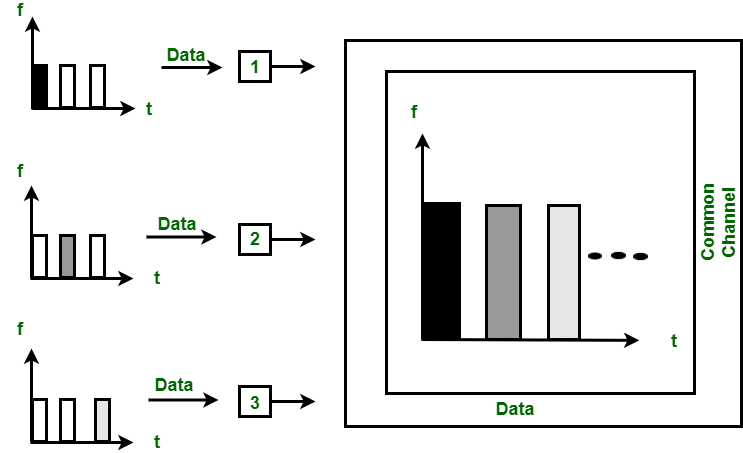
Each station must aware of its beginning of time slot and the location of the time slot. TDMA requires synchronization between different stations. It is type of access method in the data link layer. At each station, data link layer tells the station to use the allocated time slot.
Advantages of TDMA
- Efficient Use of Bandwidth: This is because in TDMA, there is special division of time in the access to the given bandwidth and in this way the signals of each user can interfere.
- Reduced Cross-Talk: Time slot division reduces the level of interference among users since every user sends his data at a different time.
- Predictable Performance: The time slots in TDMA systems are pre-designated in order and therefore it is possible to predict the quality of the service that is being offered.
Disadvantages of TDMA
- Latency Issues: There may be a delay to the time-slot method where the network is congested or where time slots are not optimized for their use.
- Synchronization Requirements: TDMA utilizes the time slot and to be able to get the time slot right at the transmitter and the receiver certain synchronization has to be done hence is difficile.
- Limited Flexibility: The disadvantage of the fixed time slot structure is that the data rates and users’ demands cannot be met according to the changes needed.
What is Code Division Multiple Access (CDMA)?
In CDMA, all the stations can transmit data simultaneously. It allows each station to transmit data over the entire frequency all the time. Multiple simultaneous transmissions are separated by unique code sequence. Each user is assigned with a unique code sequence.
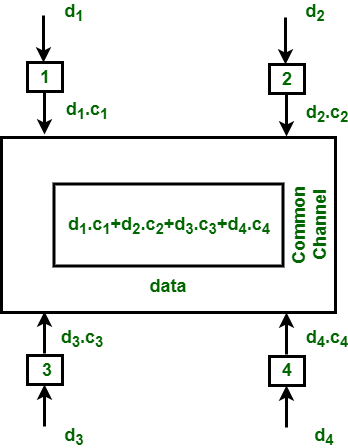
In the above figure, there are 4 stations marked as 1, 2, 3 and 4. Data assigned with respective stations as d1, d2, d3 and d4 and the code assigned with respective stations as c1, c2, c3 and c4.
Advantages of CDMA
- Increased Capacity: Yet, it must be noted that in comparison to the CDMA technology, the TDMA technology is able to provide space in the same frequency bands for a greater number of users since it does not use time slots but rather assigned codes for each user.
- Improved Signal Quality: This makes it easier to reduce interference and to have the best signal quality since CDMA make use of spread-spectrum technology.
- Flexibility and Scalability: CDMA systems are found to be more flexible in implementation and easier to grow in as far as traffic characteristics and user requirements are concerned since they do not require the use of partitioned time slots.
Disadvantages of CDMA
- Complex Implementation: Higher levels of signal processing and code management are needed in the CDMA systems than in the TDMA systems hence CDMA is more complicated system to implement and maintain.
- Potential for Interference: CDMA decreases interferences, but is flexible to near-far interference that occurs when the closer user overloads the signals of more distant ones in the vicinity of the base station.
- Higher Power Consumption: Nevertheless, it can be judged that these systems may need more energy for encoding/decoding signal, and, therefore, it can consume energy in the individuals mobile devises.
Difference between TDMA and CDMA
| TDMA | CDMA |
|---|---|
| TDMA stands for Time Division Multiple Access. | CDMA stands for Code Division Multiple Access. |
| In this, only the sharing of time of satellite transponder takes place. | In this, there is sharing of both i.e. bandwidth and time among different stations takes place. |
| There is no need of any codeword. | CDMA requires a codeword. |
| In this, guard time of the adjacent slots are necessary. | In this, both guard bands and guard time are necessary. |
| Synchronization is required. | No need of synchronization. |
| There is average capacity of the system. | There is large capacity of the system. |
| It is less flexible than CDMA. | Flexibility is high. |
| In this, there is no Near-far problem. | There is existence of Near-far problem. |
| Rate of data is average. | Rate of data is high. |
Conclusion
TDMA and CDMA are two useful communication technologies which bring control to multiple channels of communication but are very distinct from one another. In TDMA, the channel is divide into time slots, every user transmits in its time slot making it possible to estimate the performance but the users have to be synchronized. CDMA, on the other hand, uses code division to enable many users to transmit at the same time and the technique gives more capacity but comes with many problems such as interferences, though it is more complex. The decision between the use of TDMA and CDMA wholly depends on the nature of the network; user capacity, flexibility and implementational challenges.
